AI Humanizer That Preserves Citations (APA, MLA, IEEE)
A rewriter that treats (Smith, 2020, p. 44) as ordinary prose will mangle it. Here is what actually breaks in APA, MLA and IEEE citations when a paragraph gets humanized, and what a citation-safe pass has to do differently.
A citation-safe rewrite leaves (Smith, 2020, p. 44) exactly as it was typed: comma, page abbreviation, parentheses and all. A generic rewrite treats the same string as a run of words to improve, and it often comes back as (Smith 2020, page 44), or folded into the sentence as 'according to Smith's 2020 study on page 44.' That gap is the whole problem an AI humanizer that preserves citations has to solve, and it is a narrower, more mechanical problem than most academic writing advice admits.
A citation is not a sentence a model can improve. It is a formatted string sitting inside a sentence, an author surname, a year, sometimes a page number, arranged under one style's exact punctuation rules. A general-purpose rewriting model has no signal telling it those elements are a fixed unit rather than ordinary words it is free to move, reorder or replace with a synonym. Left alone with a whole paragraph, it will not reliably tell the difference between a sentence it should improve and a citation it should leave untouched.
Lowering an AI score section by section, across the abstract, the literature review, the methodology and the discussion, is a broader question with its own answer elsewhere. This piece stays on the mechanical layer underneath all of it: what actually happens to a citation when a rewrite touches it, and what a tool has to do differently to leave one alone.
What Breaks When a Rewriter Treats a Citation as Prose
Five places break in predictable ways once a paragraph gets treated as one continuous span of prose to smooth out.
- In-text page numbers drift or disappear: (Smith, 2020, p. 44) loses the page marker entirely, or the number survives while the abbreviation changes to something the target style does not use.
- Et al. strings gain or lose a period: the correct form has one period, after al only, since et is a complete Latin word on its own, and a rewrite pass will often add a second period after et as well.
- Parenthetical citations get folded into narrative prose: (Jones, 2021) becomes 'a 2021 study by Jones,' which turns a citation into a paraphrased claim about a study rather than the citation a reader expects to check against the reference list.
- Numeric IEEE brackets shift position or get renumbered: a bracket tied to a specific reference-list entry moves, or a rewritten sentence reorders two bracketed sources, breaking the link between a bracket and the entry it is supposed to point to.
- Reference-list entries get smoothed like sentences: a journal title loses its italics, a DOI gets shortened, or an IEEE author list written initials-first gets expanded into full first names because that reads more like ordinary prose.
None of this is cosmetic. A marker checking a page number against a quotation, a reviewer verifying an IEEE bracket against its reference, or a co-author scanning a reference list for a missing DOI will find every one of these, and each is a five-minute fix that should never have been necessary in the first place.
| Citation element | What a generic rewrite does to it | What a citation-safe pass does instead |
|---|---|---|
| APA parenthetical, e.g. (Smith, 2020, p. 44) | Drops the page number, or changes the comma pattern to one the context does not use | Detects the whole string as one unit and leaves the comma, ampersand and page form exactly as written |
| MLA author-page, e.g. (Chen 517) | Adds a year or a comma that MLA never uses in text | Recognizes that MLA carries no year in text and leaves the two-word form alone |
| IEEE bracket, e.g. [3] | Renumbers or reorders the bracket when a sentence gets restructured | Holds the digit fixed and edits only the words around it |
| Et al. string | Adds a stray period after et, or drops the required period after al | Treats et al. as a fixed two-word unit, not two ordinary words |
| Reference-list entry | Rewords the title, shortens the journal name, or drops italics | Leaves every reference entry untouched; only the running prose gets edited |
What an AI Humanizer That Preserves Citations Has to Do Differently
The mechanism that works is detection before rewriting, not correction after. A citation-safe pass has to locate every in-text citation, every reference-list entry and every reporting phrase that carries one, mark each as fixed content, then rewrite only the words outside those marks. TextPulse's humanizer does this by freezing citations the same way it freezes a named instrument or a technical term: the frozen span passes through a rewrite unchanged and is highlighted in the output, so a writer can see exactly what was left alone instead of taking a claim about it on faith.
The problems with in-text citations vs. reference-list entries are opposite. An in-text citation sits inside a sentence a model is actively rewriting. So the risk is the citation getting pulled into the rewrite by accident. A reference-list entry sits in its own block, structured more like a data record than a sentence, so the risk runs the other way: a model reads unfamiliar punctuation, treats it as an error, and corrects formatting that was never wrong.
Humanize your own paper
Transform your AI-assisted text and make it sound human, without touching important words or citations.
APA, MLA and IEEE Each Fail in a Different Way
APA citations have the most internal punctuation of the three, which gives a rewrite the most opportunities to go wrong. For example, a parenthetical citation includes a comma between the author and year, (Smith, 2020). A narrative citation omits the comma: Smith (2020) found. With three or more authors, a citation should include et al. starting with the first reference instead of beginning with the second mention as an old edition or outdated template may instruct. This edition, in place since 2020, is different. If you can handle getting the number of authors correct, a model can still trip up by adding the wrong punctuation. The APA style guide requires the ampersand to be placed within parentheses when authors are listed inside a parenthesis but spells out the word 'and' the moment the same names sit inside a sentence.
MLA drops the year from an in-text citation entirely and reduces the whole thing to an author's surname and a page number: (Chen 517), no comma, no abbreviation before the digit. A rewrite pass trained mostly on APA-shaped examples tends to add both back in, since a bare surname followed by a number reads like an error to a model that has seen far more APA citations than MLA ones. MLA also switches to et al. once a source has three or more authors, in the Works Cited entry as well as in text, and it never uses an ampersand anywhere.
IEEE is the style where one misplaced edit does the most damage, because its numbers are not decorative. A bracket such as [3] is tied to one specific entry in the reference list, assigned by the order sources first appear in the paper, and every later mention of that source reuses the same digit rather than earning its own entry. A rewrite that reorders two sentences, or restructures a paragraph so a different source is introduced first, can silently misalign every bracket that follows. A repeated citation to the same source at a different page carries its own locator inside the bracket, [3, p. 517] the first time and [3, p. 522] the second, a convention a model unfamiliar with IEEE may try to simplify into two separate numbered entries.
Reference Lists Need Their Own Check
A reference-list entry is closer to a data record than a sentence: an author list, a year, a title, a container, a set of locator numbers, each with its own punctuation rule and none of it meant to read like connected prose. A model asked to make a passage sound more natural has no reason to leave that record alone, and the fixes it reaches for are exactly the wrong ones. Italics on a journal name disappear. A DOI written as a full address gets shortened back to a bare string. An IEEE author list written initials-first, M. R. Chen, gets expanded into a full first name because that reads more like ordinary prose.
The safest rule is a simple one: a reference list is not a rewriting target at all. Whatever tool edits the surrounding prose should treat the whole block as frozen content, the same way it freezes a single citation inside a sentence. Restyling a reference list from Harvard to Vancouver for a resubmission through a reference format converter, for example, is a separate job with its own rules, not a side effect of making the paragraph above it read more naturally.
How to Verify Your Citations Survived Humanizing
Checking after the fact takes less time than most writers expect, and a short paragraph needs no special software at all. Read every in-text citation against the version you started with, one at a time, and confirm the author, year or page and the punctuation around it are identical. For a longer section, an in-text citation fixer built to catch exactly these slips, comma placement, et al. thresholds, page forms, checks the shapes faster than reading line by line, though it works on the prose form of a citation rather than the numbered brackets IEEE uses.
Preserved citations still have to be real ones, and auditing a bibliography for hallucinated entries is a separate job with its own page. Reducing an AI score before a journal submission is covered there too.
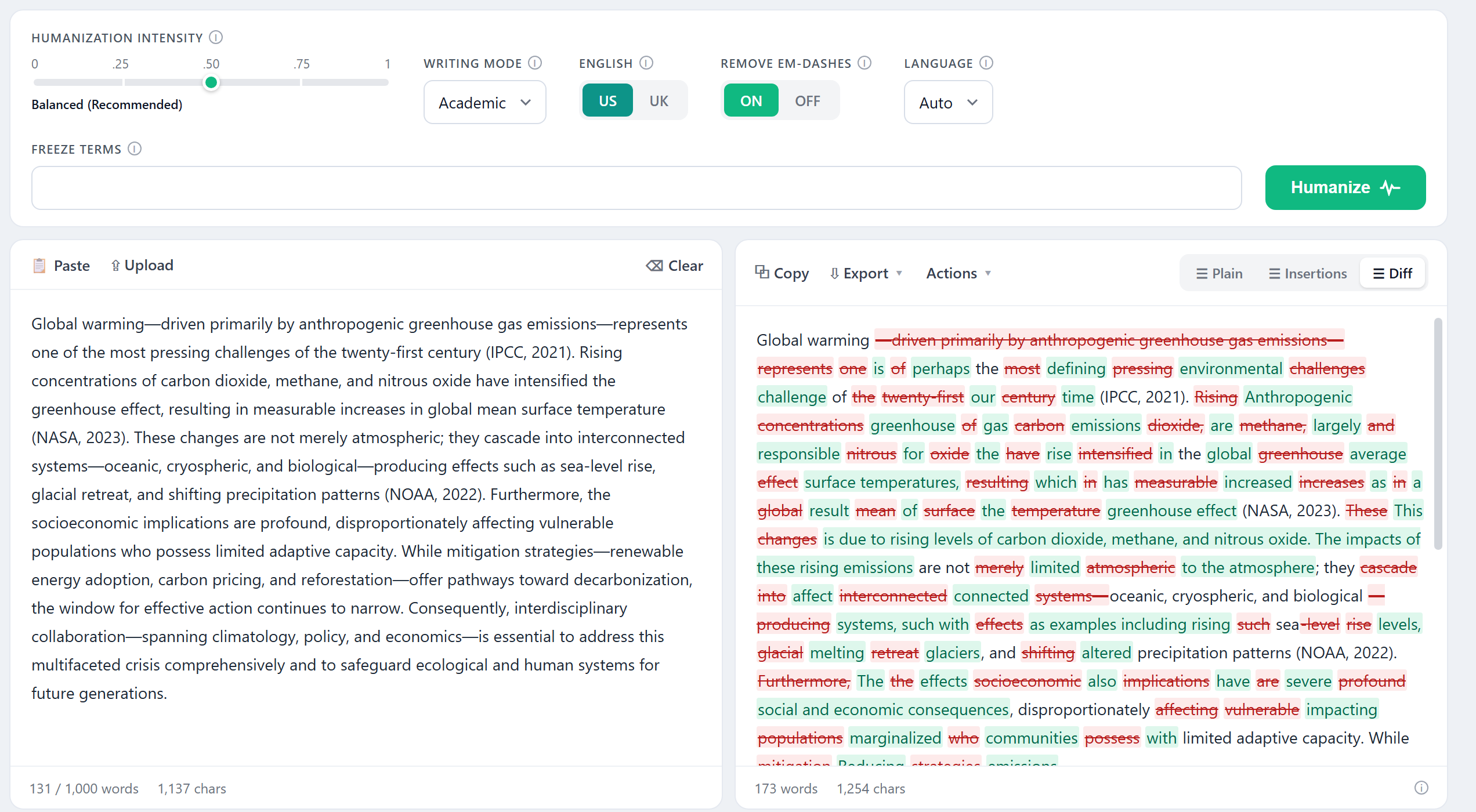
A tool that shows every edit as an insertion or deletion turns this from a search into a glance: a citation that never changed carries no marks at all, so the citations worth checking are the ones already highlighted. That is a five-minute pass on a ten-page paper, not an afternoon, and it is the difference between submitting with confidence and finding out from a supervisor's margin note that Smith lost a page number somewhere around the third revision.
Related research: the findings above are examined at scale in What Happens to Citations When AI Rewrites Academic Text? An Audit of 213,881 Citation Marks, a TextPulse Research working paper with open data, code and a citable DOI.
Related research: the humanizers discussed above are compared head to head in A Controlled Comparison of AI Text Humanizers on Academic Writing, a TextPulse Research working paper with open data and code.
Frequently Asked Questions
Yes, if the tool treats the whole paragraph as one span of prose to rewrite. A citation such as (Smith, 2020, p. 44) is a fixed, punctuated string, not a sentence to improve, and a generic rewrite will drop page numbers, add or remove commas, or fold a parenthetical citation into a narrative sentence. An AI humanizer that preserves citations detects and freezes those spans before it rewrites anything else.
Content planner and copywriter at TextPulse. Sara runs the blog day to day, from planning and drafting through to publishing. She writes the practical guides: clear explanations of academic writing problems, aimed at the person who actually has to hand something in.