TextPulse User Guide
TextPulse rewrites AI-assisted drafts into natural human phrasing while preserving your meaning, citations, numbers, and technical terms. This guide walks through every control on the dashboard and explains what each metric tells you.
The humanizer workspace
The workspace has three parts: a control rail on top where you set how the rewrite behaves, an input pane on the left for your original text, and an output pane on the right where the humanized version appears. A metrics bar slides in at the bottom after each run.
Adding your text
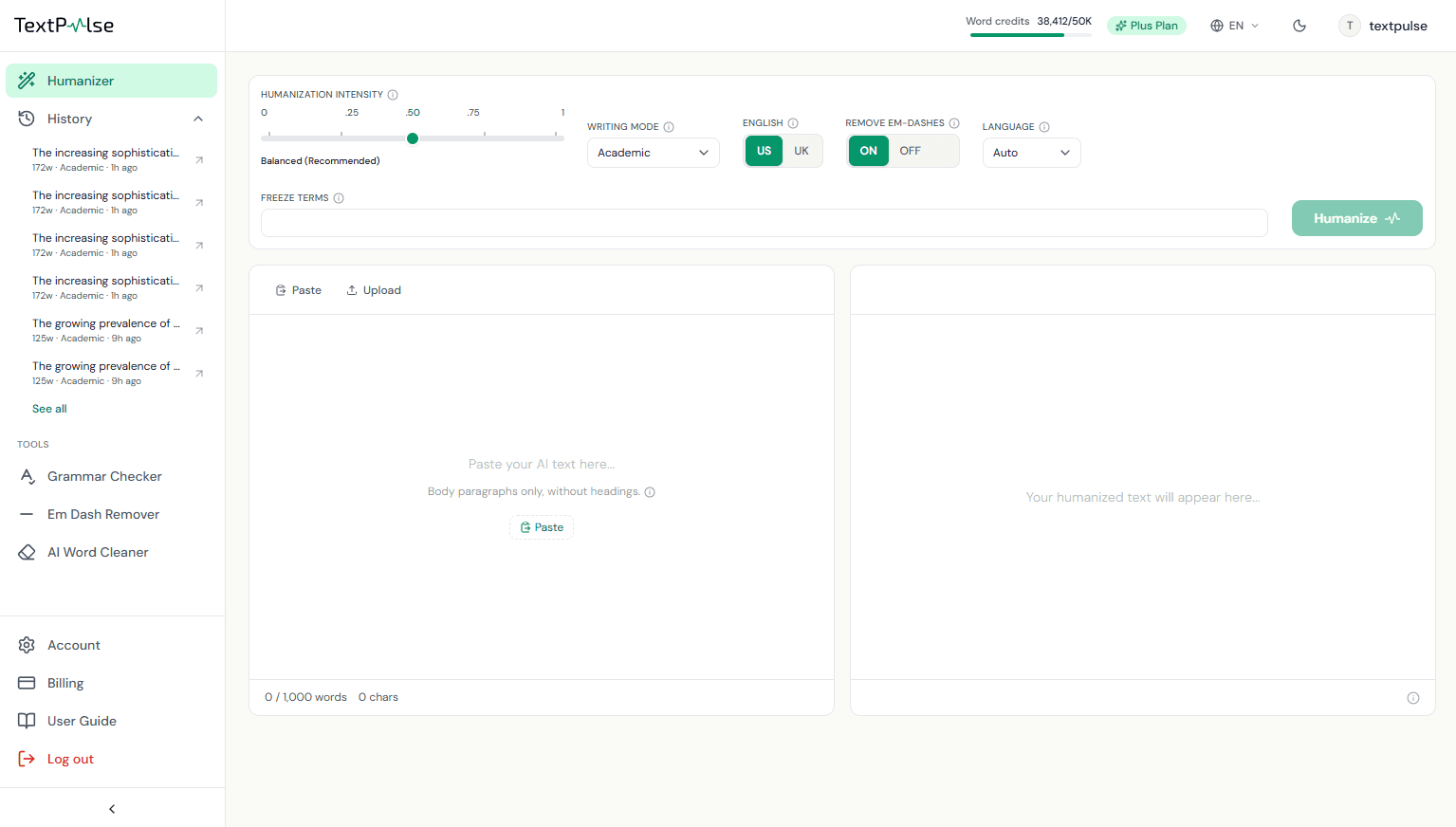
Paste text with the Paste button or Ctrl+V, or upload a .docx or .txt file with the Upload button. Paste body paragraphs only: titles, headings, tables, and figure captions come back as plain paragraph text, so remove them first. The counter under the input shows your words against the per-humanization limit for your plan (500 on Pro, 1,000 on Plus), with a 50-word minimum.
Writing modes
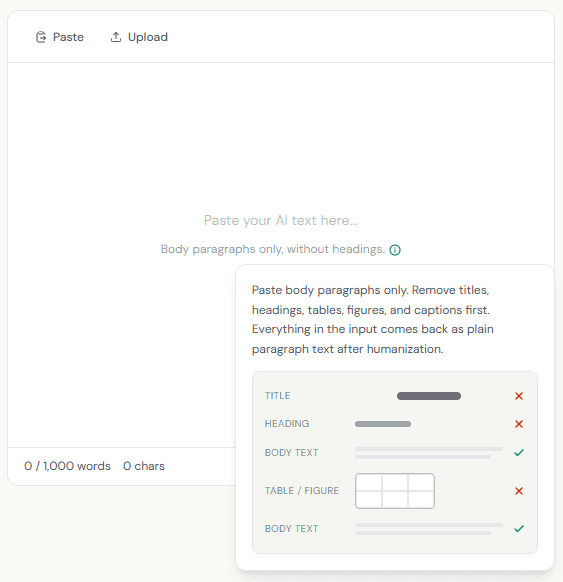
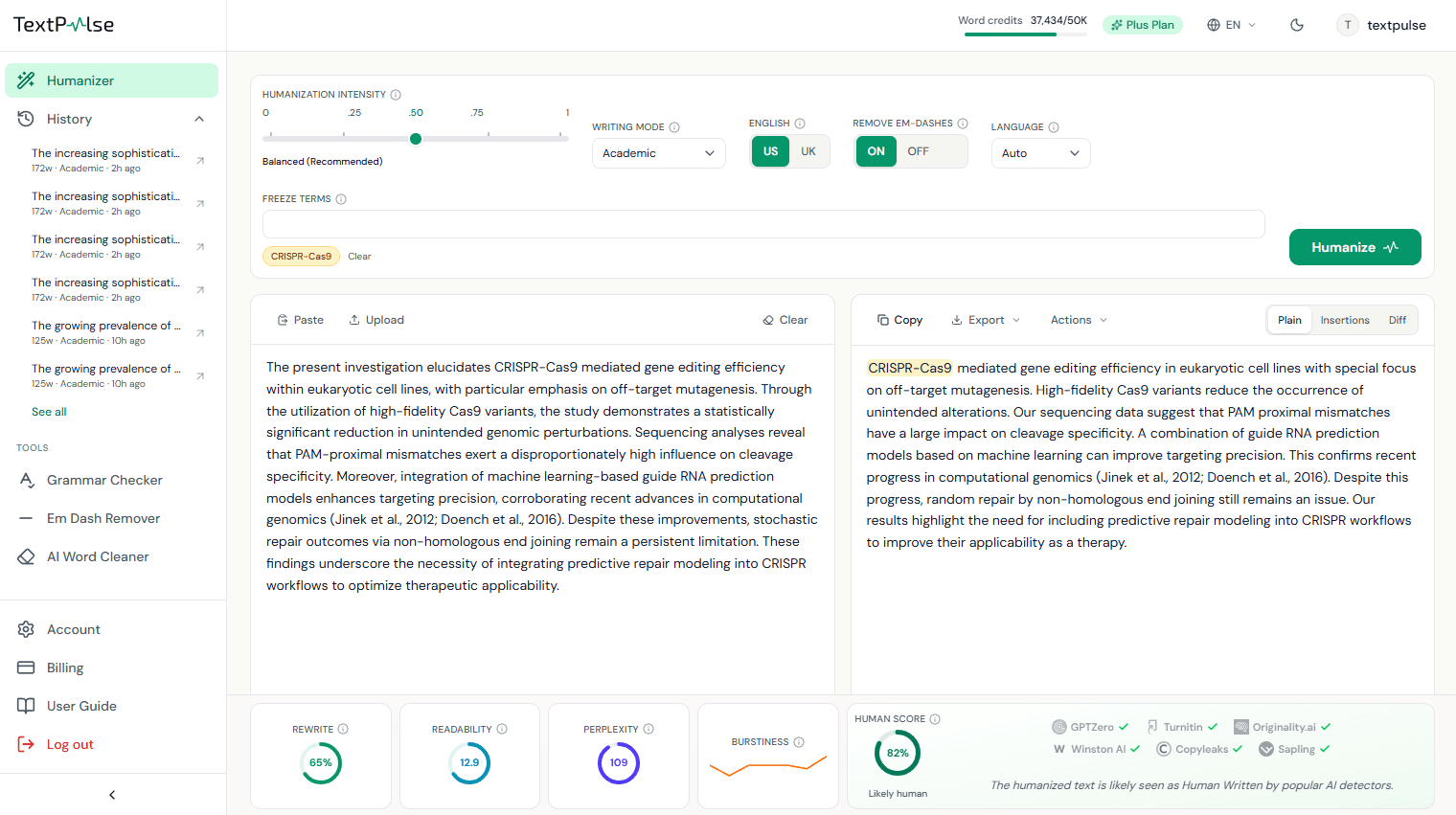
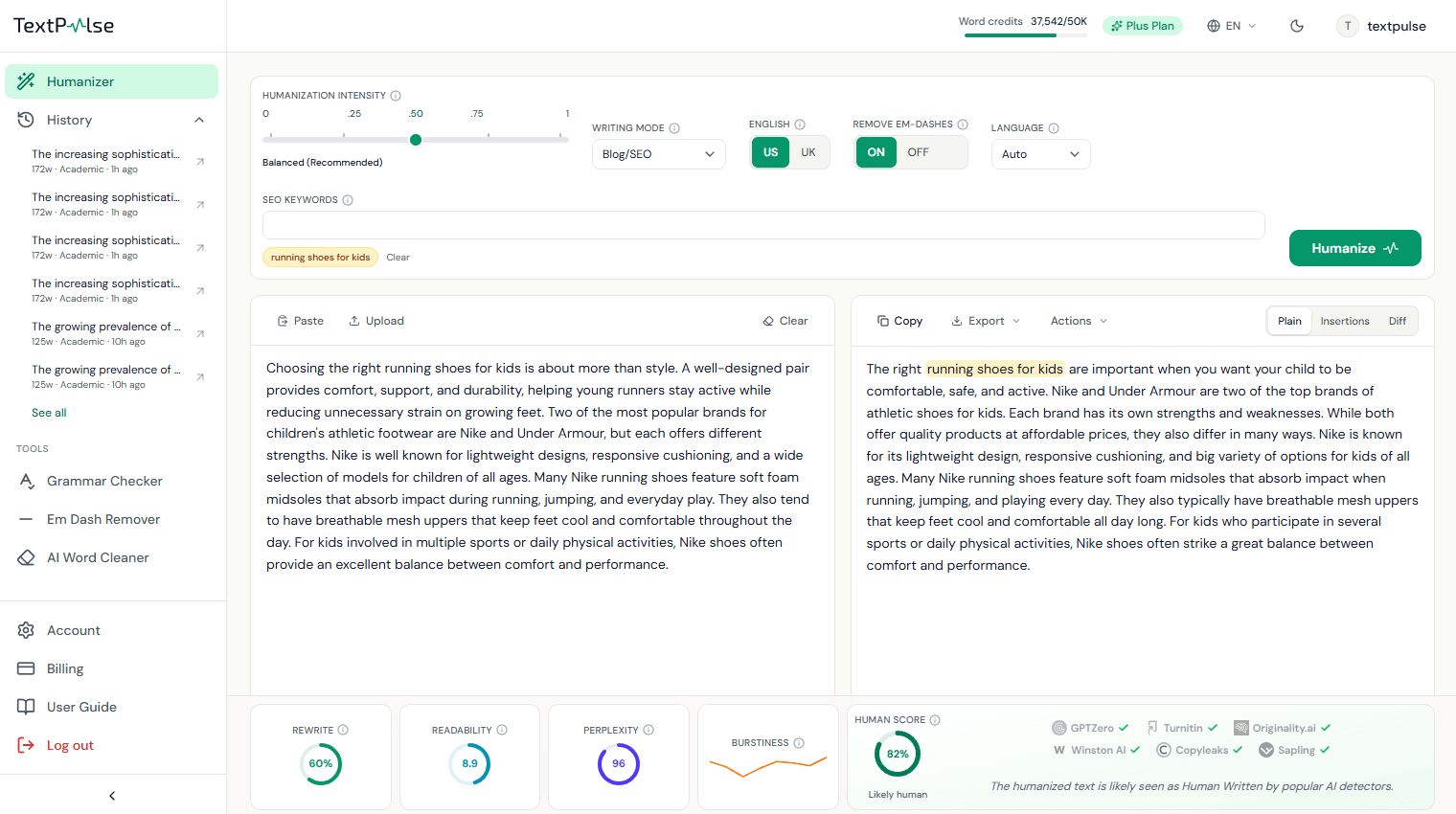
The writing mode sets the tone of the rewrite. General keeps a neutral everyday register with contractions preserved. Academic holds a formal scholarly tone, protects in-text citations, and expands contractions. Corporate uses a polished business voice. Creative keeps livelier, narrative prose. Blog/SEO writes conversationally and treats your keyword list as untouchable. Academic is available on every paid plan; the other modes are Plus features.
Voice filter
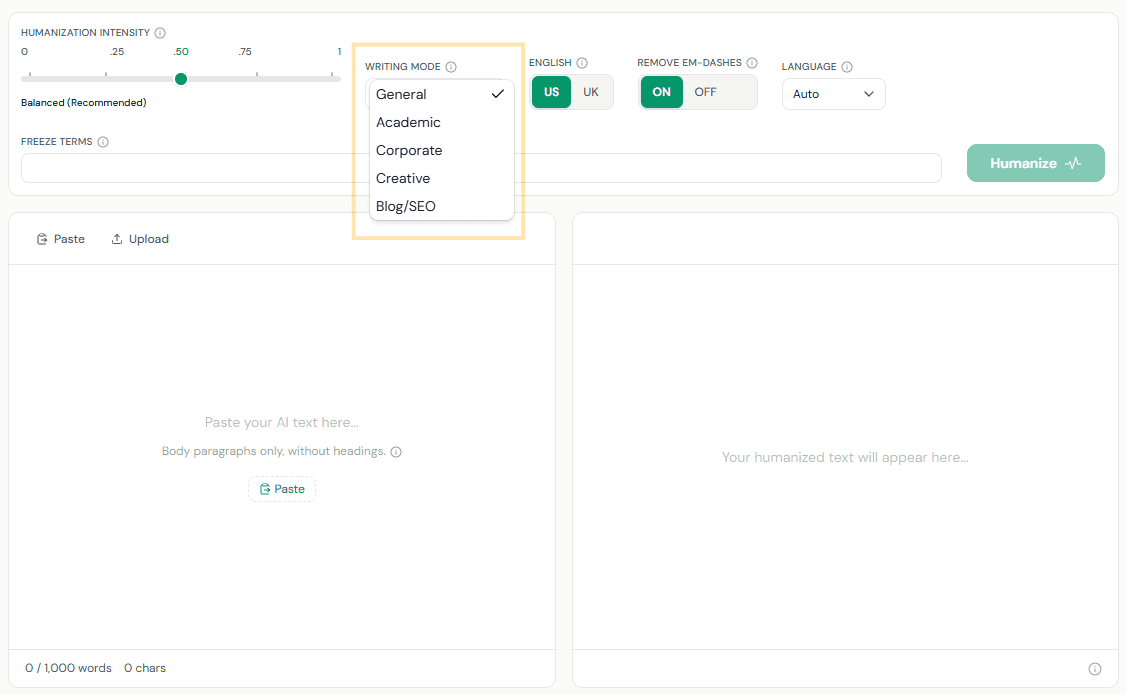
The Voice control is on the rail next to the writing mode and sets which grammatical person the output may use. It filters the voice your draft already has, so write the draft in the voice you want and pick the option that names it.
Match my draft preserves the voice as written. Formal academic keeps a neutral register and allows no first or second person. First person only preserves I and we and blocks second person. Second person only preserves you and blocks first person. The setting applies to the whole humanization. Voice is a Plus feature.
Humanization intensity
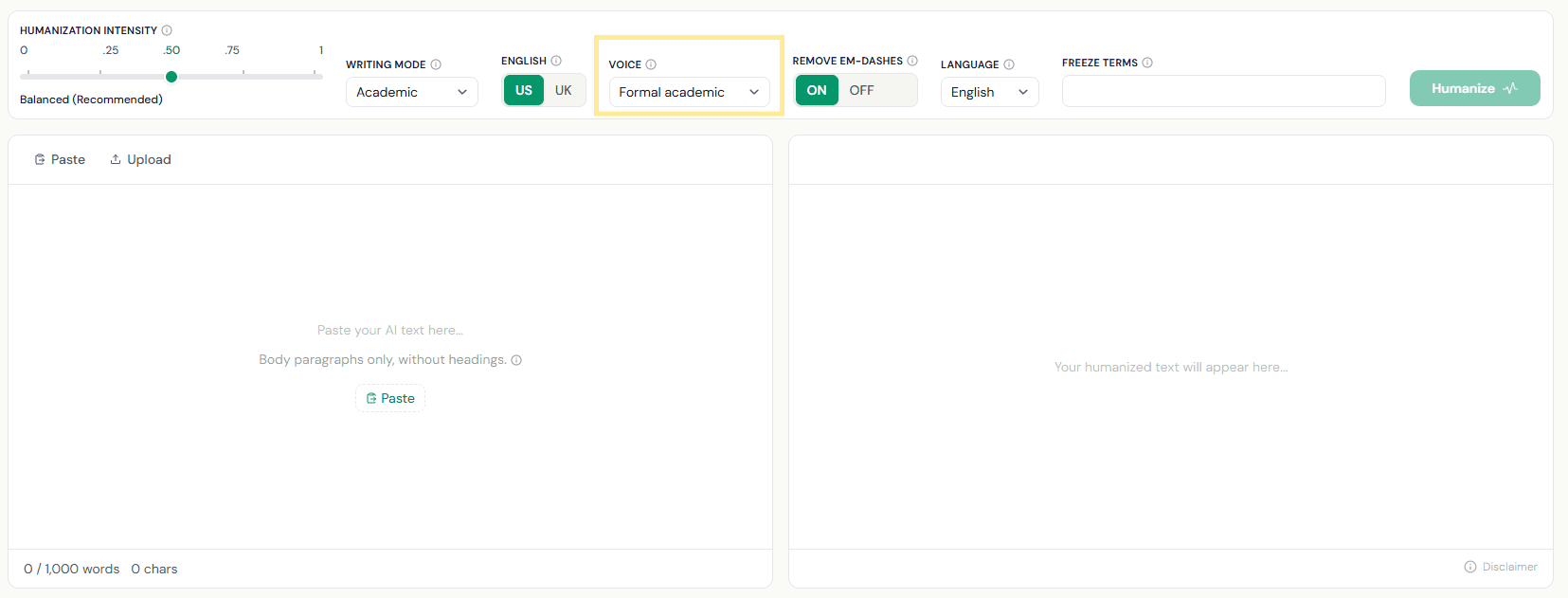
The slider has five stops from Mild to Aggressive. Mild stays closest to your original phrasing and reads most smoothly. Balanced, the recommended default, trades a little more rewriting for a result that reads more consistently human. Aggressive rewrites most deeply. Pro runs at Balanced; the full spectrum is a Plus feature.

Freeze terms and SEO keywords
Freeze terms are words or phrases the rewrite must keep exactly as written: author names, statistics, chemical formulas, technical vocabulary. Add up to 10, separated by commas or Enter. Terms you have used recently reappear as one-click chips. In Blog/SEO mode the same control is labeled SEO keywords, for the phrases your page needs to keep word for word.
Language and US/UK English
Auto detects the language of your text. English runs on the TextPulse engine; other languages (60+) run on a large-model rewrite and are a Plus feature. For English text, the US/UK toggle picks the spelling family, for example color against colour.
Remove em-dashes
AI drafts lean heavily on em-dashes, and readers notice. With the toggle ON, the rewrite replaces them with commas or restructured sentences. Leave it ON unless your style guide calls for em-dashes.
Running a humanization
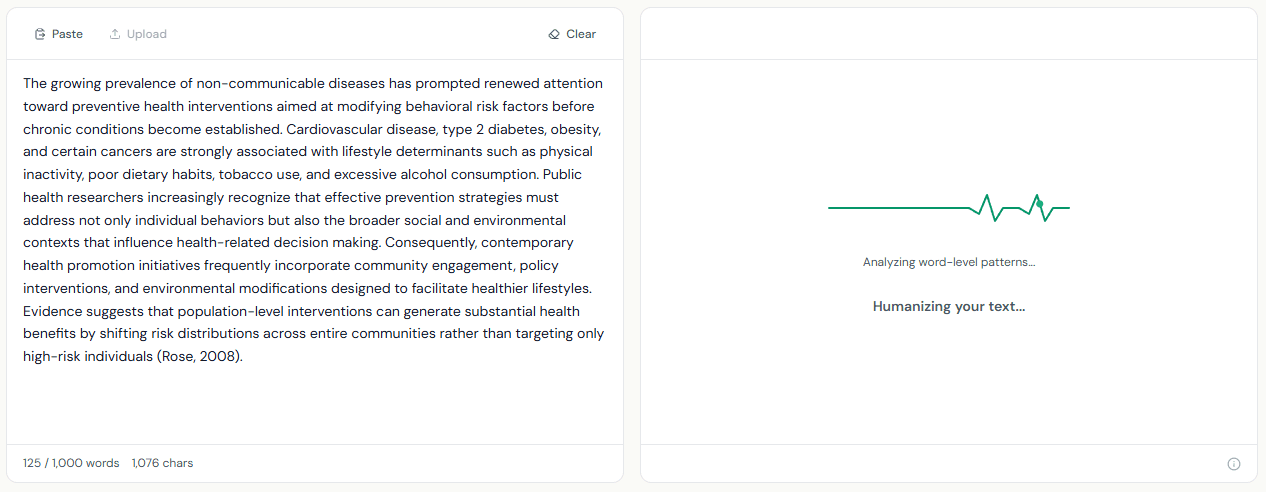
Press Humanize (or Ctrl+Enter). A typical pass takes 15 to 45 seconds; long passes can take a few minutes, so keep the tab open. Words are charged from your allowance based on the input length. If a humanization fails or times out, the words are refunded automatically and a Retry button appears. One pass runs at a time per account.
Reading the results
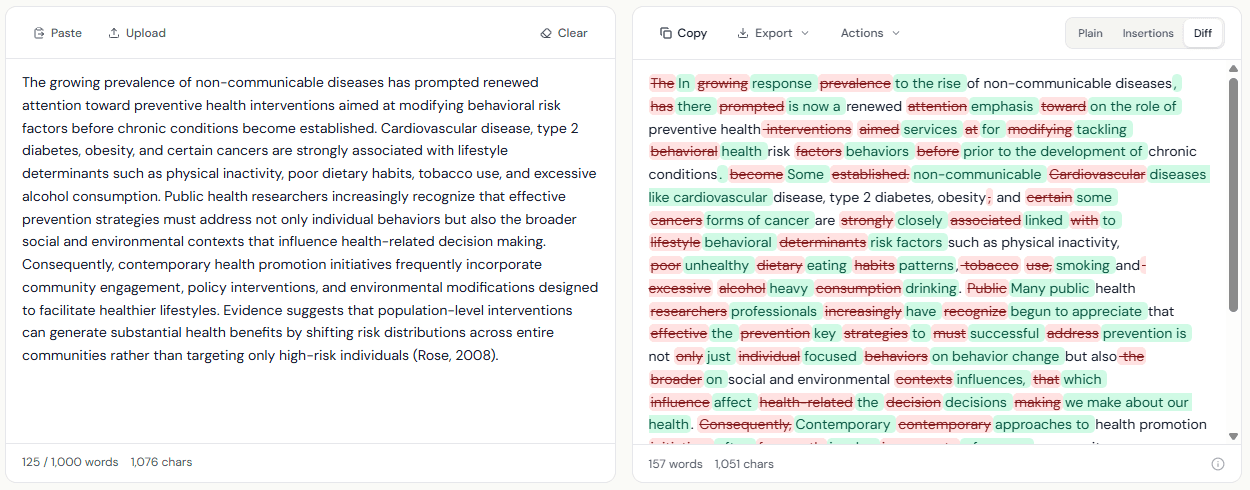
Three views of the output: Plain shows the humanized text alone. Insertions highlights the words the humanizer added in green. Diff shows the full edit, with deletions struck through in red and insertions in green, so you can review every change before using the text.
The metrics bar
After each run, four tiles and the Human Score card summarize the rewrite:
- Rewrite is the share of the output that differs from your original text.
- Readability is the Flesch-Kincaid grade level. Human academic prose usually falls around grades 10 to 16.
- Perplexity estimates how predictable the wording is, on the familiar GPT-2-style scale. Human academic writing usually scores above 40.
- Burstiness charts your sentence lengths. A jagged line that reads green means a healthy mix of short and long sentences; the line shifts to amber and orange as the rhythm flattens.
- Human Score estimates how likely detectors are to read the text as human-written, from rewrite depth, vocabulary diversity, token distribution, and sentence variation. It is a per-document estimate computed locally, never an actual detector result.

Choosing which metrics show
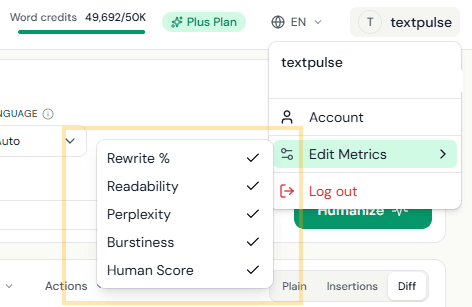
Open the user menu in the top-right corner and use Edit Metrics to toggle individual tiles on or off. Your choice is remembered on this device.
Exports
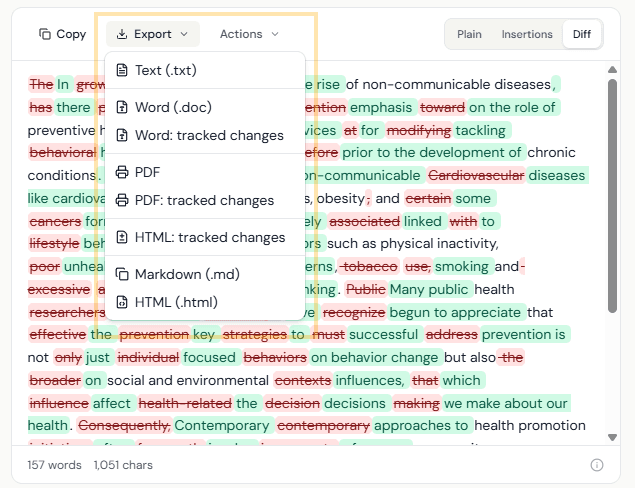
The Export menu on the output pane offers: plain text (.txt), Word (.doc), Word with tracked changes (opens in Word as real revisions you can accept or reject), PDF, PDF with tracked changes, standalone HTML with tracked changes, Markdown (.md), and clean HTML for CMS editors. Tracked-changes and PDF exports are Plus features; the diff views on screen are open to every plan.
Re-humanize
Re-humanize, under the Actions menu, feeds the current output back in for another humanization, keeping the same freeze terms. Use it when you want a deeper rewrite than a single humanization gives. Each humanization spends words from your allowance. Plus feature.
Declare AI Use
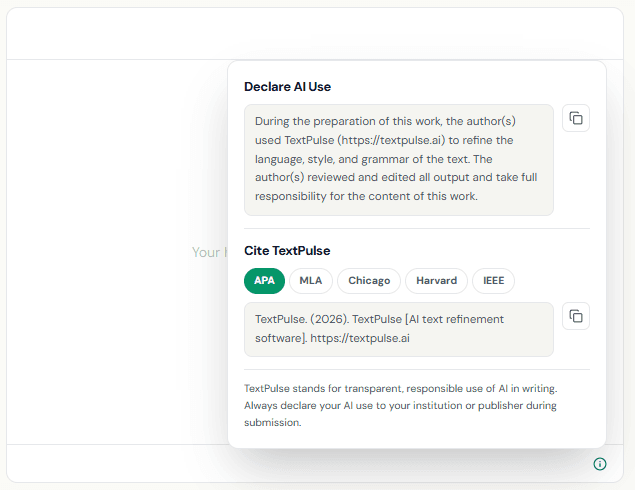
The small circle at the bottom-right of the output pane opens the Declare AI Use card: a ready-to-paste declaration of AI assistance for your manuscript, and a Cite TextPulse block with APA, MLA, Chicago, Harvard, and IEEE formats. TextPulse stands for transparent, responsible AI use; if your institution or publisher asks for disclosure, this card gives you the exact wording.
Grammar Checker
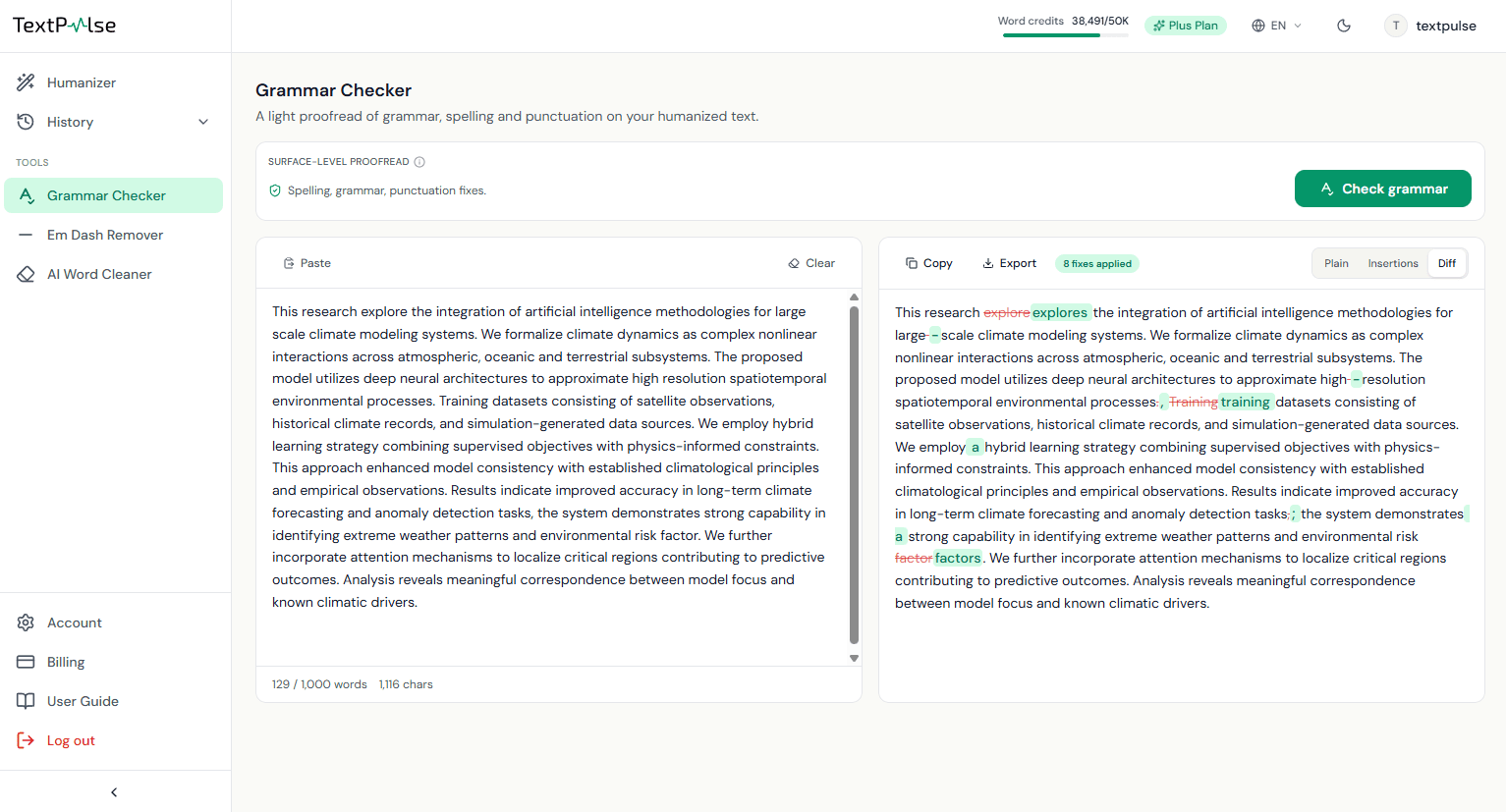
Plus includes three companion tools for polishing humanized text, listed under Tools in the left sidebar: the Grammar Checker, the Em Dash Remover, and the AI Word Cleaner. Each handles up to 1,000 words per run.
The Grammar Checker is a light, detector-safe proofread for your humanized text. It fixes only clear, unambiguous errors: missing commas, subject-verb agreement, articles, possessives, run-on sentences, sentence fragments, doubled words, misspellings, and broken punctuation. It never rephrases or smooths sentences, because heavy rewriting is exactly what pushes detector scores back up. Deterministic safeguards mean it cannot introduce em dashes or touch citations, numbers, or quoted text; the worst a bad suggestion can do is get skipped. Review the result as plain text or a word-level diff, then copy it or export it as text, Word, or Word with tracked changes. Passes use your word credits on the input count, the same as the humanizer.
Em Dash Remover
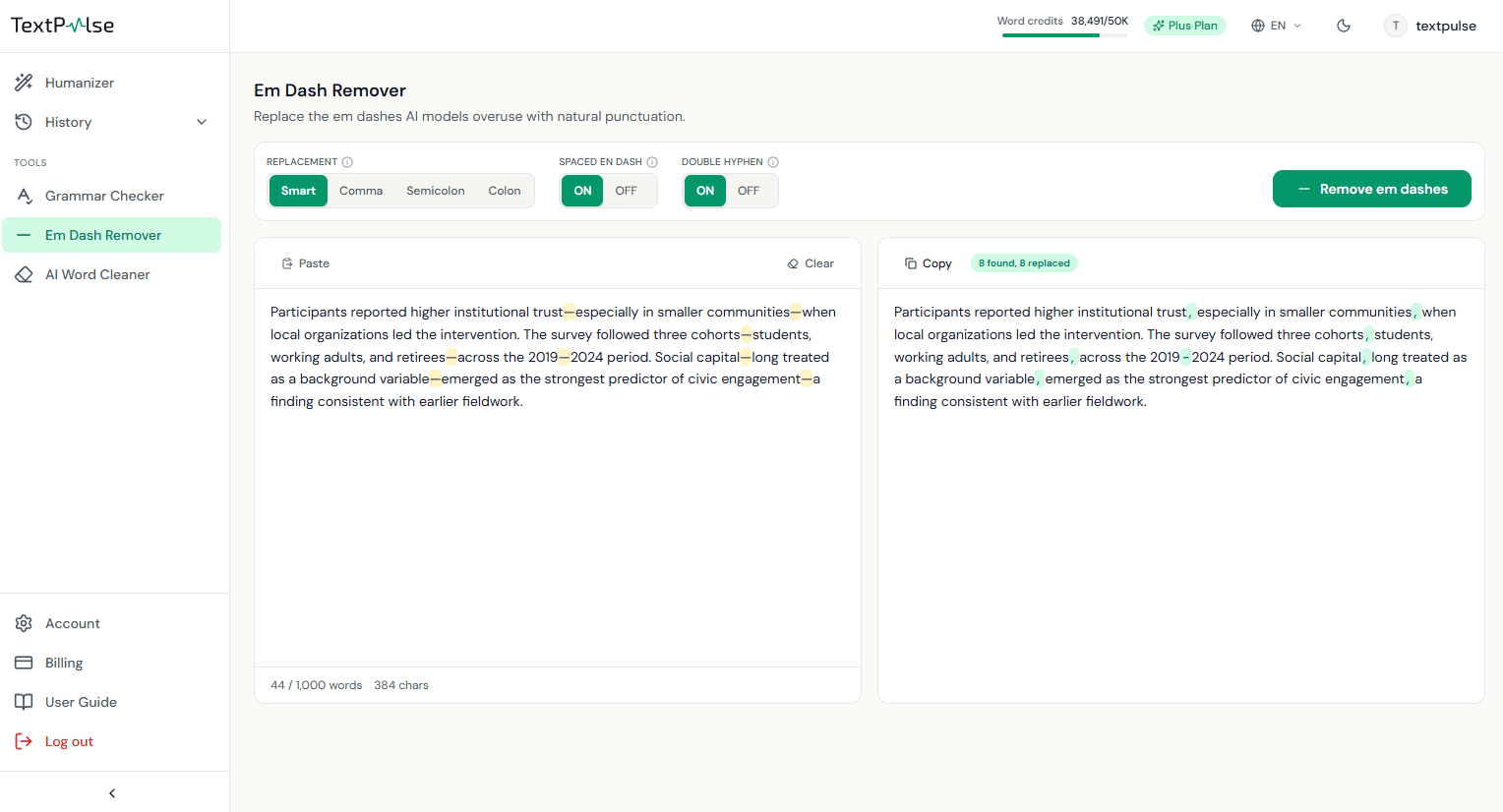
A standalone version of the humanizer's remove em-dashes option, for any text you paste in. Every em dash is highlighted in amber as you type, with a live count under the input. The Replacement pills set what each one becomes: Smart picks a comma, colon, period, or clean removal from the sentence context (recommended), or force commas, semicolons, or colons everywhere. Two toggles extend the sweep to spaced en dashes and typed double hyphens; number ranges like 2019–2024 are never touched. The output highlights every replacement so you can scan what changed. It runs instantly in your browser and never uses your word credits.
AI Word Cleaner
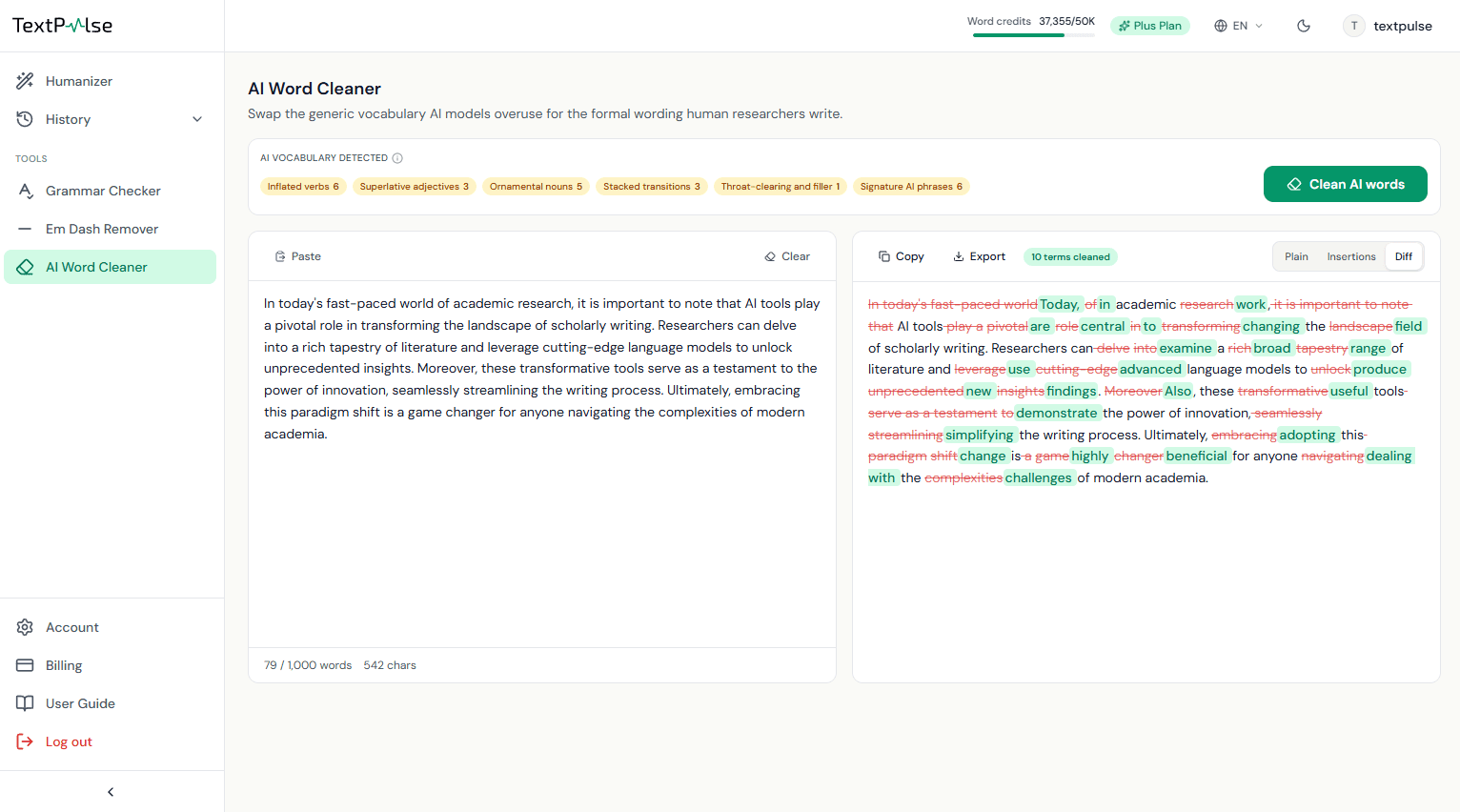
Swaps the vocabulary AI models statistically overuse (delve, pivotal, landscape, tapestry, underscores) for the plain formal wording human researchers actually write. As you paste, a research-sourced lexicon of 900+ terms flags candidates live as amber category chips. When you run the tool, a context-aware model pass checks each flagged term in its sentence and swaps only the real offenders, bridging with minimal wording so the sentence stays grammatically sound. Words used in a legitimate domain sense stay, so a finance paper's leverage is never touched, and citations, numbers, and technical terms come through untouched. Review the swaps in the diff view, then export as text, Word, or Word with tracked changes. Passes use your word credits on the input count.
History and rewind
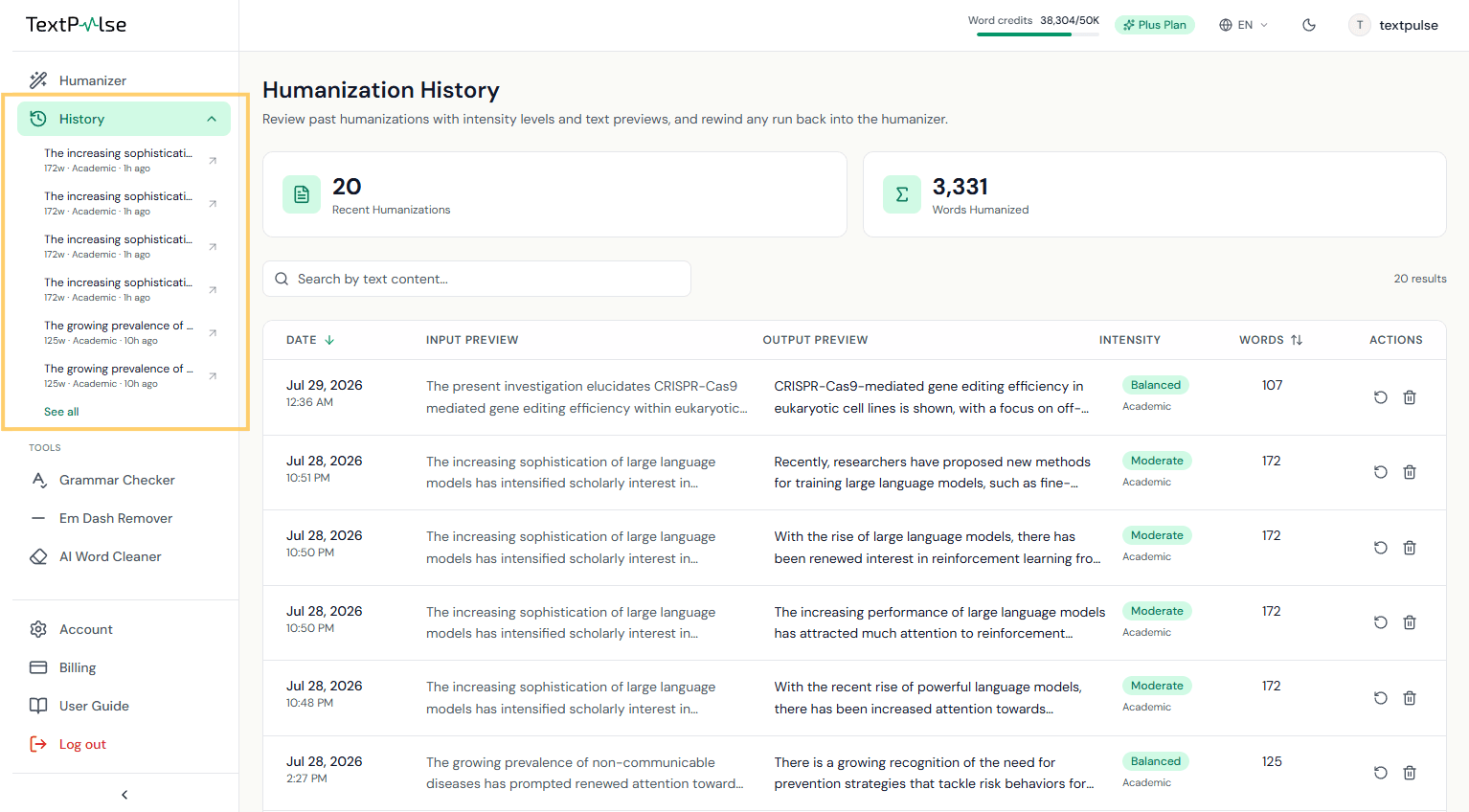
Every successful run is saved to History: the last 3 on Pro, the last 20 on Plus. The History page supports search and sorting, and Rewind loads any past run back into the humanizer. The History item in the left sidebar expands in place to show your most recent runs for one-click rewinding.
Account, credits, and billing
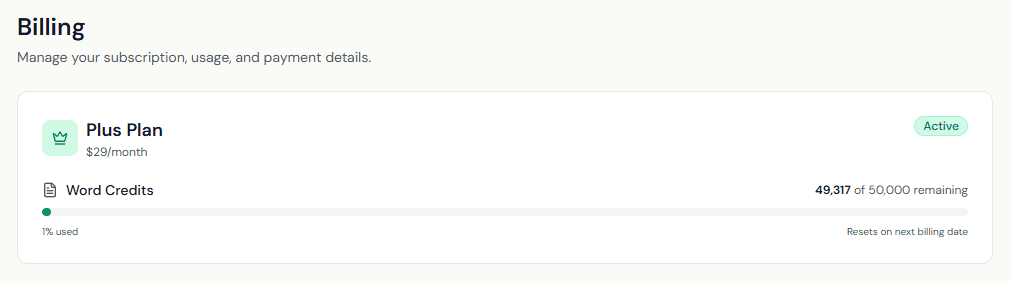
Word credits come in two buckets: your monthly plan allowance, which refills each cycle, and purchased credit packs, which never expire and are spent after the allowance. The Billing page handles plan changes, packs, and cancellation through the Stripe customer portal. Deleting your account requires cancelling any active subscription first; deletion closes the account permanently.
Questions this guide does not answer? Read the FAQs or contact us.