Journal AI Policies Compared: Elsevier, Springer, Nature, IEEE and Wiley
Elsevier, Springer, Nature, IEEE and Wiley all require AI disclosure, but they do not agree on where the statement goes or what counts as exempt. Here is what each publisher's own policy actually says, quoted directly, publisher by publisher.
A manuscript bound for Elsevier and a manuscript bound for Nature both need an AI disclosure statement before submission, but the two publishers do not ask for the same thing. Elsevier wants the statement in a separate declaration section, placed immediately before the references. Nature wants it inside the Methods section itself, and its instructions do not mention Elsevier's format at all. A researcher who checks only one policy page can follow it exactly and still send the wrong kind of disclosure to the next journal on the list.
A journal AI policy comparison across the publishers researchers submit to most often, Elsevier, Springer, Nature, IEEE and Wiley, settles the question one policy page cannot answer alone: which rules are shared across all five, and which ones differ enough to catch a manuscript out. Every publisher checked here requires disclosure once AI use passes a basic editing threshold, and every one of them bars an AI system from being listed as an author. Where they genuinely diverge is the mechanics: what counts as exempt, where the disclosure statement has to sit, and how much detail it has to carry.
TextPulse's guide to university and journal AI policy maps that wider landscape: coursework rules, research rules, and the COPE authorship position sitting behind all of it. This piece narrows to one corner of that map, the five journal publishers above, with each publisher's own wording quoted rather than summarized, and enough detail to answer one specific question. My paper is going to Elsevier. What, exactly, am I allowed to do?
Journal AI Policy Comparison: Allowed, Forbidden, Required
The table below reads left to right as a manuscript's path through each policy: what a publisher allows without question, what it forbids outright, and what has to be disclosed in between. Every quote is the publisher's own, pulled from its current author guidelines.
| Publisher | Allows | Forbids | Must disclose |
|---|---|---|---|
| Elsevier | Improving language and readability, and assisting with research methods, without replacing researcher judgment | Listing AI as an author or co-author; generating manuscript text without genuine author input; fabricating or altering data, references or research images | A declaration naming the tool and reason, placed immediately before the references; basic grammar, spelling and punctuation checks are exempt |
| Springer Nature (group-wide) | AI support for scholarly work, across every journal the group publishes | Treating an LLM as accountable for the work; presenting undisclosed AI output as the author's own | Acknowledgements, Introduction or Preface; routine AI-assisted copy editing is exempt |
| Nature | The same group-wide allowances as the rest of Springer Nature | Listing an LLM as an author, for the same accountability reason | The Methods section specifically, not the Acknowledgements |
| IEEE | AI-generated text, figures, images or code, once identified and explained | Running a manuscript under peer review through a public AI platform | The acknowledgments section, naming the AI system and the sections it touched; grammar tools are recommended, not required, to disclose |
| Wiley | Language and structural help, idea development, literature search and coding support | Listing AI as an author; using AI to create or alter research data; uploading a manuscript into AI during peer review | Documented at submission: purpose, influence on conclusions, and how the author verified it; spelling and grammar tools are exempt |
The disclose column is worth reading first. It's the one place all five publishers agree completely, and it's also the requirement most likely to trip up a manuscript that treats journal AI policy as a single yes-or-no question rather than a set of mechanics to get right, publisher by publisher.
The differences are not cosmetic. IEEE's disclosure sits in the acknowledgments section for every submission type; Nature's sits in the Methods section specifically; Elsevier's sits in a declaration immediately before the references. Placing an Elsevier-style declaration in a Nature submission, or the reverse, is a formatting error an editor has to send back before review can even start.
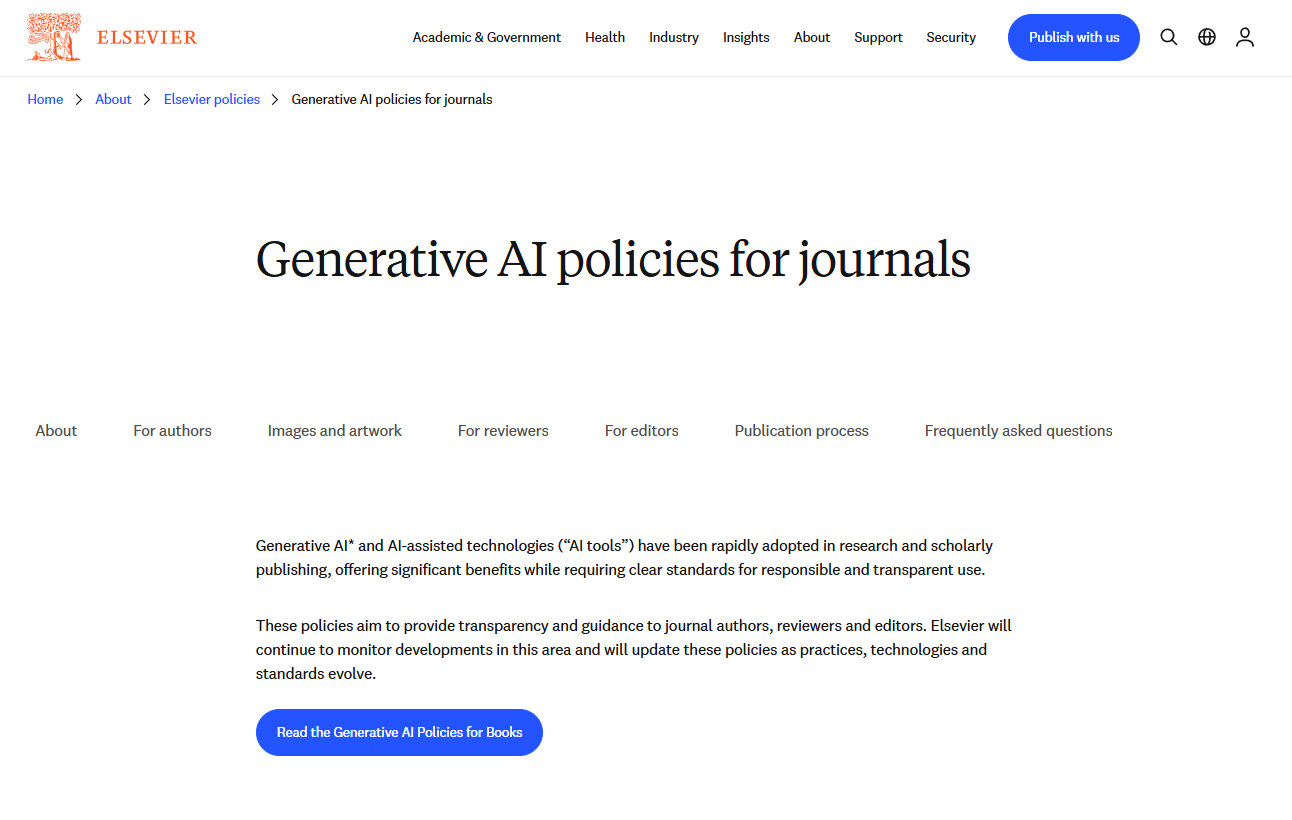
Elsevier: What You Can Do Before You Submit
Elsevier's own language is unambiguous about the role AI is allowed to play. Its policy states that authorship "implies responsibilities and tasks that can only be attributed to and performed by humans," so authors "should not list AI tools as an author or co-author, nor cite AI tools as an author." Inside that boundary, generative AI can help improve language and readability and assist with research methods, provided it never substitutes for the researcher's own judgment. The policy separately prohibits fabricating or altering data, results or references, altering primary research images, and using generative AI to produce graphical abstracts.
Disclosure is the default, not a special case. Elsevier's own suggested wording reads: "During the preparation of this work the author(s) used [NAME OF TOOL/SERVICE] in order to [REASON]. After using this tool/service, the author(s) reviewed and edited the content as needed and take(s) full responsibility for the content of the publication." That statement belongs in a separate declaration section placed at the end of the manuscript, immediately before the references, not folded into the acknowledgements or the methods.
One exemption matters more than it looks. Elsevier states plainly that "basic checks of grammar, spelling and punctuation do not need a declaration statement." Running a finished manuscript through a grammar checker before submission stays inside that exemption under Elsevier's own wording, which is worth knowing before assuming that every editing pass needs its own disclosure line.
Springer and Nature Do Not Say the Same Thing
Springer Nature's group-wide guidance states that "AI may support but not replace scholarly judgement" and that "human accountability cannot be transferred to AI systems." Under this group-wide instruction, disclosure belongs in the acknowledgements, or in the introduction or preface of the manuscript, and AI-assisted copy editing specifically does not need declaring at all. That is the rule for the group as a whole, covering every journal Springer Nature publishes.
Nature's own editorial line is narrower and separately worded. Its policy holds that large language models such as ChatGPT do not currently satisfy Nature's authorship criteria, on the ground that authorship carries accountability for the work and accountability cannot be applied to a model. Nature also names a specific location the group-wide guidance never mentions: use of a language model should be documented in the Methods section. A manuscript prepared for a different Springer Nature journal and then redirected to Nature itself needs its disclosure statement moved, not just reworded.
Humanize your own paper
Transform your AI-assisted text and make it sound human, without touching important words or citations.
IEEE: Disclosure Without an Authorship Clause
IEEE is the only publisher here that doesn't clearly state whether AI systems can be listed as authors. Instead, they've a policy which has no exceptions about what type of content should be disclosed, on all articles submitted to any IEEE publication, regardless of whether they are conference or periodical submissions. Its own wording: "The use of content generated by artificial intelligence (AI) in an article (including but not limited to text, figures, images, and code) shall be disclosed in the acknowledgments section."
The disclosure has to be specific, not general. IEEE requires the AI system to be identified by name, with the affected sections named and "a brief explanation regarding the level at which the AI system was used to generate the content." Grammar and editing tools sit outside the intent of the policy, and disclosing them is recommended rather than required. One further rule belongs here because it catches reviewers rather than authors: running a manuscript under review through a public AI platform "is considered a breach of confidentiality," regardless of anything the submitting author has already disclosed.
Wiley: Where the Editing Line Sits
Wiley allows AI technology to help with language, structure, idea development, and literature or coding support, then draws the same authorship line as the COPE position statement it cites directly: "these tools cannot fulfil the role of an author and must not be listed as one." What Wiley asks for beyond that is unusually specific. Authors "must document all AI Technology used, including its purpose, whether it influenced key arguments or conclusions, and how they personally reviewed and verified any AI-generated content."
That documentation is required at the point of submission, with one exemption: tools used "solely for spelling, grammar, and general editing are not included in these disclosure requirements." Wiley also bans two specific uses outright: creating or altering original research data and results with generative AI, and uploading a manuscript into an AI system during peer review. Both sit closer to research integrity than to writing style, which is why Wiley separates them from the disclosure rule rather than folding them into it.
What to Check Before You Submit Anywhere
Every policy above answers the same underlying question differently enough that copying one publisher's disclosure statement into a different publisher's submission portal is a real way to get a manuscript sent back for revision. The shared thread across all five is worth restating plainly: disclose past a basic editing threshold, name the tool used, and never list AI as an author under any circumstance. TextPulse's own policy on the ethical use of AI in academic writing covers the broader question underneath all five policies, where the line sits between editing an argument you made yourself and submitting one you did not.
Universities took a different path from publishers, and their policies are compared separately. The blunter student question underneath all of it, whether using AI to write an essay counts as cheating, has its own page.
None of the five wordings quoted here will stay exactly as written forever. Wiley's own guidelines page already carries a Last Updated stamp for exactly this reason, and Elsevier's policy states its own most recent update date on the page itself. Check the live policy page for your specific target journal before you submit, and treat everything quoted above as a starting point rather than the final word.
Frequently Asked Questions
Elsevier allows generative AI to improve language and readability and to assist with research methods, but not to replace the researcher's own judgment. Disclosure is required in a declaration section immediately before the references, except for basic grammar, spelling and punctuation checks, which the policy exempts. AI cannot be listed as an author or co-author under any circumstance.
Content planner and copywriter at TextPulse. Sara runs the blog day to day, from planning and drafting through to publishing. She writes the practical guides: clear explanations of academic writing problems, aimed at the person who actually has to hand something in.