Abstract
Users who want an AI model to write like a human usually assume that the machine register is a default that an instruction can lift. We tested that assumption in this study. Ten passages of human-written published academic prose gave ten topics. Four flagship models (GPT-5.6 Sol, Claude Opus 5, Gemini 3.7 Flash and DeepSeek V4 Pro) wrote about 300 words on each topic under three prompts, namely, (1) a plain request; (2) a detailed brief on the properties that separate human academic prose from assistant prose (uneven sentence length, plain words, no triads, no connective openers, hedging, asides); and (3) the same brief with a human passage as an example. Every text was placed on the frozen 47-feature stylometric human-to-AI spectrum from our earlier work and scored by GPTZero, along with the ten human passages. The pooled spectrum position fell from 148 under the plain prompt to 30 under the detailed one (human passages 10), 14 of the 40 instruction-loaded texts were inside the middle half of the human anchors, and Claude Opus 5 was positioned past the human median. The models overshot every property the prompt named, writing more unevenly and at a lower reading grade than the journals, and left the one property it did not name, vocabulary range. On GPTZero, all 120 AI texts, under every prompt and from every model, received a document AI probability of 1.00, while all ten human passages received 0.00. The human example text in the third prompt format added no help. One pass through the TextPulse humanizer positioned the same texts a mean of 47 points toward the human end, while preserving 97 percent of the meaning, and passed GPTZero in cases where the AI rewritten texts did not. Supervised fine-tuning and RLHF heavily limit the distribution a model samples from, an instruction is a condition on that limited distribution rather than a replacement for it, and a probability-based detector relies more on the underlying process and distribution, and less on the surface-level stylometric properties. The results obtained demonstrate that prompting cannot undo preference tuning. All texts, prompts, detector replies, scores and code are made publicly available for future work.
1. Introduction
Ask a current AI model to write a paragraph of academic prose and the result is fluent, well organized and, to a detector or to a trained reader, easily recognizable as machine written. The usual reply from users is that the model was not told to write like a person. Prompt guides, forum threads and paid “humanizing prompts” all have the same assumption, that the machine register is a default the model is limited to, and that an explicit instruction, or an example of human writing, will undo this limit.
We took ten texts from human written published academic papers, all from articles published before 2022, so none can carry text from the ChatGPT era. For each text, we wrote a topic statement, then asked four flagship models, namely, GPT-5.6 Sol, Claude Opus 5, Gemini 3.7 Flash and DeepSeek V4 Pro, to write about 300 words on that topic under three prompts. The first prompt asked only for a research passage. The second added detailed instructions on the properties that separate human academic writing from assistant writing, such as uneven sentence length (burstiness), ordinary word choice, no triads, no connective openers, hedging, asides, and minor irregularities. The third added a human written passage as an example for the model to imitate. Every output was placed on the stylometric human-to-AI spectrum built in our earlier work and scored by GPTZero, and the ten human passages were scored in the same manner. Every AI output was also processed through the TextPulse humanizer, so the reader can observe what a purpose-built rewrite does to the same text.
If instruction alone could make a model write like a person, AI detection would already be rendered useless as a technology, and humanizer tools would be redundant. If it cannot, then the machine register is not a default the model chooses but a property the AI model must carry, and the reason is in how these models are trained. Section 2 reviews AI model training protocols, from supervised instruction tuning to reinforcement learning from human feedback (RLHF), and its output diversity based on prior work. Sections 4 to 6 report the measurements. Section 7 concludes.
2. Background and related work
2.1 What separates human from machine prose
The stylometric differences between human and model text are well documented in the literature. Muñoz-Ortiz et al. (2023) found that human news text has a more scattered sentence-length distribution, shorter constituents and a wider emotional range than LLaMA output, which used more numbers, auxiliaries and pronouns. Herbold et al. (2023) compared 1,000 student essays with ChatGPT essays and found the model text more uniform in structure and rated higher by teachers. Reviriego et al. (2024) measured lower lexical diversity in ChatGPT-3.5 than in humans on the same tasks, with GPT-4 closing the gap on vocabulary but not on the underlying distribution. Park et al. (2025) tested the latent community structure of paraphrased text and rejected the hypothesis that model text and human text share a distribution. Our study constructed a 47-feature stylometric fingerprint (TextPulse Research, 2026e), a classifier and spectrum from it (2026f), a 1,057-word lexicon of vocabulary that models inject and suppress (2026d), and a burstiness study showing that sentence-length variation is the single largest separating feature (2026b). Kobak et al. (2025) tracked the model vocabulary into the literature itself. Across 15 million PubMed abstracts, words such as delve, underscore, crucial and pivotal surged abruptly after late 2022, and at least 13.5 percent of 2024 abstracts showed signs of model processing. Liang et al. (2024) found the same words in 6.5 to 16.9 percent of AI-conference peer reviews.
2.2 Can a model be told to write like a person
Fewer studies test whether prompt instruction removes those differences. Perkins et al. (2024) used prompt engineering to make GPT-4 submissions evade Turnitin and found that adding burstiness and misspellings lowered detector accuracy by about 17 percentage points, a gain that came from ‘damaging’ the text rather than from improved writing. Shi et al. (2024) passed detectors with instructional prompts and word substitution. Matsubara (2025) had ChatGPT rewrite an abstract in the author’s own style and found the result classified as machine text by every detector, with a median AI probability of 100 percent, while the author’s genuine abstract scored a median of 0 percent. Wang et al. (2025) tested whether current models can imitate the implicit style of ordinary authors from examples and concluded that they cannot. The outputs matched content and surface register but not the authors’ stylometric profile. Xu et al. (2026) found that raw base-model output, before preference tuning, already reads as human to GPTZero and Pangram, which points at the tuning rather than the pretraining as the source of the machine register. None of these studies gives the model the full stylometric instructions and a human written example, measures the result on a fixed spectrum, and compares it with human prose on the same topics.
2.3 How the models are trained, and what it does to their writing
Every AI model in this study is a pretrained language model that has been through several stages of post-training. Pretraining fits the model to the distribution of a large text corpus. A base model at this stage samples close to that distribution, with all its variety. The first post-training stage is supervised fine-tuning on demonstrations written or selected by human raters, which teaches the model the ‘assistant format’. The second is preference tuning. In the original recipe, reinforcement learning from human feedback (RLHF), labelers ranked pairs of model outputs, a reward model is trained to predict those rankings, and the language model is optimized against the reward model with a penalty for drifting from the supervised model (Christiano et al., 2017; Stiennon et al., 2020; Ouyang et al., 2022). Constitutional AI replaced part of the human labelers with model-written critiques against a written set of principles (Bai et al., 2022). Direct preference optimization removed the separate reward model but retained the objective (Rafailov et al., 2023). Every current flagship AI model uses some version of this pipeline, and several add reinforcement learning on verifiable tasks.
The published effect of preference tuning on the text is consistent across studies. Kirk et al. (2024) measured each stage of the RLHF pipeline and found that RLHF improved generalization but sharply reduced output diversity, on every diversity measure they used, compared with supervised fine-tuning alone. O’Mahony et al. (2024) attributed this mode collapse to specific fine-tuning components and to bias in the preference data. Padmakumar and He (2024) had people write essays with a base model, with a preference-tuned model, and alone, and found that only the preference-tuned model reduced the diversity of what the group wrote, because its suggestions were less varied than the base model’s. Singhal et al. (2023) found that most of the reward gained in RLHF was explained by response length alone. Yun et al. (2025) showed that the chat template itself, the role markers and special tokens of an instruction-tuned model, collapse output diversity even at high sampling temperature. Mahapatra (2026) probed seventeen models and found that instruction-tuned systems collapse entropy along discourse and structural dimensions regardless of scale, and Gude et al. (2026) compared two generations of models and found the more aligned generation less diverse in grammar and lexicon. Janus (2022) first documented the phenomenon in text-davinci-002, which OpenAI later confirmed was tuned on high-rated demonstrations rather than by RLHF proper, which shows that the narrowing begins with preference data of any kind, not with the reinforcement step specifically.
A reward model trained on human rankings learns what raters prefer on average, namely, complete sentences of even length, clear signposting, balanced lists, confident summary, and a polished lexicon. Optimizing against that average impacts every output toward it. Human academic prose is not the average of what raters prefer, but rather the output of individual writers, with uneven bursty sentences, simplified wording, stray asides, and unfinished thoughts. A model tuned toward the rater average can be told to imitate that texture, and it will make attempts to write similarly, but the instruction is applied on top of a distribution that has already been limited. The question for this study is how far can the attempts to prompt a flagship RLHF fine-tuned model to write in a genuinely human writing style.
3. Data and methods
3.1 Human passages
The human baseline consists of ten human written texts extracted from publicly available research articles. Each passage is a contiguous excerpt of one article chunk, cut at a sentence boundary at about 300 words, and copied without any edit. Chunks with extraction artifacts (glued table captions, missing spaces) and narrative or dialogue passages were skipped by rule, and the ten were extracted with a fixed random seed from the remainder, namely, four in linguistics, three in law, and three in the humanities. The selection script is released with the data. Table 1 presents the passages.
| Passage | PMC article | Discipline | Words | Spectrum | GPTZero AI |
|---|---|---|---|---|---|
| H01 | PMC7810638 | Linguistics | 293 | 4 | 0.00 |
| H02 | PMC8292947 | Linguistics | 300 | -37 | 0.00 |
| H03 | PMC8147217 | Linguistics | 312 | 19 | 0.00 |
| H04 | PMC8484525 | Linguistics | 326 | -20 | 0.00 |
| H05 | PMC8600356 | Law | 292 | 5 | 0.00 |
| H06 | PMC8345368 | Law | 306 | 46 | 0.00 |
| H07 | PMC8056094 | Law | 328 | 20 | 0.00 |
| H08 | PMC8576790 | Humanities | 311 | 7 | 0.00 |
| H09 | PMC7585998 | Humanities | 309 | 15 | 0.00 |
| H10 | PMC8655481 | Humanities | 299 | 40 | 0.00 |
Table 1. The ten human passages. Spectrum is the position on the frozen human-to-AI axis (human anchor median 0, AI anchor median 100). GPTZero AI is the document AI probability.
3.2 Topics and prompts
For each human passage we wrote a one-sentence topic statement
describing its subject in neutral terms. The four AI models then wrote
on that topic under three prompts. The plain prompt (C1) asked for a
passage of about 300 words for the body of a research article, in
continuous writing, with no title, headings or lists. The
instruction-loaded prompt (C2) added an explicit instruction from the
stylometric literature and from our own fingerprint study, namely, “vary
sentence length a great deal, mixing sentences under ten words with
sentences over thirty-five; prefer plain words over polished ones; avoid
a named list of model vocabulary (delve, leverage, crucial, pivotal,
multifaceted, nuanced, landscape, underscore, tapestry, robust, foster,
comprehensive, intricate, notably, highlight); do not group ideas in
threes; do not open sentences with Moreover, Furthermore, Additionally,
Overall or In conclusion; do not end with a summary sentence; hedge and
judge the way a researcher does; name specific studies, places, years or
numbers; use parenthetical asides; allow an occasional fragment, a
repeated word and an uneven paragraph; and use no em dashes. The example
plus instruction-loaded prompt (C3) added the explicit instruction along
with one of the human passages, on a different topic, with an
instruction to match its rhythm, word choice and level of formality
without reusing its content. The exact prompt text is released in
prompts.json.
3.3 Models
The four models are the current flagship on each provider’s API at the time of the study (29 August 2026), namely, gpt-5.6-sol (OpenAI), claude-opus-5 (Anthropic), gemini-3.7-flash (Google) and deepseek-v4-pro (DeepSeek). Each cell of the design is a separate, stateless request at the provider’s default temperature. Extended reasoning was switched off where the provider allows it, as in our humanizer comparison, since the question is what the model writes rather than how long it deliberates. A reply outside 200 to 420 words was regenerated once. Both attempts are available in the release. Word counts of the AI generated outputs averaged 341 against 308 for the human passages.
3.4 TextPulse humanizer
Every AI output was submitted once to the TextPulse humanizer engine under the default settings, namely, Writing Mode = Academic, Humanization Intensity = 0.5, American English, and em dashes stripped. One submission per text, and the raw humanized output saved verbatim. This experiment is reported individually in Section 6 and is not part of the answer to the main question under study.
3.5 Measures
Spectrum position
Every text is placed on the frozen human-to-AI spectrum built for the humanizer model comparison (TextPulse Research, 2026g), which is a logistic classifier with over 47 stylometric features trained on 121,000 paired human and AI texts, projected onto the axis from the human centroid to the AI centroid and scaled so that the human anchor median reads 0 and the AI anchor median 100. The middle half of the human anchors is between -36 and 33, while the middle half of the AI anchors between 61 and 139. The classifier’s probability that a text is AI written (p_ai) is reported along the axis position.
Detector
Each text was sent once to GPTZero’s document endpoint (v2 API). We report the document AI probability and the number of texts classified as human. The raw replies are cached and released.
Style components
To show what affects the spectrum, we report six of its inputs directly, namely, the coefficient of variation of sentence length (burstiness), MATTR-50 lexical diversity, mean word length, Flesch-Kincaid grade, the density of AI-leaning words per 1,000 from the frozen 1,057-word lexicon, and the share of sentences opening with a connective.
TextPulse humanizer
For each humanized text we also report the BGE document cosine to its AI source and the portion of words changed, so the change on the spectrum can be read against what was retained.
3.6 Statistics
Group means are reported with 95 percent bootstrap confidence
intervals (5,000 resamples, seed 12). With ten texts per model and
prompt, the intervals are wide and are drawn on every figure. The paper
reports differences of group location, not significance tests between
individual cells. The TextPulse shift is computed per text as humanized
minus source and summarized in the same manner. score.py
produces per-text-scores.csv and
analysis-results.json, and figures.py offers
every figure from those files.
4. The spectrum moves when the model is told to move it
Figure F1 and Table 2 present the main result on the stylometric spectrum. The ten human passages are positioned at a mean of 10 (95 percent CI -5 to 24), inside the middle half of the human anchors, which is where published academic prose is expected to be. Under the plain prompt the four models wrote at a mean of 148 (95 percent CI 127 to 168), past the AI anchor median, with GPT-5.6 Sol at 185 and Gemini 3.7 Flash at 222, further from human prose than the median AI text in the 121,000-text anchor set. Claude Opus 5 (79) and DeepSeek V4 Pro (105) were closer but still well outside the human band. Only one of the forty plain-prompt texts fell inside the human middle half.
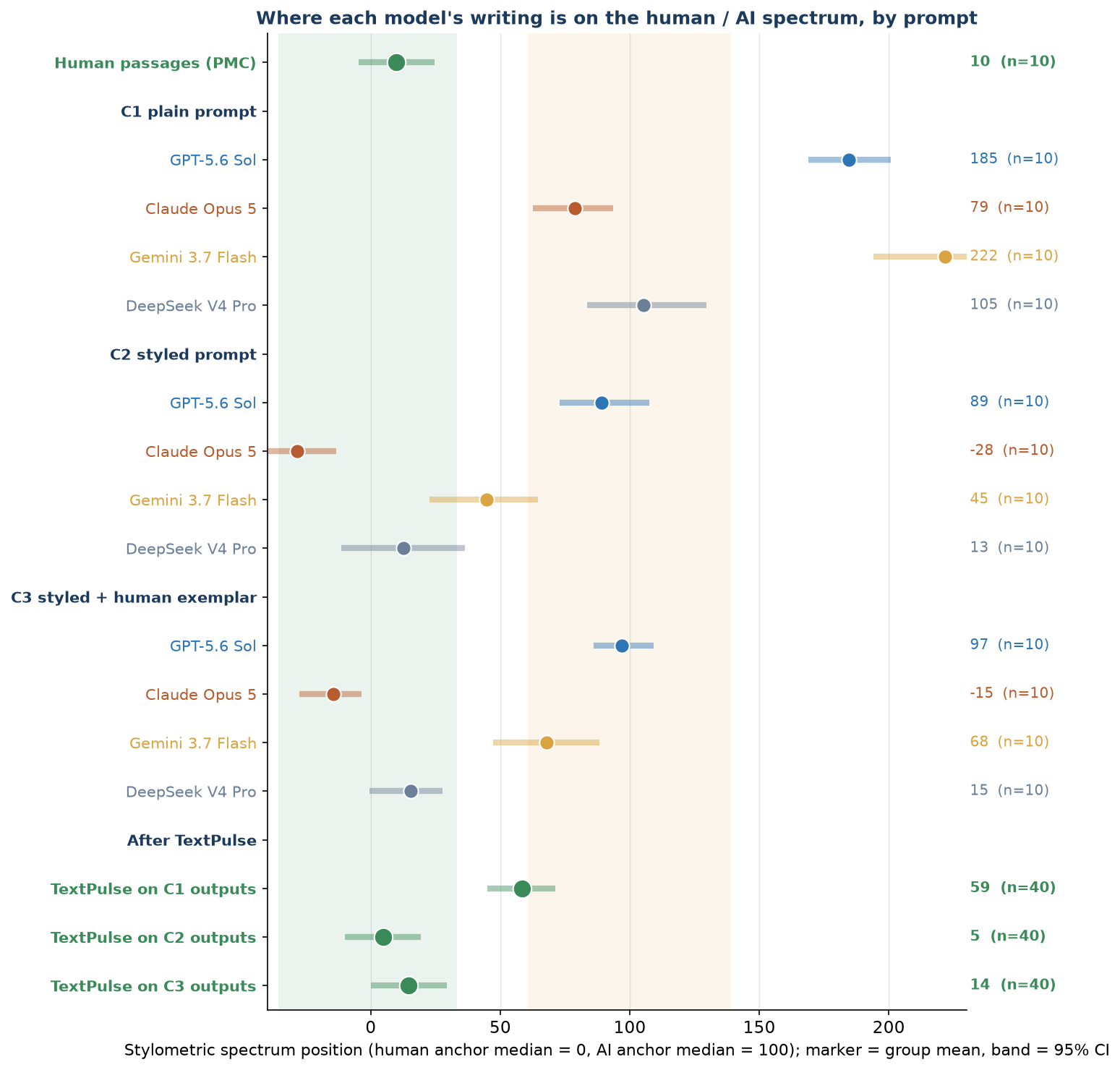
The instruction-loaded prompt changed this significantly. The pooled mean dropped from 148 to 30 (95 percent CI 14 to 47), and 14 of the 40 texts generated using the second instruction-loaded prompt (C2) were inside the human middle half. Claude Opus 5 moved furthest, from 79 to -28, past the human median and to the human side of every one of the ten human written passages’ mean. DeepSeek V4 Pro moved to 13, Gemini 3.7 Flash to 45, and GPT-5.6 Sol, the least responsive, to 89, still inside the AI band. Adding a human example on top of the instruction prompt (C3) did not help further. The pooled mean was 41 (95 percent CI 27 to 57), slightly further from human prose than C2 for every model except Claude’s neighbor DeepSeek, and 18 texts were inside the human band. The ordering of the models was the same under every prompt, namely, Claude, then DeepSeek, then Gemini, then GPT.
| Prompt | Model | n | Spectrum mean | 95% CI | p_ai | GPTZero AI | Classified human |
|---|---|---|---|---|---|---|---|
| Human passages | 10 | 9.9 | -4.8 to 24.5 | 0.18 | 0.00 | 10 of 10 | |
| C1 | GPT-5.6 Sol | 10 | 184.6 | 168.9 to 200.7 | 0.98 | 1.00 | 0 of 10 |
| C1 | Claude Opus 5 | 10 | 78.9 | 62.5 to 93.7 | 0.66 | 1.00 | 0 of 10 |
| C1 | Gemini 3.7 Flash | 10 | 221.8 | 194.1 to 248.1 | 0.99 | 1.00 | 0 of 10 |
| C1 | DeepSeek V4 Pro | 10 | 105.2 | 83.6 to 129.6 | 0.75 | 1.00 | 0 of 10 |
| C1 | All four | 40 | 147.6 | 127.0 to 168.4 | 0.85 | 1.00 | 0 of 40 |
| C2 | GPT-5.6 Sol | 10 | 89.1 | 72.9 to 107.6 | 0.69 | 1.00 | 0 of 10 |
| C2 | Claude Opus 5 | 10 | -28.5 | -44.9 to -13.2 | 0.03 | 1.00 | 0 of 10 |
| C2 | Gemini 3.7 Flash | 10 | 44.8 | 22.7 to 64.6 | 0.19 | 1.00 | 0 of 10 |
| C2 | DeepSeek V4 Pro | 10 | 12.6 | -11.5 to 36.4 | 0.22 | 1.00 | 0 of 10 |
| C2 | All four | 40 | 29.5 | 13.6 to 46.6 | 0.28 | 1.00 | 0 of 40 |
| C3 | GPT-5.6 Sol | 10 | 97.0 | 85.9 to 109.2 | 0.76 | 1.00 | 0 of 10 |
| C3 | Claude Opus 5 | 10 | -14.6 | -27.7 to -3.5 | 0.05 | 1.00 | 0 of 10 |
| C3 | Gemini 3.7 Flash | 10 | 67.9 | 47.2 to 88.2 | 0.35 | 1.00 | 0 of 10 |
| C3 | DeepSeek V4 Pro | 10 | 15.3 | -0.5 to 27.7 | 0.21 | 1.00 | 0 of 10 |
| C3 | All four | 40 | 41.4 | 26.7 to 56.9 | 0.34 | 1.00 | 0 of 40 |
Table 2. Spectrum position, classifier probability (p_ai) and GPTZero document probability by prompt and model. C1 plain prompt, C2 instruction-loaded prompt, C3 example plus instruction-loaded prompt.
Table 3 and Figure F2 show which components were affected most. The C2 prompt asked for uneven sentence length, and the models delivered it well beyond the human level. Sentence-length CV increased from 0.32 under the plain prompt (C1) to 0.58 under the instruction-loaded prompt (C2) one, against 0.4 in the human passages. Mean word length fell from 6.45 to 5.39 characters, below the human 5.67, and the Flesch-Kincaid grade fell from 21.4 to 13.8, far below the human 20.4. When instructed to write plainly, the models wrote more plainly than the journals write. AI-lexicon density fell from 137 to 78 words per 1,000, below the human 107, and connective sentence openers, which the instruction-loaded prompt banned by name, were eliminated entirely (0.00) where the human passages use them in 0.03 of sentences. One component did not change at all. Lexical diversity (MATTR-50) was 0.88 under the plain prompt and 0.877 under the instruction-loaded one, against 0.804 for the human passages. The prompt instruction did not mention vocabulary range, and the models’ vocabulary range remained where preference defaults it, wider than a human researcher’s.
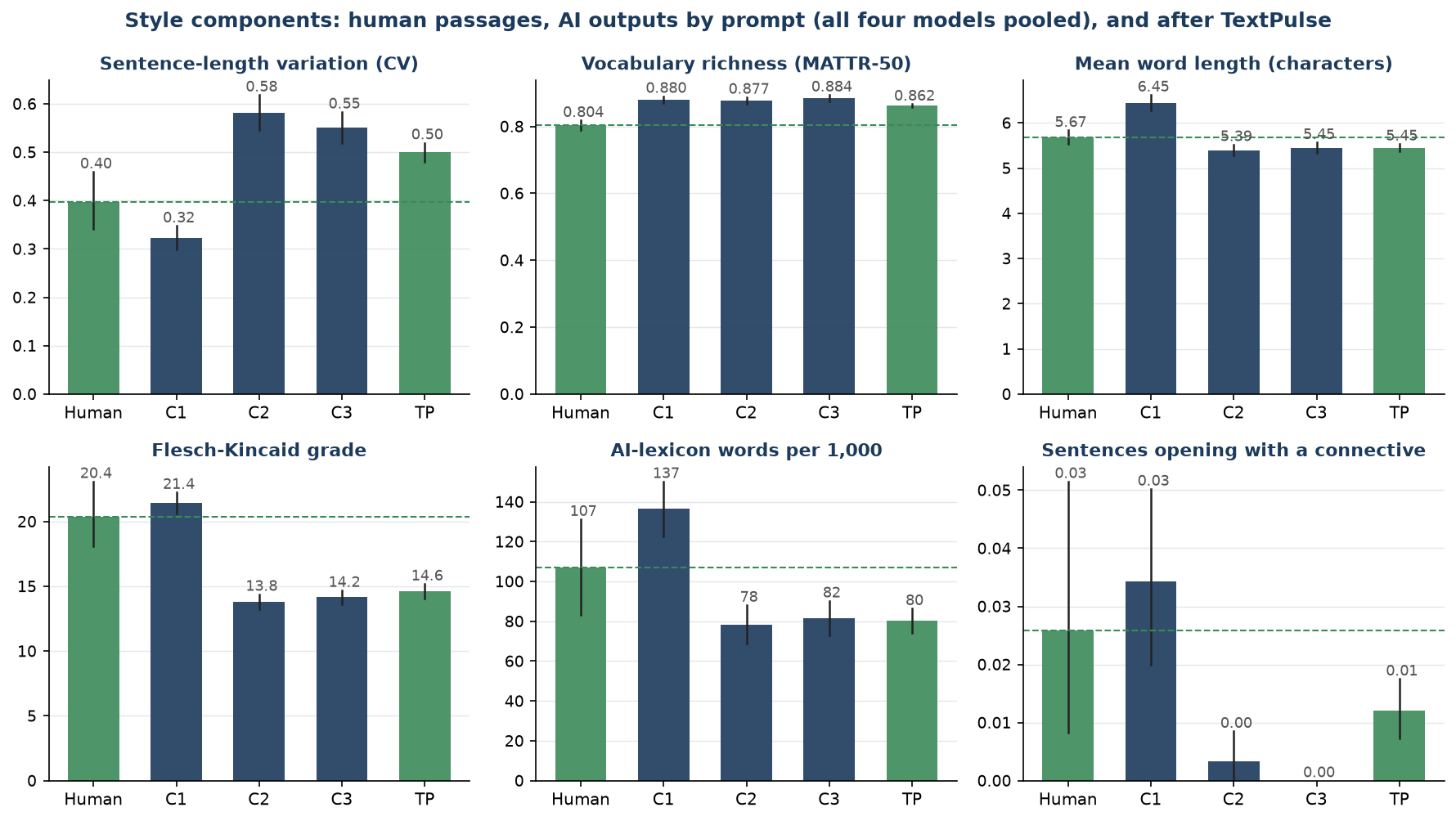
Every property named in the instruction prompt changed, several of them past the human value, and the property the prompt did not mention did not change. The result is text that scores as human on a 47-feature spectrum because the features the instruction-loaded prompt covered dominate that spectrum, without being human in the way the spectrum was designed to detect.
| Component | Human | C1 plain | C2 instruction-loaded | C3 example + instructions | After TextPulse |
|---|---|---|---|---|---|
| Sentence-length CV | 0.40 | 0.32 | 0.58 | 0.55 | 0.50 |
| MATTR-50 | 0.804 | 0.880 | 0.877 | 0.884 | 0.862 |
| Mean word length | 5.67 | 6.45 | 5.39 | 5.45 | 5.45 |
| Flesch-Kincaid grade | 20.4 | 21.4 | 13.8 | 14.2 | 14.6 |
| AI-lexicon words per 1,000 | 107 | 137 | 78 | 82 | 80 |
| Connective openers (share of sentences) | 0.03 | 0.03 | 0.00 | 0.00 | 0.01 |
Table 3. Style components, group means. The four models are pooled within each prompt (n = 40 per prompt, 10 human, 120 after TextPulse).
5. GPTZero is not moved at all
Figure F3 depicts the detector result. All 120 AI texts, under every prompt and from every model, received a GPTZero document AI probability of 1.00 and were classified as AI. The lowest probability among the 120 was 1.00. All ten human passages received a probability of 0.00 and were classified as human. The instruction prompt, which changed the spectrum from 148 to 30 and positioned 14 texts inside the human band, did not affect GPTZero. Claude Opus 5’s instruction-loaded texts, which were on the human side of the human median on the spectrum, were flagged with the same certainty as Gemini’s plain-prompt texts at 222.
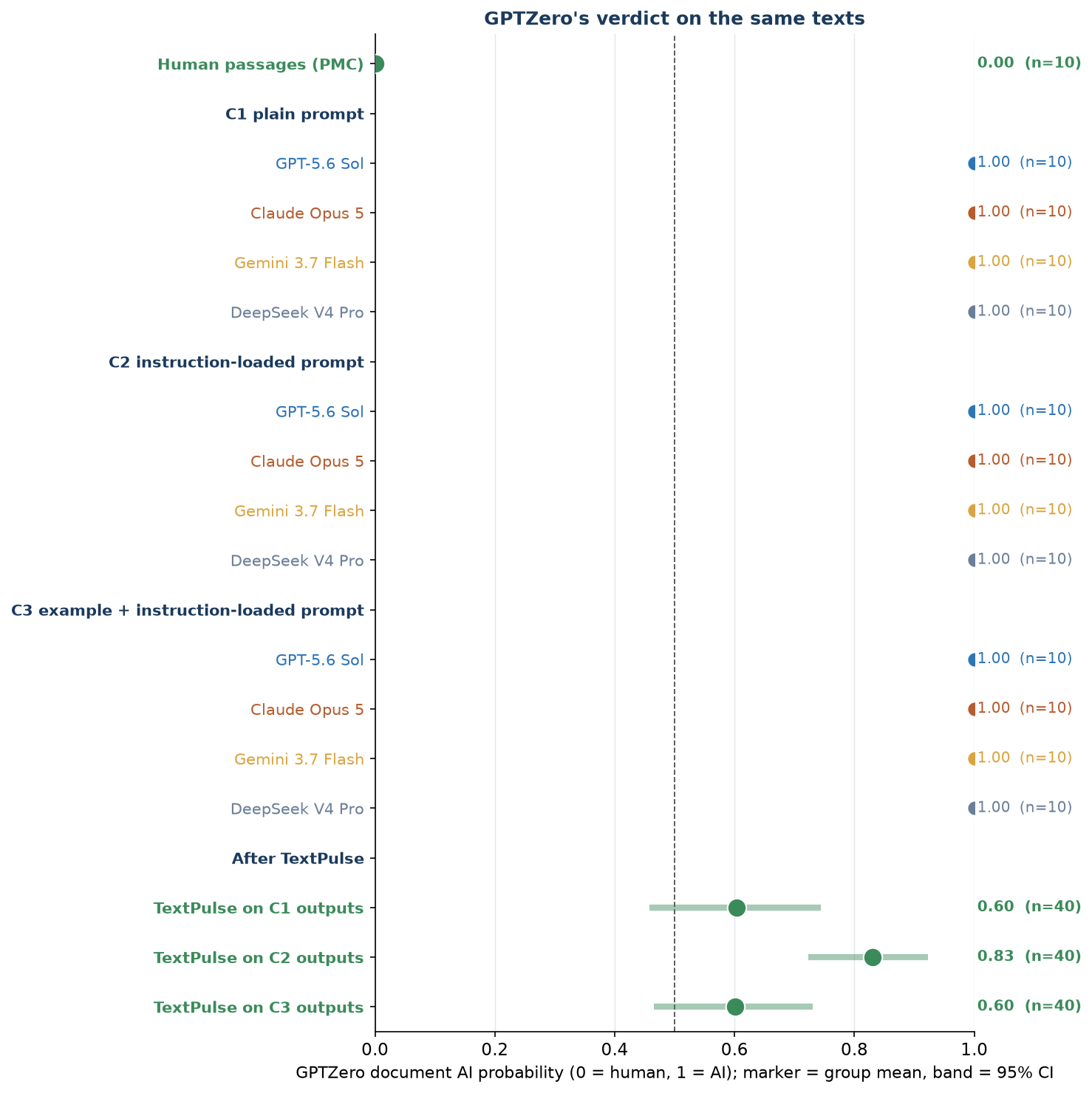
Figure F4 depicts the two measures together. The horizontal axis is the stylometric spectrum, and the vertical axis is the detector (GPTZero). The human passages is at the bottom left. Every AI text, wherever it is on the horizontal axis, is on the top line. Instruction moved the texts along the horizontal axis and left the vertical axis untouched.
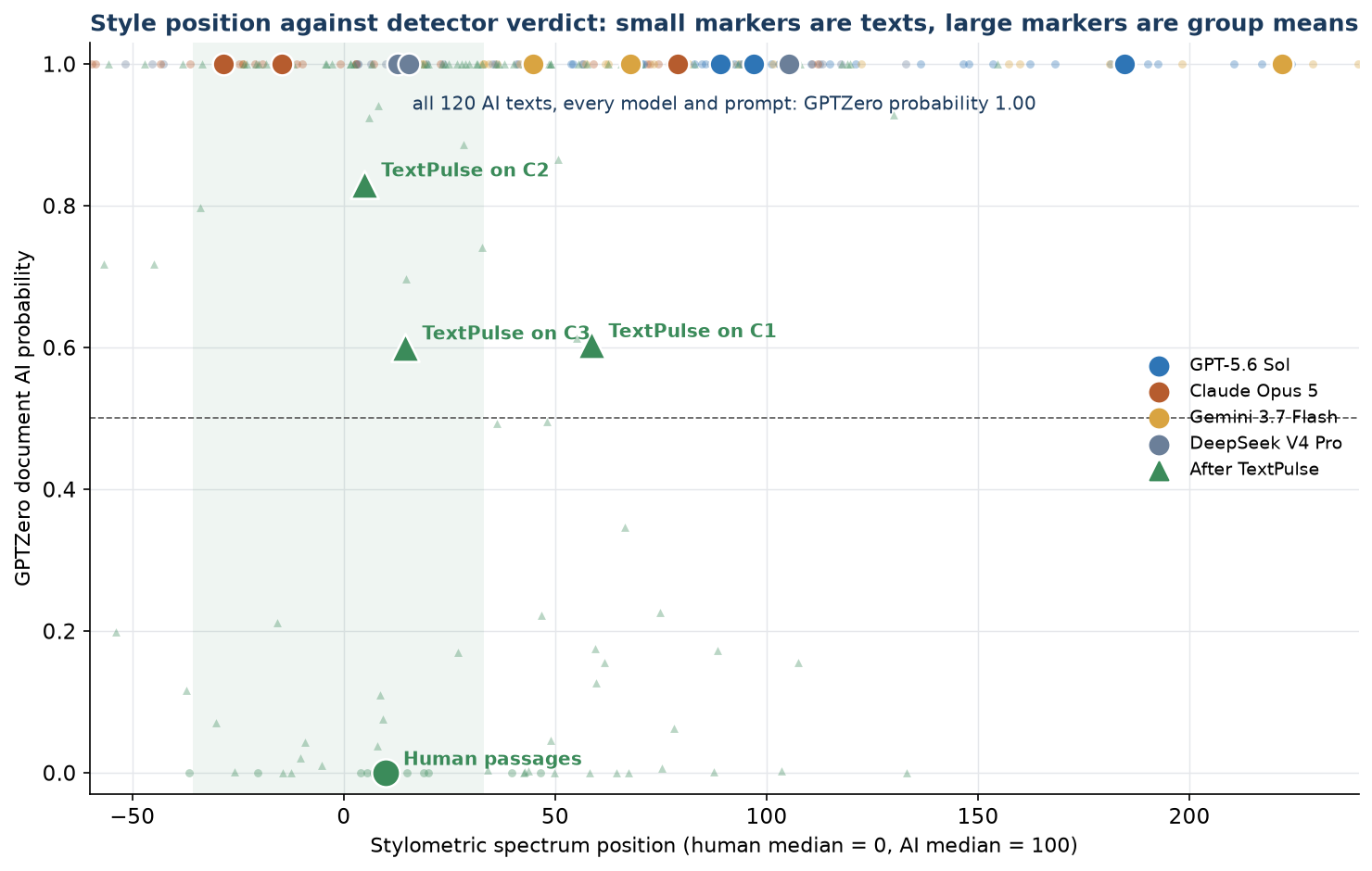
The two instruments disagree because they read different concepts. The spectrum reads 47 surface counts: sentence lengths, word lengths, punctuation, openers, vocabulary lists, etc. A model can be instructed what those counts should be and can hit them. GPTZero reads the probability distribution of each token under a language model and the manner in which probability varies across the text. A preference-tuned model asked to write “unevenly” produces an uneven text whose every token is still the token such a model would produce, since the unevenness is itself generated in the model’s own manner. The detector probes the generation process, not the surface linguistic features it was instructed to synthetically ‘imitate’. This is the distinction between a text that has the statistics of human writing and a text that came from the human distribution, and it is the main reason Sadasivan et al. (2025) tie detectability to the distance between the two entirely different token distributions, rather than to any list of surface-level stylometric features.
6. What one pass through TextPulse does
Every AI text was then processed once through TextPulse humanizer. Figure F5 and Table 4 present this shift on the spectrum. Across the 120 texts the mean shift was -47 points toward the human end (95 percent CI -55 to -39), with the largest shifts on the texts that started furthest away. Gemini’s plain-prompt texts moved from 222 to 80 and GPT’s from 185 to 95. The pooled plain-prompt (C1) texts moved from 148 to 59, the instructed texts from 30 to 5 (C2), and the example + instructed texts (C3) from 41 to 14. After the process, 54 of the 120 texts were inside the human middle half (12 of the plain-prompt texts, 22 of the instructed, and 20 of the example + instructed texts), against 33 before. The rewrite preserved the text. The document cosine to the source averaged 0.972 while 49 percent of the words in the humanized texts changed compared to the raw AI texts. AI-lexicon density fell by a further 19 words per 1,000 and the reading grade by 1.8. Sentence-length variation remained similar to the source.
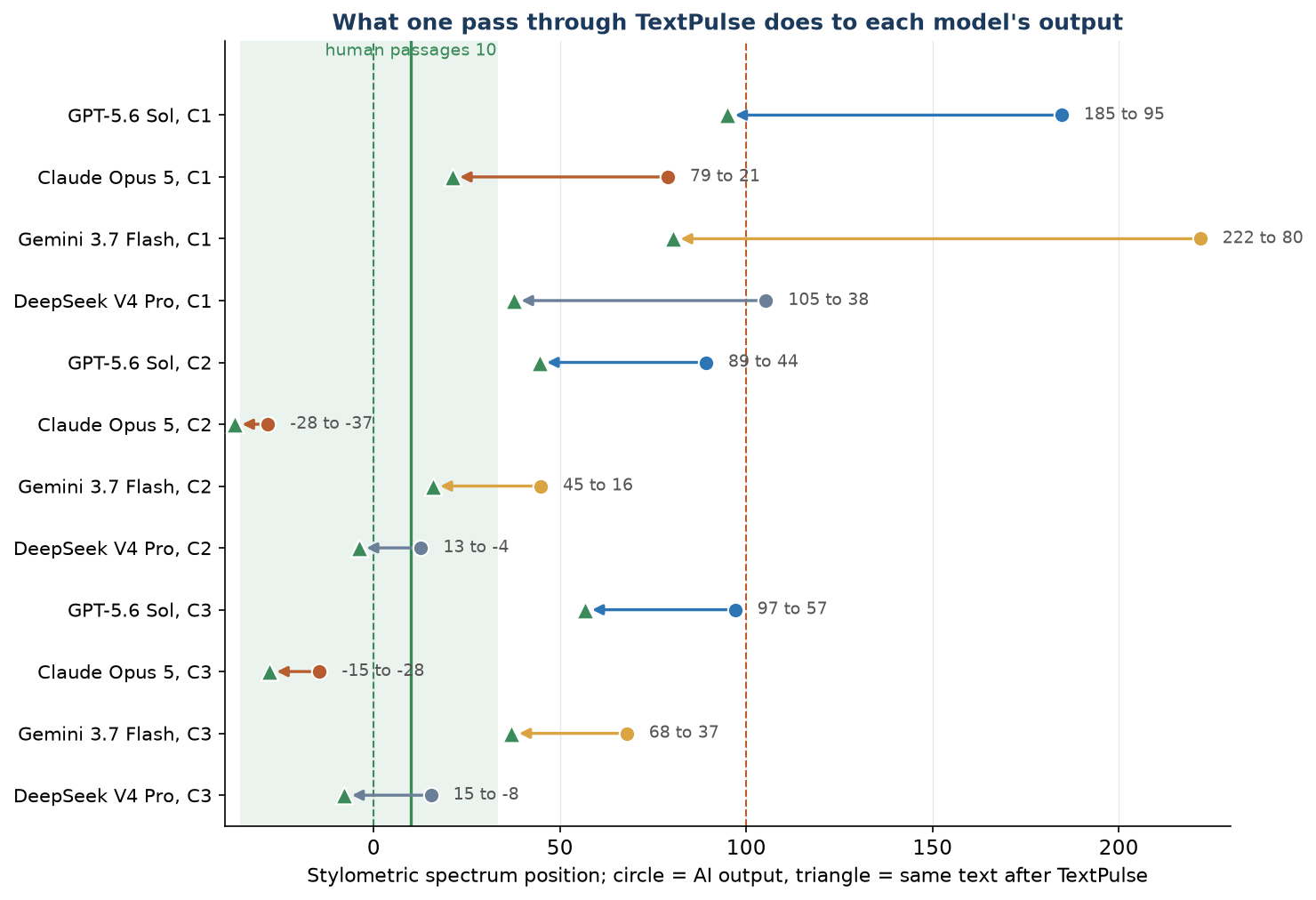
GPTZero was run on all 120 humanized texts. Of these, 37 were classified as human: 17 of 40 plain-prompt texts, 6 of 40 instruction loaded texts and 14 of 40 example + instruction loaded texts. The mean document AI probability fell from 1.00 to 0.60 on the plain-prompt texts, 0.83 on the instruction-loaded ones and 0.60 on the example + instruction loaded ones.
| Prompt | Model | Spectrum before | Spectrum after | Cosine to source | Words changed | GPTZero AI after | Classified human after |
|---|---|---|---|---|---|---|---|
| C1 | GPT-5.6 Sol | 185 | 95 | 0.968 | 59% | 1.00 | 0 of 10 |
| C1 | Claude Opus 5 | 79 | 21 | 0.962 | 60% | 0.50 | 5 of 10 |
| C1 | Gemini 3.7 Flash | 222 | 80 | 0.957 | 70% | 0.37 | 7 of 10 |
| C1 | DeepSeek V4 Pro | 105 | 38 | 0.961 | 58% | 0.54 | 5 of 10 |
| C2 | GPT-5.6 Sol | 89 | 44 | 0.979 | 49% | 0.90 | 1 of 10 |
| C2 | Claude Opus 5 | -28 | -37 | 0.974 | 37% | 0.86 | 1 of 10 |
| C2 | Gemini 3.7 Flash | 45 | 16 | 0.978 | 44% | 0.77 | 2 of 10 |
| C2 | DeepSeek V4 Pro | 13 | -4 | 0.971 | 44% | 0.79 | 2 of 10 |
| C3 | GPT-5.6 Sol | 97 | 57 | 0.981 | 48% | 0.61 | 4 of 10 |
| C3 | Claude Opus 5 | -15 | -28 | 0.974 | 39% | 0.65 | 2 of 10 |
| C3 | Gemini 3.7 Flash | 68 | 37 | 0.984 | 42% | 0.52 | 4 of 10 |
| C3 | DeepSeek V4 Pro | 15 | -8 | 0.975 | 42% | 0.62 | 4 of 10 |
Table 4. One pass through TextPulse. Spectrum before and after are the cell means; cosine is the BGE document similarity between the humanized text and its AI source; GPTZero columns cover all 120 humanized texts.
Two key observations are worth noting. First, a rewriting engine that changes the token sequence impacts the AI detector where a prompt instruction to the AI model does not. The reason for this is that the rewrite changes the process that produced the text rather than the stylometric surface the model was asked to produce. Second, the instructed texts were harder to change than the plain ones. The source already carried the surface markers of human writing, so the humanization (rewrite) had less to change and the detector retained more of its signal. Instruction and humanization are not additive. The reader should note that these detector results describe TextPulse’s own engine and are reported for completeness. The humanizer comparison study (TextPulse Research, 2026g) is the controlled test of that engine against its competitors.
7. Verdict: prompting cannot undo preference tuning
The question in the title has a two-part answer. On the surface, yes, told which properties separate human prose from machine prose, current flagship models can reproduce those properties easily, and on a spectrum built from those properties they can be placed among human texts. On a deeper level, no, an AI detector that reads the generation process or token distribution rather than the stylometric surface classifies every one of the 120 texts as machine written with full confidence, regardless of the AI model or prompt used, or however ‘human’ the stylometric surface reads.
Every model in this study has been through supervised fine-tuning and preference optimization, and the published measurements of those stages agree that they limit (or ‘narrow’) the distribution the model samples from (Kirk et al., 2024; O’Mahony et al., 2024; Padmakumar and He, 2024; Yun et al., 2025; Mahapatra, 2026). This limitation is the token distribution after training, and an instruction is a condition applied to that distribution, but never a replacement for it, as empirically shown in this study. When requested to write unevenly, the model samples an uneven text from the narrowed distribution itself. The surface counts therefore change, but the per-token signature that a probability-based detector reads does not, since the same narrowed process produced every single token.
This is also the reason the components changed in the way they did in Section 4. The instruction prompt mentioned sentence length, word choice and openers, and each was changed to past the human value, since a preference-tuned model executes an instruction to the letter. But the prompt did not mention vocabulary range, and so vocabulary range did not move. A human writer does not need to be instructed how to write, because a human writer is not applying a list to a narrowed distribution. Xu et al. (2026) report that raw base-model output, before any preference tuning, reads as human to the same detectors. Base models are not offered to the public as writing assistants. The models that are offered carry the tuning, and this tuning impacts the detection verdict.
For a writer, no prompt tested here, including the most detailed brief we could write plus a human written example, produced a text that a university-grade detector would treat as ‘human’, and the prompt that changed the stylometric surface furthest produced text that read simpler and more uneven than the journals it was imitating. For the detection question, surface stylometry, including our own spectrum, can be directed by instruction and should not be used on its own as evidence of authorship. The probability-based detector was not impacted at all in this study, but it was only impacted by a humanizer (rewriting) engine (Section 6), which is the same finding of the humanizer literature reviewed in our earlier paper. To conclude, on the surface, RLHF AI models can reproduce the stylometric properties of human writing when instructed, but they remain limited to the narrow token distribution they were trained on, and the output is always based on the next best token from this narrowed distribution itself. AI detectors are trained to detect this per-token signature, and so fine-tuned AI models are flagged as machine written with full confidence.
8. Limitations
Ten topics and four models give ten texts per cell, so the confidence intervals in Table 2 are wide and cell-level differences of a few points should not be read. The human baseline is ten passages from three disciplines, all from the same corpus family that supplied the spectrum’s human anchors, so the human passages are expected to be near the human median by construction. The comparison that matters is between the AI cells and that fixed reference. The spectrum is a linear model over 47 surface features and Section 4 shows that it can be driven, which is a finding of this paper as well as a limitation of the instrument itself. GPTZero was considered in this study. We did not test Turnitin, Originality or Pangram on these texts, and a detector built on different principles could respond to the instruction-loaded prompt differently. Reasoning was switched off in every model, and a reasoning pass might change how a model applies an instructed output.
Data availability
The ten human passages, AI output including rejected attempts, TextPulse output, the exact prompts, the cached GPTZero replies, the per-text scores, the analysis results and every script are released with this paper. The archive is deposited on Zenodo (DOI 10.5281/zenodo.22159494).
References
Bai, Y., Kadavath, S., Kundu, S., Askell, A., Kernion, J., Jones, A., … & Kaplan, J. (2022). Constitutional AI: Harmlessness from AI feedback. arXiv:2212.08073. https://arxiv.org/abs/2212.08073
Christiano, P. F., Leike, J., Brown, T., Martic, M., Legg, S., & Amodei, D. (2017). Deep reinforcement learning from human preferences. Advances in Neural Information Processing Systems, 30. https://arxiv.org/abs/1706.03741
Gude, A., Santos-Rios, R., Bond, F., Flickinger, D., Gomez-Rodriguez, C., & Zamaraeva, O. (2026). More aligned, less diverse? Analyzing the grammar and lexicon of two generations of LLMs. arXiv:2605.06030. https://arxiv.org/abs/2605.06030
Herbold, S., Hautli-Janisz, A., Heuer, U., Kikteva, Z., & Trautsch, A. (2023). A large-scale comparison of human-written versus ChatGPT-generated essays. Scientific Reports, 13, 18617. https://doi.org/10.1038/s41598-023-45644-9
Janus. (2022). Mysteries of mode collapse. LessWrong. https://www.lesswrong.com/posts/t9svvNPNmFf5Qa3TA