Does Google Penalize AI Content? What the Policy Actually Says
Nearly every result for this question paraphrases Google's guidance instead of quoting it. This piece works from Google's own spam policy, AI-content guidance, and ranking-systems documentation instead, with the exact wording and the date each page last changed.
Type does Google penalize AI content into a search bar and the first page is nine blog posts confidently answering a question none of them actually sourced. They paraphrase a paraphrase of Google's February 2023 guidance, and somewhere in the retelling the sentence Google actually wrote gets lost. Read Google's own documentation and the target comes into sharper focus than any of those roundups suggest: the policy names a specific practice, scale used to manipulate rankings, not the fact that a model helped write the page.
We're not going to summarize someone else's summary here. Instead, we'll be using Google's own words about the AI-content guidance, the spam policy on scaled content abuse, and the documentation about precisely when the Helpful Content System folded into core ranking. Because Google updates their wording on these things more often than most SEO advice accounts for, we've put every quote below in bold, named the page it came from, and listed when that page was last changed.
None of Google's own pages say the words "AI-generated content is penalized." That sentence does not exist in the documentation, and the gap between what Google actually wrote and what the search results claim it wrote is the entire subject of this piece.
Does Google Penalize AI Content? What the Policy Actually Says
Not for being AI-generated. Google's current guidance is explicit that automation, including AI, has produced helpful content for years, sports scores and weather forecasts are the examples Google itself uses, and using it does not put a page at a disadvantage by default. What loses rankings is a specific practice: producing pages at scale for the primary purpose of manipulating search results rather than helping the person reading them.
| Google page | Last changed | What it actually says |
|---|---|---|
| AI-generated content guidance | Revised 10 Dec 2025 | "Using generative AI tools or other similar tools to generate many pages without adding value for users may violate Google's spam policy on scaled content abuse." |
| Spam policies for web search | Revised 15 May 2026 | "Scaled content abuse is when many pages are generated for the primary purpose of manipulating search rankings and not helping users." |
| Creating helpful, reliable content | Revised 10 Dec 2025 | "If you use automation, including AI-generation, to produce content for the primary purpose of manipulating search rankings, that's a violation of our spam policies." |
| Ranking systems guide | Revised 10 Dec 2025 | The Helpful Content System "evolved and became part of our core ranking systems" in March 2024, now listed under retired standalone systems |
| Official blog, March 2024 update | Published 5 Mar 2024, updated 26 Apr 2024 | The update delivered "45% less low-quality, unoriginal content in search results" than before, revised up from an original 40% estimate |
Read those five rows together and a pattern holds: every operative sentence is about purpose and effect, manipulating rankings, failing to help users, producing pages at scale, never about the fact of AI involvement on its own. The practical reason to check the page directly rather than trust a screenshot from 2023 still circulating in someone's roundup is that Google revises the wording on a schedule that has nothing to do with any single site's ranking.
How This Wording Has Changed Since 2023
Google's first dedicated statement on AI-generated content went up in February 2023, a plain post arguing that automation was not new to search and that quality mattered more than method. Scaled content abuse did not exist as a named policy until 13 months later: Google announced it alongside expired domain abuse and site reputation abuse in March 2024, the same update that folded the standalone Helpful Content System into core ranking. That is the actual sequence, and most of the roundups that cite "Google's 2023 guidance" as the whole policy are quoting a page that predates the specific rule they are trying to explain.
The documentation kept moving after that. Google's guidance on AI-generated content itself was last revised in December 2025, and the spam policies page defining scaled content abuse was revised again in May 2026, three months before this piece was checked against it. None of the three revisions changed the underlying test. What changed was explanation and emphasis, which is exactly why a 2023 screenshot is not a safe citation in 2026.
What Counts as Scaled Content Abuse?
Volume produced for ranking rather than for readers, whether a person, an AI tool, or both did the producing. Google's own definition does not carve out an automation exception or a human exception; the test is the primary purpose behind the page, not the method used to draft it. A single well-researched article generated with AI assistance and genuinely edited is a different case from five hundred near-identical pages targeting long-tail variations of the same term, and Google's policy is written to catch the second case, not the first.
The pattern shows up constantly in one specific form for marketing teams: a template swapped across hundreds of city or product-variant pages, each one thin, each one built from the same skeleton with a name and a number changed. That was a spam pattern before generative AI existed. AI just made producing the five hundredth variant cost the same as producing the first one, which is why the policy reads as newly urgent even though the underlying rule has not changed.
Is the Helpful Content Update Still a Thing in 2026?
Not as a standalone update, no. Google's own ranking systems guide now lists the Helpful Content System under retired systems, folded into core ranking as of March 2024, and describes the change as multiple systems across the core algorithm now assessing helpfulness rather than one dedicated system doing it periodically. Google's own figure for the effect of that March 2024 change, revised a few weeks after the initial rollout, was 45 percent less low-quality, unoriginal content in search results, up from an original 40 percent estimate.
What Is E-E-A-T and Does It Actually Apply to AI-Assisted Content?
E-E-A-T stands for experience, expertise, authoritativeness, and trustworthiness, the qualities Google's own guidance says its ranking systems try to identify, with trust named as the most important of the four. Google frames it as the reasoning behind a set of self-assessment questions it publishes, not a score plugged into a formula: does a page offer original analysis, does the person who wrote it demonstrably know the subject. AI-assisted content is judged against the same four qualities as anything else, which is why a page assembled at speed with no original reporting or verification tends to fail on experience and trust regardless of who or what typed it. A free readability checker catches the flattened, generic phrasing that usually travels alongside those problems, even though it cannot measure trust directly.
Humanize your own paper
Transform your AI-assisted text and make it sound human, without touching important words or citations.
Does AI Content Actually Rank on Google?
Sometimes, and unevenly. There isn't an official Google statement about how much ranking content is AI-helped. So every statistic you see comes from a third party's own detection tool. The detection tools don't agree with each other (they're trained on different samples and set to different thresholds), but the thing the independent studies converge on is a shape rather than a number: content that is exclusively AI output with no editorial pass, no original data, and no verification struggles to hold a top ranking for a competitive term, whereas AI-helped content that goes through real editing performs closer to content that never touched AI at all.
That gap is the actual mechanism behind every case study of an AI-heavy site losing traffic: the ordinary quality evaluation Google runs on everyone, applied to pages that happened to skip the editing step, no manual AI penalty required. Treat any claim that a specific percentage of AI content is safe with real suspicion. Google has never published a threshold, and a site built around finding one is optimizing for a number nobody at Google has confirmed exists.
Three Myths About AI Content and Ranking
Myth 1: Google Penalizes a Page for Being AI-Generated
Penalized is doing most of the work in that sentence, and Google's documentation never uses it about authorship. The current wording on Creating Helpful, Reliable, People-First Content, revised 10 December 2025, reads: "If you use automation, including AI-generation, to produce content for the primary purpose of manipulating search rankings, that's a violation of our spam policies." Remove the purpose clause from that sentence and no violation remains in it. A page drafted with AI to answer a question a real person asked sits outside the sentence entirely.
Google's February 2023 guidance on AI-generated content made the same point three years earlier, stating that its ranking systems would continue to reward high-quality content however it was produced, and that appropriate use of AI or automation sits inside Google's guidelines. That wording has survived every revision since. What has also survived is the confusion behind this myth, because the traffic losses people point to as evidence are real.
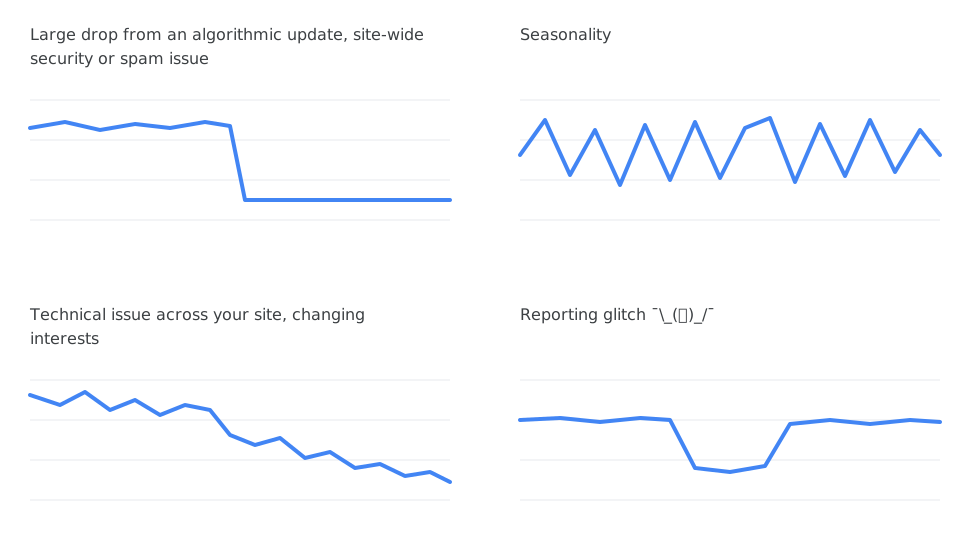
The mechanism behind those losses is ordinary. A site publishes forty thin pages in a quarter, none of them checked, none carrying anything a reader could get only there. The quality evaluation that runs on every site finds forty thin pages and treats them as forty thin pages. No AI-specific rule was applied, and the publisher who blames one usually goes on to fix the wrong thing.
Myth 2: Google Runs an AI Detector as a Ranking Signal
No Google documentation describes an AI-detection step anywhere in ranking. There is no published classifier score, no AI label attached to a URL, and no statement that a probability of machine authorship feeds into any system Google names in its ranking documentation. The signals Google does describe are properties of the page and its usefulness: purpose, originality, whether the content was made to help the person who landed on it.
The confusion is understandable, because detectors exist and produce a confident-looking number. How AI detectors actually work explains what that number measures, which is the statistical predictability of the text itself rather than the origin of it. A detector score describes writing style. Nothing Google publishes connects that style measurement to a ranking outcome, and the two questions have different answers often enough that treating them as one is a real risk.
It alters what we check before launching a page. We haven't fixed anything of any consequence by having a low detector score on a thin page. A high score on a page with original data, named author and sources that check out is a fact about the prose and its rhythm: a copy problem, not a ranking problem. Fix it because the page reads badly, and only for that reason.
Myth 3: There Is a Safe Percentage of AI in a Page
No published Google source names a percentage, a ratio, or a threshold of any kind for AI-produced text. None of the figures in circulation traces back to a page Google publishes. The myth also depends on the previous one: a percentage rule would require the detection step Myth 2 covers, so a publisher believing both is asking Google to run a system it has never described in order to enforce a number it has never named.
What replaces the percentage is a question about substance. A page carrying original measurement, a named author, sources that check out and a reason to exist competes normally whether a model drafted 10 percent of its sentences or 90 percent of them. A page carrying none of those things struggles at any ratio, and rewriting it into a lower detector score changes nothing about why it struggles.
What Does Correlate With AI Pages Losing Visibility
Four things, and all four are ordinary quality failures that AI workflows make easier to commit at scale. Publishing volume with no editorial pass. Recombining published material with nothing added to it. Facts that fail on the first check a reader runs. Pages with no author anybody could hold responsible. The fixes are unglamorous and they run in a fixed order:
- Verify every figure, quotation and citation against a source that exists, before publication rather than after a reader finds the error.
- Add at least one thing the model could not have produced: a measurement you took, a screenshot of a real interface, a decision you made and would defend.
- Attach a named author with a traceable record, since Google's documentation strongly encourages accurate authorship information where readers would expect it.
- Edit for rhythm and word choice last, once the substance is settled, so the pass improves a page that already deserves its position.
The last step is the cheapest and the least decisive. Free writing tools will flag the flat vocabulary and even sentence length of an unedited draft in a couple of minutes, and a humanizer tuned for marketing copy rewrites the rhythm without disturbing the phrases a page ranks for. Neither one supplies the first item on that list, and the first item is what decides whether the page holds a position at all.
Two documented policies decide this rather than any general preference. The helpful content update and the scaled content abuse policy are each covered on their own page.
Take the three myths off the table and the remaining work is dull and specific: check the facts, add something only you have, put a real name on the page. Every site that lost traffic in the rush to publish AI drafts skipped all three, and the tool used to write the first draft is the least interesting part of the story.
Will AI Content Rank on Google? The Five Conditions That Decide
Five conditions decide it, and Google states or implies each one in its own current documentation. None of the five mentions who or what typed the draft. A page that satisfies all five behaves like any other page in the index and competes on the ordinary merits. A page that misses two or three of them sits below content that satisfies them, whatever produced the words, and it will keep sitting there while its publisher looks for a penalty that was never applied.
| Condition | What Google's documentation ties it to | How an AI-only draft scores by default |
|---|---|---|
| Purpose of the page | Content made to help a reader, rather than primarily to move a ranking position | Depends entirely on the brief, since a model writes toward whatever purpose it is given |
| Value added beyond what exists | Guidance that generating many pages without adding value for users may breach the spam policies | Weak by construction: a model recombines published material and adds nothing from outside it |
| First-hand experience | The self-assessment question about expertise that comes from having actually used a product or service, or visiting a place | Zero. A model has used no product and visited no place |
| Clear authorship | Google strongly encourages accurate authorship information, such as bylines where readers would expect them | Absent until a publisher attaches a named, accountable byline |
| Accuracy that survives a check | Trust, which Google's documentation calls the most important of the four E-E-A-T aspects | Unreliable. Verified output and fluent invention look identical on the page |
Read the right-hand column and the shape of the problem is clear. A model handles the first condition well when the brief is good, handles the second poorly by construction, and cannot touch the third at all. Two sites publishing at the same volume with the same tool end up in completely different places, and the gap between them is almost always rows three, four and five rather than anything about the drafting.
Where AI-Assisted Pages Do Rank
The first is where the information is checkable and someone actually checked it (the step that turns fluent output into accurate output). The second is where a person supplied material the model had no access to: a number they measured, a screenshot of a real interface, a decision they made and would defend in public. The third is where the page answers the query completely enough that the reader stops there instead of going back to the results. In all three cases, AI-helped pages reliably show up high in the search results.
The easiest to win are format-driven queries. The correct answer for those questions is fixed, public, and a model will assemble it correctly if you put the source material in front of it. That's citation format, that's a definition, that's comparing two named tools, that's a sequence of steps, whatever it might be. That kind of page has less editorial work. It's more like verification work. And that's what an AI drafting workflow will leave undone.
The harder queries need something the drafting step cannot reach. Four kinds of material do most of the work, and a publisher has to go and get all four:
- A measurement from your own work: a number you recorded, a before-and-after you can date, a result you would let someone audit.
- An artefact: a screenshot of a real interface, a real document, a real email, specific enough that nobody else could have produced the identical image.
- A judgement: a recommendation you would defend when it turns out badly, with the reasoning that led to it.
- A named source a reader can go and check for themselves, quoted accurately, with the date the source last changed.
Editing is the other half of the job, and it is the half most workflows skip. A humanizer tuned for marketing and SEO copy changes sentence rhythm and word choice while leaving the exact phrases a page ranks for where they are, which matters when a draft already earns its position and the edit should not cost it. A rewrite improves how a page reads. It cannot improve what the page knows.
Where AI Content Stops Ranking
Three patterns account for most of it, and volume is the first. Publishing many near-identical pages to cover keyword variations is the practice Google names as scaled content abuse, and the policy applies the same way whether a person, a tool, or both produced them. The second pattern is a page carrying nothing that could only have come from its publisher. The third is a factual error a reader catches before the publisher does, which costs more than a ranking.
The second pattern is the quiet one, and the most common. A page can be accurate, well structured, correctly optimized and still carry no reason to exist, because every sentence on it restates material already published on ten other domains. Google's guidance keeps returning to whether a page adds value for users, and recombination is the one thing a model does without adding any. The flat vocabulary and even sentence rhythm that come with it are catalogued in a companion post on AI writing patterns, and they are the visible symptom rather than the disease.
The surface tells are the cheap part to fix. Free writing tools that flag generic AI vocabulary and flat sentence length will find them in a couple of minutes, and an editing pass removes them. The missing first-hand material takes considerably longer, because no editing pass can invent it and no second model can supply it. That asymmetry is why so many sites fix the wrong problem first and see nothing move.
Should You Disclose That Content Was AI-Assisted?
Google's own guidance frames disclosure as a courtesy to readers rather than a ranking requirement: sharing how a piece was created can give an audience more context, in Google's own phrasing, and its documentation on AI-generated content suggests considering a note on automation when that makes sense for the audience. No page of Google's documentation ties a disclosure label to a ranking boost or penalty either way. The stronger business reason to disclose sits with the reader relationship, not the algorithm: a publication that gets caught concealing AI use loses reader trust faster than any core update removes rankings.
What Should You Actually Do Before Publishing AI-Assisted Content?
Run every AI-assisted draft through the same checklist regardless of how it was produced, because Google's own quality signals do not distinguish by origin:
- Verify every fact, figure, and citation against a source that actually exists
- Add something the page would not have without a person: a real example, a number you measured, an opinion you would defend in public
- Run the draft through a free AI word cleaner, then edit until the sentence rhythm and word choice sound like your publication, not the flattest average of the training data
- Say who or what helped produce the page, in whatever form fits your site, if a reader would reasonably want to know
- Check the page against Google's own self-assessment questions before it goes live, not after a ranking drop prompts the audit
That last step is where a humanizing pass earns its place in the workflow: the editing pass that gives AI-assisted copy the sentence variety and specificity Google's own quality signals are built to notice, not a ranking trick. The actual words and rhythms that make a paragraph read as generic are catalogued in a companion piece on AI writing patterns, and a tool built for marketing and SEO content can carry your target keywords through that same edit untouched, which matters if the draft already earns its rankings and the edit should not cost them.
The questions underneath this have pages of their own. Whether AI content ranks on Google at all and whether it hurts SEO are treated separately, as are the two policies that actually govern it: the helpful content update and the scaled content abuse policy. E-E-A-T gets its own explanation, since it is cited far more often than it is read. On the production side there are pieces on humanizing a blog post for SEO and on doing the same at scale.
Check Google's documentation again before your next planning cycle, not this piece. The wording moves, the dates above prove it moves on a real schedule, and the only durable strategy is reading the source instead of the roundup built on top of it.
Frequently Asked Questions
No, not simply for being AI-generated. The real answer to "does Google penalize AI content" is that its own spam policy and AI-content guidance target a specific practice instead: producing pages at scale to manipulate rankings without helping the reader. That practice is judged the same way whether a person or a model produced the words, and no page of Google's documentation singles out AI authorship by itself.
Content strategist at TextPulse, here since the company started. Mark writes the product and technical coverage: how the humanizer works under the hood, what changes in each release, and what a specification actually means for your writing. His reviews of writing software come from using them on real documents rather than reading a feature list.