Google's Helpful Content System and AI
The helpful content system stopped running as a standalone thing in March 2024, which means there is no update to recover from and no rollout window to sit out. The questions Google published alongside it are still live, still revised, and three of them now ask directly about automation. This is what each one asks of a page a model helped draft.
If you are an agency owner and your client's traffic is sliding downhill, you will probably start looking for a helpful content update recovery checklist. You may find a dozen of them. You'll follow the one that seems to be the most thorough. Every step in it assumes a system that stopped running on its own in March 2024. The system doesn't need an update to recover from, to sit out a rollout window, or to pass a separate scoring pass.
Search for Google helpful content update AI advice today and most of the results describe that retired arrangement. In 2022, Google introduced the helpful content system to bring to the forefront content that is written for people instead of for search traffic. Today, two years after its introduction, Google has rolled it into their core ranking systems and moved the old explanation page to be under a general page on creating helpful, reliable, people-first content.
The change matters more for AI-assisted publishing than for almost anything else, because the self-assessment questions Google wrote for the original system survived the fold-in, and three of them now ask directly about automation. The wider question of whether Google penalizes AI content is settled in Google's spam documentation, where the test is purpose rather than authorship. What follows here is narrower: the questions themselves, and what each one asks of a page a model helped draft.
Google Helpful Content Update AI Guidance: What Actually Changed
The standalone system is gone and its signals now sit inside core ranking. Google's own helpful content FAQ describes what happened to the system in one sentence: "In March 2024, it evolved and became part of our core ranking systems, as our systems use a variety of signals and systems to present helpful results to users." That page was last revised in December 2025, so the wording is current rather than a leftover from the announcement.
Three consequences follow for anyone planning work around it. Helpfulness is assessed continuously by the same systems that handle everything else, so there is no dated rollout to watch for. There is no separate recovery, so a site that lost ground fixes pages instead of waiting for the next pass. And the self-assessment questions did not retire with the system that prompted them; they sit on Google's live guidance page, revised as recently as December 2025.
The Self-Assessment Questions Google Published
Google publishes close to forty questions on its page about creating helpful, reliable, people-first content, arranged in groups: content and quality, expertise, whether a page is people-first, whether it was made search-engine-first, and a framework Google introduces in its own words as "Consider evaluating your content in terms of 'Who, How, and Why' as a way to stay on course with what our systems seek to reward." The questions are written for self-assessment, so each one is phrased as something a publisher answers about their own page.
| Question group | One question from it, in Google's words | Where an AI-assisted page usually loses |
|---|---|---|
| Content and quality | "Does the content provide original information, reporting, research, or analysis?" | A draft assembled from what already ranks has no original input to point at |
| Expertise | "Is this content written or reviewed by an expert or enthusiast who demonstrably knows the topic well?" | No named reviewer, or a byline that leads nowhere |
| People-first content | "After reading your content, will someone leave feeling they've learned enough about a topic to help achieve their goal?" | The page restates the query and stops, so the reader searches again |
| Search-engine-first content | "Are you using extensive automation to produce content on many topics?" | Topic selection driven by keyword volume rather than by what the audience asked for |
| Who, How, and Why | "Is the use of automation, including AI-generation, self-evident to visitors through disclosures or in other ways?" | Nothing on the page says anything about how it was produced |
Read the full set in order and one pattern stands out. Very few of the questions ask about the writing. They ask what went into the page before anybody wrote a sentence: who did the work, what they knew first-hand, why the topic was chosen, and what the page adds that the sources behind it did not already say. Prose quality is the last thing on the list and the easiest thing to fix.
Humanize your own paper
Transform your AI-assisted text and make it sound human, without touching important words or citations.
What the How Questions Ask of a Page Drafted with AI
The How group also addresses these topics in three questions: Google asks whether the use of automation, including AI-generation, is self-evident to visitors through disclosures or in other ways; whether you're providing background about how automation or AI-generation was used to create content; and whether you are explaining why automation or AI was seen as useful to produce content. All three sit under the Who, How, and Why framework rather than under any rule about quality.
Read the wording precisely and the bar is lower than most disclosure advice implies. Google uses the phrase through disclosures or in other ways, which leaves the form open and stops short of prescribing a label. In the section on authorship, the same page says Google strongly encourages adding accurate authorship information, such as bylines, to content where readers might expect it. Encourage is the verb Google chose, and turning it into need inside a client policy misstates the source.
The why question is the one teams skip and the one with the most straightforward answer available. If a model drafted a comparison table because pulling forty specifications by hand would have taken a week that nobody had, that is a real reason and a defensible one. If the only answer is that it was faster and cheaper to publish more pages, the search-engine-first group of questions is already asking about that.
Which of These Questions an AI Draft Fails First
Originality fails first, then first-hand experience. A language model produces a competent synthesis of what has already been published, which is exactly what the opening content-and-quality question rules out: Google asks whether a page provides original information, reporting, research, or analysis, and whether a piece drawing on other sources goes past copying and rewriting them to add substantial value of its own. A synthesis of the top ten results answers no to both, however well it reads.
The second failure is stylistic and much easier to repair. The search-engine-first group asks whether a publisher is using extensive automation to produce content on many topics, and a page can give that away in its vocabulary long before anyone examines the publishing schedule. Running a draft through a free AI word cleaner surfaces the stock phrasing that makes a page read as one of many rather than as something a person sat down to write.
Closing the first gap takes an input rather than an edit: a number the team measured, a screenshot of the actual interface, a client result nobody else can quote, a named person who reviewed the page and will defend it in public. Those are what the questions about original information and first-hand expertise are built to detect. An editing tool tuned for marketing and SEO copy changes how a page reads, and it cannot supply what was never put into the page.
The specific words and rhythms a reviewer notices first are catalogued in a companion post on AI writing patterns, which is a shorter read than the full question list and a faster way to see what gives a draft away.
Can a Site Still Be Hit by the Helpful Content Update?
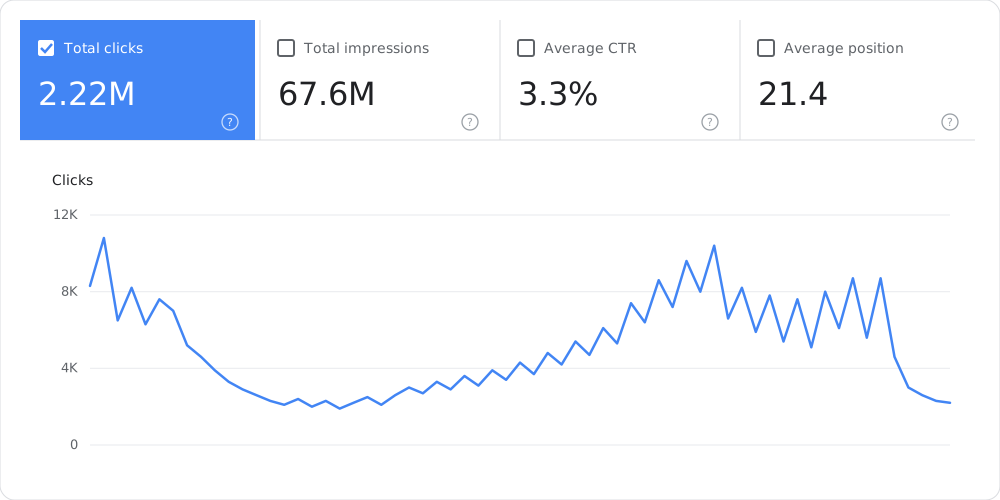
Not as a discrete event, no. Since March 2024 there has been no separate helpful content pass to be caught by, so a drop that lines up with a core update is the core systems assessing a site the way they now always do. The practical difference is timing. A standalone system ran periodically, which put a fixed and often painful gap between fixing a site and seeing anything move.
The scaled content abuse policy is the sharper instrument of the two and is covered separately. E-E-A-T, cited constantly and read rarely, is explained on its own page.
Signals folded into core ranking are applied as pages are reprocessed, which makes recovery a question about the pages rather than about the calendar. Pick the twenty worst pages on the site and write down an answer to Google's questions for each of them. The ones with nothing to say about originality are the pages to rewrite, merge or delete before anything else gets touched.
Frequently Asked Questions
No. Google announced the helpful content system in 2022 and folded it into its core ranking systems in March 2024, which its own helpful content FAQ states directly. There is no standalone update to track, no rollout window, and no separate recovery to wait for. The signals it introduced are now assessed continuously alongside everything else in core ranking.
Content strategist at TextPulse, here since the company started. Mark writes the product and technical coverage: how the humanizer works under the hood, what changes in each release, and what a specification actually means for your writing. His reviews of writing software come from using them on real documents rather than reading a feature list.