Originality.ai vs Turnitin vs Copyleaks
Three detectors, three buyers, three very different standards of published evidence. Turnitin arrives through a university's admin settings, Originality.ai is bought with a card on a credit plan, and Copyleaks reaches students through LMS integrations. What each one measures, and which one is likely to score your work.
Three names dominate the question of which AI detector actually matters: Originality AI vs Turnitin vs Copyleaks. Almost nobody buys two of them. One arrives through a university's admin settings without the writer choosing anything, one is bought with a card by an agency owner checking work someone else wrote, and the third arrives bundled into the learning management systems universities already run.
An AI detector is a classifier that scores text on how closely its statistical patterns resemble machine-generated writing. All three sell that same core function to a different buyer, which is why lining up three headline accuracy percentages produces a comparison that decides nothing. Who pays, what evidence sits behind each claim, and what the output actually shows: those three questions separate the products.
This sits alongside TextPulse's guide to AI humanizer tools, which covers the rewriting half of the same market. Here the subject is the detectors themselves, three products aimed at three buyers with three very different standards of published proof.
Originality AI vs Turnitin: Who Actually Buys Each One
Turnitin sells to institutions, and the writer being scored has no part in the purchase. The AI writing indicator only runs where an institution has switched the feature on: Turnitin's guides state that admins can enable or disable the AI writing feature from their admin settings page, and that disabling it removes the indicator and report from the Similarity Report. A university decides whether the tool touches your work, on which assignments, and whether the result ever reaches you. Turnitin does not sell to individuals, so there is no public per-seat price to quote.
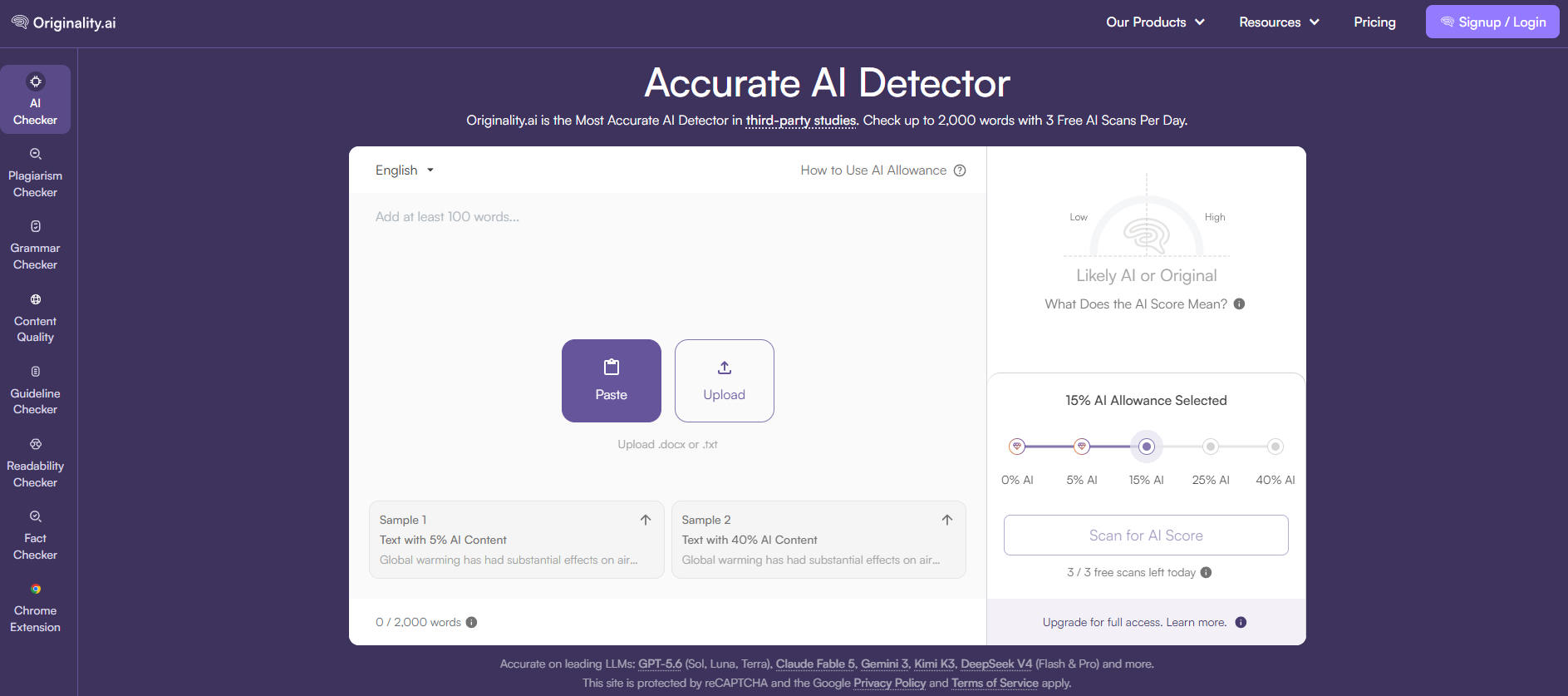
Originality.ai sells straight to individuals and businesses on a credit model, and publishes its numbers openly. Its pricing page lists Pro at $14.95 per month billed monthly, or $12.95 per month billed annually, carrying 2,000 credits a month, and Enterprise at $179 per month billed monthly, or $136.58 per month billed annually, carrying 15,000 credits. The site's own FAQ sets one credit at 100 words for an AI-only check, with an AI plus plagiarism check costing two credits per 100 words. Someone signs up, pays, and scans.
Those two distribution models create two different relationships with a score. A Turnitin percentage is generated about you, by a third party, on a schedule nobody consulted you on. An Originality.ai scan is generated by you, on text you chose, at a moment you chose, with the result on screen seconds later. Copyleaks is the third name people put in this comparison, and the section below explains why no figure for it appears here.
| Detector | Who buys it | What it publishes about accuracy | What you see |
|---|---|---|---|
| Turnitin | Institutions. An administrator enables the AI writing feature; the writer has no switch and no account. | Both figures carry a qualifier: "less than 1%" at document level for documents with 20% or more AI writing, and "around 4%" at sentence level. | Nothing by default. Turnitin states the AI indicator and report are not visible to students. |
| Originality.ai | Individuals and businesses, self-serve. Pro $14.95/month billed monthly or $12.95/month billed annually, 2,000 credits. | The tagline "The Most Accurate AI Detector." No percentage, dataset or method stated on the pricing page. | A scan you run yourself. 1 credit per 100 words for an AI-only check, 2 credits per 100 words with plagiarism. |
| Copyleaks | Individuals at $13.99 a month billed annually ($16.99 monthly), teams on a Pro tier at $74.99 a month, and institutions through LMS integrations | Advertises AI detection in more than 30 languages alongside plagiarism detection in more than 100; in the 2026 VUB study its median score on fully AI-generated papers stayed under 20% | A unified report covering AI detection and plagiarism, with highlighted sections and credits metered against scanned words |
What Each Detector Publishes About Its Own Accuracy
The three publish evidence of three different qualities, and none of it is independent. Turnitin gives the most specific figures. Its own blog states: "Our document false positive rate...is less than 1% for documents with 20% or more AI writing...Our sentence-level false positive rate is around 4%." Turnitin adds that 54% of the time, those false-positive sentences sit right next to actual AI writing, which is useful detail about where the errors cluster.
That two-tier figure is revised messaging rather than the original claim. At launch in April 2023 Turnitin published a single sub-1% false positive rate with no document or sentence split. After Inside Higher Ed reported higher-than-expected false positives on 1 June 2023, Turnitin's Chief Product Officer published the split version above, alongside two product changes: raising the minimum submission from 150 words to 300, and altering how leading and trailing sentences are scored. A number that moved once under public scrutiny deserves to be read with its history attached.
Turnitin publishes a rate; Originality.ai's pricing page carries a tagline without one. The former's pricing page claims that its product is "The Most Accurate AI Detector." It lists no percentage, no dataset and no measurement method. Can you fact-check an unquantified superlative? Can you compare it to Turnitin's four percent? With only published self-reported evidence to go on, Turnitin gives a buyer more to work with.
One independent study has stress-tested Originality.ai by name. Jabarian and Imas, in NBER working paper w34223, assembled 1,992 pre-2020 human texts and 1,992 AI texts across genres from four frontier models, then tested four detectors, Originality.ai and GPTZero among them, on short passages and on text already processed by humanizer tools. They reported that commercial detectors outperformed an open-source baseline, and that only one tool held a false positive rate at or below 0.5% while staying robust across humanizers. Which tool that was is not identified in the summary material checked here. The wider evidence on how accurate AI detectors actually are runs well past these three products.
Where Copyleaks Fits
Copyleaks sells AI and plagiarism detection as one product. Individuals pay $13.99 a month billed annually, or $16.99 billed monthly, for 1,200 unified credits covering up to 300,000 scanned words; a Pro tier at $74.99 a month adds 25 seats and larger volumes. It detects AI writing in more than 30 languages and plagiarism in more than 100, ships browser extensions and a Google Docs add-on, and reaches institutions through LMS integrations, which is why it appears in university pipelines as well as individual workflows.
The most useful independent reference point on its accuracy is the June 2026 Vrije Universiteit Brussel study in the International Journal for Educational Integrity: on fully AI-generated papers, Copyleaks' median score sat under 20 percent, well below what a confident flag requires, while genuine human papers were cleared reliably.
What can still be said applies to every detector, Copyleaks included. Every one of them reports back a score based on statistical facts about the final text, never a fact about how you wrote it. None have access to your drafts, your version history or your prompts. So what they report is all an inference about the final text itself. And every accuracy claim is a claim about how often that inference lands.
Humanize your own paper
Transform your AI-assisted text and make it sound human, without touching important words or citations.
What Each Report Actually Puts in Front of You
Turnitin returns a percentage inside the Similarity Report viewer, visible to instructors and administrators. The number is a share of qualifying text, which Turnitin defines as prose sentences in a long-form writing format. It is produced by splitting the document into overlapping segments of a few hundred words, scoring each sentence from 0 for human to 1 for AI, and averaging the segment scores across the document. Beside the percentage, the report highlights the segments the model predicted were AI generated.
Two further facts change how that number should be read. It is a separate report from the Similarity Score, and Turnitin states the two are different from and independent of each other, with AI writing highlights absent from the Similarity Report entirely. How the similarity score and the AI score differ decides which one an accusation is actually about. Students see neither the indicator nor its report by default, leaving an instructor's PDF download as the only route to the number.
Originality.ai returns its result to the person who ran the scan, immediately, and bills it. The credit arithmetic then shapes how the tool gets used: a 5,000-word article costs 50 credits as an AI-only check, or 100 credits with plagiarism included, so a 2,000-credit Pro month covers roughly 200,000 words of AI-only scanning. Volume like that belongs to somebody checking other people's writing rather than to a student with one essay due on Friday.
Which One Is Likely to Read Your Work
For a student, Turnitin is the one that matters, and usually the only one. It reaches your file through the submission portal your institution already runs, without you selecting it, agreeing to it separately or seeing what it returns. Coverage varies, since the feature has to be enabled: Vanderbilt University disabled the AI detector in August 2023, and the University of Texas at Austin's provost's office states that the university does not endorse the use of AI detection software and holds no central contracts for it.
Originality.ai is the one that matters for commissioned and freelance writing. A content agency checking a writer's deliverable, a publisher screening submissions and an in-house team auditing a site all fit the credit model, because all three are checking volume they did not write. Nothing in its published plan structure describes an institutional submission workflow of the kind Turnitin runs, which is why a student essay rarely meets it.
None of this makes a case for running your own essay through a paid detector before you submit. A score from one product does not predict another product's score, since each model was trained on different data and calibrated to a different threshold, and the number you would be buying is not the number anyone will read. The useful checks are about the writing itself. A readability checker tells you whether your sentences sit at the register your marker expects, which is a question no detector answers and every rubric does.
On the tooling side, the best AI humanizer for academic writing is assessed separately, as is the strongest option for ESL writers.
Where a detector score does land on you, the next question is what your institution actually permits, since a percentage means nothing without the rule it is being measured against. TextPulse's AI use policy page sets out where disclosure sits in that chain. Run the comparison that decides your outcome: what your own reader has been told to look for, against what your draft currently gives them.
What Our Own Research Found
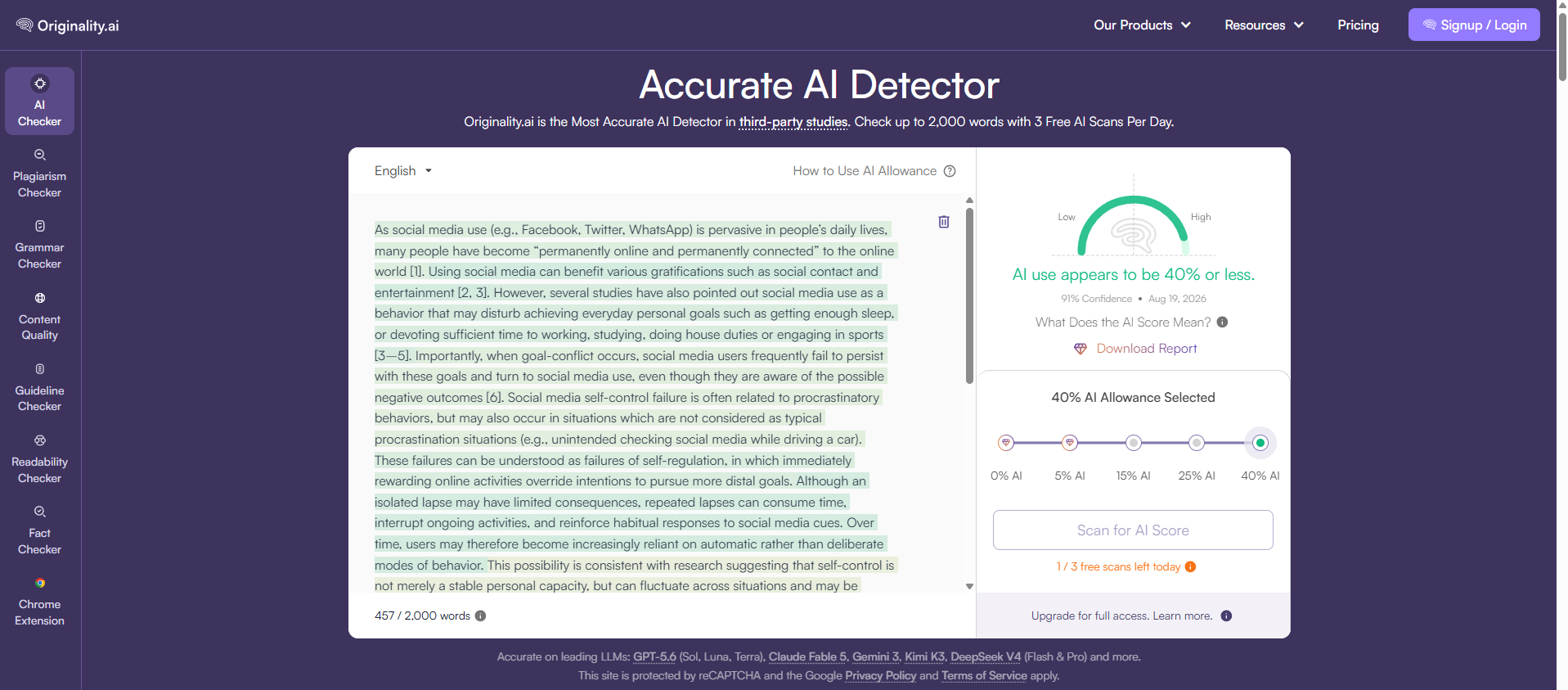
In the TextPulse Research detector agreement study, nine commercial AI detectors rated the same 90 academic texts. One was a 455-word hybrid text: a human-written opening and closing around a 168-word AI-generated middle. Originality.ai scored this text 0% AI, while verdicts from the other tools on the same words ranged from 0% to 95.7% AI. The full paper, corpus, and per-tool score matrix are open access at TextPulse Research.
Frequently Asked Questions
Neither vendor publishes evidence that settles it. A comparison of Originality AI vs Turnitin runs into two different standards of proof: Turnitin states a document-level false positive rate of less than 1% for documents scored above 20% AI and a sentence-level rate of around 4%, while Originality.ai's pricing page calls itself the most accurate AI detector without giving any figure at all.
Content strategist at TextPulse, here since the company started. Mark writes the product and technical coverage: how the humanizer works under the hood, what changes in each release, and what a specification actually means for your writing. His reviews of writing software come from using them on real documents rather than reading a feature list.