Best AI Humanizer for Academic Writing: Every Tool Compared (2026)
Universities allow AI assistance when you disclose it. The problem is that AI prose reads as generic and uniform, and university-grade detectors score it accordingly. This guide compares every major AI humanizer on how it rewrites, who it is built for, what it costs, and whether an academic draft survives the pass.
Using AI to help write a paper is no longer the problem. Hiding it is, and so is submitting prose that still reads like a language model wrote it. This guide compares every major AI humanizer on the same terms: how the rewrite engine actually works, who the tool is built for, what it costs in real numbers, and whether a citation-heavy academic draft comes through the pass intact.
At a Glance: How the Humanizers Rated
Every tool in this guide was run on the same 30 academic research snippets and rated out of five on seven measures: Turnitin AI score, grammar, citation handling, key term preservation, academic tone, dashboard experience and multilingual support. TextPulse finished highest overall at 4.71, ahead of WriteHybrid at 3.79 and Undetectable AI at 3.71.
No tool won every measure, and the exceptions are the useful part. Undetectable AI returned the lowest Turnitin AI scores of the whole set, half a point clear of TextPulse, and four tools tied at the top for academic tone. The ranking is decided further down the table, on whether a rewrite survives contact with a reference list. Citation handling and key term preservation are where most of this field falls away.
| # | Humanizer | Overall | Rating | Strongest measure |
|---|---|---|---|---|
| 1 | TextPulse | 4.71 | ★★★★½ | Citations, tone, dashboard and languages, all 5.0 |
| 2 | WriteHybrid | 3.79 | ★★★½☆ | Citation handling 4.5, second only to TextPulse |
| 3 | Undetectable AI | 3.71 | ★★★½☆ | Turnitin AI score 4.5, the best result in the set |
| 4 | JustDone | 3.64 | ★★★½☆ | Key term preservation and tone, both 4.0 |
| 5= | WriteHuman | 3.57 | ★★★½☆ | Academic tone 4.0 with a workable dashboard |
| 5= | HumanizerAI Pro | 3.57 | ★★★½☆ | Turnitin AI score 4.0 from a free tool |
What Universities Actually Allow
The rule at most institutions is disclosure, not prohibition. Oxford's guidance on using AI in study tells students that generative AI can support learning and that the requirement is transparency about how it was used, with unacknowledged use treated as the breach. Publishers converged on the same position. Elsevier's policy permits generative AI to improve readability and language, and asks authors to declare it in the manuscript. Nature's editorial policy does the same while ruling out AI as a listed author, and COPE's position on AI tools makes the reasoning explicit: a tool cannot accept responsibility for the work, so a human author must, and must say what the tool did.
Citing the tool is a solved problem too. APA publishes a format for citing ChatGPT, treating the model as software with a version and a date. Our guides to citing ChatGPT in a paper and writing an AI disclosure statement cover the wording departments expect.
So the honest workflow is available: draft with AI assistance, disclose it, cite it where required. What none of those policies do is excuse prose that reads badly, and that is where the second problem starts.
Why AI Text Needs Humanizing
Raw model output has a recognizable texture. Sentences arrive at a uniform length. Paragraphs open with the same flat connectives, moreover and furthermore and in addition. Hedges stack where a researcher would commit. Intensifiers like plays a crucial role appear regardless of subject, and sections close with a formulaic summary that adds nothing. A marker reads that and hears a machine, whatever the disclosure statement says. Our catalogue of the words and phrases that give AI writing away lists the specific tells.
The second problem is measurement. Universities now run university-grade detectors over submissions, and the four that matter in academic contexts are Turnitin, GPTZero, Originality.ai and Pangram. They do not search for a phrase list. They score how predictable the text is: how confidently a language model would have guessed each next word, and how little the sentence lengths vary across a passage. Generated prose scores as highly predictable because a model chose the likeliest word at every step. Turnitin's documentation adds a further category for text that was revised by an AI paraphrase tool, so a light word swap can move a draft from one flagged bucket into another rather than out of both. The mechanics are worked through in how AI detectors work.
An academic humanizer exists to solve both problems in one pass: make the prose read like a person wrote it, and move its statistical profile toward the range human academic writing occupies.
How AI Humanizers Work
Every tool in this guide does some version of the same three things, and the differences between them are differences of degree and discipline.
The first is varying sentence structure. The engine breaks the uniform rhythm by splitting some sentences, joining others, and moving clauses so that length and shape vary the way they do in writing produced over days rather than seconds. This is the change that moves a detector score most, because sentence-length variance is one of the properties being measured.
The second is replacing model-typical vocabulary. Words a language model over-selects get swapped for the ones a writer in that field would reach for, which lowers predictability word by word. Done crudely this is just synonym substitution, and it is how a rewrite ends up saying something slightly different from what you meant.
The third is adjusting register. The output is aimed at a target reader, and this is where general tools and academic tools separate hardest. A general humanizer aims for conversational, because sounding human is usually taken to mean sounding casual. Academic prose is formal, hedged in specific ways, and dense with defined terminology, so a conversational rewrite of a methods section reads wrong to an examiner even when it reads well to anyone else.
What none of them can promise is an outcome on a specific document, because the detectors keep changing and each institution runs its own version on its own day. What a vendor can do is publish measured results and describe exactly what its engine protects, which is the standard the sections below apply.
What Separates One Humanizer From Another
Four things decide whether a tool suits academic work, and every section below reports them.
- Citation handling. Whether in-text citations and reference entries survive the rewrite verbatim. A tool with no citation rule treats an author surname and a page number as ordinary rewritable words, and a fluent edit that moves either one breaks a reference a marker checks against the list.
- Terminology control. Whether you can lock exact vocabulary before the pass. Randomly assigned quietly becoming randomly distributed is a different claim about your method, and a validated instrument name has one correct form.
- Register target. Whether the output aims at academic prose or at general readability. Rewriting to sound more human usually means rewriting to sound more conversational, which is right for a newsletter and wrong for a thesis chapter.
- Published evidence. Whether the vendor publishes a measured result with a named corpus and named detectors, or an unquantified claim. A vendor stating a percentage without naming the test behind it has committed to nothing.
Humanize your own paper
Transform your AI-assisted text and make it sound human, without touching important words or citations.
AI Humanizers Compared
| Tool | What it is built around | Free tier | Paid entry | Best suited to |
|---|---|---|---|---|
| TextPulse | Academic rewriting with citations, terminology and register protected | A free demo humanization | On the TextPulse pricing page | Theses, manuscripts, coursework |
| Undetectable AI | Monthly word pools with a money-back guarantee on flagged output | Limited one-time trial | $9.99/mo for 10,000 words, about half billed annually | General content at volume |
| QuillBot Humanizer | A humanizer feature inside a paraphrase and grammar suite | Short runs, capped daily | Premium $4.17/mo billed annually | Existing QuillBot subscribers |
| Grammarly Humanizer | A tone and voice agent with preset styles and a custom voice | Yes, with an account | Pro $12/mo | Business and everyday writing |
| WriteHuman | Request-metered rewrites returning several variations | Limited trial use | Basic $12/mo annually, 80 requests at 600 words | Short-form general writing |
| Walter Writes AI | Multilingual humanization across a broad tool suite | 300 words on registration | Starter $8/mo annually, 30,000 words | Multilingual general content |
| HIX Bypass | Detector-by-detector bypass inside the HIX.AI suite | Limited trial | $14.99/mo, or $9.99 billed yearly | Short-form content with a target detector |
| StealthGPT | One-click bypass with self-reported rates and a refund | Trial only | Pro, Samurai and Enterprise tiers | SEO and copywriting at volume |
| Phrasly | Stealth writing plus a document editor | 550 words, no card | Monthly and annual plans | General student and marketing drafts |
| Humbot | One-click bypass on fixed monthly word allowances | 300 words, one time | Basic $7.99/mo for 3,000 words | Light, occasional use |
| BypassGPT | Bypass metered by daily runs and words per request | 1,000 words per request, 10 runs a day | Starter $19/mo, or $9 billed annually | Frequent short passes |
| GPTinf | Bypass tool on a re-run credit model | 240 words, one time | $4.99/mo entry tier | Budget occasional use |
| Ryne AI | A student platform metering every tool in shared coins | 100 coins, 250 words per run | Sapphire $19.99/mo billed annually | Students wanting one bundled account |
| StealthWriter | Sentence-level rewriting with alternatives to choose between | 10 humanizations a day, 1,000-word inputs | Starter $20/mo | Writers who want manual control |
| Netus AI | A credit pool shared across a content marketing suite | 50 credits, 500 words a month | Basic $14/mo for 15,000 words | Content marketers |
| Rephrasy | Tiered plans with custom styles and a lifetime option | Quick Pass $12.99 for 24 hours | Growth $8.25/mo billed annually | Students on a fixed budget |
| Grubby AI | Straightforward monthly word allowances | 300 words per input | Essential $12.99/mo for 10,000 words | Light general rewriting |
| JustDone | Humanizing inside a 35-tool writing platform | A few short scans | $19.99/mo, or $9.99 billed annually | Writers wanting one subscription |
| Smodin | Rewriting inside a student suite with citations and essays | Limited daily use | From $5/mo | Students already using Smodin |
| WriteHybrid | Word-pool plans scaling to team and API access | 500 words a month, no card | Starter $19/mo for 20,000 words | Teams producing content |
| HumanizerAI Pro | A free browser tool with no paid tier | Free, unlimited processing | No paid plan | One-off casual rewrites |
How These Ratings Were Tested
Every tool received identical input: 30 academic research snippets generated with Claude from one plain prompt asking for a research snippet, so no tool was handed text that happened to suit it. The snippets carry what academic writing actually contains, in-text citations, defined terminology and numeric claims. Each tool ran on its default settings with an academic mode selected where one exists, one pass per snippet, with no second attempt kept in place of a worse first one.
Seven measures, each rated out of five:
- Turnitin AI score. The AI writing percentage Turnitin returned on the humanized output. More stars means a lower score.
- Grammar. Errors the rewrite introduced, measured with LanguageTool against the original snippet.
- Citation handling. Whether in-text citations and reference entries came through with author names, years and formatting intact.
- Key term preservation. Whether defined terminology, instrument names and technical phrases survived rather than being swapped for a loose synonym.
- Academic tone. Whether the output held scholarly register or drifted toward conversational phrasing.
- Dashboard experience. How the interface holds up on a long document: input caps, mode controls, whether changes are visible, and how much reconciling is left to the writer.
- Multilingual support. Depth of handling in non-English academic prose, rather than the number of languages advertised.
Overall is the mean of the seven. A rating card sits under each tool below, and the complete table follows the last one.
The Best AI Humanizers for Academic Writing
TextPulse
TextPulse is an academic AI humanizer, and the narrowness is the point: it was built for documents that carry a reference list. The engine was trained on peer-reviewed human writing rather than general web text, so its target register is academic prose at the Flesch-Kincaid grade 13 to 18 band examiners expect, not the conversational voice general tools drift toward.
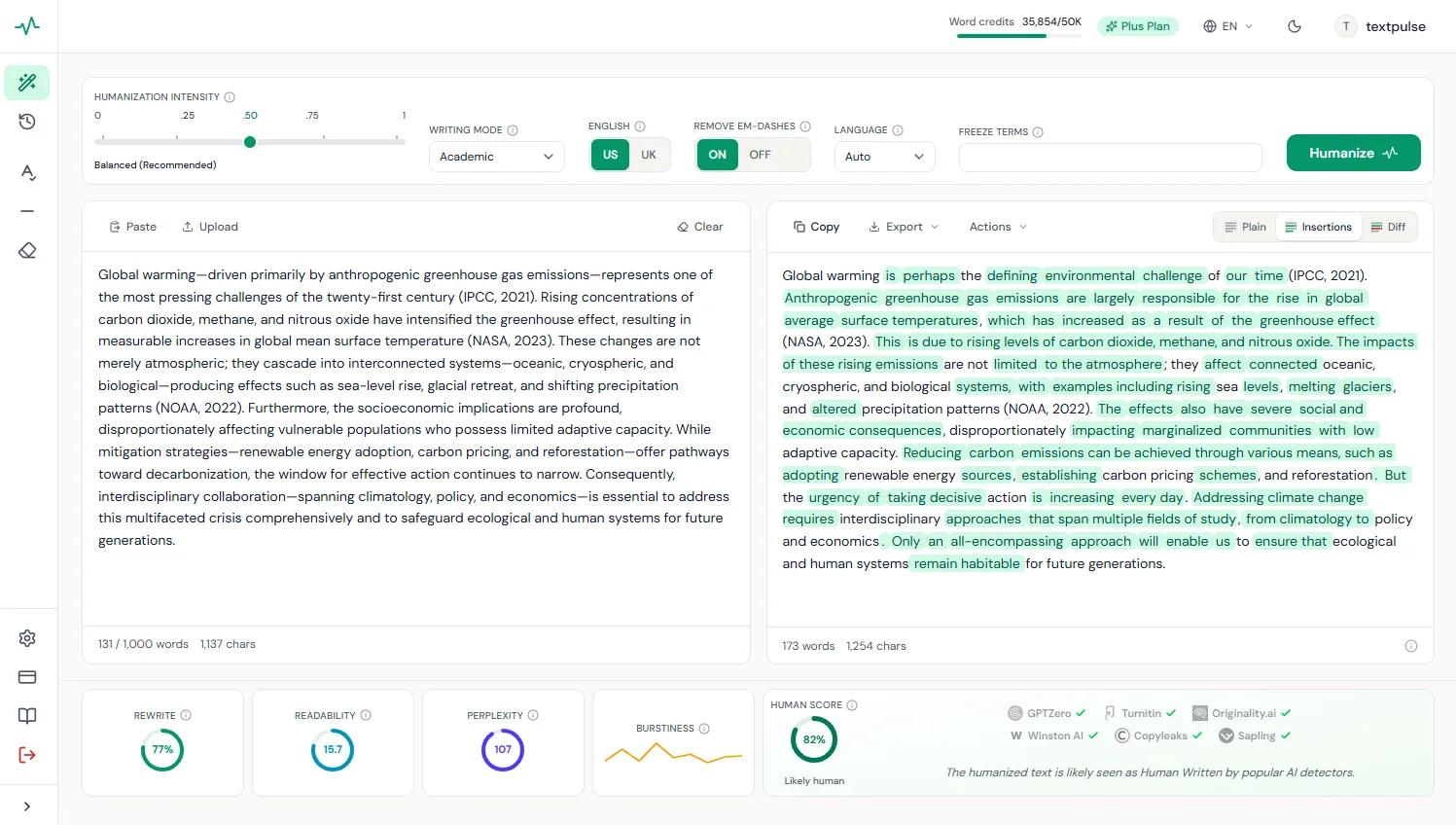
Three protections run through every pass. In-text citations and reference entries survive verbatim across APA, MLA, IEEE, Chicago, Harvard and Vancouver, in parenthetical and narrative forms alike. Freeze terms let you lock any construct, instrument name or technical phrase before the rewrite starts. Statistics, effect sizes and chemical formulas are preserved automatically, so a p value or a confidence interval cannot drift. Documents process whole rather than in fragments, which matters because seams between passes are where terminology and tense start disagreeing with themselves.
On evidence, TextPulse publishes a measured benchmark on a 2,000-document academic corpus: humanized output passed Turnitin AI 92.33% of the time, Originality.ai 89.12% and GPTZero 87.91%. Those are the vendor's own figures and are labeled as such. Every pass also reports an estimated Human Score computed from your text rather than a verdict borrowed from a detector. Used by postgraduate researchers, thesis writers and authors preparing journal submissions.
Undetectable AI
Undetectable AI is one of the largest names in general humanization, and it sells by volume. Plans are monthly word pools: 10,000 words at $9.99, 20,000 at $19, 35,000 at $31 and 50,000 at $42.50, each roughly half price billed annually, with larger tiers, an API and white-labelling above that. Every plan carries the same features, including unlimited detection checks and a human auto-typer that types text into a window keystroke by keystroke.
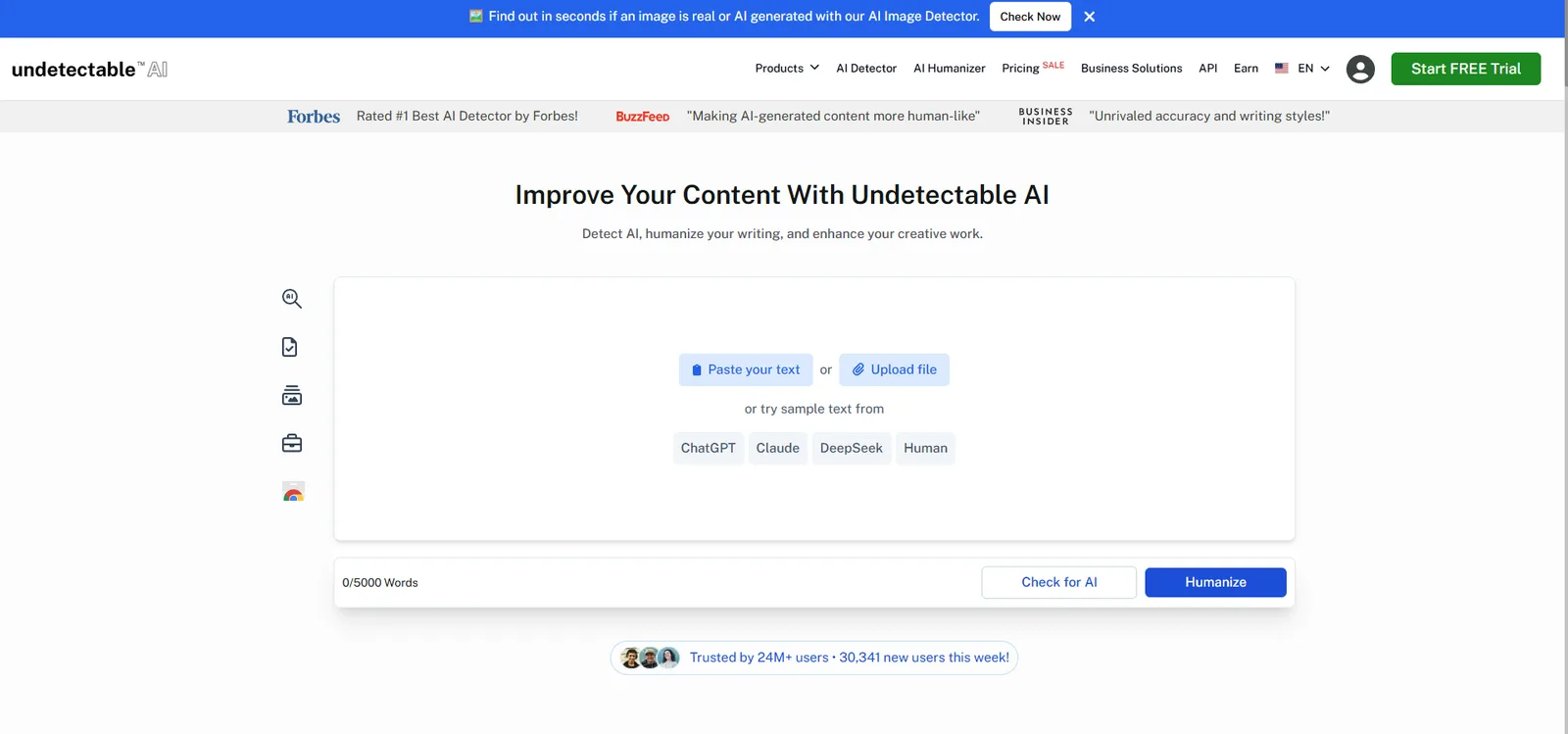
Its headline commitment is commercial rather than measured: if output it produced is flagged as not human, it refunds the cost of that humanization. Passing detectors is listed as a product feature with no percentage or corpus attached. For academic use the gap is what the feature list does not name: no referencing style, no terminology lock, and writing-level matching rather than a held academic register. Used mainly by content teams and agencies producing at scale. The Undetectable AI review covers the pricing tiers and where the academic gap sits.
QuillBot Humanizer
QuillBot's Humanizer is a feature inside QuillBot Premium, which is listed at $4.17 a month billed annually and bundles a paraphraser, grammar checker, plagiarism checker, summarizer and QuillBot's own AI detector. QuillBot says the suite serves more than 35 million writers, and the breadth genuinely is the product.
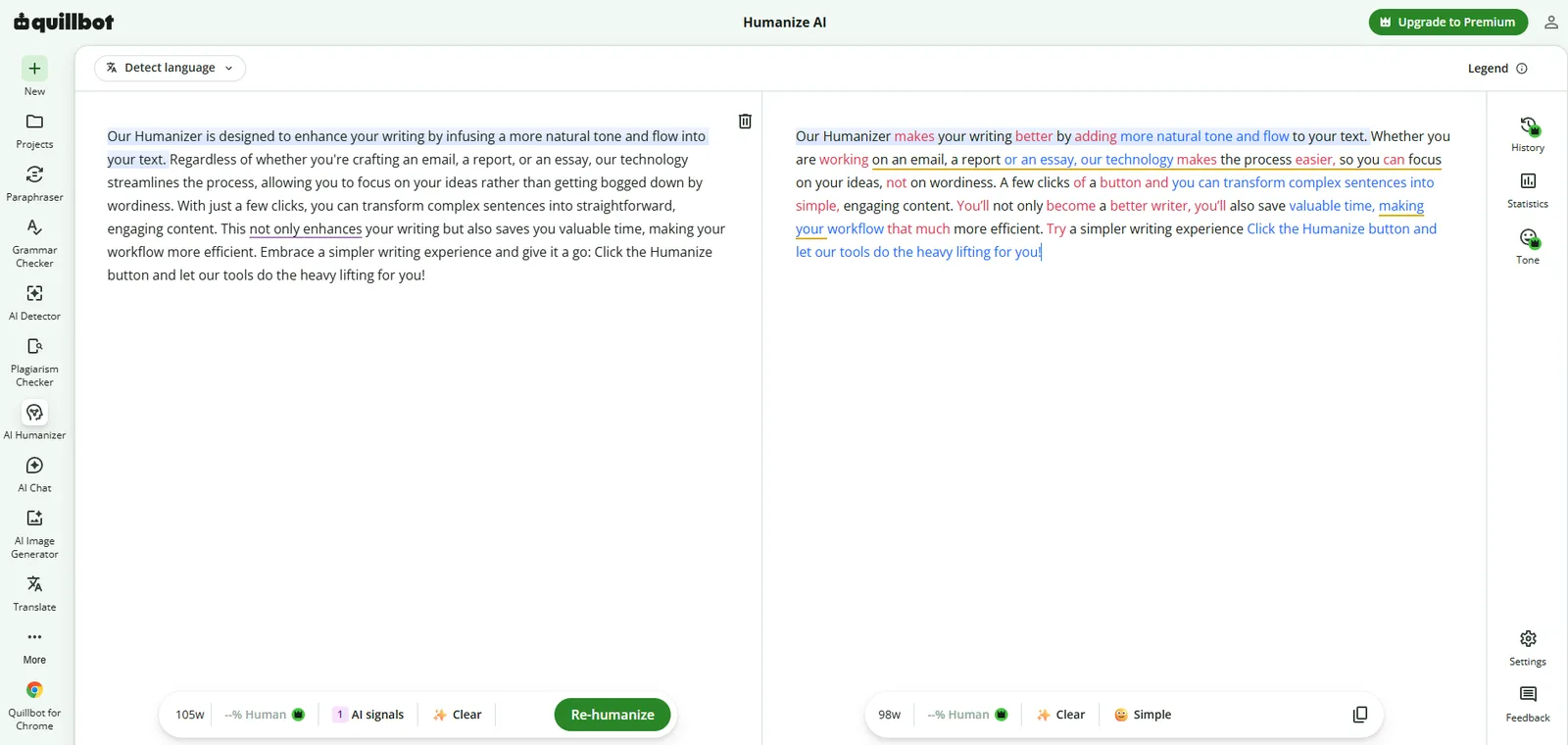
The Humanizer shares its engine lineage with the paraphraser, which is QuillBot's core technology: swapping vocabulary and restructuring sentences while holding meaning. That matters for detection, because changing which words appear is not the same as changing how predictable the text is. Pangram, whose classifier performed best in the 2026 Vrije Universiteit Brussel study, ran humanizer output through its detector and recorded full detection of QuillBot's. Turnitin's AI-paraphrased category is aimed at exactly this mechanism. Used by students who already subscribe for the paraphraser. Our full QuillBot Humanizer review goes deeper.
Grammarly Humanizer
Grammarly's Humanizer is an agent inside its writing suite, described by Grammarly as built by linguists, with four preset styles, a custom voice trained on a sample of your own writing, and support for six languages: English, Spanish, French, German, Portuguese and Italian. It starts free with an account, with Grammarly Pro at $12 a month.
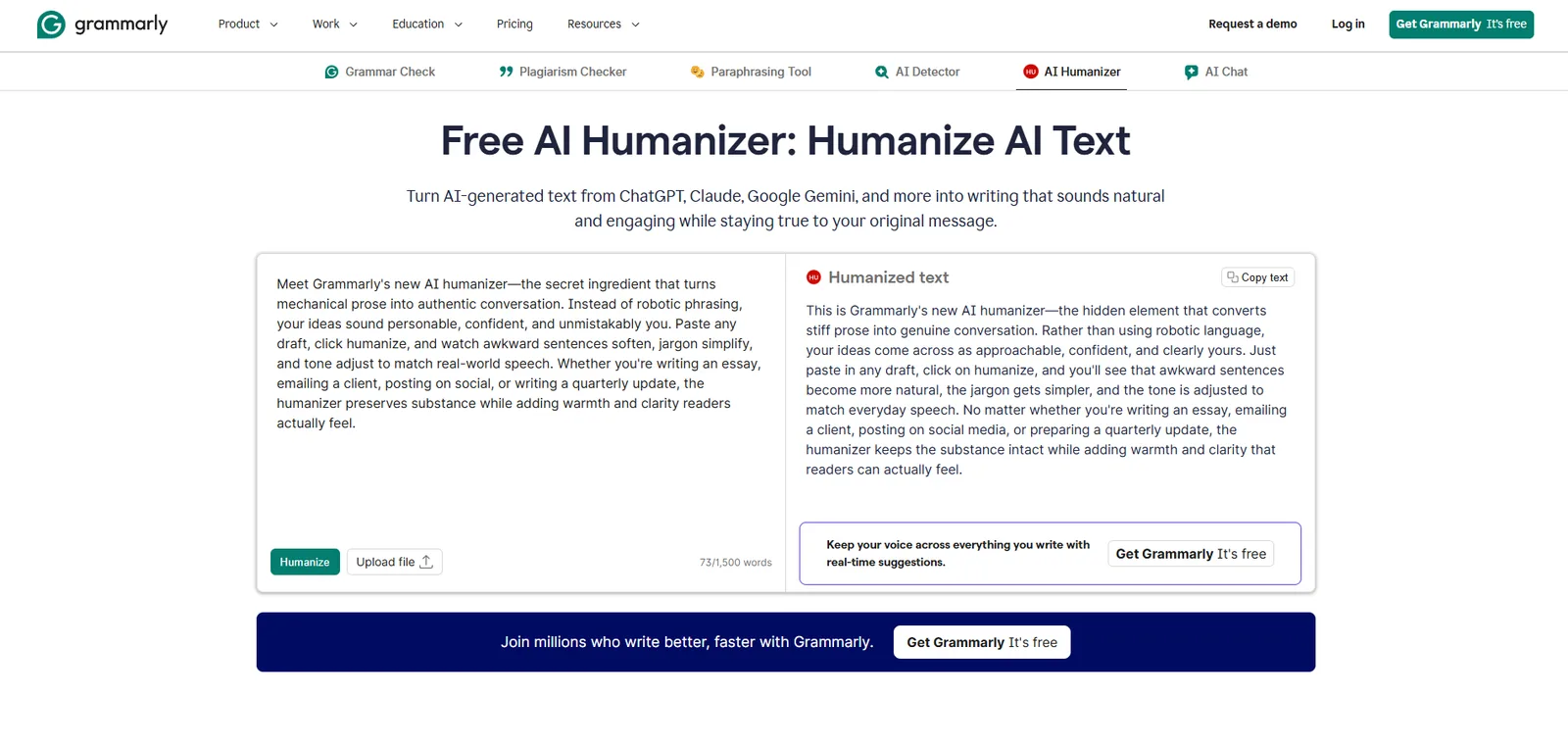
Read its own pages and the purpose is tone and voice for general writing, email, marketing copy, support messages and essays, and the surrounding features are transparency tools: Authorship logs whether text was typed, AI generated, Grammarly edited or copied, and the AI detector flags passages before a reviewer does. That is a coherent product for disclosure, not for detection. It states no detector pass rates and names no citation or terminology handling, and because its rewriting is AI powered it tends to introduce model-typical vocabulary such as thereby and underscoring. Used by business writers and students polishing everyday prose. See TextPulse vs Grammarly for the head to head.
WriteHuman
WriteHuman calls itself the premium AI humanizer for serious writing. Plans meter two ways at once, requests per month and words per request: Basic at $12 a month billed annually gives 80 requests at up to 600 words, Pro at $18 gives 200 requests at up to 1,200 words, and Ultra at $36 gives unlimited requests at up to 3,000 words. Paid tiers return two to five rewrite variations per input, and the suite includes an AI detector, an image detector, a Chrome extension, a REST API and support for more than 40 languages.
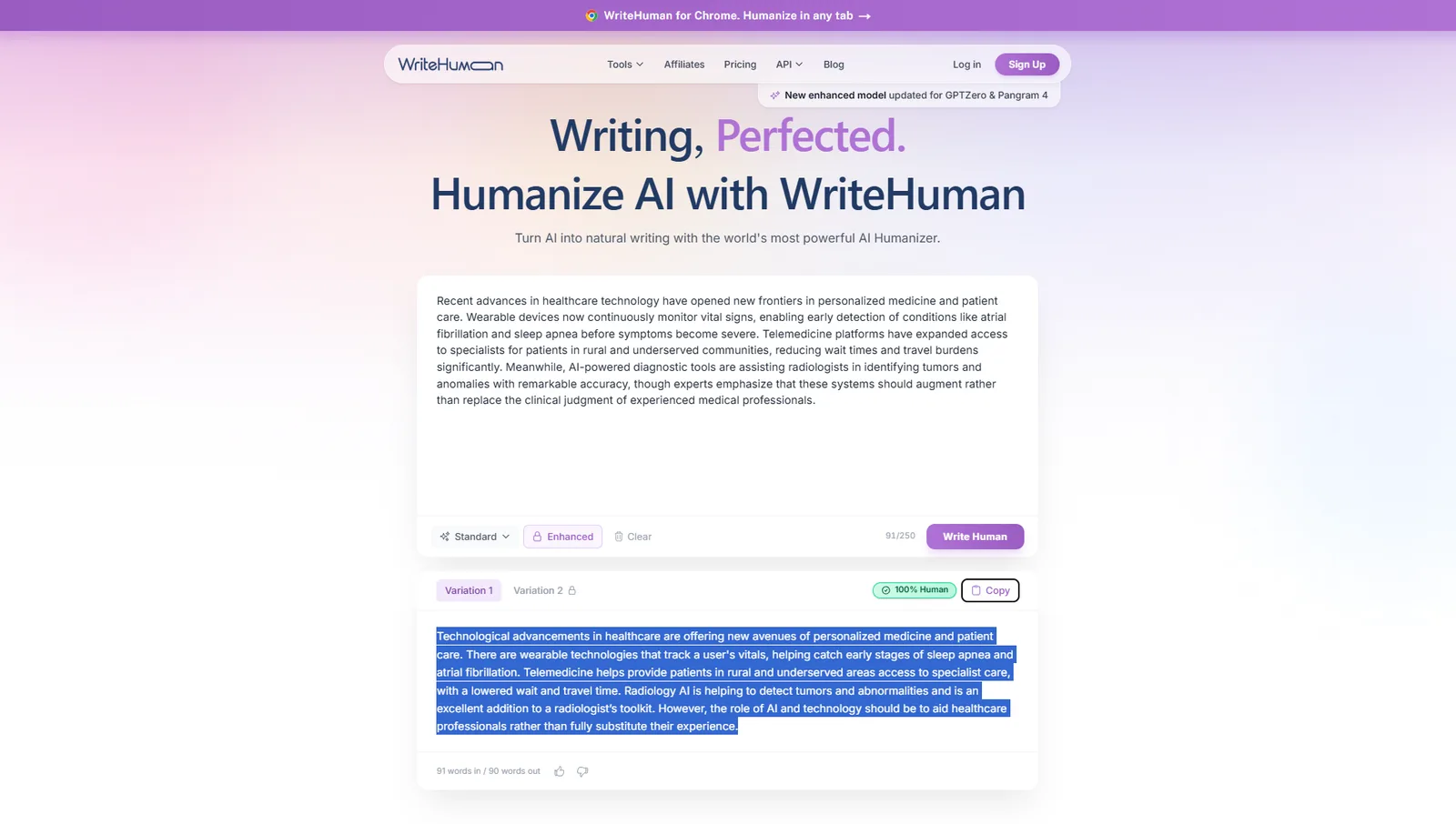
It is candid about limits, telling users the rewriter does not create new ideas and that results should be reread and fact checked like any first draft. Its marketing rests on a first-place ranking on a Humanizer Leaderboard that cites no methodology, and no numeric accuracy figure is attached. For academic work the binding constraint is the per-request cap, which splits a chapter into fragments you then reconcile yourself. Used by bloggers and short-form writers. The WriteHuman review works through the per-request caps on a chapter-length draft.
Walter Writes AI
Walter Writes AI is a broad humanization suite whose strongest card is language reach, advertising more than 80 languages alongside an AI detector, a paraphraser, a grammar checker, a resume rewriter, mobile apps, a Chrome extension and a developer API. Pricing billed annually runs Starter at $8 a month for 30,000 words with a 750-word cap per request, Pro at $13 for 70,000 words at 1,500 words per request, Elite at $26 for 200,000 words at 2,000 words per request, and Teams at $99 for 500,000 words with ten seats.
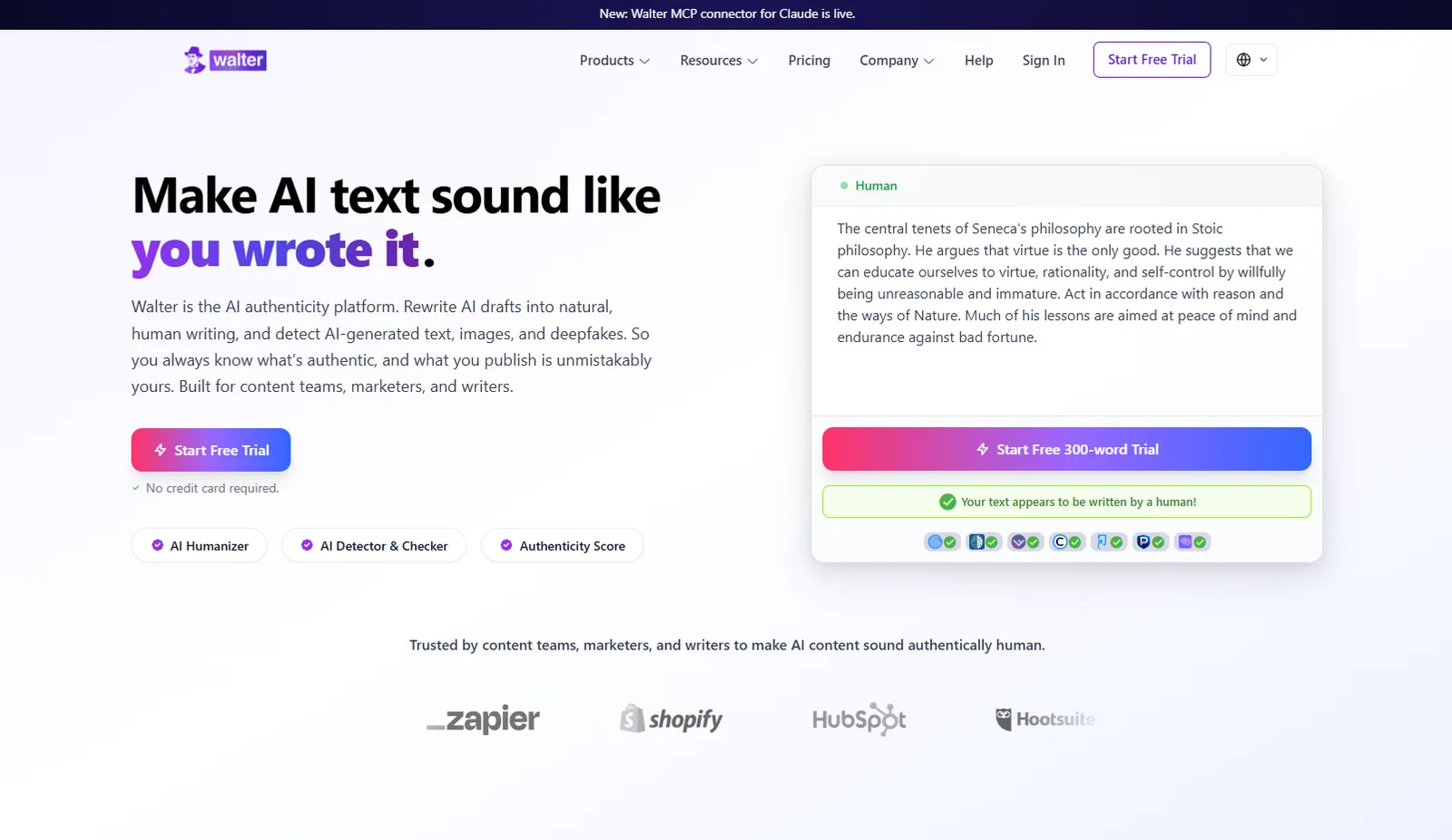
For academic use the per-request cap matters more than the monthly pool, since even the top tiers stop at 2,000 words and a dissertation chapter goes through in pieces. Breadth advertised as a language count also says nothing about depth in any one language: holding scholarly register and citation conventions in German or Spanish is a different job from producing fluent sentences. Used by multilingual content producers. The Walter Writes AI review takes apart what a language count does and does not tell you.
HIX Bypass
HIX Bypass is the bypass module of the wider HIX.AI family, and its marketing is organised detector by detector, with dedicated pages naming Sapling, Content at Scale, GPTZero, ZeroGPT, Copyleaks, Winston AI and Turnitin. It ships three rewrite modes, Fast, Aggressive and Latest, a bundled detector, and support for more than 50 languages. The Standard plan is $14.99 a month, or $9.99 billed yearly, covering 5,000 humanizer words a month with a 3,000-word input limit, and an Unlimited plan removes the caps at $59.99 a month.
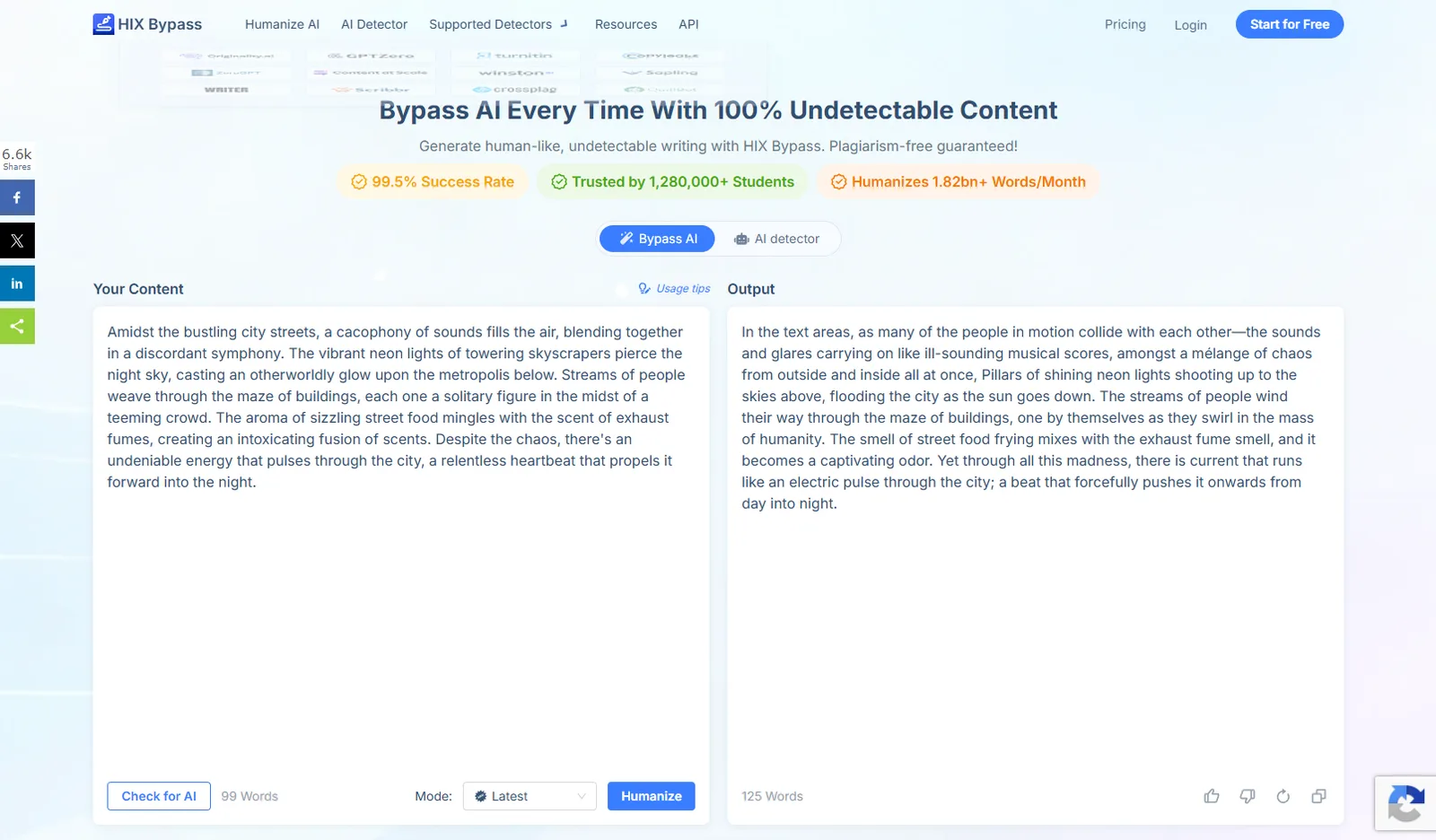
Optimising against named detectors is a moving target, because every detector vendor retrains. A tool organised around documents rather than scores ages better. One practical warning: HIX Bypass and BypassGPT are separate products on separate domains and listicles conflate them constantly, so confirm which one a figure describes. Used by short-form content writers with a specific detector in mind. The HIX Bypass review explains why optimising detector by detector ages badly.
StealthGPT
StealthGPT is a stealth writing tool aimed at students, SEO writers and professional copywriters, sold across tiers named Pro, Samurai and Enterprise. It is one of the few vendors to publish figures with a stated sample: 98% human average on Turnitin and 95% on GPTZero, each from a run of 30 samples with zero detections, backed by a money-back guarantee if a subscriber is detected. Enterprise plans handle up to 20,000 words in a single humanization run, a large one-pass ceiling for the category.
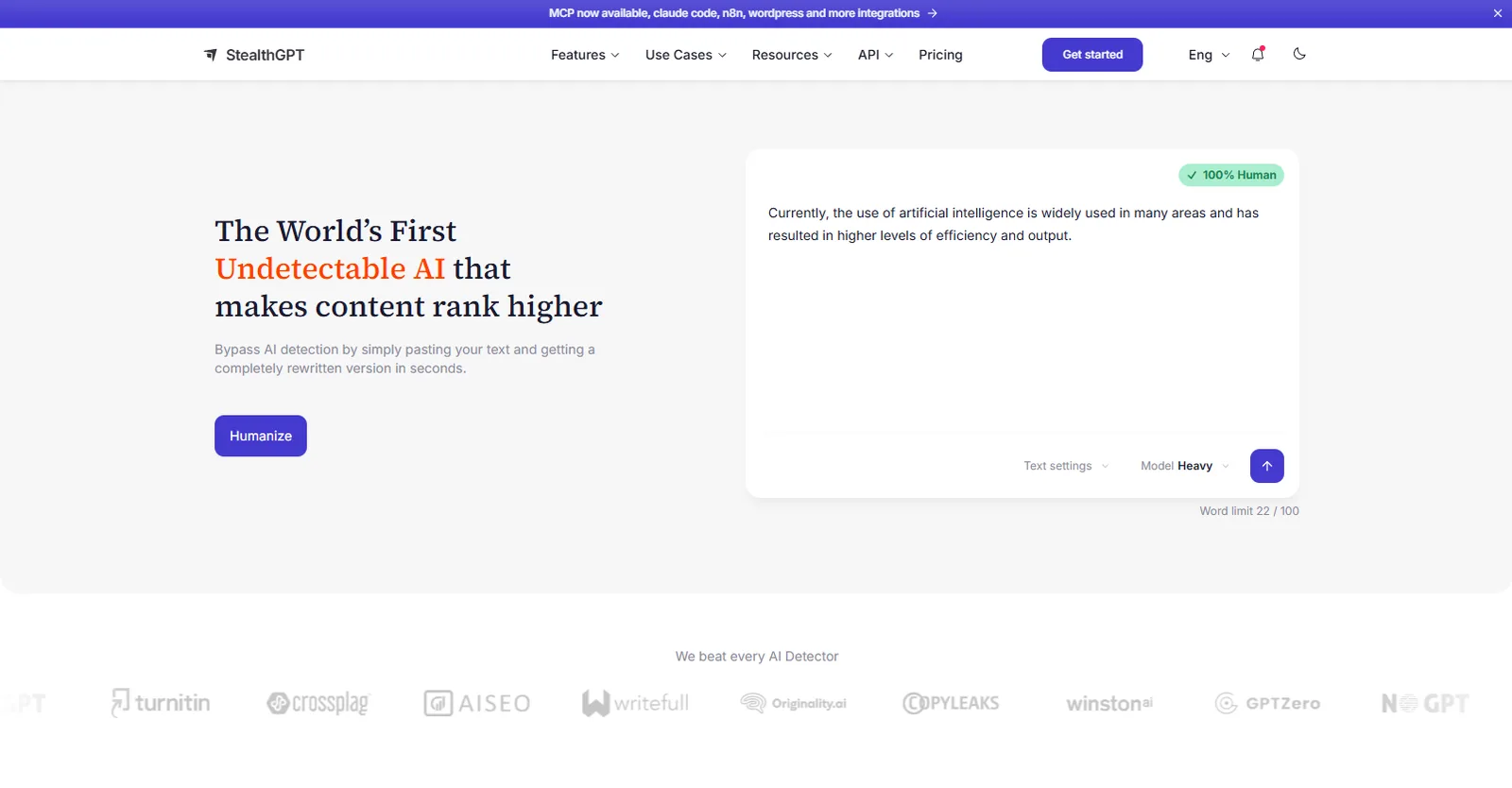
Publishing a sample count is more than most of this market does, and the limits sit on the same page: 30 documents is a small run for a claim about classifiers scoring millions of submissions, and no dataset or method accompanies the figures. Nothing in its materials describes citation handling or terminology locking, which fits its stated audience. Used by volume content producers. The StealthGPT review weighs its published figures against the sample they came from.
Phrasly
Phrasly positions itself as an AI stealth writer and detection remover, claiming more than three million users, and has grown beyond the humanizer into Phrasly Pages, a document editor that generates and develops full drafts, plus a paraphraser and an API. The free tier allows 550 words without a card, with monthly and annual plans above it, and the company says its models are trained on real human data rather than synthetic text.
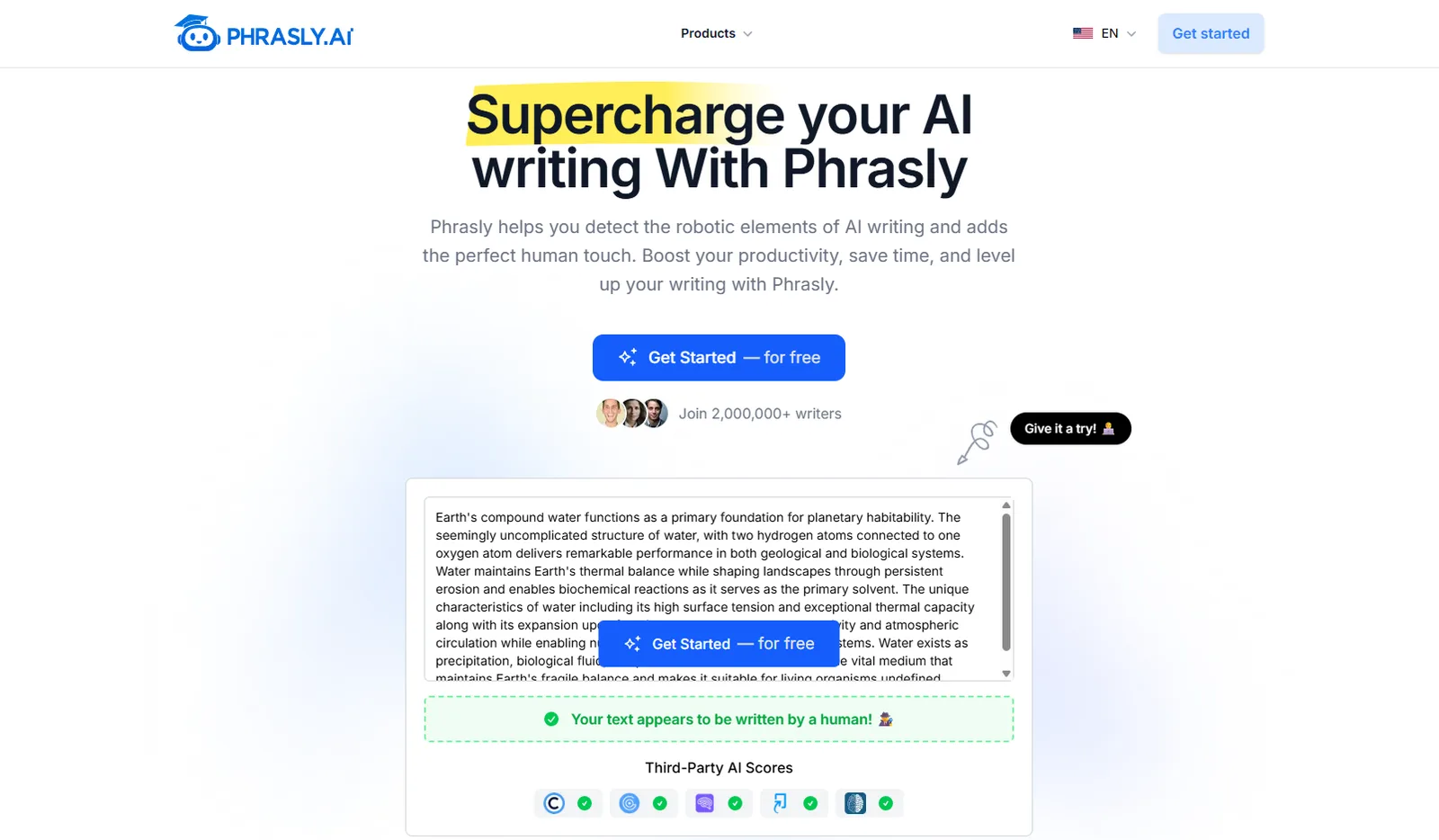
Its marketing carries one of the boldest claims in the category, that it is the only humanizer to fully bypass Anthropic's AI watermark, published without a dataset or method. That claim deserves scepticism on mechanism alone: Claude's watermark is a statistical bias in token selection rather than hidden characters, so removing it means genuinely changing the text's statistical profile, which is the same job as beating any modern detector. Its pages describe adjustable rewrite strength rather than citation or terminology handling. Used by general student and marketing writers. The Phrasly review examines the watermark claim on mechanism.
Humbot
Humbot is a straightforward one-click bypass tool on fixed monthly allowances: a free trial covering 300 words once, Basic at $7.99 a month for 3,000 words, Pro at $9.99 for 30,000 words, and Unlimited at $39.99. The jump from Basic to Pro is the one worth noticing, since ten times the words costs two dollars more.
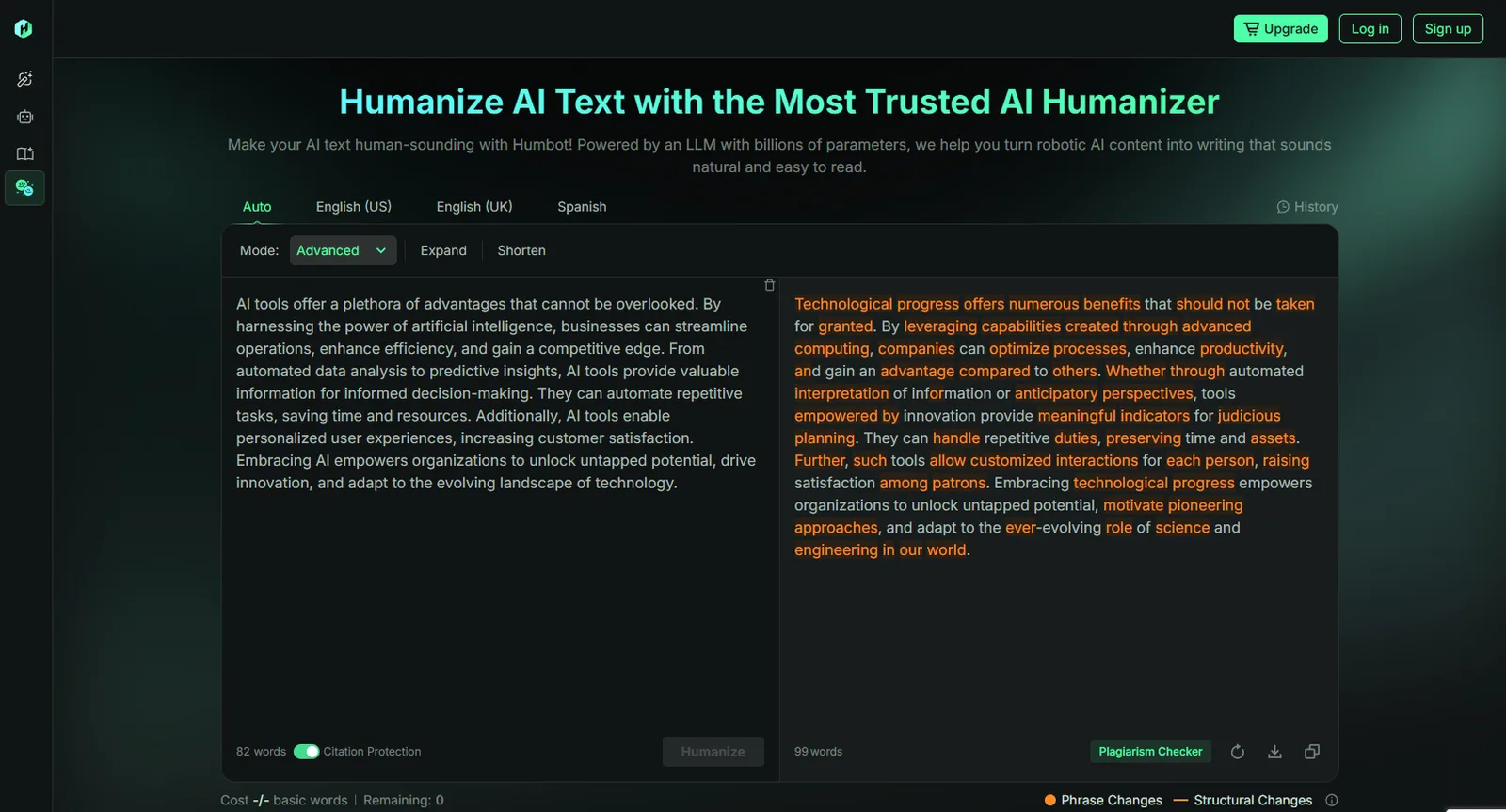
Reddit testing compilations circulated in 2026 put its success rate around 71%, below Undetectable AI and ahead of BypassGPT, and the common criticism of tools in this band is that they behave more like paraphrasers than humanizers, changing surface vocabulary without moving the deeper statistical patterns detectors measure. It names no citation or terminology handling. Used for light, occasional rewriting. The Humbot review covers its citation protection toggle and what it does not cover.
BypassGPT
BypassGPT meters by daily runs and words per request rather than a monthly pool. The free tier allows 1,000 words per request across 10 humanizations a day, Starter is $19 a month or $9 billed annually with 10,000 words per request and 50 daily runs, and Pro at $39 raises that to 150 daily runs. It also publishes a large library of reviews of rival humanizers, which is worth knowing when you meet one of those reviews in search results.
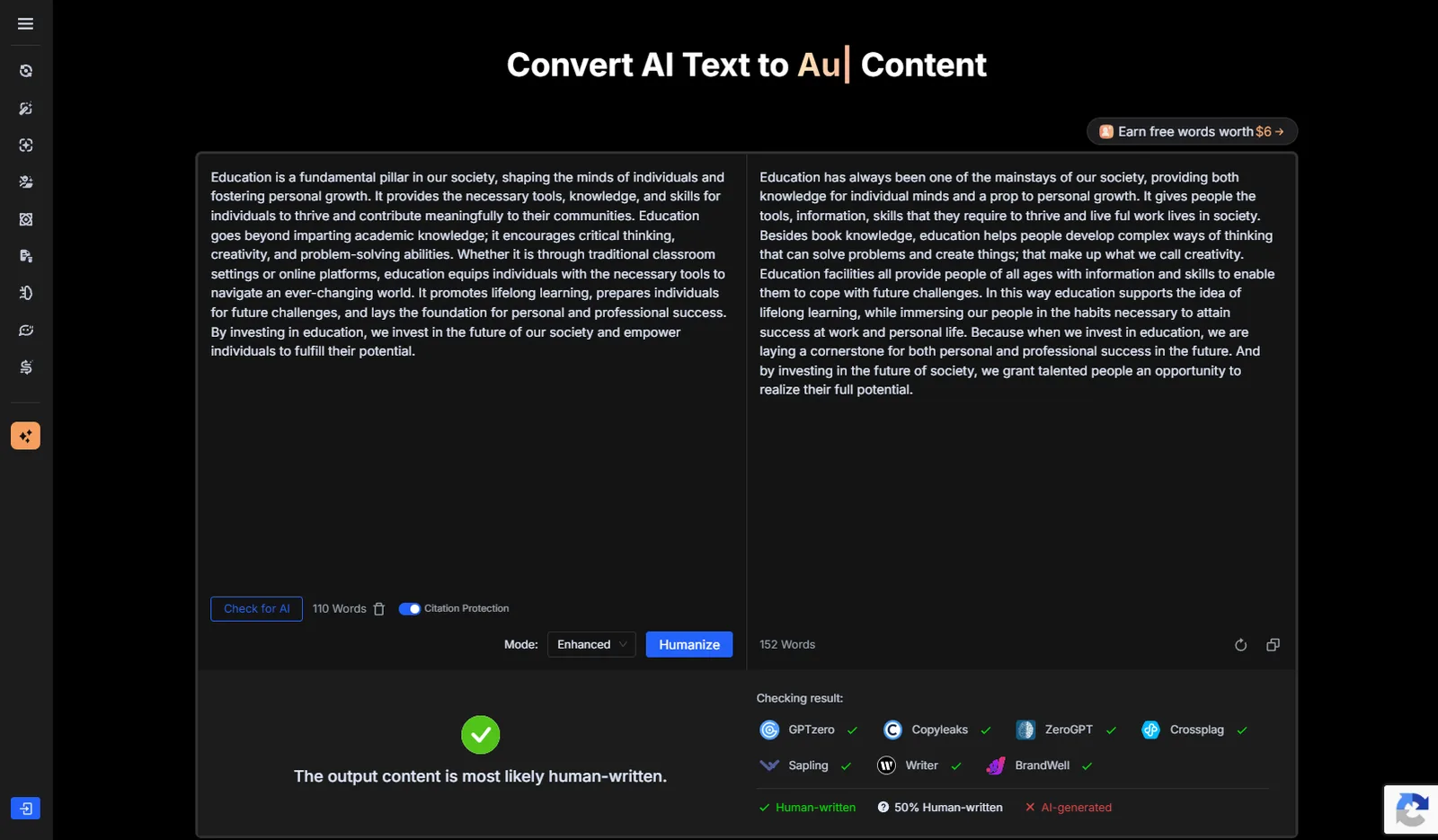
Reddit testing put it around 67%, in the same band as Humbot and with the same characterisation, surface-level rewriting rather than structural change. Note again that BypassGPT and HIX Bypass are unrelated products. Used by writers making frequent short passes. The BypassGPT review looks at daily-run metering and its seven-detector reporting.
GPTinf
GPTinf is a budget bypass tool built on a credit model that lets you re-run the same text through additional passes, with tiers at $4.99, $12.49 and $29.99 a month and a one-time free allowance of 240 words. The re-run design is unusual and honest about what it implies: if the first pass does not move a score enough, you spend credits going again rather than getting a different engine.
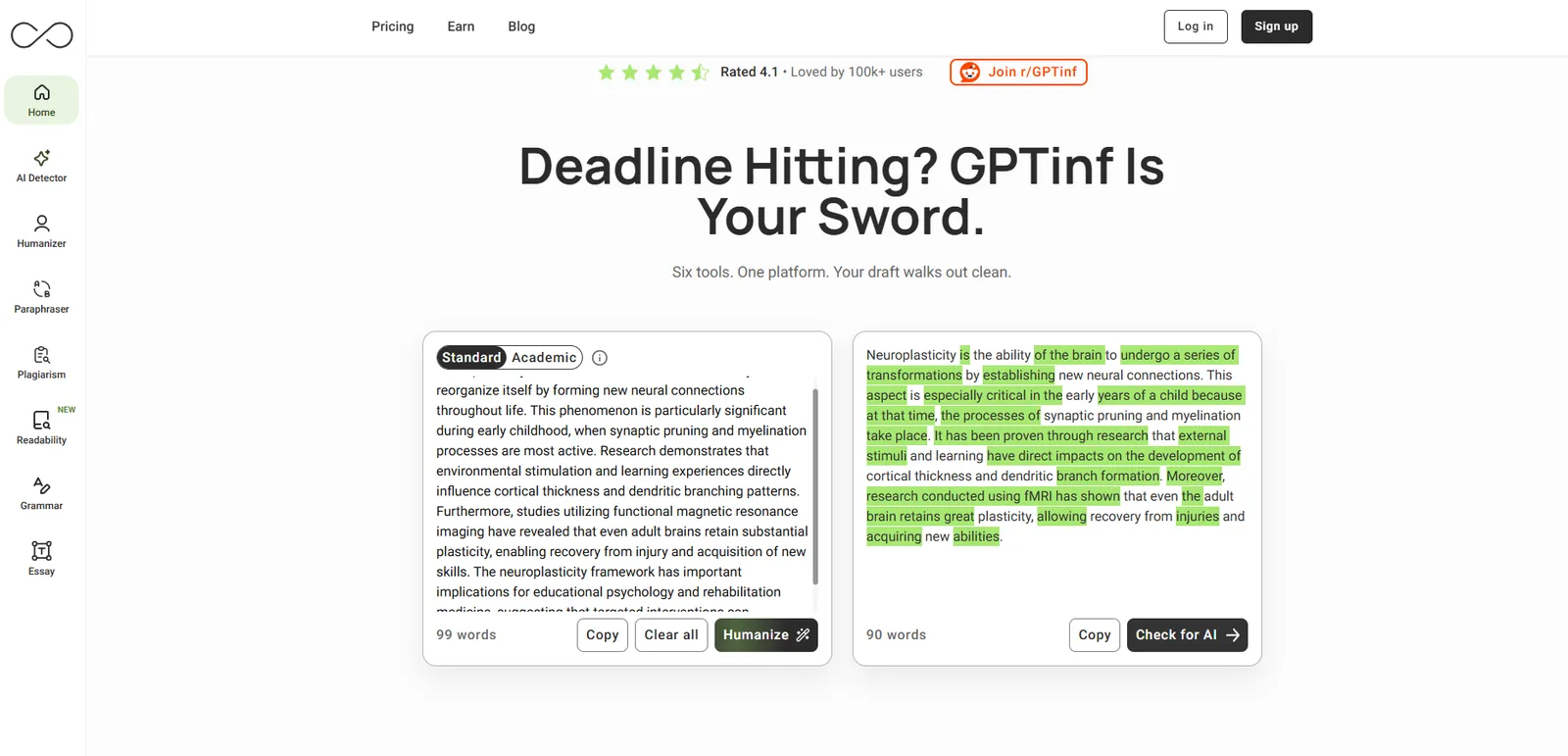
That works acceptably for short general text and poorly for a chapter, where repeated passes compound drift, each one moving further from what you originally wrote. No citation handling or register target is described. Used by budget-conscious occasional users. The GPTinf review covers the Academic mode and what repeated passes do to a chapter.
Ryne AI
Ryne AI is a student platform rather than a standalone humanizer, bundling humanization with multi-model AI chat, an essay composer, a note taker and a Turnitin-equivalent AI report, all metered in shared coins. It claims more than 2.3 million students. The free Amethyst tier gives 100 coins, English only, and 250 words per run. Sapphire is $29.99 a month or $19.99 billed annually at $167.99 a year, with 10,000 coins, all languages, 750 words per run and one AI report a month. Emerald is $39.99 or $29.99 annually at $251.99 a year, with unlimited coins, 1,500 words per run and three reports. Ruby is $109.99 or $99.99 annually. Unused coins roll over.
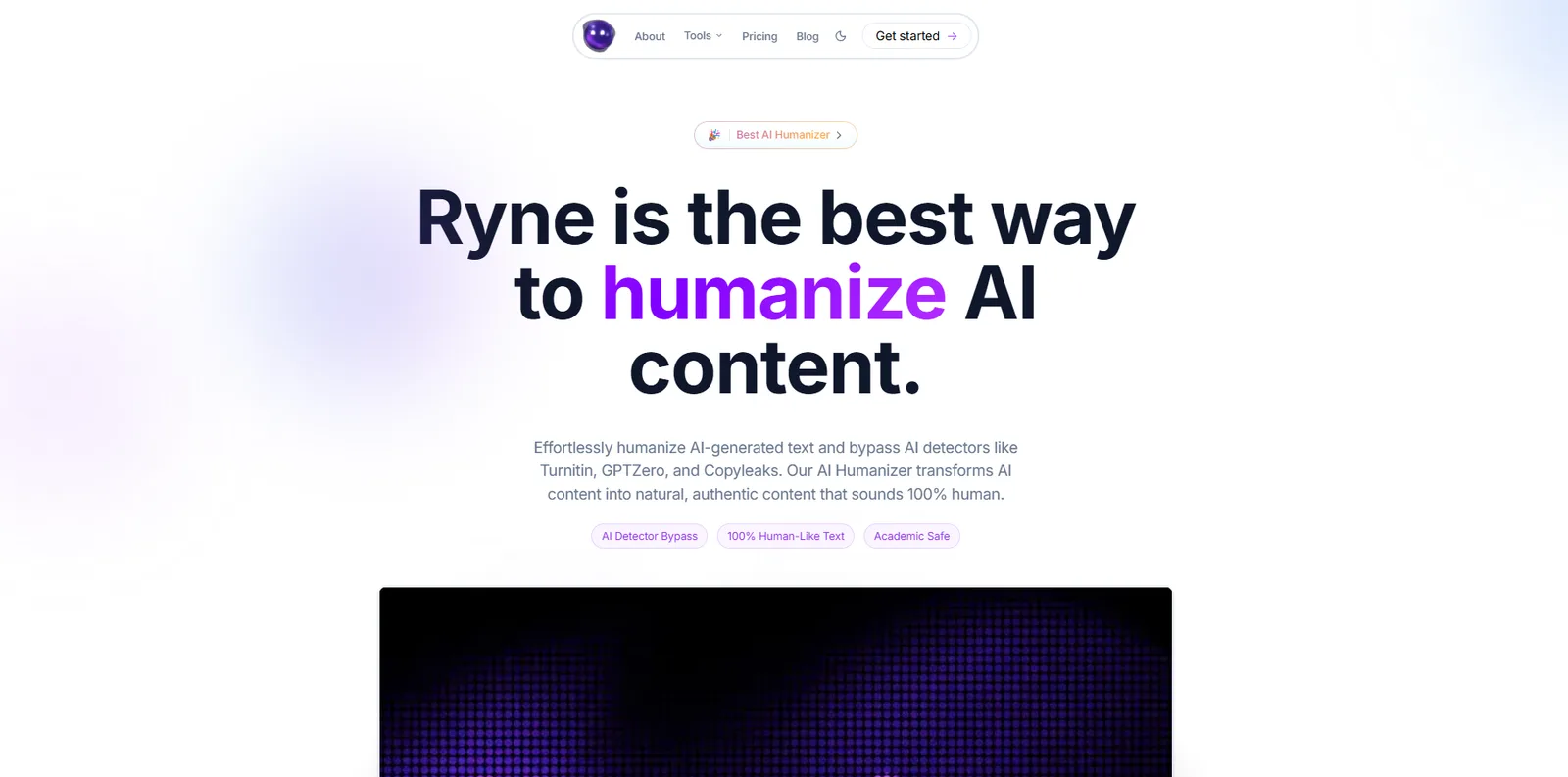
The built-in AI report is the genuinely useful piece, since checking your own draft before submission is sound practice. Two things temper it for research writing. The words-per-run ceiling, 750 on Sapphire and 1,500 on Emerald, splits anything chapter length. And third-party testing reports a marked gap between content types, with meaningful improvement on creative text and very little on academic and factual writing, which is the category that matters here. Used by undergraduates wanting one bundled account. The Ryne AI review covers the coin system and the gap between creative and academic text.
StealthWriter
StealthWriter pairs a humanizer with a detector and meters by daily volume: free at 10 humanizations and 10 scans a day with 1,000-word inputs, Starter at $20 a month for 50 a day with 5,000-word inputs, Plus at $50 for 150 a day, and Pro at $100 for 350 a day. Two features distinguish it. Deep Scan gives a sentence-by-sentence breakdown with colour-coded highlights showing what is flagged, and Alternative Rewrites lets you click any sentence and choose between several versions.
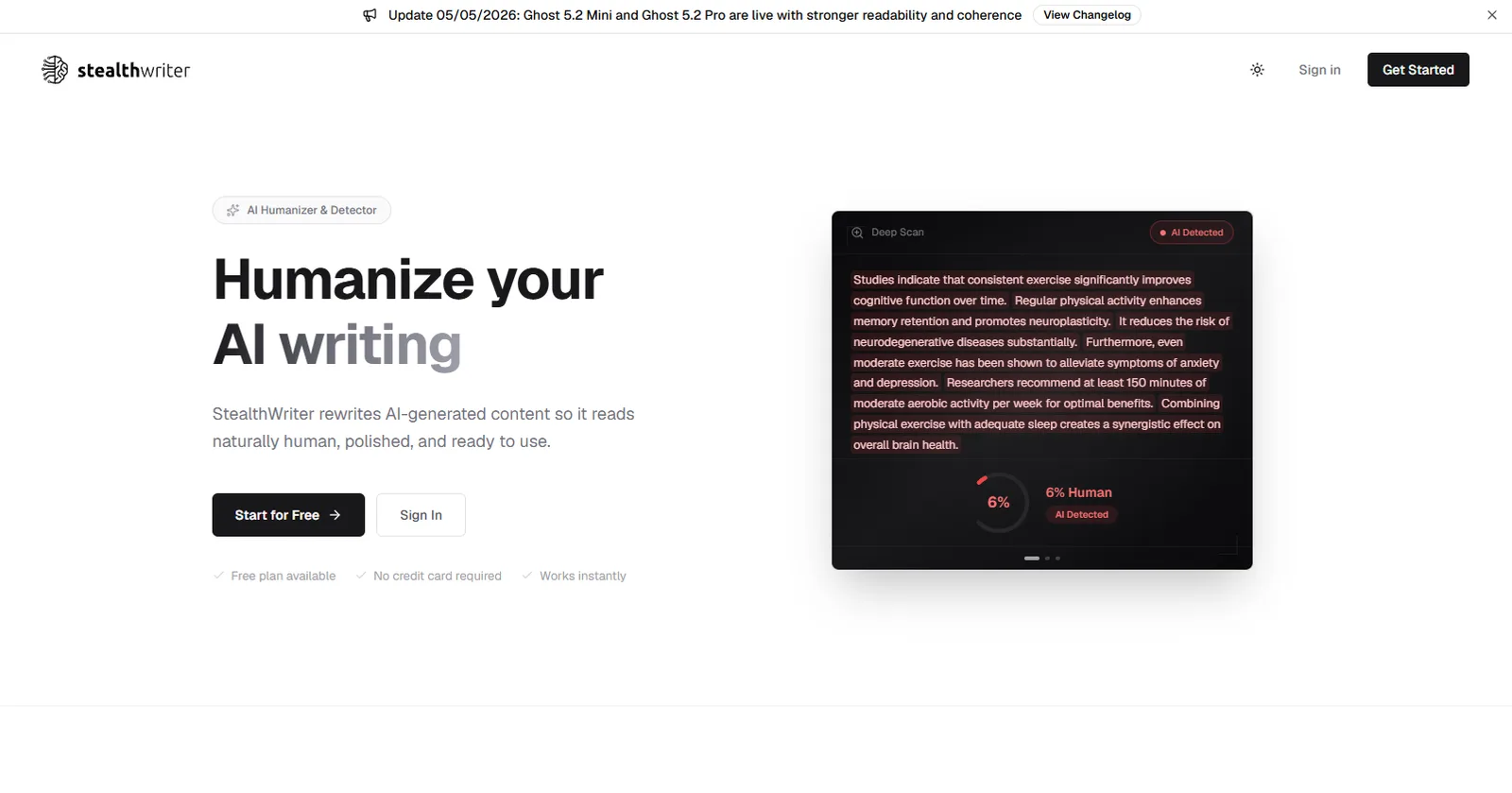
That manual control is real, and it is also the trade: you become the quality layer, judging sentence by sentence. Reviewers note that its rewriting runs heavy enough to drift from the original meaning, which is a manageable risk in a blog post and a serious one in a methods section where a shifted verb changes what you claim you did. It names no citation or terminology protection. Used by writers who want to inspect every change. The StealthWriter review covers Deep Scan, alternative rewrites, and the drift they are meant to catch.
Netus AI
Netus AI is a content marketing suite in which humanizing is one of many tools drawing on a shared credit pool, priced free with 50 credits, then $14, $30, $59 and $99 a month, at one credit per ten words. Basic at $14 gives 1,500 credits, which is 15,000 humanizer words. The same credits also buy paraphrasing, summarising, readability analysis, keyword extraction, email writing and SEO article generation, and the platform advertises 36 languages.
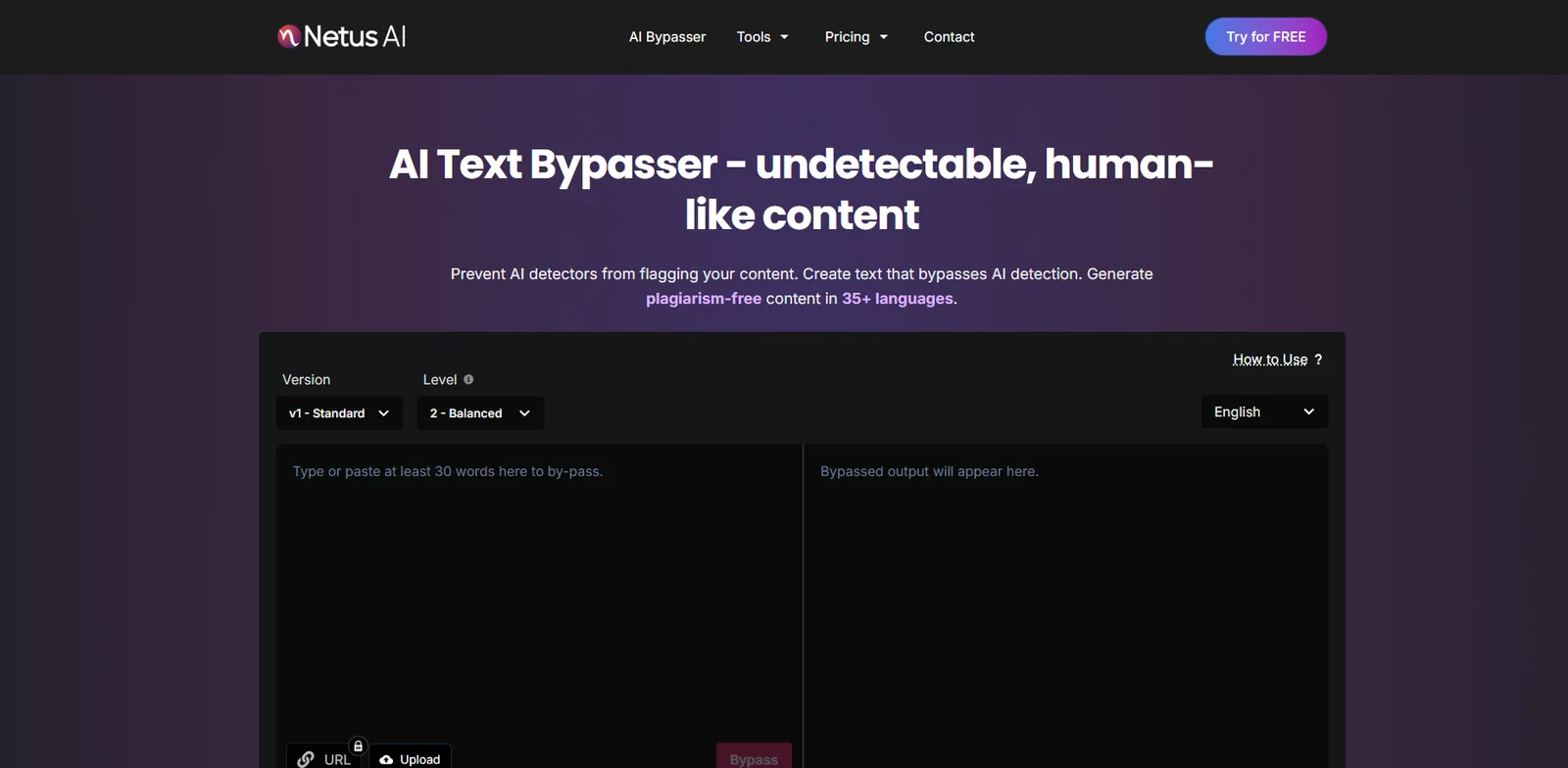
Shared credits are the thing to understand before buying: a month spent generating articles is a month with fewer humanizer words. The tool set is aimed squarely at content marketing, and nothing in it addresses citations, locked terminology or academic register. Used by marketing teams. The Netus AI review works through the shared credit pool before you buy.
Rephrasy
Rephrasy prices unusually, offering a Quick Pass at $12.99 for 24 hours of access alongside subscriptions: Growth at $8.25 a month billed annually at $99 a year with student-focused tools and basic modes, Business at $10 a month at $120 a year adding three custom styles and API access, and Professional at $18.33 a month at $220 a year for higher processing volumes. A lifetime licence is $199 one time and includes a built-in detector.
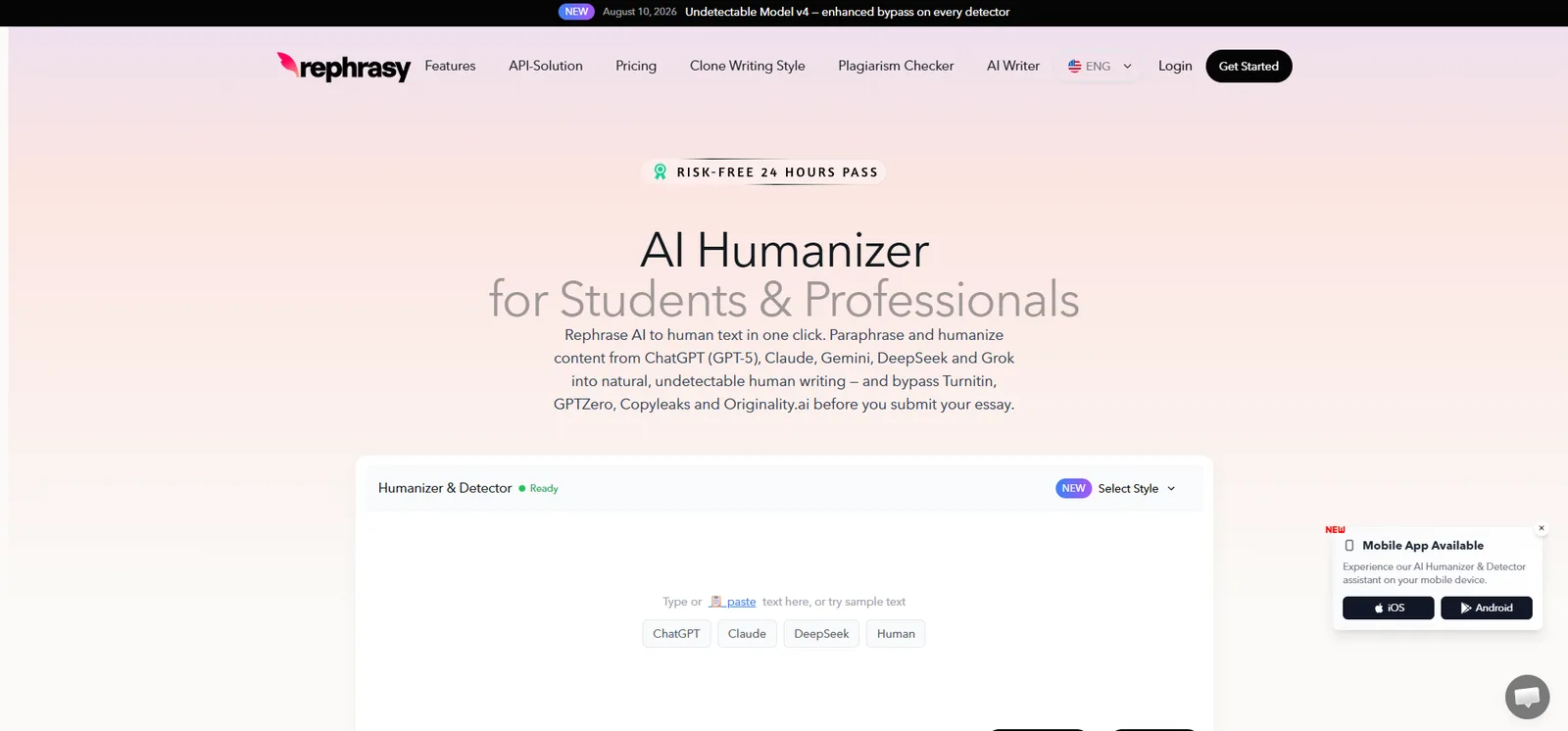
The 24-hour pass is genuinely useful for a single deadline, and the lifetime option is rare in a category built on subscriptions, though it carries the usual risk of any lifetime deal in a fast-moving market. Third-party roundups rate its output well against detectors. Custom styles are a tone feature rather than an academic protection, and no citation or terminology handling is described. Used by students working to fixed budgets. The Rephrasy review weighs the 24 hour pass and the lifetime licence.
Grubby AI
Grubby AI keeps its structure simple: a free tier capped at 300 words per input, Essential at $12.99 a month for 10,000 humanizer words, Pro at $15.99 for 30,000 words, and Unlimited at $22.99 with larger input limits for heavy use, with annual billing available at a discount.
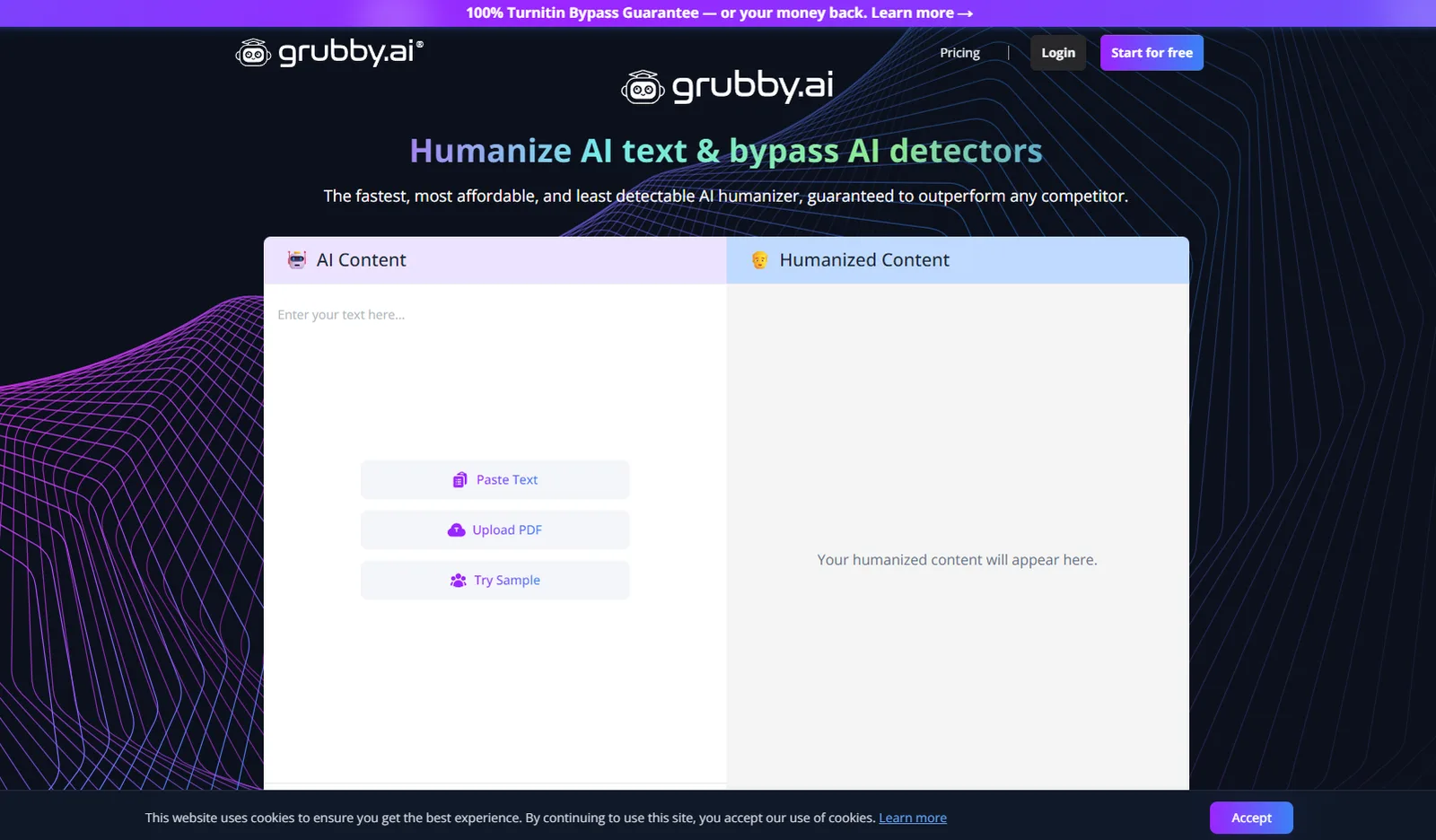
Reviewers place it as effective on short passages and quick edits, with consistency dropping on longer pieces, which makes it better suited to minor tasks than to publication-ready material. For academic work the 300-word free input is not enough to judge quality on a real section, and the tool describes no citation or terminology handling. Used for casual short-form rewriting. The Grubby AI review covers what a money-back bypass guarantee actually promises.
JustDone
JustDone is a 35-tool writing platform in which humanizing is one function, offering task-specific modes for emails, blogs and academic content. It runs a free tier with a few short scans and basic AI checks, a seven-day trial at $2 that auto-renews into the monthly plan unless cancelled, an unlimited monthly plan at $19.99, and an annual plan at $9.99 a month charged $119.88 upfront.
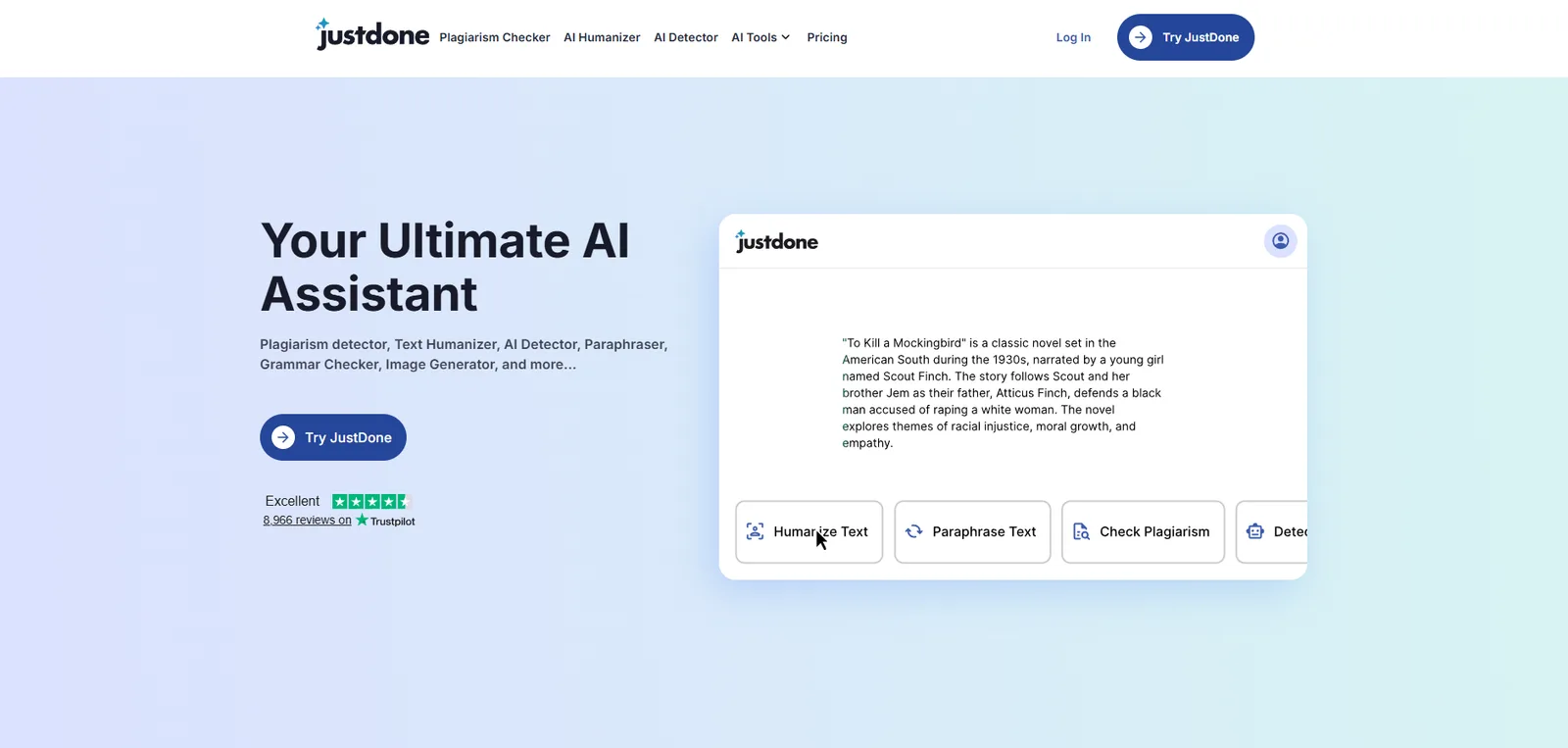
The auto-renewing trial is worth a calendar reminder. The named academic mode is a genuine nod to the use case, though a mode is not the same as documented protection for citations, defined terms and statistics, and the platform publishes no measured detector results. Used by writers who want one subscription across many tasks. The JustDone review covers its academic mode and the auto-renewing trial.
Smodin
Smodin is a student suite rather than a humanizer specialist, combining rewriting with citation generation, essay drafting, plagiarism checking and translation, with paid access starting from around $5 a month. Its strength is that many students already have an account for the citation tools, so the rewriter is simply there.
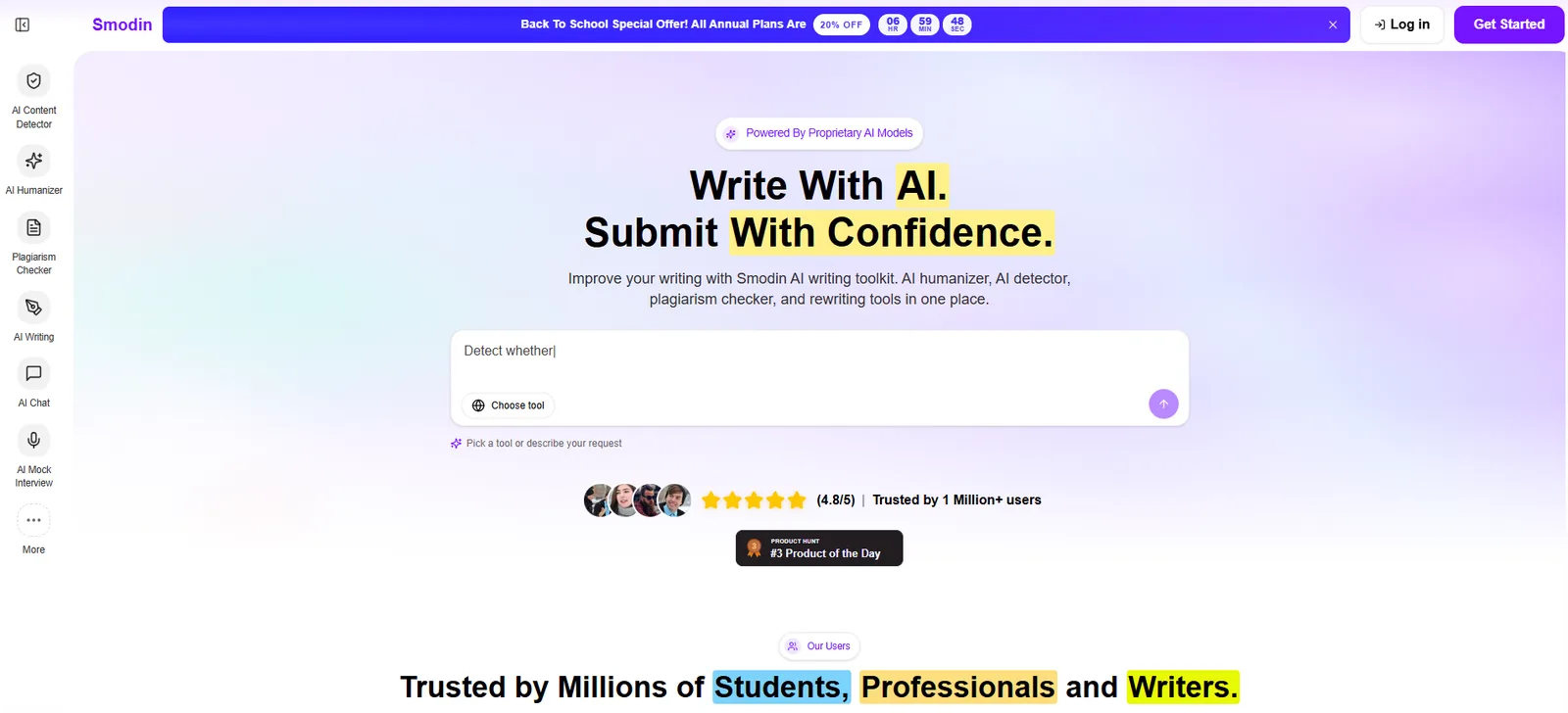
That bundling is also its academic limitation. Rewriting is one feature among many rather than the engineered core, and while the suite handles citations as a separate generator, that is not the same as protecting the citations already inside a draft while the prose around them changes. Used by students already inside the Smodin ecosystem. The Smodin review draws the line between generating citations and protecting them.
WriteHybrid
WriteHybrid sells word-pool plans scaling from individual to team use: free at 500 words a month with no card required and recurring monthly, Starter at $19 for 20,000 words with basic processing, Pro at $49 for 60,000 words with priority processing and tone options, and Agency at $99 for 150,000 words with team access and an API.
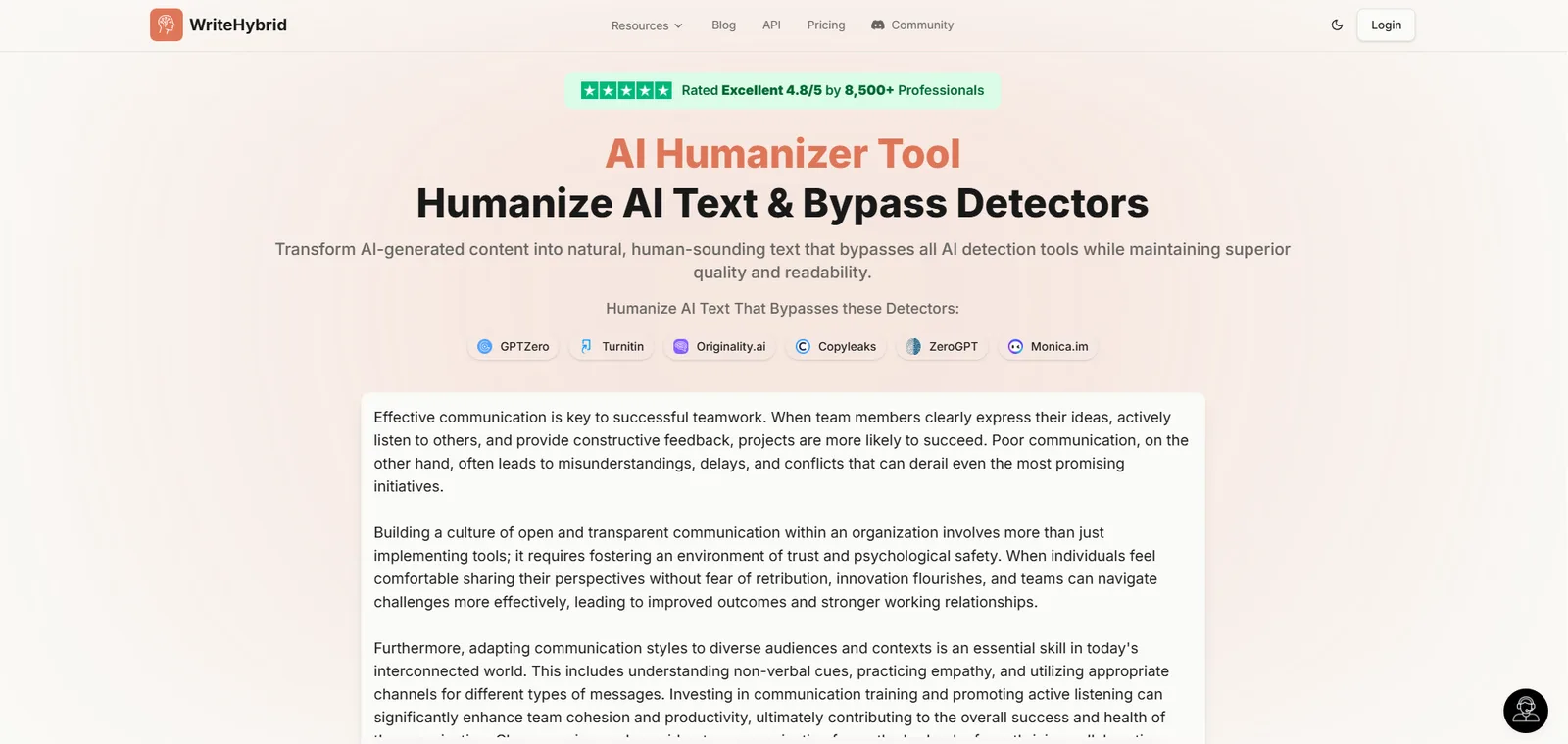
The recurring free tier is more generous than most one-time trials, which makes it easy to test on a real paragraph. The tier structure points at its intended buyer: team access and API at the top end describe content operations, not individual researchers, and tone options are a style control rather than an academic register target. No citation handling is described. Used by content teams. The WriteHybrid review covers the strongest citation result of any competitor here.
HumanizerAI Pro
HumanizerAI Pro is a free browser tool with no paid tier, offering unlimited processing at no cost and claiming a 100% bypass rate. Free and unlimited is a genuine convenience for a one-off paragraph, and the absence of a signup wall lowers the barrier to trying it.
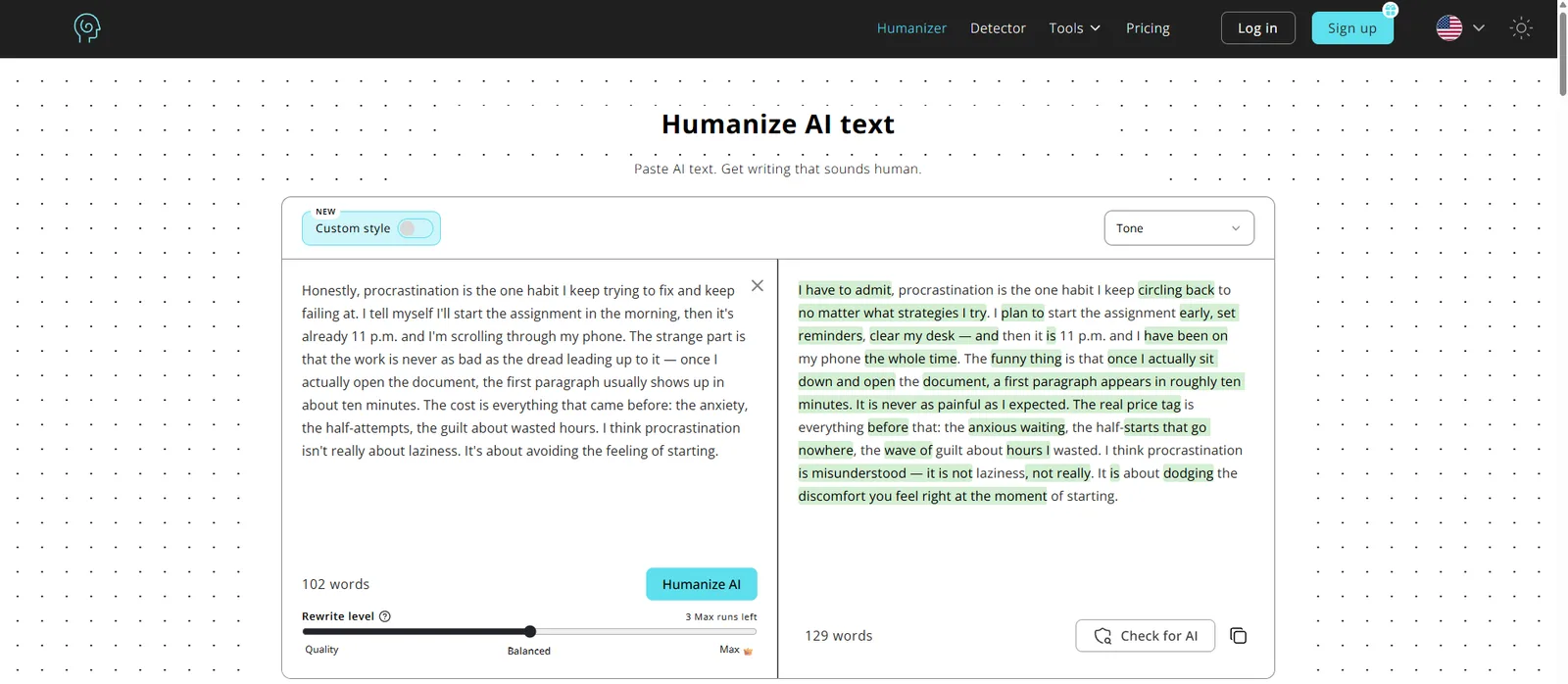
Treat the 100% claim the way you would treat any absolute in this market, particularly one published without a corpus, a date or a named detector. Free tools also run on smaller models than paid engines, which usually shows in output quality on long or technical passages, and a tool with no revenue has little to invest in keeping pace as detectors retrain. No academic handling is described. Used for casual one-off rewrites.
MorphMind Academic Humanizer
MorphMind's Academic Humanizer is a different kind of entrant: an open source skill file for Claude Code from a University of Minnesota startup, covered in Nature within days of its July 2026 release. It edits AI-assisted drafts for rigor, stripping machine habits, tying claims to evidence and preserving citations under a stated fidelity rule, and it costs nothing beyond the model usage running it. It publishes no detector results, and its documentation says plainly that it is not for evading AI-use disclosure. It arrived after the benchmark above was run, so it carries no rating card here; in our GPTZero check its output scored 100 percent AI, unchanged from the source draft. The MorphMind Academic Humanizer review covers the six layer design and the token distribution result in full.
Full Results: All 21 Humanizers Rated
| Humanizer | Turnitin | Grammar | Citations | Key terms | Tone | Dashboard | Languages | Overall |
|---|---|---|---|---|---|---|---|---|
| TextPulse | 4.0 | 4.5 | 5.0 | 4.5 | 5.0 | 5.0 | 5.0 | 4.71 |
| WriteHybrid | 3.5 | 3.0 | 4.5 | 4.0 | 4.0 | 4.0 | 3.5 | 3.79 |
| Undetectable AI | 4.5 | 3.5 | 3.5 | 3.5 | 5.0 | 3.0 | 3.0 | 3.71 |
| JustDone | 4.0 | 3.0 | 3.5 | 4.0 | 4.0 | 4.0 | 3.0 | 3.64 |
| WriteHuman | 3.5 | 3.5 | 3.5 | 3.5 | 4.0 | 4.0 | 3.0 | 3.57 |
| HumanizerAI Pro | 4.0 | 3.5 | 3.5 | 3.5 | 3.0 | 4.0 | 3.5 | 3.57 |
| QuillBot Humanizer | 2.0 | 4.0 | 4.0 | 4.0 | 5.0 | 2.5 | 3.0 | 3.50 |
| Grammarly Humanizer | 2.0 | 4.0 | 4.0 | 4.0 | 5.0 | 2.5 | 3.0 | 3.50 |
| GPTinf | 3.5 | 3.5 | 3.0 | 3.5 | 3.0 | 4.0 | 4.0 | 3.50 |
| Humbot | 4.0 | 3.5 | 3.5 | 3.5 | 3.0 | 3.5 | 3.0 | 3.43 |
| Phrasly | 4.0 | 3.0 | 3.5 | 3.5 | 3.0 | 3.5 | 3.0 | 3.36 |
| Smodin | 3.5 | 3.0 | 3.0 | 3.5 | 3.5 | 3.5 | 3.0 | 3.29 |
| StealthGPT | 4.0 | 3.5 | 3.0 | 3.0 | 2.5 | 3.0 | 3.0 | 3.14 |
| BypassGPT | 4.0 | 3.0 | 3.0 | 3.0 | 3.0 | 3.0 | 3.0 | 3.14 |
| StealthWriter | 4.0 | 2.5 | 3.0 | 3.5 | 3.0 | 3.0 | 3.0 | 3.14 |
| Ryne AI | 3.5 | 2.5 | 3.0 | 3.5 | 3.0 | 2.5 | 3.0 | 3.00 |
| Rephrasy | 3.5 | 3.0 | 2.5 | 2.5 | 3.0 | 3.0 | 3.0 | 2.93 |
| Walter Writes AI | 4.0 | 3.0 | 3.0 | 2.5 | 2.0 | 2.5 | 3.0 | 2.86 |
| Netus AI | 3.5 | 3.0 | 2.5 | 2.5 | 3.0 | 2.5 | 3.0 | 2.86 |
| Grubby AI | 3.5 | 2.5 | 2.0 | 2.5 | 2.5 | 3.0 | 3.0 | 2.71 |
| HIX Bypass | 3.5 | 2.5 | 2.5 | 2.0 | 2.0 | 2.5 | 3.5 | 2.64 |
Reading the ratings. Five is the best result in this set, four is strong, three adequate, two weak and one fails the task outright. Half points are used throughout. On the Turnitin column more stars means a lower AI score, so every measure runs in the same direction and the overall is a straight mean of the seven.
TextPulse finished top at 4.71, and it is worth being precise about why, because it did not sweep the board. Undetectable AI beat it on raw Turnitin scores. What decided the ranking is that a low AI score is worth very little if the citations arrive mangled and the defined terms have been swapped for approximations, which is exactly where most of this field lost points. TextPulse rated 5.0 on citation handling, academic tone, dashboard experience and multilingual support, and it is the only tool here built specifically for documents that carry a reference list. For a thesis, a journal submission or any work that gets marked on its sources, that is the trade worth making. TextPulse's academic humanizer is the recommendation. The HumanizerAI Pro review covers the rewrite level slider and the free-tool trade-offs.
How to Judge a Humanizer Yourself
Test on your own text, not the vendor's sample. Paste in a real paragraph from your own draft, ideally one with two or three citations and a couple of defined terms, and read the output against the original line by line. Check the citations first: are the surnames, years and page numbers exactly where you left them, in the same form. Check the technical vocabulary next: has anything been helpfully replaced with a near-synonym that changes the claim. Then read for register, and ask whether the paragraph still sounds like it belongs in your discipline or has drifted toward a blog voice.
Check the caps before the price. Words per request or per run decides whether your chapter goes through whole or in fragments, and fragments create seams where terminology drifts and tense shifts. A cheap plan that splits a 4,000-word chapter into five passes costs you the reconciliation time the price tag never mentions.
Finally, weigh evidence over adjectives. A vendor naming a corpus size and specific detectors has committed to something checkable. A vendor promising undetectability with a refund has committed to a customer service process, which is not the same thing and arrives too late for a submitted document.
Where TextPulse Fits
For academic work, TextPulse is the tool this guide recommends, and the reasoning is the four criteria above rather than loyalty. It is the only humanizer here that names citation preservation across six referencing styles as a feature, the only one with a terminology lock in freeze terms, the only one holding output to an academic register band on the strength of peer-reviewed training data, and one of the very few publishing a measured benchmark with a named corpus size and named detectors.
The tools in this guide are not bad products. They are mostly good products aimed at somebody else: content teams, marketers, bloggers, students polishing an email. If that is your document, several of them will serve you well and cost less than TextPulse's Pro and Plus plans. If your document has a reference list, defined terms and an examiner, the protections stop being features and start being the whole job. The TextPulse humanizer for researchers is built for that document.
Related reading: the best AI humanizer to pass Turnitin, the best AI humanizer for ESL and international students, and how a humanizer differs from a paraphraser.
Related research: the humanizers discussed above are compared head to head in A Controlled Comparison of AI Text Humanizers on Academic Writing, a TextPulse Research working paper with open data and code.
Frequently Asked Questions
Using AI assistance is allowed at most institutions provided you disclose it, and cite the tool where your department requires it. Oxford's guidance frames unacknowledged use as the breach rather than use itself, and Elsevier, Nature and COPE all permit AI assistance for language and readability with a declaration. What no policy excuses is passing AI work off as unassisted, so check your own department's wording and disclose.
Content strategist at TextPulse, here since the company started. Mark writes the product and technical coverage: how the humanizer works under the hood, what changes in each release, and what a specification actually means for your writing. His reviews of writing software come from using them on real documents rather than reading a feature list.