Winston AI Review: The 99.98% Accuracy Claim vs the Evidence
Winston AI advertises 99.98% accuracy, the highest self-claimed figure in the detector industry, measured on an internal test set the company has never published. The peer-reviewed RAID benchmark put its overall accuracy at 71% at a fixed 5% false positive rate, still second among the four commercial detectors tested. Here is what each number actually measures, and who this tool genuinely suits.
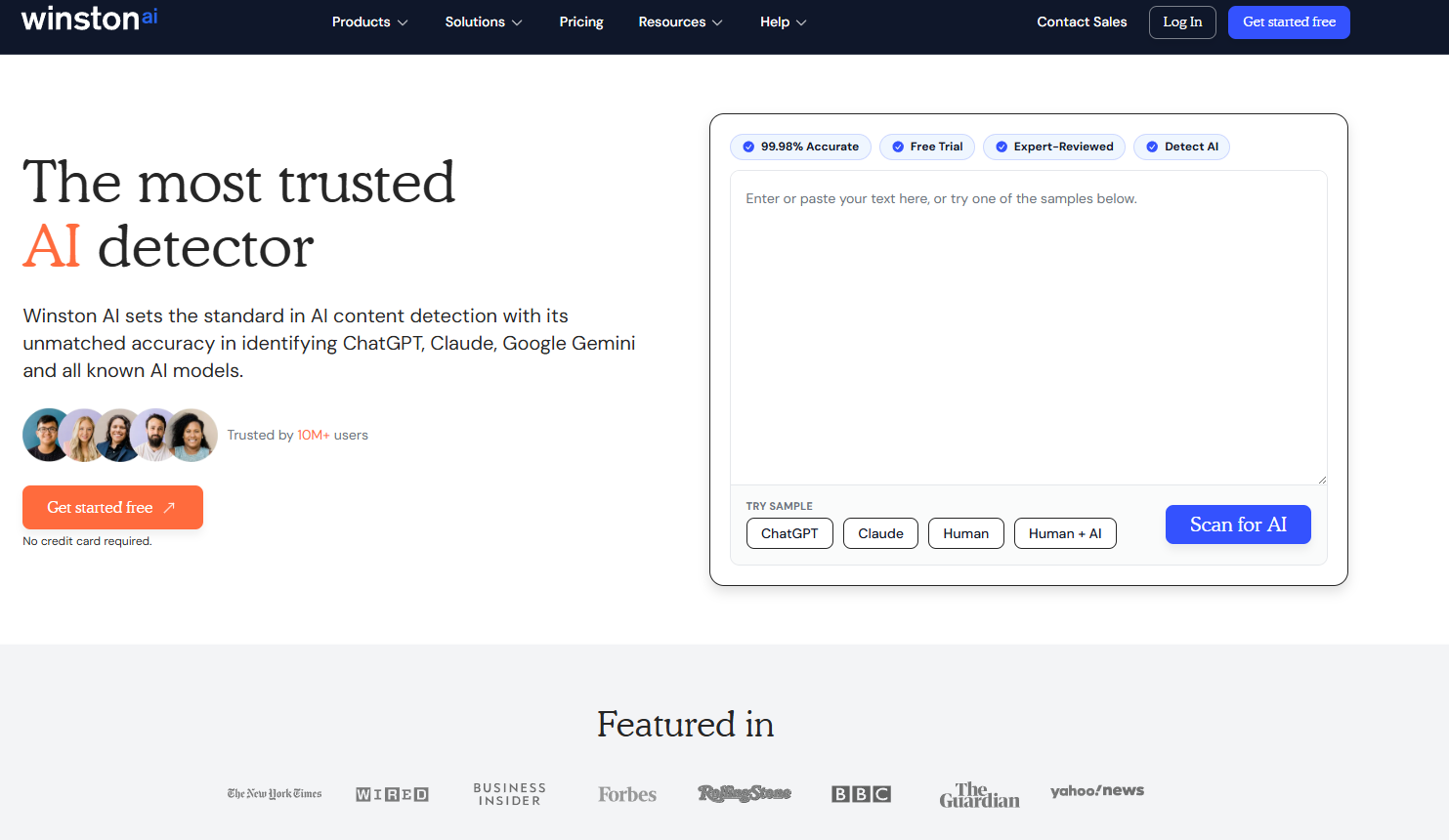
Winston AI advertises 99.98% accuracy, the highest self-claimed figure of any mainstream AI detector. The number sits on the company's homepage next to the words "The Most Trusted AI Detector," and it comes from the company's own internal testing, not from an outside lab. No methodology, test set size, human-to-AI sample ratio, or operating threshold is published alongside it. That gap between the claim and its documentation is the first thing a careful reader needs to know about this tool.
The second thing is that Winston has actually been tested by outsiders, which is more than some detectors can say. The RAID benchmark, a peer-reviewed study presented at ACL 2024, ran Winston against roughly 6.2 million machine-generated texts and measured 71.0% overall accuracy with the false positive rate fixed at 5%. That is a long way from 99.98%. It also placed Winston second of the four commercial detectors tested, ahead of GPTZero and ZeroGPT. Both facts matter, and neither cancels the other.
What follows is what Winston is and who it is built for, what the vendor claims, what a self-benchmark of 99.98% can and cannot mean statistically, and what the independent numbers actually show.
What Is Winston AI and Who Uses It?
Winston AI is a paid, subscription-based detector aimed squarely at educators and content publishers. Its feature list reads like a teacher's workflow: the company's site describes OCR that extracts text from scanned documents, photos, and handwriting, a Google Classroom integration listed among its supported platforms, a plagiarism checker alongside the AI detection, and document organization for managing batches of submissions. The vendor states it detects output from ChatGPT, Gemini, Claude, LLaMA "and much more."
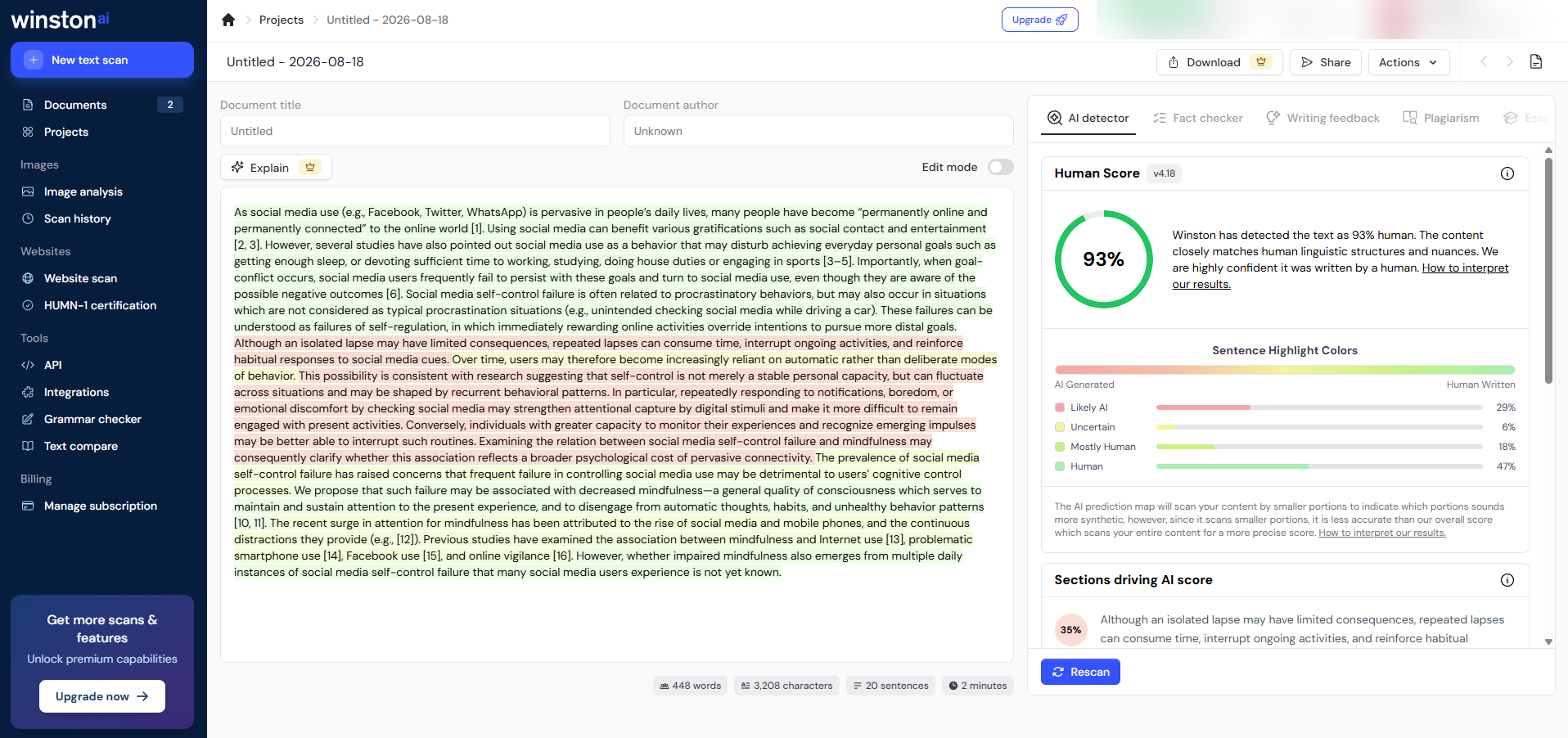
The most distinctive part of the interface is the per-sentence output. Instead of returning only a single percentage, Winston produces what it calls an AI prediction map: a color-coded, sentence-by-sentence assessment of which parts of a document read as machine-generated. For an educator, that map is more useful than a bare score, because it shows where the tool's suspicion is concentrated. It is also easy to over-read, a point covered below.
What Does the Company Claim?
The headline claim on Winston AI's homepage is "99.98% Accurate." As of this writing, the page carrying that figure does not publish how the test corpus was built, how many samples it contained, what mix of human and AI text it used, or what decision threshold the detector was set to when the figure was measured. That is not unusual for this industry; the same gap between vendor accuracy claims and independent evidence runs across nearly every detector on the market. Winston's version of the claim is simply the largest number anyone has put on it.
What Can a 99.98% Self-Benchmark Actually Mean?
Treat the arithmetic seriously for a moment. A 99.98% accuracy rate means 2 errors in every 10,000 samples. To measure that figure at all, a company needs a labeled test set of at least tens of thousands of documents where the true origin of every text is known with certainty. Then the number only describes performance on that corpus: those AI models, those prompts, those genres, that text length, at one chosen threshold.
None of that requires bad faith. A detector trained on essays generated by popular chat models, then tested on a corpus of essays generated by popular chat models, will genuinely score near the ceiling. The problem is transferability. The moment the incoming text comes from a different model, a different sampling strategy, or a writer whose natural style is unusually uniform, the corpus the benchmark was measured on no longer describes the text being judged. An internal benchmark is a controlled experiment run by the party with the strongest interest in its outcome, on conditions of its own choosing. It is evidence, but it is the weakest kind, and the missing methodology means no one outside the company can even check it.
What Does Independent Testing Show?
The most rigorous public test that includes Winston is RAID: A Shared Benchmark for Robust Evaluation of Machine-Generated Text Detectors, a peer-reviewed study by Dugan and colleagues presented at ACL 2024. RAID evaluated 12 detectors, including four commercial products, against roughly 6.2 million generations spanning 11 language models, 8 writing domains, 4 decoding strategies, and 11 adversarial attacks, with every detector calibrated to the same 5% false positive rate so the scores are comparable.
| Detector | Overall accuracy in RAID (FPR fixed at 5%) |
|---|---|
| Originality.ai | 85.0% |
| Winston AI | 71.0% |
| GPTZero | 66.5% |
| ZeroGPT | 65.5% |
Two readings of that table are honest at the same time. Winston's 71.0% is nowhere near 99.98%, and Winston still beat two of its three commercial rivals on the hardest public benchmark available. The averages also hide a revealing spread. In RAID's per-model results, Winston scored 99.6% on ChatGPT output and 98.8% on GPT-4 output, close to its own advertised figure, but fell to 47.6% on GPT-2 text and 24.8% on text from the base MPT-30B model. On paraphrased machine text, its accuracy dropped to 52.6%.
That spread is the whole story of the 99.98% claim in miniature. On text resembling what the detector was presumably tuned for, recent chat models writing plain prose, Winston performs close to its marketing. Off that distribution, performance falls off a cliff. An internal benchmark built from on-distribution text can genuinely produce a near-perfect number while telling you almost nothing about the messy mix of models, edits, and paraphrases a real inbox contains. The statistical signals detectors rely on are covered in more depth in our explainer on how AI detectors work.
Humanize your own paper
Transform your AI-assisted text and make it sound human, without touching important words or citations.
False Positives: Who Gets Hurt?
RAID's design makes one trade-off visible that vendor marketing rarely does: every accuracy score in the study was measured after fixing the false positive rate at 5%. At that calibration, 1 in 20 genuinely human documents gets flagged. A detector can lower that rate by raising its threshold, but only by catching less AI text; the two numbers move together, and a vendor quoting one without the other is quoting half a result.
The burden of those errors is not spread evenly. Writing that is formulaic, conventional, and low-variance reads as machine-like to every statistical detector, and that description fits methods sections, literature reviews, and the careful prose of writers working in a second language. The pattern of AI detectors flagging non-native English speakers at elevated rates is documented across the industry, and nothing about Winston's method exempts it. The per-sentence prediction map deserves the same caution: a red-highlighted sentence is a statistical observation about word patterns, not evidence about authorship. Students facing a wrongful flag should start from documentation, not confession; our guide on how to prove you did not use AI covers what actually persuades.
Pricing and Access
Winston is a paid product with a limited trial. Winston lists a 14-day free trial with 2,000 credits, an Essential plan at $18 per month (or $10 per month billed annually) with 100,000 monthly credits, an Advanced plan at $29 per month (or $16 annually) that adds team seats and larger scans, and an Elite tier above that. For an individual educator screening a class's worth of submissions, that puts Winston in impulse-purchase territory, cheaper than institutional contracts, more capable than most free tools.
Where Winston Fits in the Detector Landscape
On the independent evidence, Winston is a mid-priced commercial detector that performs better than the free tier of the market and worse than its own advertising. It suits an educator who wants per-sentence visibility, Classroom integration, and plagiarism checking in one inexpensive tool, and who treats every result as a prompt for a conversation rather than a verdict. It does not suit anyone who needs the score to function as proof, because no detector's score does.
The Full Comparison
Winston is one detector in a crowded field, and its 71% versus 99.98% gap is one instance of an industry-wide pattern. For how it stacks up against Turnitin, GPTZero, Originality, ZeroGPT, and the rest on the same evidence-first terms, see our full guide to AI detectors compared.
What Our Own Research Found
In the TextPulse Research detector agreement study, nine commercial AI detectors rated the same 90 academic texts. One was a 455-word hybrid text: a human-written opening and closing around a 168-word AI-generated middle. Winston AI scored this text 7% AI, while verdicts from the other tools on the same words ranged from 0% to 95.7% AI. The full paper, corpus, and per-tool score matrix are open access at TextPulse Research.
Frequently Asked Questions
The 99.98% figure is Winston AI's own claim, measured on an internal test set the company has not published. In the peer-reviewed RAID benchmark presented at ACL 2024, Winston scored 71.0% overall accuracy with the false positive rate fixed at 5%, though it reached 99.6% on ChatGPT output specifically. The claim describes a chosen corpus, not real-world performance.
PhD in natural language processing, with years spent building NLP applications end to end. Moe works on text analysis: lexical and syntactic structure, and what separates machine-generated prose from human prose statistically. He has been experimenting with computational linguistics since the early days of NLTK, spaCy and WordNet, and still writes most of his tooling in Python.