The Best AI Detectors for Academic Writing in 2026: 10 Tools Compared
Two of these ten detectors publish the same 99.98% headline accuracy figure. One names the researchers behind it and breaks its false positive rate out by genre. The other names no test at all. Ten tools placed on four axes: who buys them, what they claim, what evidence sits behind the claim, and what the report actually shows, plus the process-tracking model that may replace scoring altogether.
Two of the ten tools here publish the same headline number: 99.98% accuracy. One of them names the researchers and the universities behind that figure and breaks its false positive rate out by content genre. The other names no test at all. That contrast is the most useful thing in any set of AI detectors compared side by side, and it will still be useful after every price on every one of these pages has changed.
This guide compares the best AI detectors for academic writing in 2026: Turnitin, GPTZero, Copyleaks, Originality.ai, Pangram, Winston AI, ZeroGPT, Scribbr, Sapling and Compilatio, the ten a student, a researcher, a marker or an editor is most likely to meet. They are sold to different buyers, priced on different models, and they report different things back. Comparing them on accuracy alone misses almost everything that decides which one your text is run through, and what happens after it is.
The four things that actually differ
Detector marketing pages converge on one number and diverge on everything else. Four questions separate these products, and only one is the percentage on the homepage.
- Who it is sold to. A tool licensed to institutions and shown only to instructors sits in a different position from one anybody can sign up for in a browser, and the difference decides who ever sees a result about you.
- What figure it publishes. Every vendor here publishes a claim of some kind, from a bare percentage to a false positive rate quoted to four figures.
- Whether a named test sits behind that figure. This is the axis that separates the ten most sharply, and the one no vendor comparison table uses.
- What the report actually returns. A document-level percentage, sentence-level highlights, an interpretability view and a shareable report are four different objects, and an accusation built on one is a different conversation from an accusation built on another.
The third question is worth sitting with. A percentage with a named institution, a named dataset and a stated method behind it can be argued with, replicated or disputed. A percentage with nothing behind it can only be believed or ignored, and belief is not a basis for a misconduct hearing. Perplexity, the statistical property an earlier generation of detectors leaned on hardest, is measurable enough that a free perplexity checker will show you what it looks like on your own writing, though no vendor below reports its verdict as a perplexity score.
The comparison table: who each one is sold to, and what it claims
| Detector | Sold to | How you get access | Headline claim | Named test behind the claim |
|---|---|---|---|---|
| Turnitin | Educators and administrators at licensed institutions | Institution licence only | Document false positive rate under 1% above the 20% threshold | Turnitin's own validation set; no external study named |
| GPTZero | Teachers, students, writers, recruiters, publishers | Direct signup, free tier | 99% accuracy, 96.5% on mixed documents | Points to RAID, a third-party benchmark, and a Penn State partnership |
| Copyleaks | Education and enterprise, inside Canvas, Blackboard and Moodle | Direct signup and LMS licence | Over 99% accuracy with a 0.03% false positive rate | Independent data exists: the 2026 VUB study below |
| Originality.ai | Writers, editors, marketers, agencies, enterprise | Direct signup, credit-based | 99% accuracy on the latest AI models | Its own accuracy study plus third-party peer-reviewed work |
| Pangram | Universities, schools and enterprises | Direct signup, institutional and API plans | 99.98% accuracy, false positive rate of 1 in 10,000 | A study it attributes to Chicago Booth and University of Maryland researchers |
| Winston AI | Individuals, teams, website certification customers | Direct signup, credit-based | 99.98% accuracy, stated as the only detector to reach it | None named |
| ZeroGPT | Individuals; the no-signup pre-check | Free, 15,000 characters, no account | Above 98% on internal evaluations | None named; the figure is the vendor's own |
| Scribbr | Students; free checker plus premium tier | Free in the browser | 78% of test texts identified correctly | Scribbr's own comparison, run by Scribbr itself |
| Sapling | Developers and support teams; API-first | Direct signup, public API, browser extension | Per-sentence AI probabilities | None named; independent reviews disagree sharply with each other |
| Compilatio | European institutions and students, strongest in French-speaking systems | Institution licence, or direct student purchase from 4.99 euros | 94 to 99% reliability, under 1% false positives | Ranked 2nd of 14 tools, Weber-Wulff et al. 2023 |
One row behaves unlike the rest. Turnitin cannot be bought by the person being assessed, cannot be run by them before submission, and returns its results to somebody else. Compilatio is licensed by institutions the same way, but also sells students the same checks directly, so it is the one institutional detector you can run on your own draft first. Every other detector here is a product a student, a writer or an editor can open in a browser and point at their own text this afternoon.
The accuracy claims, and which have a named test behind them
Winston AI and Pangram publish the same figure. Winston states it is "The only AI detector with a 99.98% accuracy rate". Pangram's homepage states: "Detect AI-generated content with 99.98% accuracy. Trusted by universities, schools, and enterprises worldwide." The numbers are identical. The evidence behind them is nowhere near it.
Pangram names its source. Its own pages credit the statistic to a comparison study from researchers at the University of Chicago's Booth School of Business and the University of Maryland, and publish a false positive breakdown by content genre. Winston's pages name no study: no dataset, no sample size, no method for the 99.98% figure. The credibility markers there are SOC 2 and GDPR badges and press logos, which speak to security posture and media coverage rather than to detection performance. The full teardown of each claim sits in the dedicated reviews: Pangram reviewed and Winston AI reviewed.
The most specific numbers of the ten are published by Turnitin and are error rates, not accuracy rates: a document false positive rate under 1% above its 20% threshold, a roughly 4% sentence-level error likelihood, and a stated chance of missing 15% of AI text in a document, a published miss rate almost nobody quotes back. How Turnitin's detector works and what its false positive rate means in practice are covered separately.
GPTZero publishes 99% accuracy and points at RAID, a third-party benchmark, and a Penn State research partnership, which puts it a step above a bare number and a step below a citation. Originality.ai publishes 99% on the latest AI models, citing its own study and third-party peer-reviewed work, and also publishes the sentence that should govern this entire section: "Any AI detector accuracy claim that is not transparently supported by methodology, benchmark data, and independent or reproducible analysis should be viewed skeptically." Applied evenly, that standard asks the same question of every figure on this page, including both 99.98% claims. ZeroGPT's figure, above 98% on internal evaluations, has no named test behind it either; the ZeroGPT accuracy review traces where that number comes from. Scribbr's 78% is at least honest about its scale, though the test is Scribbr's own.
The same standard has to apply to our own numbers. TextPulse publishes measured pass rates of 92.33% on Turnitin AI, 89.12% on Originality.ai and 87.91% on GPTZero for its academic AI humanizer. Those are vendor figures from vendor testing, exactly like Winston's and Pangram's, and no tool on either side of this market can promise what a detector will report about a specific document.
The Top 10 AI Detectors for Academic Writing
Each entry covers the same four things: how the engine works, what the vendor claims, what independent evidence shows, and who actually uses the tool. The dedicated review linked from each section goes deeper.
1. Turnitin: the institutional default
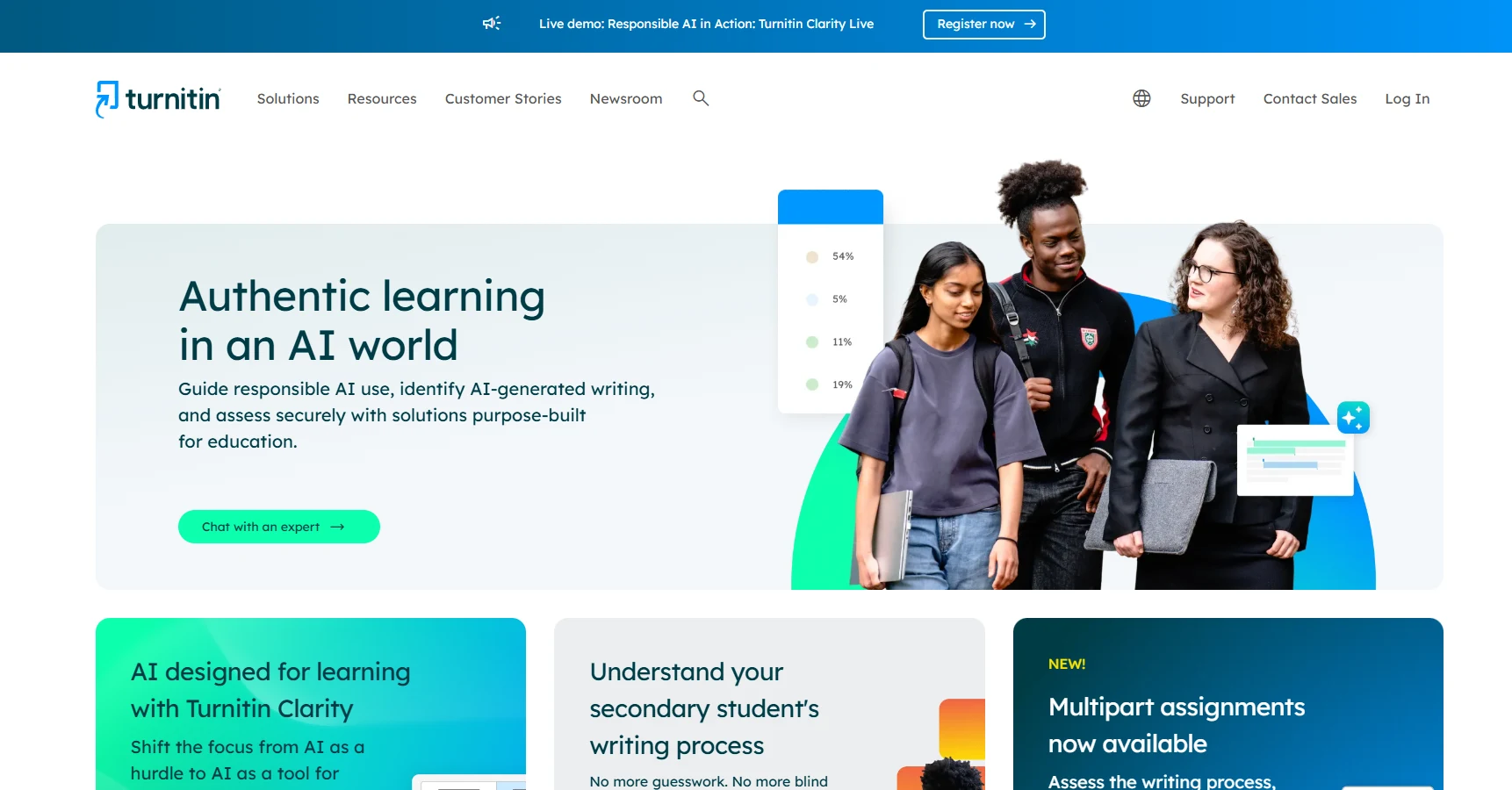
Turnitin's AI writing indicator is a deep-learning classifier trained on academic prose. It breaks a submission into overlapping segments of a few hundred words, scores each segment for the statistical patterns of model-generated text, and aggregates the results into the document percentage instructors see. Only long-form prose counts as qualifying text; bullet lists, quotations and references are excluded.
Turnitin publishes error rates rather than an accuracy rate: a document false positive rate under 1% for papers above its 20% threshold, a roughly 4% error likelihood on any single highlighted sentence, and a stated chance of missing 15% of the AI text in a document. The 2026 VUB study was harsher than the vendor's own numbers: Turnitin reported 0% AI on every one of the 40 fully AI-generated theses in the test set. It stays the default because it ships inside the plagiarism workflow more than 16,000 institutions already license, by Turnitin's own count, and only instructors and administrators see the score. It is also the most walked-back tool on this page: several major universities have disabled it over false positive concerns, tracked in universities that stopped using Turnitin. How Turnitin detects AI and similarity versus AI score cover the mechanics.
2. GPTZero: the biggest student-side brand
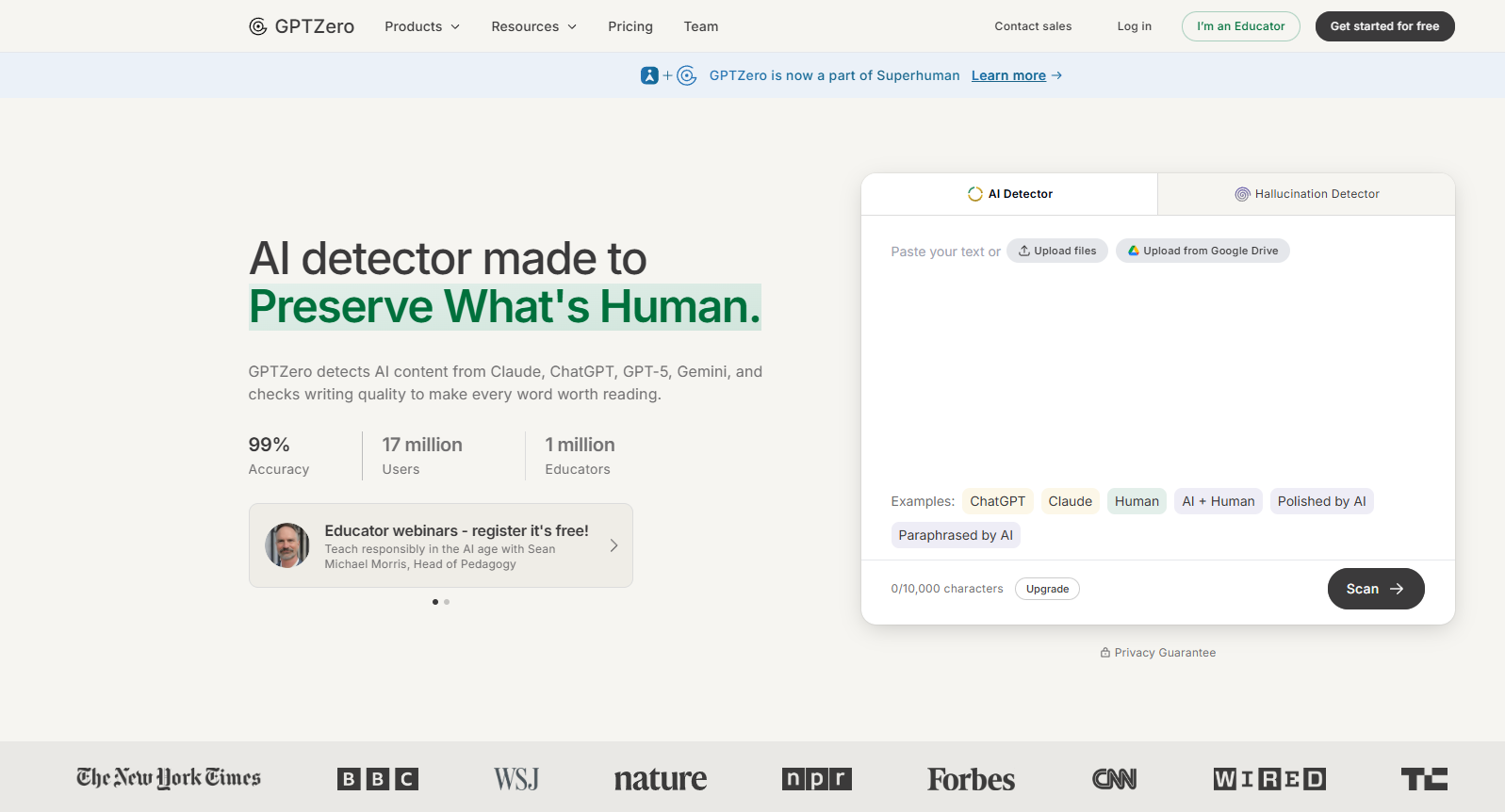
GPTZero launched in January 2023 as a perplexity and burstiness checker and has since rebuilt its engine into a multi-layer classifier. A scan returns a document verdict, a probability split across AI, human and mixed, per-sentence highlighting of the passages driving the result, and an AI vocabulary list. Its homepage claims 99% accuracy, 17 million users and 1 million educators; the free tier accepts about 10,000 characters per scan, and the company publishes an ESL calibration intended to reduce false flags on non-native English writing.
On evidence it sits mid-field. It points to the third-party RAID benchmark and a Penn State research partnership, a step above a bare claim, but in the VUB study its median score on fully AI-generated theses stayed under 20%, with wide swings between individual papers. It is the tool students most often use to pre-check their own drafts before submission. How GPTZero works walks through the report layer by layer; GPTZero versus Turnitin explains why the two disagree on the same text.
3. Copyleaks: the detector inside your LMS
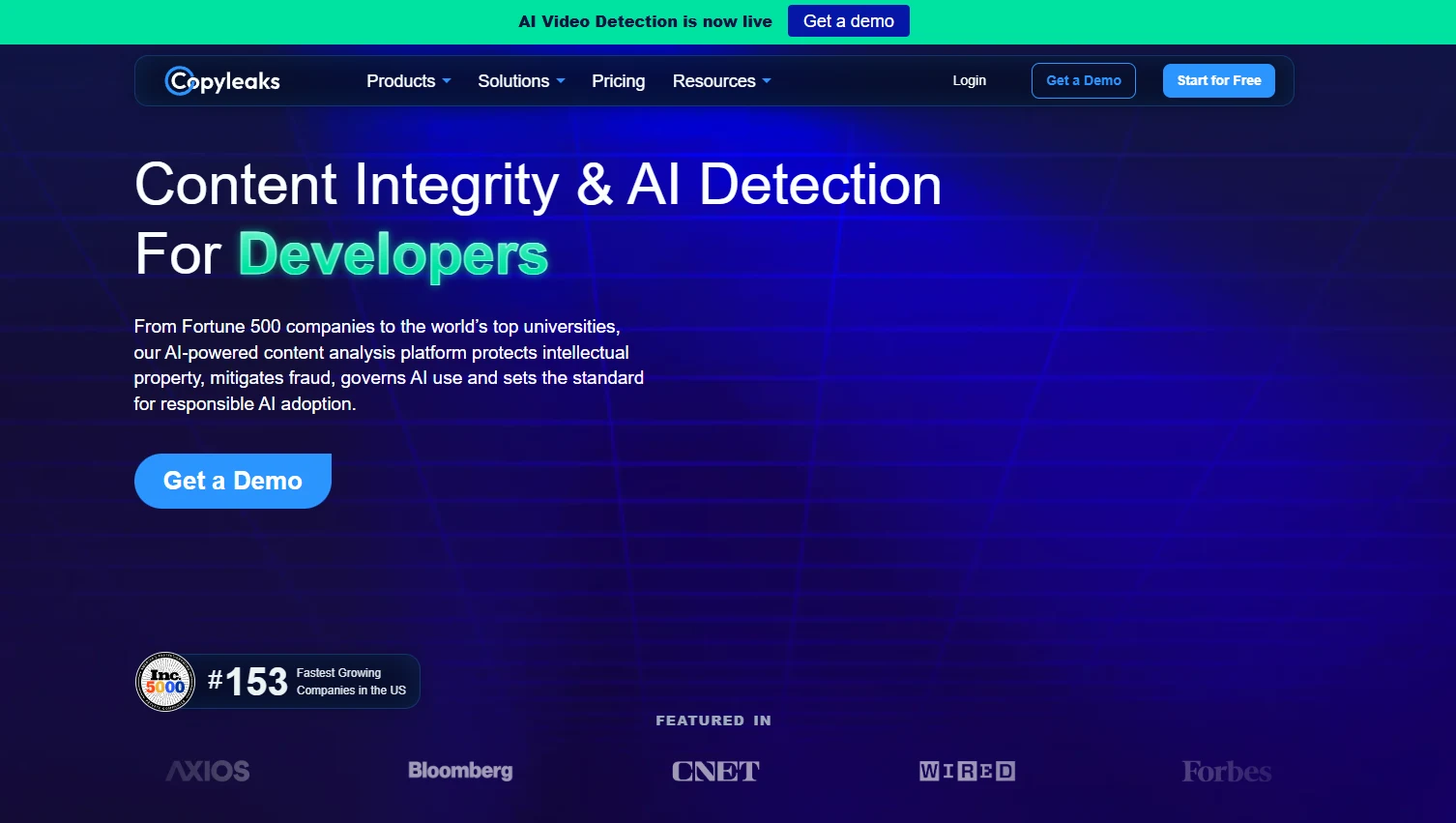
Copyleaks sells AI detection and plagiarism checking as one enterprise product, wired into Canvas, Blackboard and Moodle, with the broadest language coverage of the ten: the vendor lists more than 30 languages with per-language detection models. A scan returns a document percentage with highlighted passages. The vendor claims over 99% accuracy with a 0.03% false positive rate, and the free scanner accepts about 25,000 characters.
The independent record is the weak half of the pitch. In the VUB study, Copyleaks did not classify a single one of the 40 fully AI-generated theses as fully AI-written, flagged only 10 of the 40 even partially, and kept a median reported AI share under 20% on papers that were 100% machine-generated. It did clear all 40 human-written papers, every one by a non-native English speaker, which is genuine evidence in its favor on false positives. The Copyleaks review has the full picture.
4. Originality.ai: built for publishers, not classrooms
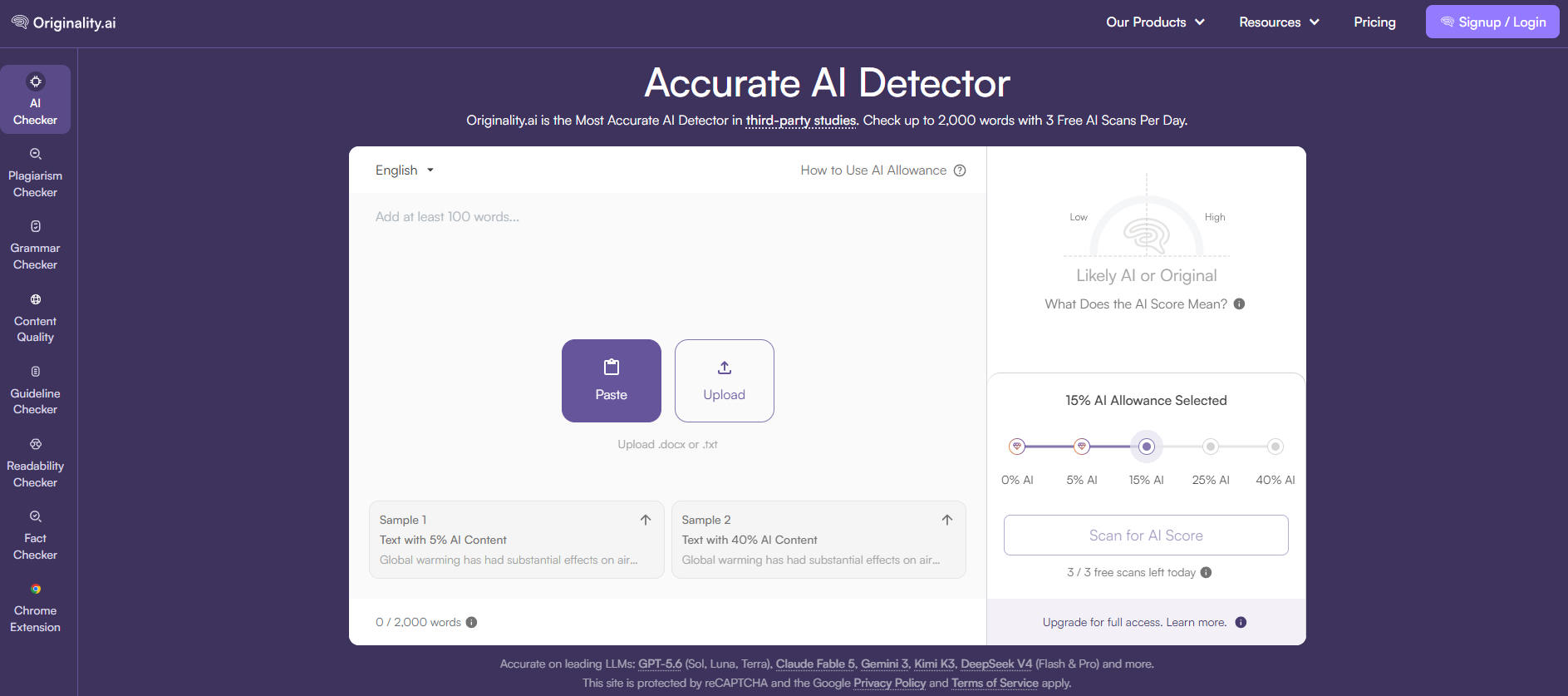
Originality.ai serves publishers, SEO agencies and content teams screening freelance copy, and every design choice follows from that buyer: credit-based pricing at one credit per 100 words, an API, a Chrome extension, plagiarism and fact-checking add-ons, and an adjustable AI allowance slider that lets an editor set how much AI-assisted text is acceptable. It retrains its detection models for each new generation of language models and claims 99% accuracy on the latest ones, citing its own study and third-party peer-reviewed work.
It performs respectably in independent testing, among the strongest commercial tools in the RAID benchmark, and its calibration is deliberately aggressive: it would rather over-flag than under-flag. That is the right trade-off for a publisher and the wrong one for a misconduct panel, and it is the single most important thing to understand when its pre-check score disagrees with what a university tool later shows. Originality.ai versus Turnitin maps that gap.
5. Pangram: the one independent studies keep favoring
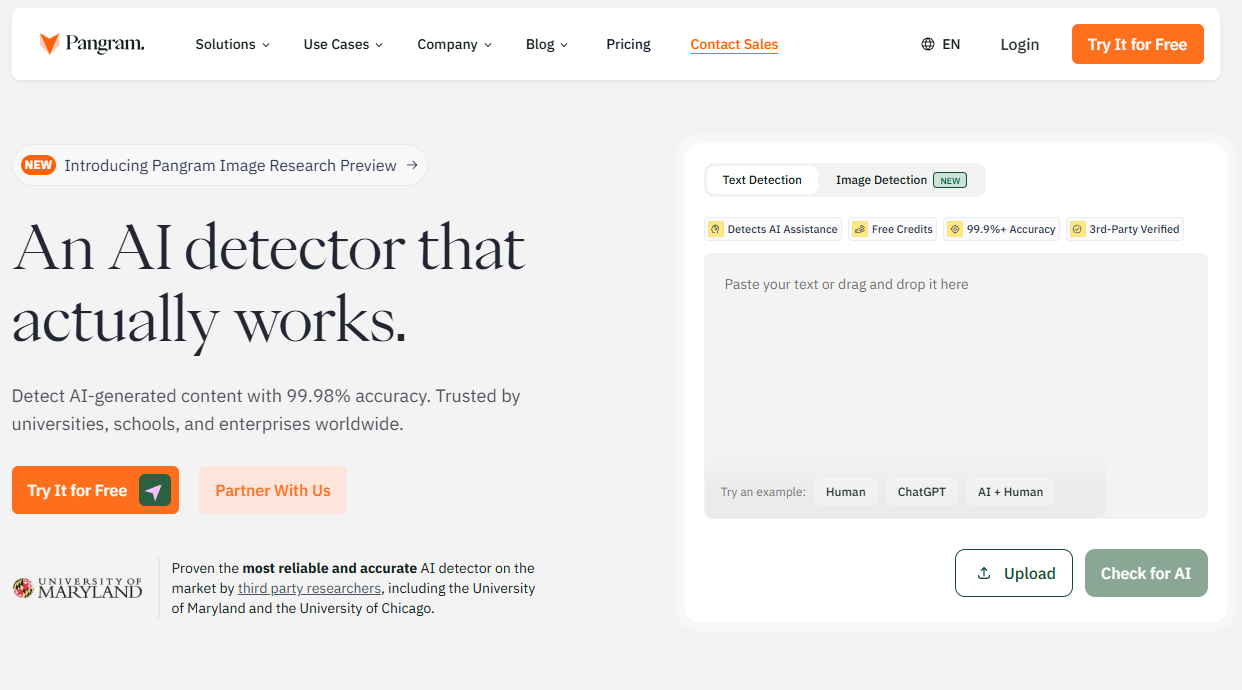
Pangram is the youngest tool here and the one researchers keep validating. Its classifier was trained specifically to hold false positives near zero, and its report includes an interpretability view showing which phrases drove the verdict. Features cover more than 20 languages, file upload with OCR, a browser extension and a Google Docs integration; the free tier scans up to 2,000 words a day. The vendor claims 99.98% accuracy and a false positive rate of 1 in 10,000, published with a per-genre breakdown.
Unusually, the independent evidence points the same way as the marketing. The 2026 VUB study found it the only tool of the four tested whose median score on fully AI-generated theses came close to the true value, and the closest aligned on hybrid and humanized papers. The NBER working paper from Chicago Booth and Maryland researchers found it the only detector holding false positives at or below 0.5% while staying strong on rewritten text. Both studies are recent and limited in scope, but no other tool on this page has this much current evidence in its favor. The Pangram review reads both studies closely.
6. Winston AI: the biggest claim, the least evidence
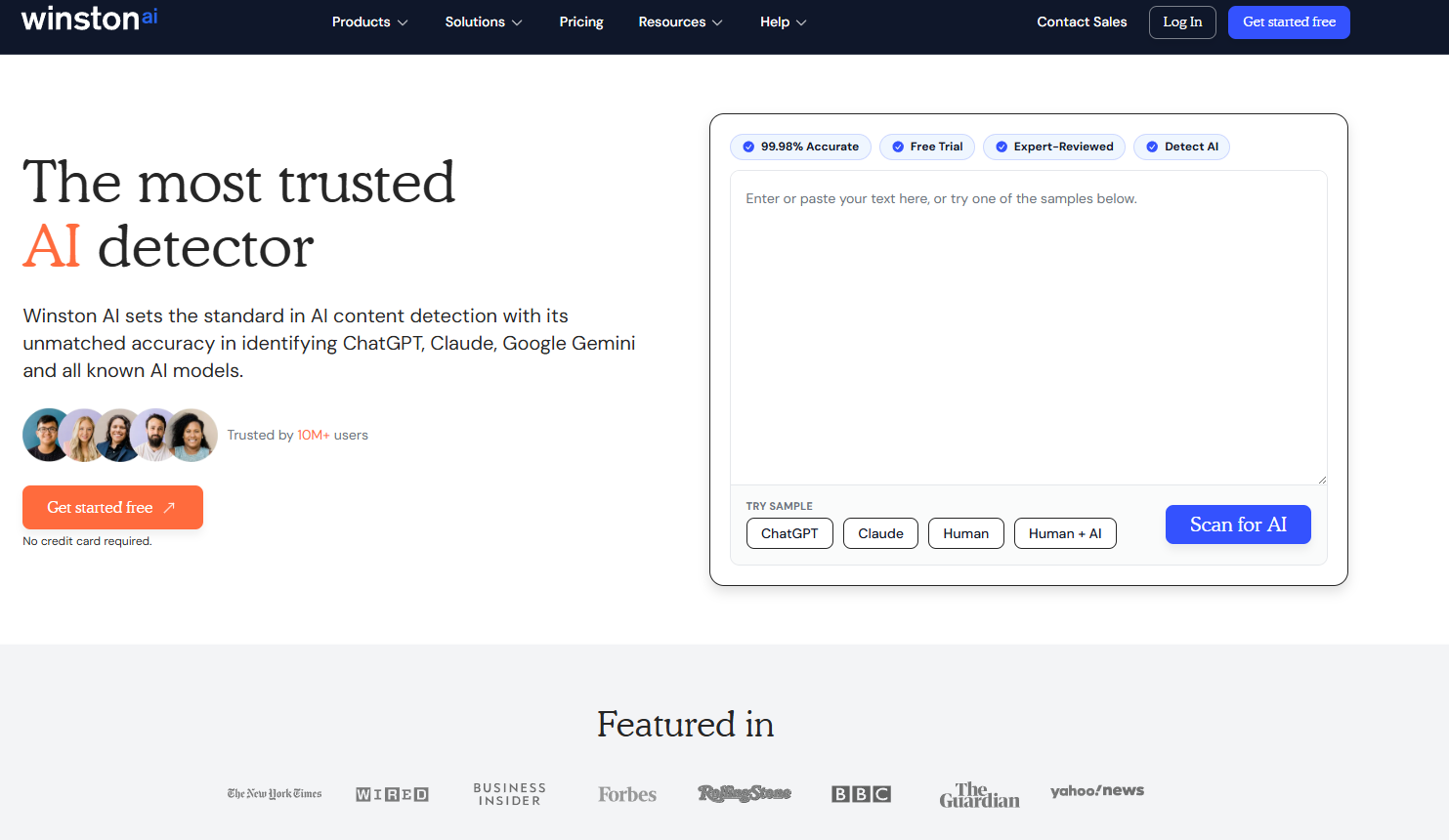
Winston AI is a credit-based detector aimed at educators and content teams. Its feature set is practical: a per-sentence heat map, OCR that reads photographed and handwritten pages, a plagiarism add-on and a Google Classroom integration. The homepage claims 99.98% accuracy and more than 10 million users; the accuracy figure comes from internal testing, and no methodology, dataset or sample size is published anywhere on the site.
The best independent reference point is the RAID benchmark (ACL 2024), where Winston detected 71% of AI text overall at a fixed 5% false positive rate: excellent on ChatGPT-style output at 99.6%, far weaker on older and open-source models, and down to 52.6% on paraphrased text. A competent tool with an inflated headline. The Winston AI review examines the claim in detail.
7. ZeroGPT: the free pre-check
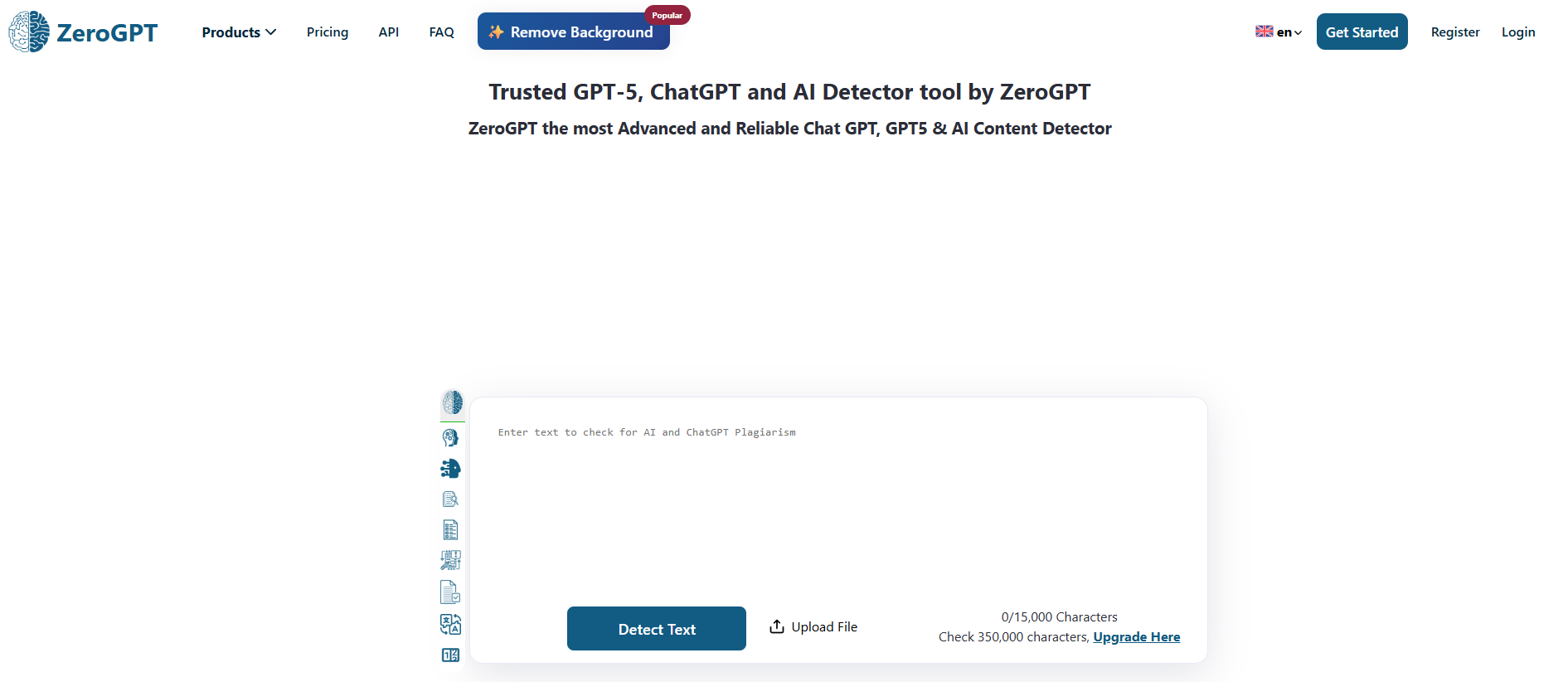
ZeroGPT is the highest-traffic free pre-check: paste up to 15,000 characters with no account and get an instant percentage plus highlighted sentences from what it brands DeepAnalyse technology. The vendor claims accuracy above 98% on internal evaluations and names no external test. Independent comparisons consistently place it near the bottom of the commercial field, and its score on the same text can swing between runs. As a rough first look it is harmless; as a verdict it is the least defensible tool on this page. The ZeroGPT accuracy review traces its claims to their sources.
8. Scribbr: the trusted brand with a licensed engine
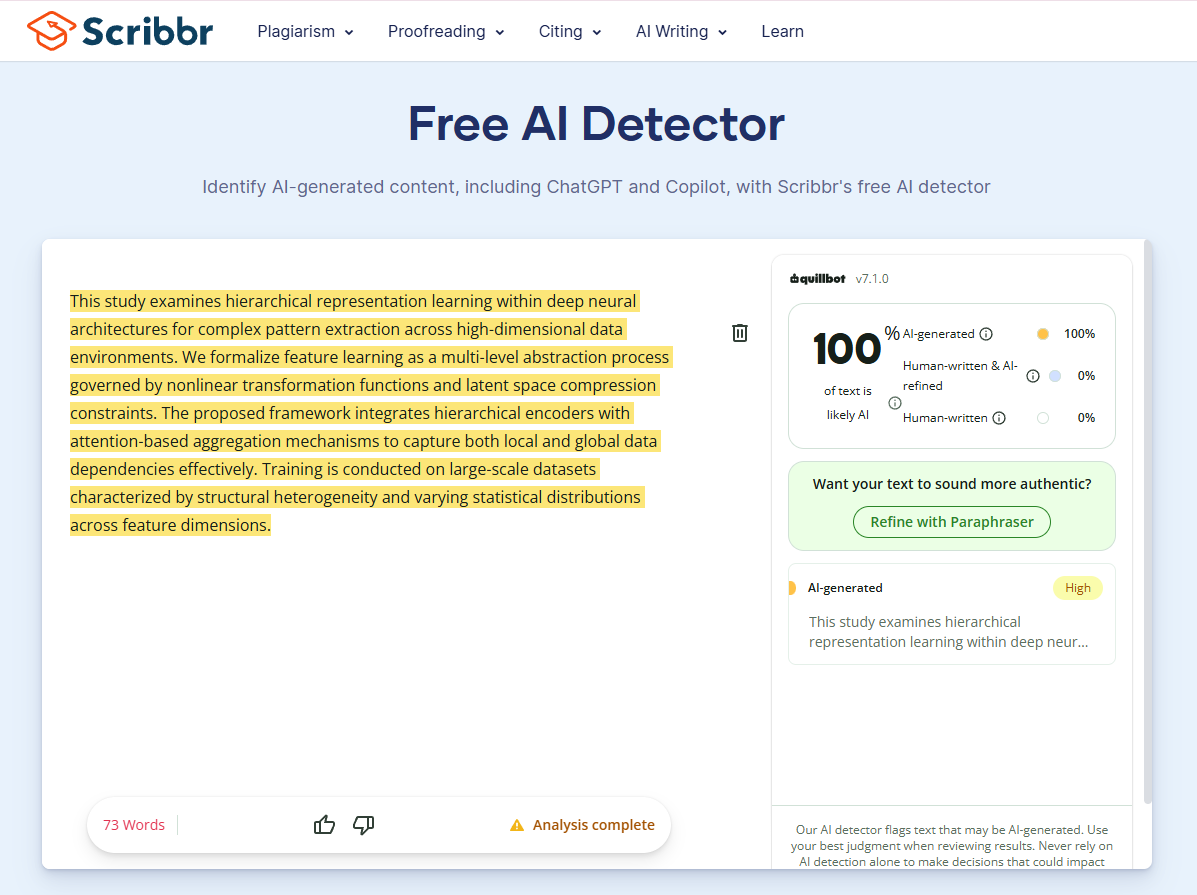
Scribbr's AI checker is the QuillBot detection engine under Scribbr branding: the result panel displays the engine version, and Scribbr's about page places both companies in the Learneo family. The free tier scans about 1,200 words in the browser with no signup and reports a three-way split across AI-generated, AI-refined and human-written. In Scribbr's own July 2026 comparison the free checker identified 78% of test texts and the premium version 84%, with zero false positives in that sample.
Those are the best published numbers in the free tier, and they come from a test Scribbr designed, ran and scored itself, in which its own corporate sibling tied for first. Students trust the checker because Scribbr's citation and thesis guides earned that trust; the detector inherits it. The Scribbr review covers what free and premium actually measure.
9. Sapling: the developer tool
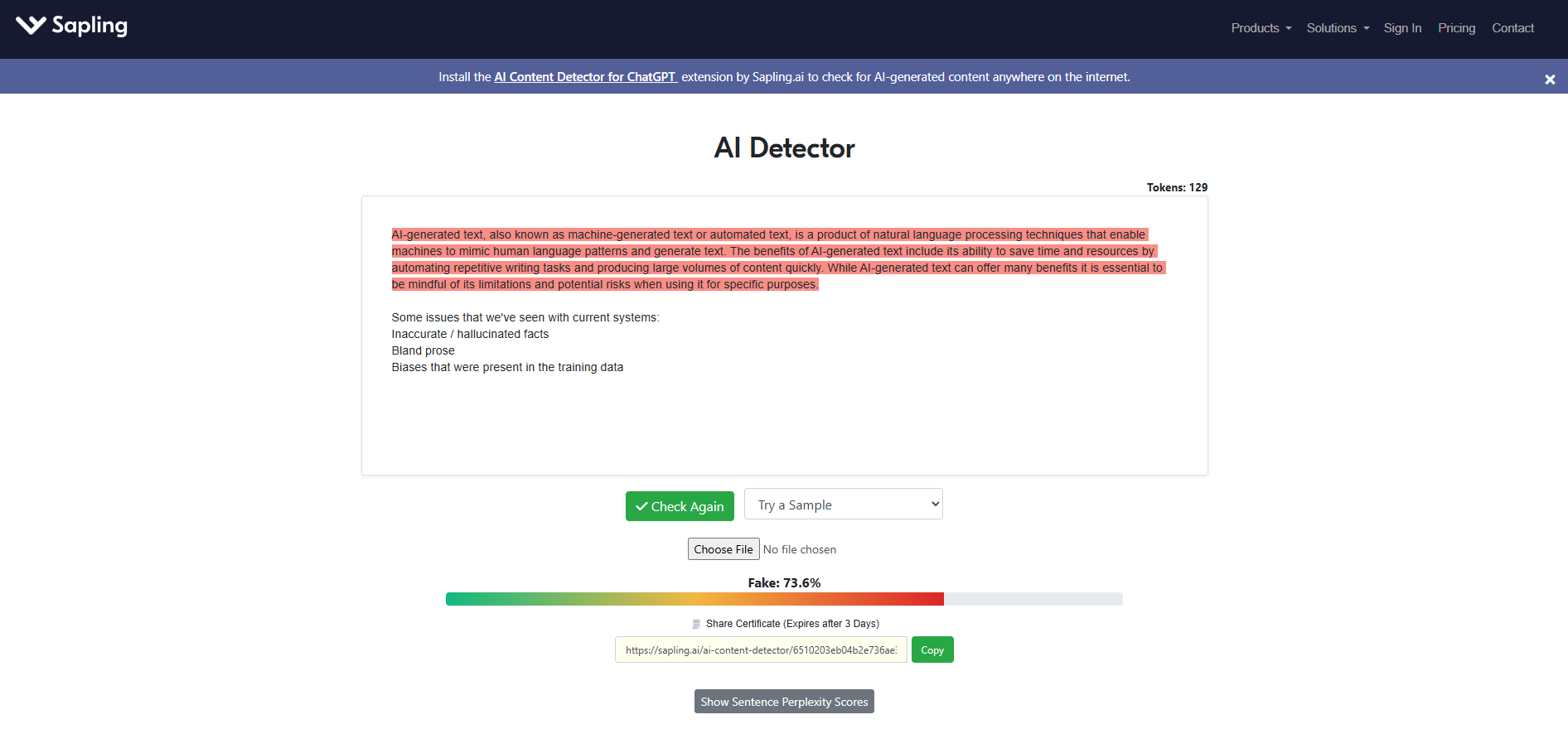
Sapling's detector comes from an NLP company whose main business is writing assistance for customer-support teams, and it shows: the most accessible API of the group, per-sentence probability scores with a perplexity view, and a browser extension that scans text inside Google Docs, Gmail, Zendesk and Salesforce. Free checks cap at 2,000 characters; paid plans raise the cap to 100,000.
Its independent record is the most volatile of the ten: 68% with zero false positives in Scribbr's comparison, near-total misses in a 2023 arXiv benchmark, and at least one hands-on review that saw it flag everything as fake. Single-review scores generalize badly for every detector, and Sapling is the clearest demonstration. The Sapling review looks at why.
10. Compilatio: Europe's institutional counterpart
Compilatio is the plagiarism-and-AI suite European institutions license where US-centric roundups assume Turnitin: strongest in French-speaking systems, with AI detection integrated into the same instructor-facing workflow as its similarity checking, and a student edition that sells the same checks by the credit. It claims a 94 to 99% reliability rate and under 1% false positives, and it is the only tool here besides Turnitin to place near the top of a peer-reviewed test, second of fourteen in Weber-Wulff and colleagues. If you study in the EU, the detector reading your thesis may well be this one. The Compilatio review covers what that ranking does and does not establish.
Humanize your own paper
Transform your AI-assisted text and make it sound human, without touching important words or citations.
iThenticate: the detector on the publisher's desk
One more Turnitin product deserves a section here, because most researchers meet it without ever seeing it. iThenticate is Turnitin's screening tool for publishers, journals and research institutions, built for checking manuscripts before publication rather than grading coursework. Its pitch is publishing with confidence: screen a high-stakes document for potential misconduct before it goes out. Thousands of scholarly journals run submissions through it via Crossref's Similarity Check service, so if you have submitted to a peer-reviewed journal, your manuscript has probably passed through iThenticate whether or not anyone told you.
Two things separate it from the Turnitin row above. It is document-first rather than course-first: no classes, no assignments, one report per manuscript. And unlike Turnitin, it can be bought by the person being assessed. Credits are sold directly on the site, priced per document, which makes it the one tool in the Turnitin family an author can run on their own manuscript before a journal does. The report is a similarity report first, matching against published literature and the web, and Turnitin lists iThenticate among the products that carry its AI writing detection for eligible customers.
For an academic writer the practical use is narrow and real: a pre-submission originality check on the final manuscript, run by the same company whose tools the journal is likely to use. What the report does not do is fix anything. It flags overlap and likely AI writing, and revising the flagged prose is still your job, which is the half of the submission checklist an academic AI humanizer is built for.
What independent research says about the category
Vendor figures cluster near 99%. Published research does not. Weber-Wulff and colleagues tested 14 systems in the International Journal for Educational Integrity in 2023, Turnitin among them, and Liang and colleagues found in Patterns the same year that 89 of 91 TOEFL essays by non-native English speakers, 97.8% of them, were flagged as AI by at least one of seven detectors, with 18 flagged by all seven.
The most direct academic test of the tools above is the 2026 VUB study, published open access in the International Journal for Educational Integrity: real master's theses, four commercial detectors, and medians below 20% on fully AI-generated papers for three of the four. Jabarian and Imas, in NBER working paper w34223, built a corpus of 1,992 pre-2020 human texts and 1,992 AI texts from four frontier models and stress-tested Pangram, GPTZero, Originality.ai and an open-source baseline: the commercial detectors beat the baseline, and only one tool held a false positive rate at or below 0.5% while staying strong across rewritten text. The open-source baseline flagged between 30% and 69% of human text, which is why free GitHub detectors are absent from the table above.
OpenAI withdrew its own AI Text Classifier on 20 July 2023, stating it was "no longer available due to its low rate of accuracy". Giray, Roe and Espiritu, publishing in English Teaching: Practice & Critique in March 2026, put the equity problem plainly: "These tools disproportionately flag authentic writing by multilingual students, creating a chilling effect that paradoxically encourages AI use to avoid false accusations." The pattern behind that finding is documented in how detectors treat non-native English writing.
Institutions have acted on the false positive record. Vanderbilt disabled Turnitin's AI detector in August 2023, reasoning that against the 75,000 papers it submitted in 2022, a 1% false positive rate implies around 750 papers incorrectly labeled. Michigan State's documentation states that AI detection tools should not be the sole basis for adverse action against a student, and the University of Texas at Austin does not endorse AI detection software at all. How accurate AI detectors actually are, as a category, is a separate question from which one your institution licenses.
The model that sidesteps scoring: process tracking
A different answer to the false positive problem is gaining institutional interest: stop scoring the finished text and record how the document was written instead. Grammarly's Authorship feature and the assessment platform Cadmus both work this way, capturing the writing process, typing, pasting, revision history, as it happens. A process record cannot false-positive an essay that was genuinely typed, which is exactly the failure mode that made universities switch detectors off. The trade-offs are different, surveillance questions replace statistics questions, but if your institution adopts one of these, the detector debate above becomes largely irrelevant to you: the evidence is the process log, not a probability score.
How to read a detector score you have been handed
A number arrives without its context almost every time. Four questions restore enough of it to have a sensible conversation.
- Which tool, and which figure. A document-level percentage and a sentence-level highlight carry different published error rates from the same vendor, and Turnitin's are 1% and around 4% respectively.
- What the vendor published about being wrong. A tool that states a miss rate and a false positive rate has told you where its limits are. A tool that publishes only an accuracy percentage has not.
- Whether the score is evidence or a prompt. Michigan State's wording, that these tools should not be the sole basis for adverse action, is a common institutional position and is worth quoting in an appeal. The appeal letter guide shows how.
- What your institution's policy actually says. Whether a detector is licensed, whether its output can be used in a misconduct process, and what a student can request are written down somewhere, and they vary widely between universities.
What Turnitin does with humanized text is answered separately, alongside a wider survey of humanizer alternatives.
Detector vendors will keep publishing round numbers, and most will keep declining to say where the numbers came from. Which of these ten your work meets is decided by whoever reads it, so the useful preparation is knowing what that tool publishes about its own error rates before anyone quotes a percentage at you. Current TextPulse pricing sits on its own page, updated there rather than in a roundup.
What Our Own Research Found
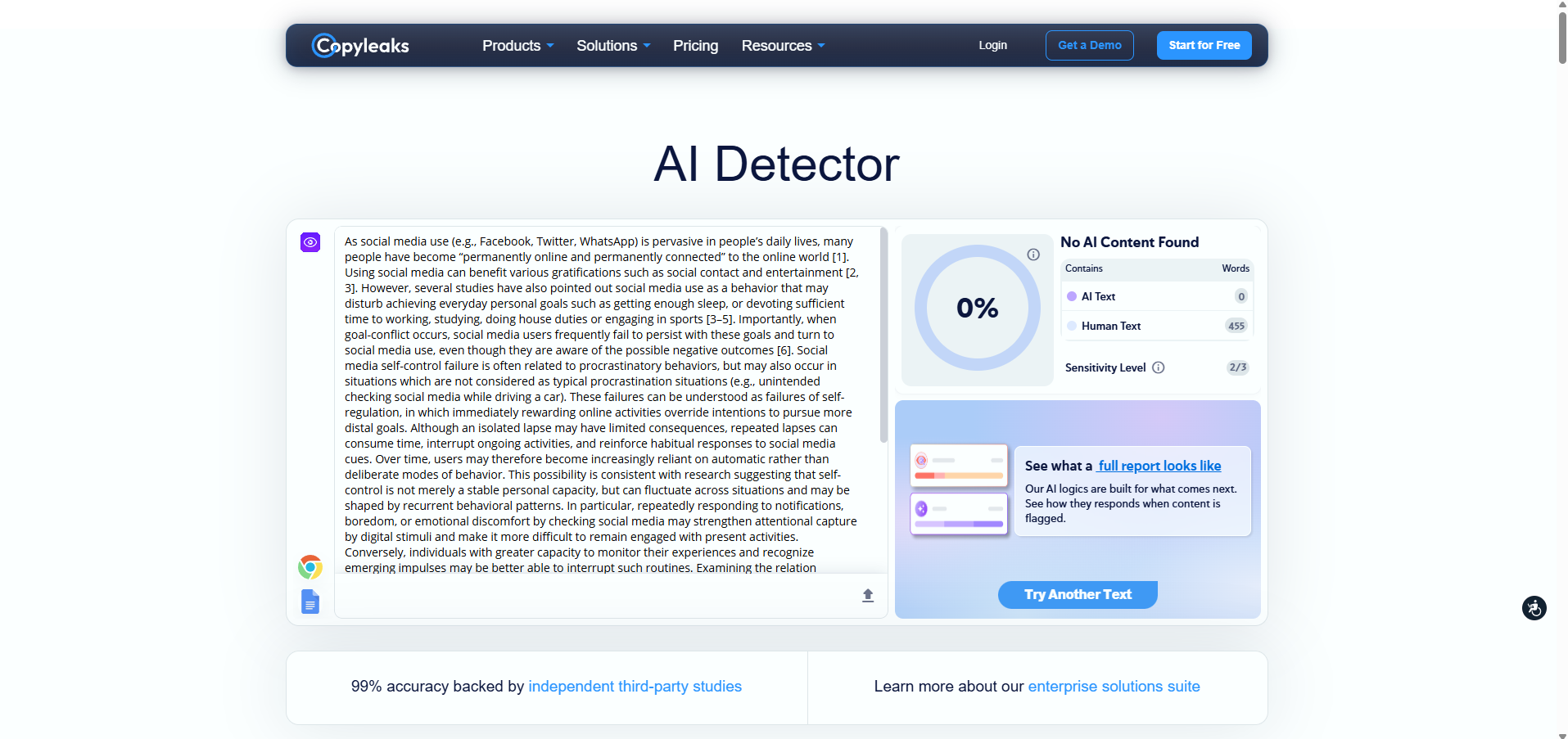
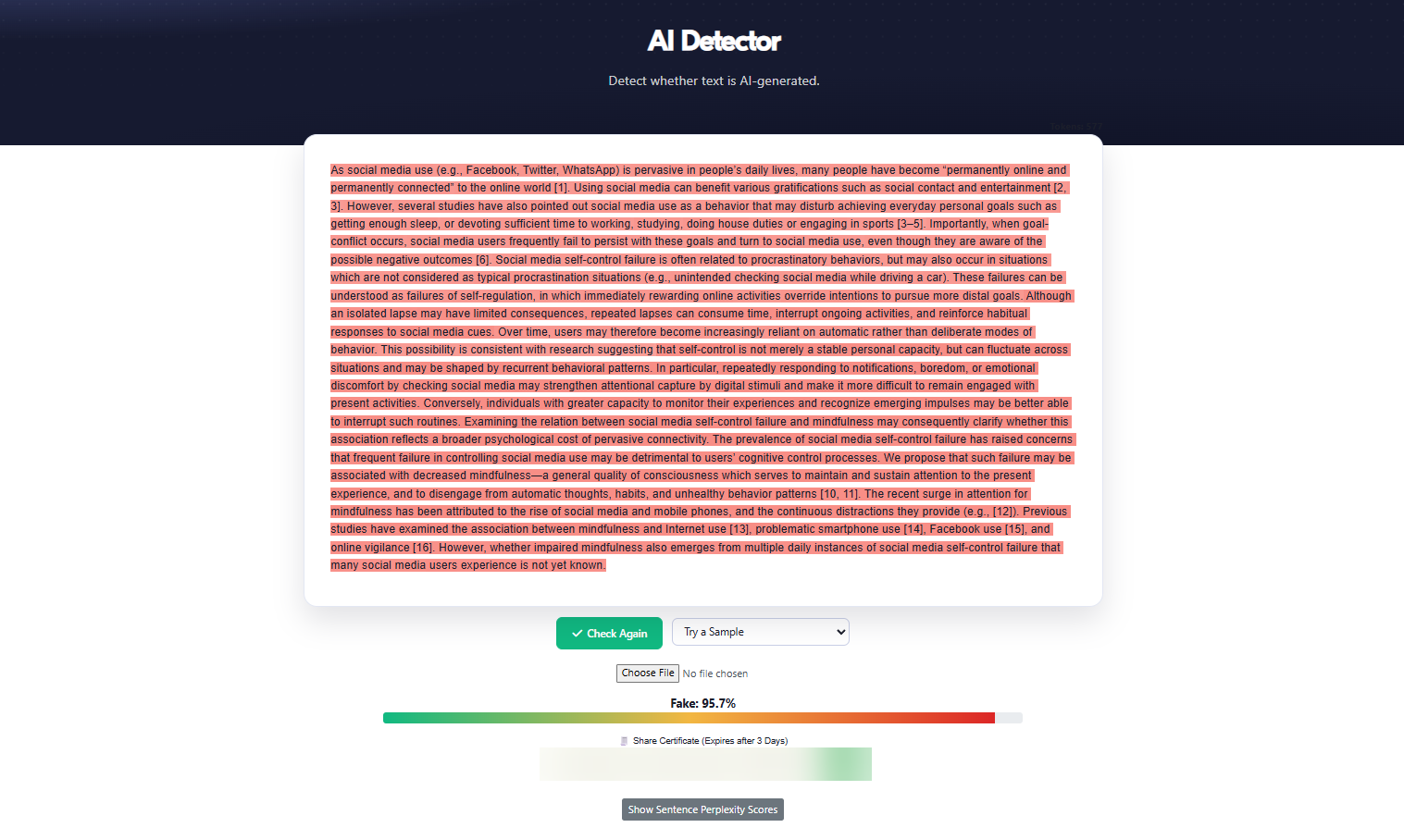
In the TextPulse Research detector agreement study, nine commercial AI detectors rated the same 90 academic texts. One was a 455-word hybrid text: a human-written opening and closing around a 168-word AI-generated middle. Copyleaks scored this text 0% AI, while verdicts from the other tools on the same words ranged from 0% to 95.7% AI. The full paper, corpus, and per-tool score matrix are open access at TextPulse Research.
Frequently Asked Questions
No vendor claim settles it, but the most recent independent evidence favors Pangram: a 2026 Vrije Universiteit Brussel study in the International Journal for Educational Integrity found it the only tool whose median score on fully AI-generated academic papers came close to the true value, while GPTZero, Copyleaks and Turnitin returned medians under 20%, and an NBER working paper found it the only detector holding false positives at or below 0.5%. Both studies are recent and limited in scope, and no detector's output is proof on its own.
Content strategist at TextPulse, here since the company started. Mark writes the product and technical coverage: how the humanizer works under the hood, what changes in each release, and what a specification actually means for your writing. His reviews of writing software come from using them on real documents rather than reading a feature list.