Copyleaks AI Detector Review: The Detector Built Into Your LMS
Copyleaks is the AI detector most students meet without choosing it, bundled with plagiarism checking inside Canvas, Moodle, and Blackboard. The vendor advertises over 99 percent accuracy and a .03 percent false positive rate. In the June 2026 Vrije Universiteit Brussel study, it failed to fully flag a single one of 40 entirely AI-generated papers. Here is what the evidence actually shows.
Most students never choose Copyleaks. It arrives pre-installed, wired into the assignment dropbox by an institution that signed the contract years ago, and the first time many writers hear the name is when a percentage appears next to their submission. So the question that matters is not whether Copyleaks is popular. It is whether the detector your university bolted into its learning management system is accurate enough to carry the weight institutions place on it.
The vendor's answer is emphatic: its product page advertises over 99 percent accuracy and an industry-low .03 percent false positive rate. The most rigorous independent academic test published to date answers differently. In a peer-reviewed study from Vrije Universiteit Brussel published in June 2026, Copyleaks did not fully flag a single one of 40 entirely AI-generated academic papers.
Both of those statements are true at the same time, and the distance between them is what this review is about: what Copyleaks is, what the company claims, what independent testing has actually found, and what a score from it can and cannot prove.
What Is Copyleaks, and Who Actually Uses It?
Copyleaks started as a plagiarism checker and added AI detection when generative models arrived, which is exactly why institutions like it: one submission produces one combined report covering both plagiarism matches and suspected AI content. Its own site lists native integrations for Canvas, D2L, Moodle, Blackboard, Schoology, Edsby, and Sakai, which covers most of the LMS market a student is likely to sit inside. The company also claims support for more than 30 languages and detection of output from GPT-5, GPT-4, Claude, Gemini, DeepSeek, Llama, and others.
That distribution model is the single most important fact about Copyleaks. Alongside Turnitin and GPTZero, it is one of the few AI detectors institutions actually deploy at scale, which means the people scored by it are rarely the people who chose it, and rarely the people who can see the full report.
What Does Copyleaks Claim About Its Own Accuracy?
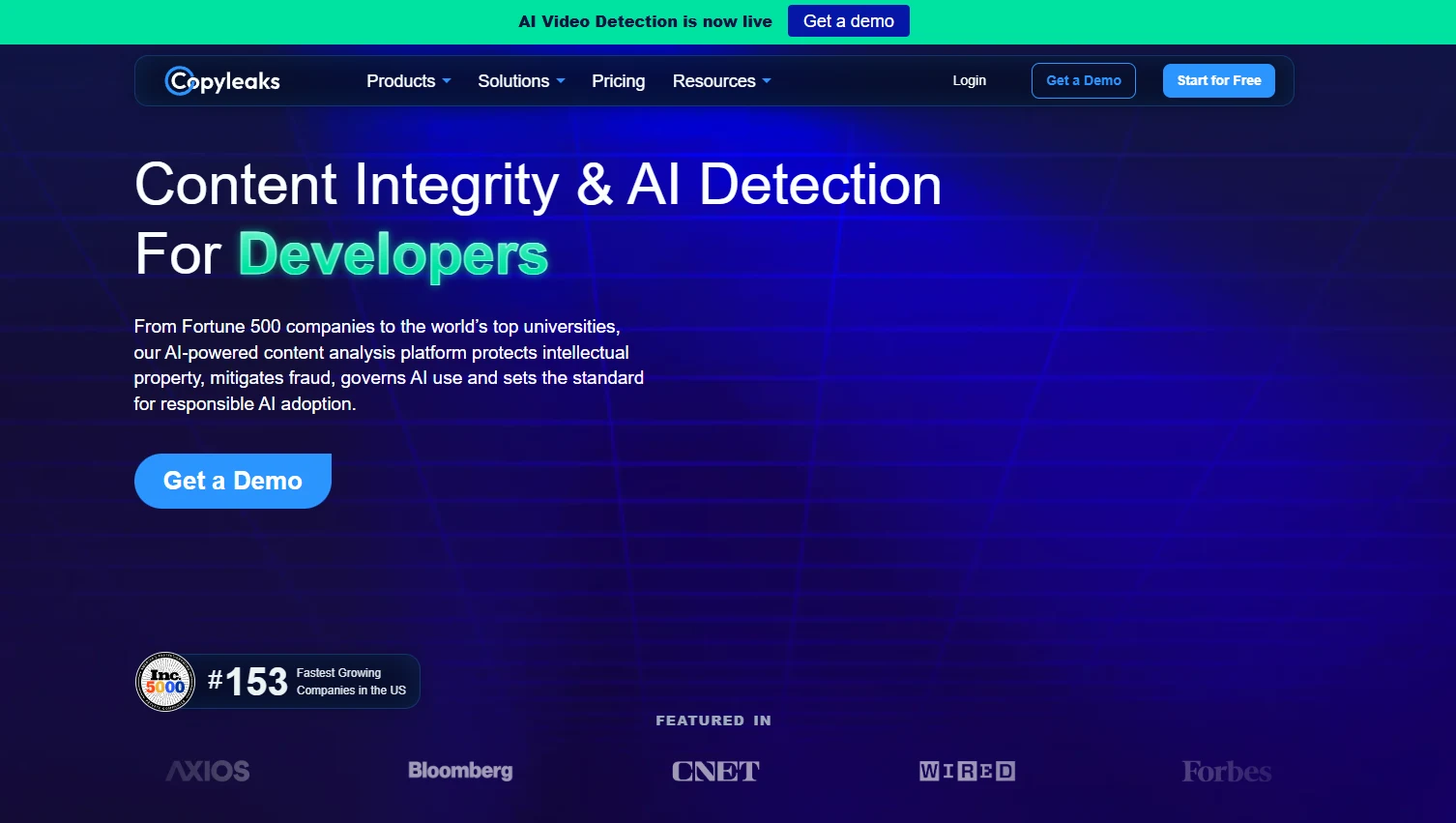
The headline on the company's AI detector page reads "99% accuracy backed by independent third-party studies," and further down the same page the claim sharpens to "over 99% accuracy and an industry-low .03% false positive rate." The page publishes per-language figures for its latest model, listing English at 99.97 percent on human text and 99.20 percent on AI text, with French, German, Italian, Portuguese, and Spanish all above 93 percent. It also states that the tool maintains "low false-positive rates for non-native English text," and points to a study on arXiv by Cornell Tech researchers that named Copyleaks the most accurate detector tested.
Read those claims carefully. The per-language numbers come from the vendor's own testing methodology, and the third-party studies it cites are the ones it selected. That does not make the figures false, but it makes them marketing until an outside party reproduces them on the kind of documents universities actually adjudicate. Mechanically, Copyleaks describes a model trained on human writing that flags deviations from human patterns, the same statistical family of signals TextPulse's explainer on how AI detectors work covers for the whole category.
What Does Independent Evidence Show?
The strongest independent test so far is the Vrije Universiteit Brussel study published in the International Journal for Educational Integrity in June 2026. The researchers built a corpus of 160 long academic papers, each over 4,000 words, split evenly across four categories: fully human-written by non-native English-speaking graduate students, fully AI-generated, hybrid, and AI-generated then deliberately humanized. They ran all 160 through four institutional detectors: Pangram, GPTZero, Copyleaks, and Turnitin.
Copyleaks cleared all 40 human-written papers, a genuinely good result. Everything else went badly. On the 40 fully AI-generated papers it classified none as fully AI-written, flagged only 10 of 40 even partially, and its median reported AI share stayed below 20 percent on documents that were 100 percent machine-generated. On humanized AI papers it caught 22.5 percent. Pangram, the study's best performer, flagged 97.5 percent of the fully AI-generated set and 92.5 percent of the humanized set on the same documents.
| Paper set (40 each) | Copyleaks | Turnitin | Pangram |
|---|---|---|---|
| Fully human-written | 100% correctly cleared | 100% correctly cleared | 100% correctly cleared |
| Fully AI-generated | 25% flagged at least partially, 0% fully | 0% flagged | 97.5% flagged, 65% fully |
| Humanized AI | 22.5% identified | 50% identified | 92.5% identified |
The authors' conclusion was blunt: of the four tools studied, "at this moment only one produced satisfactory results," and it was not Copyleaks. On long-form academic writing from current models, the documents institutions care most about, Copyleaks' dominant failure mode in this test was missing AI text, not falsely accusing humans.
What About False Positives, and Who Gets Hurt?
False negatives embarrass a vendor. False positives ruin a student's semester, so the .03 percent claim deserves its own scrutiny. In Bloomberg Businessweek's 2024 investigation, reporters ran 500 Texas A&M application essays, all written in the summer of 2022 before ChatGPT existed, through Copyleaks and GPTZero. The two services falsely flagged 1 to 2 percent of them, in some cases with near 100 percent stated certainty. One to two percent sounds small until you multiply it across a university's submission volume, and it is 30 to 60 times the rate Copyleaks advertises.
The fairness picture is genuinely mixed. In the VUB study, the 40 human papers Copyleaks cleared were all written by non-native English speakers, which is real evidence in the vendor's favor on that sample. But the wider peer-reviewed literature has repeatedly found detectors misfiring on exactly this population, a pattern covered in depth in TextPulse's page on why AI detectors are biased against non-native speakers, and Bloomberg's reporting profiled students whose records were damaged by scores they could not inspect or contest. If that happens to you, the practical playbook is documented separately: how to prove you didn't use AI.
Humanize your own paper
Transform your AI-assisted text and make it sound human, without touching important words or citations.
Pricing and Access, for People Who Did Not Choose It
The vendor's own pages set out the individual pricing: a free scan allowance of up to 25,000 characters, a Personal plan at 16.99 dollars per month (13.99 billed annually) with credit limits, a Pro plan at 99.99 dollars per month, and custom-priced Education and Enterprise contracts sold through its sales team. Students almost never pay any of this. The institution buys the license, the instructor sees the report, and the writer being scored frequently sees nothing at all unless someone shares it. That asymmetry, not the sticker price, is the access reality that matters.
Where Copyleaks Fits in the Detector Landscape
Copyleaks' real strengths are operational: one report bundling plagiarism and AI detection, the broadest LMS coverage in the category, and more supported languages than most rivals. As an enterprise workflow product it is credible. As a measurement instrument, its public evidence base is thinner than its deployment footprint. In the one peer-reviewed head-to-head on long academic documents, it trailed the best-in-class tool by enormous margins, and even Turnitin, whose own detection method works differently, caught more of the humanized set. A Copyleaks percentage, high or low, is one model's estimate under conditions its vendor controls the reporting of. It is a reason to look closer, never a verdict on its own.
The Full Comparison
Copyleaks is one player in a crowded field, and the pattern this review found, vendor certainty out front, thinner independent evidence behind, repeats across it. For how it stacks up against Turnitin, GPTZero, Pangram, ZeroGPT, and the rest on the same evidence-first standard, see the full AI detectors compared guide.
What Our Own Research Found
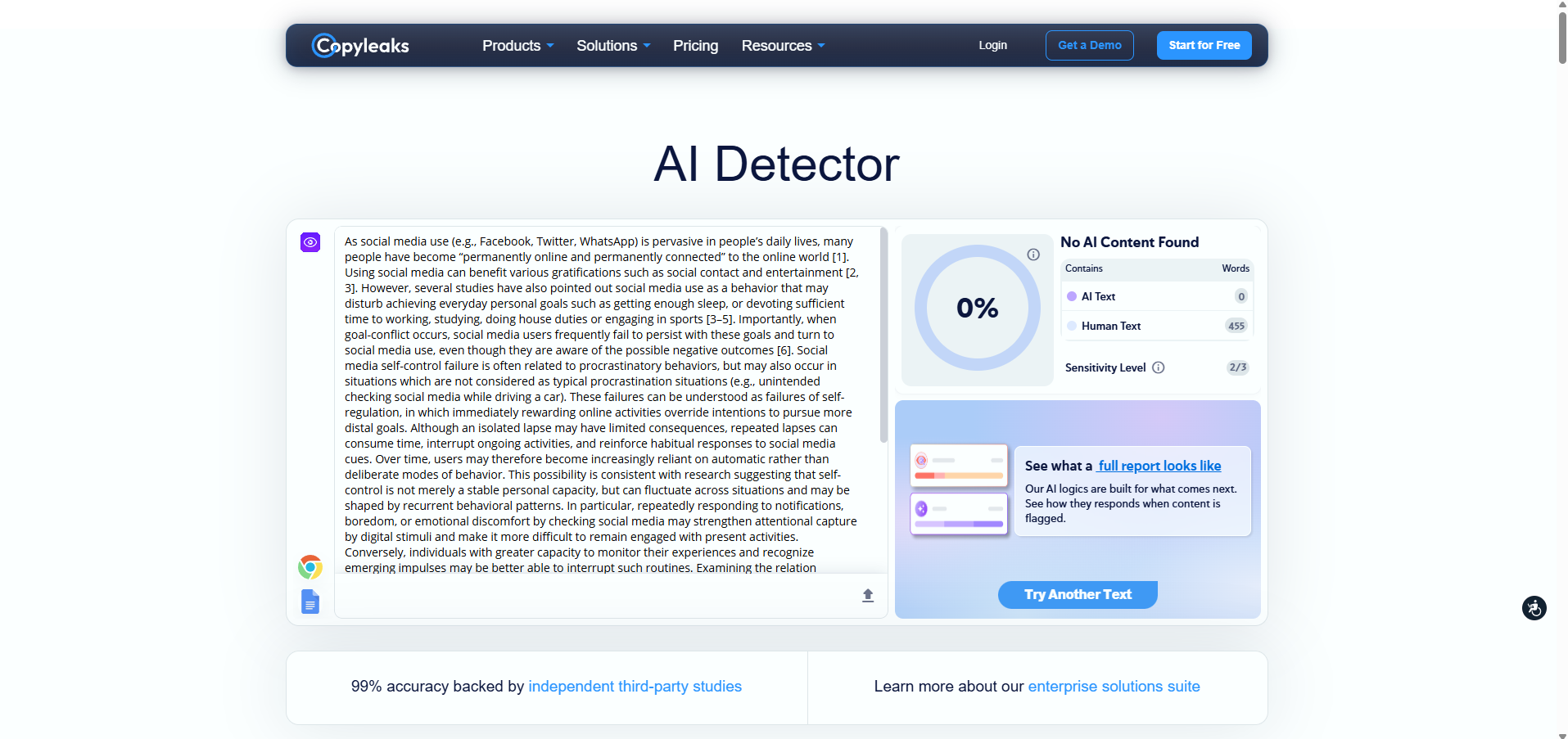
In the TextPulse Research detector agreement study, nine commercial AI detectors rated the same 90 academic texts. One was a 455-word hybrid text: a human-written opening and closing around a 168-word AI-generated middle. Copyleaks scored this text 0% AI, while verdicts from the other tools on the same words ranged from 0% to 95.7% AI. The full paper, corpus, and per-tool score matrix are open access at TextPulse Research.
Frequently Asked Questions
The vendor's product page claims over 99 percent accuracy and a .03 percent false positive rate, based on its own testing methodology. Independent results are weaker: in a peer-reviewed June 2026 study from Vrije Universiteit Brussel, Copyleaks classified none of 40 fully AI-generated academic papers as fully AI-written and identified only 22.5 percent of humanized AI papers, while correctly clearing all 40 human-written papers in the same test.
PhD in natural language processing, with years spent building NLP applications end to end. Moe works on text analysis: lexical and syntactic structure, and what separates machine-generated prose from human prose statistically. He has been experimenting with computational linguistics since the early days of NLTK, spaCy and WordNet, and still writes most of his tooling in Python.