How Turnitin Detects AI, Step by Step
Turnitin's AI writing detector does not read a document as a whole. It segments a submission into chunks, scores each one, averages the results, and only then produces the percentage on a report. This covers that pipeline, what it flags across ChatGPT, Claude and Gemini, what independent testing found it misses, and who actually gets to see the number.
A Turnitin report can return a single number, say forty-two percent, and say almost nothing else about how it got there unless someone goes looking for the mechanism behind it. That number is not read off the document as a whole and it is not a guess. It is the end of a specific, documented pipeline that runs the same way on every submission.
So how does Turnitin detect AI? By breaking up a submission into parts, scoring them individually based on whether they are likely to be AI generated or AI generated and then paraphrased, and averaging those scores to determine the overall percentage score shown on the report. Every stage of that pipeline is described in Turnitin's own documentation, not reverse-engineered from outside.
This is specifically about Turnitin's AI writing detection feature, a separate system from the older similarity or plagiarism check that compares a submission against other documents. The mechanics below sit inside the broader question of how AI detectors actually work, and Turnitin is a useful worked example precisely because it publishes more of its own method than most vendors do. What follows is the pipeline first, then what it flags in practice, what independent testing found it misses, and who inside an institution actually gets shown the result.
How Does Turnitin Detect AI? The Pipeline in Brief
Turnitin's AI writing detector runs four steps in a fixed order. First, it checks whether a document has enough qualifying prose text to score at all. Second, it divides that text into segments of a few hundred words each. Third, a model scores every segment individually. Fourth, the segment scores are averaged into the single document-level percentage a reader actually sees.
The AI Writing Report Is Not the Similarity Report
The Turnitin AI writing report is a separate product from the similarity report that checks for plagiarism. They run on different models and are displayed on different tabs in the same interface. The similarity score compares a submission against a database of previously published sources and other student papers, and returns the percentage that matches. The AI score does something else entirely: a classifier reads the prose, assigns each scored segment a likelihood of being AI-generated, and rolls those scores up into a single document percentage. Because they measure different things, a submission can carry a similarity score of 2 percent and an AI score of 60 percent, or the reverse.
The AI percentage is also narrower than it sounds. It describes the proportion of eligible prose the model predicts was written by AI, not the entire document, because code blocks, bullet points, headings and short-form writing are removed before the score is calculated. As of this writing the detector runs on English, Spanish and Japanese text only.
Step One: Segmenting the Document Into Chunks
Before anything is scored, Turnitin's model divides the submission into chunks of a few hundred words each, roughly five to ten sentences per chunk. Segmentation happens first because the model was built to score a chunk of that size, not a single sentence and not an entire dissertation in one pass.
Only prose text counts towards a chunk. The model was designed to read long-form writing. A document that contains both prose and tables or code will be scored as having some percentage of prose text but may not describe all of the prose text in the document. This is because the detector is scoring a pool of data that does not include code blocks, bullet points, or short-form text. This is why the document may return a percentage that only describes part of what was submitted.
Chunk-level scoring has a quieter consequence worth naming. A single AI-drafted sentence sitting inside an otherwise human-written chunk of a few hundred words gets averaged together with everything else in that chunk, so its effect on that chunk's own score is diluted by however much surrounding human-written text shares the same chunk. A short AI-drafted insertion still reaches the model. It simply carries less weight than a chunk that is AI-drafted from its first word to its last.
Step Two: Scoring Each Segment
Each chunk is scored on its own, independently of every other chunk in the document. The model predicts whether that specific stretch of text is human-written, AI-generated, or AI-generated and then paraphrased, a three-way distinction rather than a simple yes or no.
This is a separate category and not just an extension of AI-generated suggests there's a real problem with paraphrasing weakening detection. This is backed up by a 2023 study, which found that running AI-generated text through a dedicated paraphrasing model dropped a research detector called DetectGPT from 70.3% accuracy to 4.6%, at a constant 1% false-positive rate. It doesn't appear Turnitin has published anything about how resistant their own three-way classifier is to the same technique. The category exists for a documented reason.
Scoring at the chunk level rather than the whole-document level is a deliberate design choice. A ninety-page thesis with two AI-drafted paragraphs and a five-page essay that is entirely AI-drafted are different problems, and averaging across chunks is what lets one document-level number reflect that difference instead of flattening it.
Turnitin has not published the internal architecture of that per-chunk model in the same detail as its pipeline steps. It is a supervised classifier trained on labelled examples, not a simple threshold on the kind of raw next-token score covered in TextPulse's guide to what perplexity in AI detection actually measures, though the same underlying idea, unusually predictable text, is almost certainly part of what such a classifier learns to notice.
Step Three: Averaging Into a Document-Level Percentage
The chunk scores are averaged into the single percentage a report displays. That percentage represents the proportion of qualifying prose text, long-form writing only, that the model predicts is AI-generated or AI-generated-and-then-paraphrased. It is a proportion of scored segments, not a claim that an exact share of the document's words were literally typed by a machine.
The percentage on the report is the average. This is why two documents that both return forty percent can look different up close. One might have forty percent of its chunks scored as fully AI-generated. Another might have every chunk scored as partially likely, averaging out to the same headline number. It doesn't show which pattern produced it.
Can Turnitin Detect ChatGPT, Claude or Gemini?
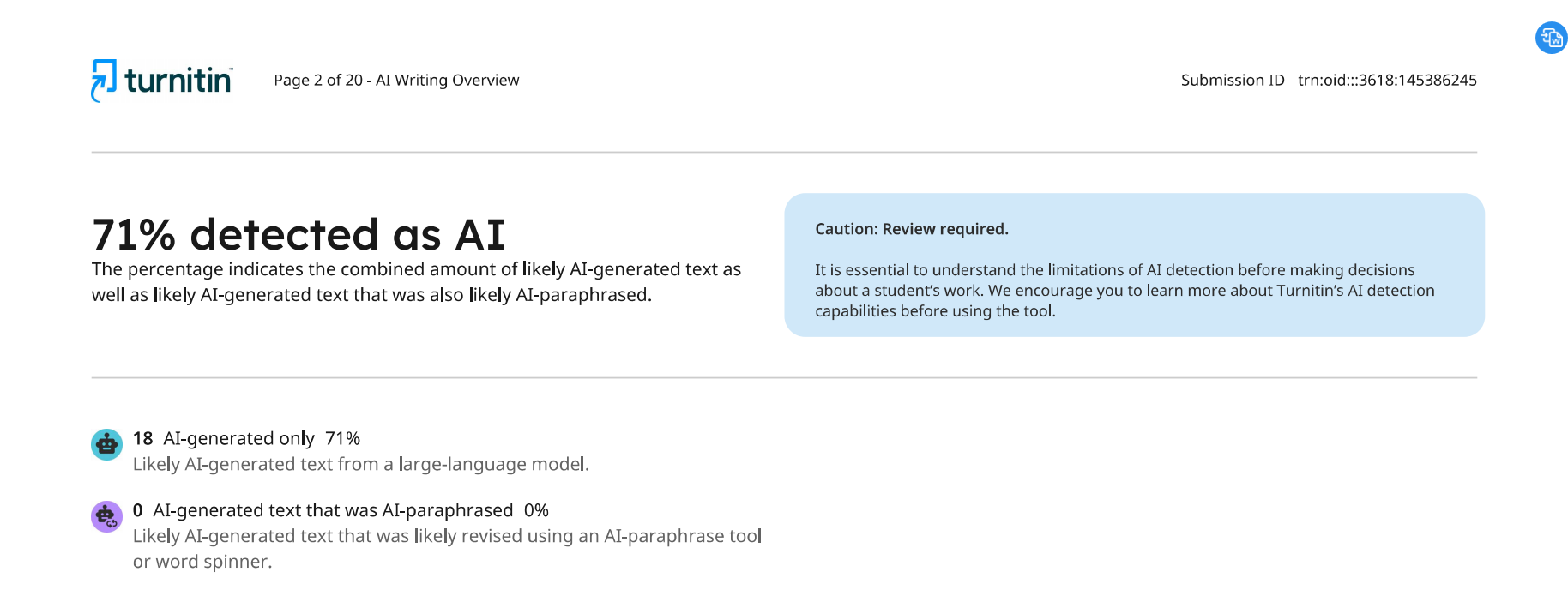
Usually yes, when a document carries substantial AI writing, and the classifier does not care which vendor produced it. Turnitin says its model looks for a writing pattern rather than a brand name, and its coverage has expanded repeatedly since the original GPT-3.5 and GPT-4 launch in 2023. Current guidance names the GPT-5 series, Gemini and Claude among the systems it is trained against, with new model releases added on an ongoing basis. A student who used Gemini, Claude or DeepSeek instead is not working around the detector simply by choosing a different company.
The share of submissions this affects has grown. About 15 percent of the essays Turnitin scanned between October 2025 and February 2026 showed 80 percent or more AI-generated writing, up from about 3 percent when the tool launched in April 2023.
Paraphrased AI text gets its own category rather than a free pass, which is the three-way classification described above. Turnitin's documentation separates text it judges to be AI-generated only from text it judges to be AI-generated and then AI-paraphrased, and in August 2025 it added detection aimed specifically at AI bypasser tools built to rewrite machine output past a detector. That does not mean paraphrasing is pointless or that every rewritten passage gets caught. It means the assumption that paraphrasing is invisible to Turnitin by default has been out of date for some time. What the tool does with paraphrased text specifically, and with DeepSeek output, is covered separately.
Humanize your own paper
Transform your AI-assisted text and make it sound human, without touching important words or citations.
The Minimum Word Requirement and the Asterisk Threshold
A submission needs at least 300 words of qualifying prose text before Turnitin's AI detector will generate a score at all, raised from an earlier 150-word minimum. Below that length, there simply is not enough text for the segment-and-average process to run on.
That 300-word floor lines up with the size of a single scoring chunk described earlier, a few hundred words, five to ten sentences. A document right at the minimum is really only handing the pipeline about one chunk's worth of qualifying text to average, rather than several, which is part of why a report sitting near that floor is more likely to land in the less reliable range the next threshold exists to flag.
Turnitin also will not display a percentage below a 20% threshold. Since July 2024, the report shows an asterisk next to a percent sign instead of a number. That single piece of report behaviour causes more confusion than any other part of the pipeline, so it gets its own section below.
| Condition | What the report shows | Why |
|---|---|---|
| Fewer than 300 words of qualifying prose | No AI score at all | Not enough text for the segment-and-average pipeline to run on reliably |
| Score would fall below 20% | An asterisk next to a percent sign, not a number | Turnitin's own documentation reports a measurably higher false-positive rate in that range |
| Score of 20% or higher | A specific percentage | Considered reliable enough by Turnitin to display as a number |
What Does the Asterisk Score Mean on Turnitin?
An asterisk on a Turnitin AI writing report means the model detected some AI writing, but less than 20 percent of the document, and Turnitin declines to publish a number in that range. Where a percentage would normally sit, the report shows an asterisk next to a percent sign instead. Turnitin's own product documentation states it directly: "When AI is detected below the 20% threshold in the report, it is now indicated with an asterisk (*%) and no percentage is attributed."
An asterisk is therefore not an error, not a missing score, and not a sign that something went wrong with the upload. It is a deliberate decision by the vendor to withhold a figure it does not consider reliable enough to print.
Why Turnitin hides the number below 20 percent
Because that band is where the tool is most likely to be wrong, and Turnitin's own accuracy promise is scoped to exclude it. The company commits to keeping its false positive rate "under 1% for documents with over 20% of AI writing". Read the scope carefully: the commitment has a floor built into it, and the floor is the same 20 percent. Below that line the company does not claim the same reliability, so rather than print a small number a reader would inevitably treat as precise, it prints nothing at all. The asterisk exists to avoid false positives, which is to say it exists to avoid handing an instructor a figure that would misrepresent a human-written document.
The reasoning tracks the mechanics described earlier. A document-level score is an average across chunks of a few hundred words. When only a small share of those chunks score as AI, the resulting average rests on very little signal, and the pipeline cannot reliably separate a genuine 8 percent from a spurious one. Suppressing the number is the honest response to that, and it is the same instinct behind the 300-word minimum.
What the asterisk means in practice at a university
In practice, most institutions treat an asterisk as nothing to act on, and read it as a low score consistent with human-written work. The reasoning is straightforward. If the vendor that built the detector will not stand behind a figure in that range, an instructor has nothing substantive to raise with a student, let alone anything to bring to a misconduct panel. For most academic integrity processes a report showing an asterisk is functionally equivalent to a clean report.
That is a description of how the result gets used, which is worth knowing if you are staring at one. It is not the same as a finding about what the document actually is, and the distinction matters in both directions.
What an asterisk does not mean
- It is not a certificate of human authorship. Turnitin is declining to score the document confidently, which is a statement about the detector rather than about the writer.
- It is not the same as zero. A document with no AI writing at all and a document with one AI-assisted paragraph can produce the identical asterisk, which is exactly why the number is withheld.
- It is not comparable between submissions. Two asterisks tell you both documents fell under the same threshold and nothing about how they compare with each other.
- It is not the similarity score. Plagiarism matching is a separate report on a separate tab, and it displays its own percentage regardless of what the AI indicator does.
The practical consequence worth carrying away is that a light AI-assisted edit, one paragraph rewritten with help and the rest written unaided, will often produce an asterisk rather than a small percentage. Neither the presence nor the absence of a number settles the question on its own, which is the same conclusion the accuracy figures below arrive at from the other direction.
What Turnitin Claims About Accuracy, and Whose Numbers These Are
Turnitin publishes its own accuracy figures, and they are worth reading as exactly that: the vendor's own validation numbers, not an independent audit. Its published material states a false-positive rate under 1% for documents the model scores above 20% AI writing, a threshold that lines up with the asterisk cutoff described above. The same programme was later extended to English Language Learner writing samples in response to research on detector bias.
Turnitin says it validated that figure against a big baseline of human-written papers submitted before ChatGPT existed. Turnitin's materials are inconsistent about the exact size of that baseline; the FAQ page cites 700,000 papers, while a blog post from Turnitin's Chief Product Officer cites 800,000, with the same under-1% claim attached to both. Turnitin's materials also describe a tradeoff, by the company's own account: catching AI-generated content more aggressively means missing roughly 15% of it.
The company has also revised its own claims in public. In 2023, shortly after launch, Turnitin's chief product officer acknowledged that lab testing had not predicted how many false positives would appear in real-world use, particularly on short submissions, and reported a sentence-level false-positive rate of around 4 percent. Raising the minimum scoreable length from 150 to 300 words was the response to that gap.
Read together, these figures describe a specific tradeoff rather than a single accuracy number. A false-positive rate under 1% sounds close to negligible until it is scaled against how many submissions run through the system, and a 15% miss rate means a meaningful share of AI-generated content is scored as human by design, not by malfunction. Turnitin's own materials present both numbers as the intended balance of the system, not as evidence the tool is simply right or simply wrong.
What Independent Testing Found
Independent testing adds detail the vendor figures do not, in the same spirit as the broader independent testing of AI detectors that keeps turning up gaps between lab conditions and real submissions. Temple University's Center for the Advancement of Teaching ran one of the more careful examinations available. Researchers submitted 120 writing samples, split evenly between fully human writing, fully AI-generated writing, AI-generated writing run through a paraphrasing tool, and hybrid texts combining human and AI contributions, and recorded what Turnitin returned for each.
The tool correctly identified 93 percent of the purely human samples and 77 percent of the purely AI-generated ones. On the tougher questions, accuracy fell further. Turnitin accurately identified just 63 percent of the paraphrased AI samples as AI-generated, and only 43 percent of the hybrid samples as neither fully human nor fully AI. Those are the categories closest to how AI-helped writing actually gets produced, and the researchers flagged hybrid text in particular as likely to account for a large and growing share of real submissions as more courses assign work that uses AI for part of the task.
| What was tested | Turnitin's result |
|---|---|
| 100% human-written samples | 93% correctly identified as human |
| 100% AI-generated samples | 77% correctly identified as AI |
| AI text run through a paraphrasing tool | 63% correctly identified as AI |
| Hybrid samples, part human and part AI | 43% correctly identified as neither 0% nor 100% |
| Documents with over 20% flagged (Turnitin's own figure) | Under 1% false positive rate |
None of these are independent findings on Turnitin's side. Researchers outside the company, cited in coverage of Turnitin's own bias studies, describe a more complicated picture again, particularly for non-native English writers and heavily edited drafts.
Where the Sentence-Level Highlights Break Down
The document-level score is not the only view an instructor can open, and the other one is less reliable. Some interfaces show a flag report that highlights specific sentences as likely AI-written. Temple's researchers checked those highlights against which sentences in their hybrid samples were actually AI-written and found no relationship between the two. This matters if an instructor forwards a screenshot of a highlighted paragraph rather than the summary percentage: the overall document score performed considerably better than the sentence-level highlights did.
Who Actually Sees the Score
The AI score is not part of the student-facing report by default. It sits on its own tab, visible to instructors and administrators, and a student sees it only if the instructor chooses to share the report or raise it directly. This is a real structural difference from the similarity score, which students can typically view themselves inside the same system once a submission has been processed.
The same applies to whether the feature exists at all for a particular course, which is an institutional decision above and beyond the instructor. Account-level administrators can switch Turnitin's AI detection on or off for a whole institution. One lecturer may not be able to turn it on if their university has turned it off, and the reverse. Two students at different universities can submit comparable work and have very different experiences of this tool, for reasons that have nothing to do with what either of them wrote.
Why Some Universities Have Turned It Off
The University of Waterloo discontinued Turnitin's AI detection feature in September 2025, and its published reasoning is unusually direct. The university cited the tool's documented unreliability, its bias against students whose first language is not English, and its own internal testing, which included at least one case of entirely human-written text scored as 100 percent AI-generated. Weighed against the expense of the tool, the university concluded the costs outweighed the benefits and redirected the effort toward assessment redesign and AI literacy training instead.
Waterloo is one visible example of a wider split rather than an outlier. Universities that keep the feature switched on have generally added guardrails rather than treating the score as a verdict on its own, requiring a conversation with the student before anything formal starts and treating the number as a reason to open that conversation rather than close it. Reading up on how universities are handling AI policy more broadly makes the pattern clearer: whether a score reaches you at all depends on a decision made well above your seminar room, not on a fixed property of the technology itself.
What a High Score Does, and Does Not, Prove
A high AI score is evidence, not a verdict. Turnitin itself frames the percentage as one data point for an instructor's judgment rather than a finding of misconduct, and the accuracy figures above explain why that framing matters: even a document-level score that performs reasonably well misreads a meaningful share of heavily edited, paraphrased or hybrid writing, and the sentence-level highlights are markedly less reliable than the summary number. None of that guarantees any individual score is wrong. It means one percentage is a reason to ask questions rather than a finding to accept on sight.
A single document-level percentage compresses four separate steps into one number, and none of those steps read meaning or check whether an argument is sound. Seeing how a shorter passage scores on the underlying statistical signals a pipeline like this is built from is a more direct way to understand a report than treating the percentage as a verdict. TextPulse's free perplexity checker runs a simplified version of that kind of word-level scoring against your own draft, outside of any institutional pipeline, and its free burstiness checker covers the sentence-rhythm half of the same measurement. Both give you a reading on your own writing, not a prediction of what Turnitin will say about it. No tool can responsibly promise that about a system it does not control.
Turnitin reports two numbers and they measure unrelated things. Which is which is set out separately, along with what actually counts as a good Turnitin score once you know what the percentage refers to. Several related questions have pages of their own: whether a professor can tell you used ChatGPT without any detector at all, the blunter version of it, will I get caught, and for particular settings, AI detection in nursing programmes and whether college admissions offices run these checks. The broader framing sits in a separate piece on academic integrity and AI.
None of this is likely to be the final version. Turnitin has rewritten its thresholds, its visibility rules and its model coverage more than once since 2023, and August 2026 will not be the last word either. It sits alongside the rest of TextPulse's free tools collection, for anyone who wants a second signal before treating one institution's percentage as the final word.
What Our Own Research Found
In the TextPulse Research detector agreement study, nine commercial AI detectors rated the same 90 academic texts. One was a 455-word hybrid text: a human-written opening and closing around a 168-word AI-generated middle. Turnitin scored this text 26.8% AI, while verdicts from the other tools on the same words ranged from 0% to 95.7% AI. The full paper, corpus, and per-tool score matrix are open access at TextPulse Research.
Related research: the findings above are examined at scale in Text Length and the Reliability of Human versus AI Text Classification, a TextPulse Research working paper with open data, code and a citable DOI.
Frequently Asked Questions
How does Turnitin detect AI? It divides a submission into segments of a few hundred words, scores each segment individually for whether it looks AI-generated or AI-generated-and-then-paraphrased, then averages those segment scores into the single percentage shown on the report. The process runs the same way on every submission that meets the minimum word count.
PhD in natural language processing, with years spent building NLP applications end to end. Moe works on text analysis: lexical and syntactic structure, and what separates machine-generated prose from human prose statistically. He has been experimenting with computational linguistics since the early days of NLTK, spaCy and WordNet, and still writes most of his tooling in Python.