GPTZero vs Turnitin: Which One Decides Your Grade
GPTZero and Turnitin get treated like two versions of the same test. They are not. One is licensed to your university and attached to your actual submission. The other is a consumer product you can run yourself at midnight. Here is what separates them.
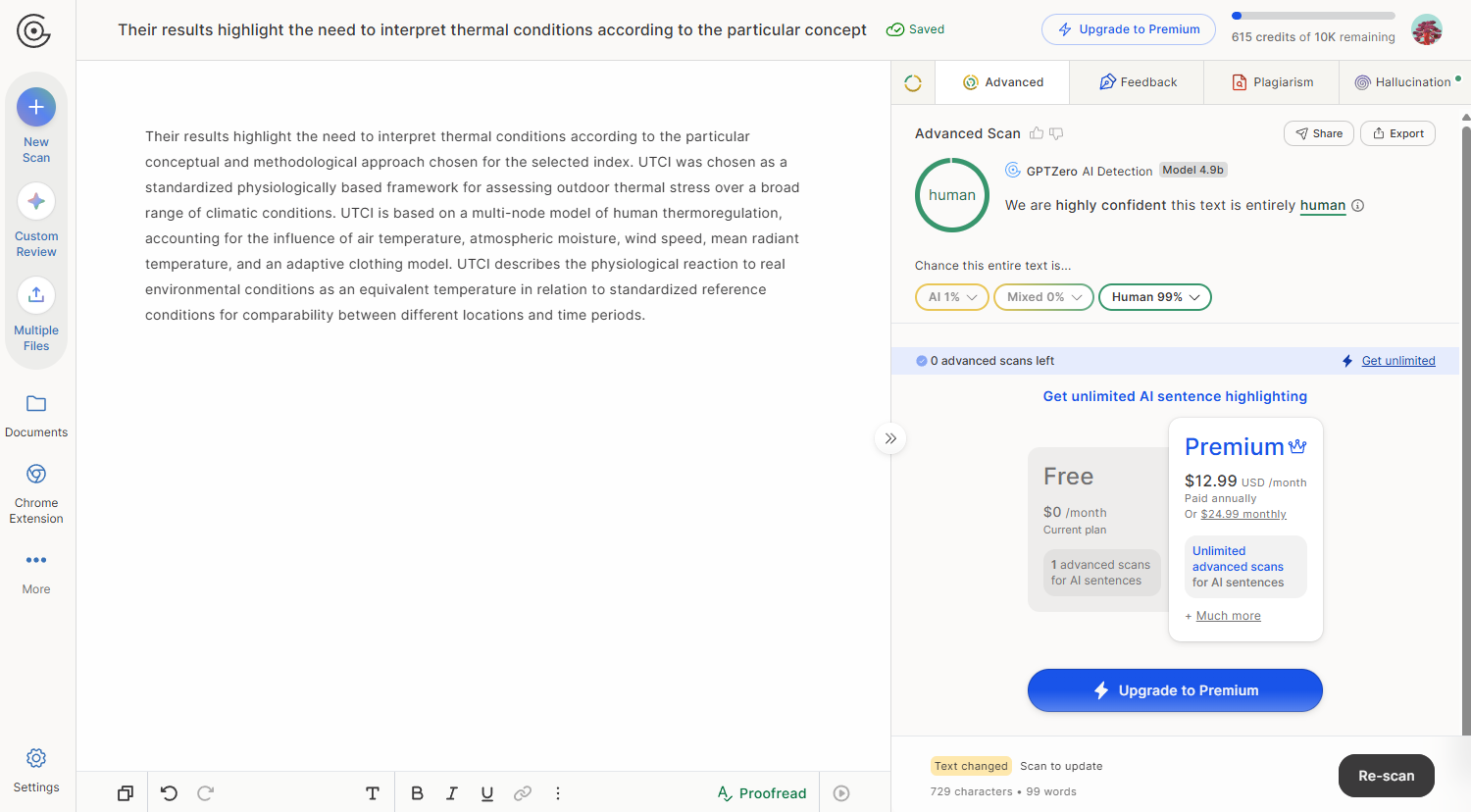
At 11pm the night before a deadline, a student pastes their own essay into GPTZero and watches a number climb past 40 percent. Panic sets in, but that number has no connection to whatever their university's actual submission system reports once the file goes in the next morning, because GPTZero vs Turnitin is a comparison between products built for two different buyers, not two versions of the same test.
Turnitin is the product a university buys and wires into the assignment submission portal. GPTZero is the product anyone can open in a browser tonight, paste text into, and get a number back within seconds, whether or not their institution has ever licensed it. Both claim to catch AI-generated writing. Neither publishes a figure suggesting one predicts the other.
This piece stays on that distinction: what each product actually is, what a marker sees, and why a self-run score is not a preview of an official one. For the wider question of what happens when a writer tries to change what a detector reports, our comparison of AI humanizer tools covers where those products help and where they do not.
GPTZero vs Turnitin: Why Students Confuse Two Different Products
The confusion is understandable, since both sit in the same sentence in most students' minds: 'the AI checker.' Turnitin is a companion to the plagiarism-matching Similarity Report it has run for two decades, licensed to an institution and switched on, or off, in that institution's own admin settings. GPTZero launched as a standalone AI detector built for anyone to use directly, and has since added plagiarism checking, grammar correction, and other writing-quality features of its own, plus institutional licensing deals of its own with, per GPTZero's own figures, more than 3,500 colleges.
That overlap matters: GPTZero is not purely a consumer product, since some institutions license it as their own official check too. Turnitin's side of the comparison has stayed consistent for years regardless: no public page has ever let an individual sign up and pay to run a personal paper through its AI Writing Indicator, only an institutional license does that. Confirm directly with Turnitin if the distinction is load-bearing for a decision you are making.
The buyer difference shapes everything downstream. Turnitin sells to an institution that needs one consistent record attached to a submission, so its output lives inside a report an administrator can open again months later during an appeal. GPTZero sells to an individual who wants an answer in the next thirty seconds, so its output is a screen you read and close. Neither design is wrong for its buyer. What it does mean is that the two numbers are produced under different pressures, and a product built to give one person a fast answer has no reason to line up with a product built to survive a disciplinary process.
GPTZero vs Turnitin at a Glance
The table below lines the two up on the four questions that actually matter to a student or a marker: who can run it, what the marker sees, what it measures, and what it costs. Some cells stay deliberately open, because neither vendor's own pricing page rendered a usable dollar figure at the time of this check.
| Turnitin | GPTZero | |
|---|---|---|
| Who can run it | Only an institution with a Turnitin license; no consumer product exists for individual writers | Any individual can sign up directly; GPTZero also licenses to institutions separately |
| What the marker sees | The AI Writing Indicator appears inside the instructor and admin view of the Similarity Report; students do not see it by default | Whatever the student chooses to share; a self-run score has no automatic route into an instructor's view unless the institution separately licenses GPTZero for its own workflow |
| What it measures | The share of qualifying prose text scored as likely AI-generated or AI-paraphrased, averaged across overlapping sentence segments | AI-generated content across named models including Claude, ChatGPT, GPT-5, and Gemini, per GPTZero's own product description |
| What it costs | No published consumer price; sold to institutions directly | A free tier for individuals; paid Professional and Enterprise or Team plans exist, but GPTZero's own pricing page did not render usable dollar figures at the time of this check |
Humanize your own paper
Transform your AI-assisted text and make it sound human, without touching important words or citations.
What Each Score Actually Measures
Turnitin defines its own percentage precisely: the share of 'qualifying text,' meaning prose sentences in a long-form document, that its model scores as likely AI-generated or likely AI-generated and then modified by a paraphrasing or bypass tool. The document is split into overlapping segments of roughly five to ten sentences, each sentence scored from 0 to 1, and the segment scores averaged into the single number a marker sees. A submission needs at least 300 words of qualifying prose before any score generates at all.
GPTZero's own site states a headline '99% Accuracy' figure and describes its detector as validated through third-party testing, covering output from named models including Claude, ChatGPT, GPT-5, and Gemini. What GPTZero's public pages do not lay out, at least not anywhere this review found, is the sentence-level mechanism Turnitin documents: how a document gets segmented, scored, and averaged into that headline number. That gap is worth naming on its own: one vendor publishes its method in enough detail to audit, the other publishes a result. A free burstiness checker can at least show you where your own draft sits on one of the statistical signals these classifiers tend to read, independent of which named tool eventually opens the file.
Who Sees the Score, and When It Actually Reaches a Marker
Turnitin's own guidance states plainly that its AI writing detection indicator and report are not visible to students by default. An instructor sees the percentage inside the Similarity Report viewer once their institution has switched the feature on, and the only route to a student ever seeing their own score is an instructor manually downloading the report and sharing it directly.
A GPTZero score works the opposite way by default: whoever runs it sees it right away, whether that is a student checking a draft or an instructor checking a submission by hand outside any institutional contract. That informality cuts both ways. In 2023 at UC Davis, a professor failed student William Quarterman for plagiarism after running his work through GPTZero directly, entirely outside any Turnitin-style institutional workflow, days before a separate case involving Turnitin's own AI detector became public. Nobody licensed it institutionally, but a person with authority over the grade chose to act on it directly. It was a real grade.
Why a GPTZero Score the Night Before Does Not Predict Turnitin's
Nothing links the two numbers mathematically. Different training data, different scoring mechanics, different minimum word counts, different file-handling rules: a score from one tells you nothing calibrated about what the other would report on the same document. Turnitin's own guidance underlines the same point about its own tool in isolation: the score is data for an educator's judgement, not a determination of misconduct on its own.
The practical differences compound. Turnitin scores only qualifying long-form prose and needs 300 words before it returns anything at all, so a short reflective piece produces no score where a consumer checker will return a percentage on a single paragraph. Document handling differs too: what counts as body text, against what gets skipped as a heading, a caption, a block quotation or a reference entry, is a decision each vendor makes on its own terms and neither publishes in full. Feed both tools the same file and they are, in a real sense, reading two different documents before any model scores a word.
Both tools carry a documented failure rate. Turnitin states a sub-1% document-level false positive rate on documents already flagged above 20% AI, and about 4% at the sentence level, figures specific enough that Vanderbilt University cited them by name when it turned Turnitin's AI detector off in 2023.
Originality.ai is the third detector worth putting beside Turnitin, and that comparison has its own page. For the tools rather than the detectors, the best AI humanizer for academic writing is assessed separately.
Checking your own draft against the same kind of statistical signal, through TextPulse's own free tools or otherwise, tells you something real about the writing. It still will not tell you what your marker's actual Turnitin report says, because that number was never yours to run in the first place.
Related research: the findings above are examined at scale in Do AI Detectors Agree? An Inter-Rater Reliability Study of Nine Commercial Detectors and Text Length and the Reliability of Human versus AI Text Classification, TextPulse Research working papers with open data, code and a citable DOI.
Frequently Asked Questions
No. GPTZero vs Turnitin is a comparison of two products with different training data, different scoring mechanics, and different minimum word counts, so neither score predicts the other. A student's own GPTZero check the night before a deadline has no calibrated relationship to whatever their university's Turnitin-integrated submission system reports the next day.
Content strategist at TextPulse, here since the company started. Mark writes the product and technical coverage: how the humanizer works under the hood, what changes in each release, and what a specification actually means for your writing. His reviews of writing software come from using them on real documents rather than reading a feature list.