MorphMind Academic Humanizer Review
MorphMind's Academic Humanizer is a free, open source Claude skill that removes visible machine writing patterns from AI-assisted papers and links inline claims to evidence. The editing it does is rigorous, and in our GPTZero test the output still scored 100 percent AI. This review describes the MorphMind humanizer skill in detail.

MorphMind's Academic Humanizer is an open source skill file that instructs Claude to edit AI-assisted research writing. The skill is installed in Claude Code, reads a draft with any writing sample the author adds, audits the text against machine writing patterns, and returns a rewrite with a change log. This MorphMind academic humanizer review evaluates the tool for academic documents, namely theses, journal manuscripts and coursework that are likely to be read by a university-grade AI detector like Turnitin AI, the gold standard in academia.
The skill was released in July 2026 by MorphMind, a startup cofounded by Jie Ding, an associate professor at the University of Minnesota, and it received news coverage in Nature and the trade press within days of release. The intended user is a researcher who already drafts with an AI assistant and wants the output to match their own scholarly register.
MorphMind is one entry in a large category of tools that rewrite AI text before submission. Our roundup of AI humanizer tools compares the category as a whole. This review covers what the skill does in detail, and what an AI detector reports about its output.
What Universities Actually Allow
Publisher and university policy require disclosure on AI use. COPE's position on AI and authorship states that an AI tool cannot hold authorship and that the authors remain responsible for all content a tool produced. The policies of the large publishers permit AI assistance with language and readability, require a disclosure statement in the manuscript, and keep the author responsible for accuracy. University integrity codes follow the same structure.
The MorphMind documentation is explicit on this point. The skill file states that it is not intended for evading AI-use disclosure, and the README describes the tool as an editing aid for clarity and voice. Whether a rewrite is used as editing or as concealment is determined by the author's own disclosure.
Why AI Drafts Need Humanizing
Researchers turn to these tools for two reasons. The first one is stylistic. Unedited, raw AI model output is recognizably robotic and generic, with sentence lengths clustered near the mean, a small set of connectives, and a recurring inflated vocabulary. Our lexicon of AI words and phrases documents how limited that vocabulary is.
The second reason is mechanical. Turnitin, GPTZero, Originality.ai and Pangram do not evaluate meaning. They measure how predictable a passage is relative to what a language model would generate, and AI assisted text is highly predictable based on its underlying token distribution. The measurement is described in how AI detectors work, and it determines the most important result in this review.
How AI Humanizers Work
- Sentence structure variation. Detectors measure sentence length variance (burstiness) directly, and converting a sequence of uniform twenty word sentences into a mixture of short and long sentences changes the statistical profile of the text.
- Vocabulary replacement. The recurring lexicon of generated text is a detection signal in itself, and replacing it changes the texture of a paragraph without changing the argument.
- Register adjustment. General purpose tools target conversational prose because most of their customers write marketing copy, while academic writing requires the scholarly register to be preserved.
What the MorphMind Academic Humanizer Is and How It Works
The Academic Humanizer is an instruction file, published on GitHub under an MIT license, that loads into Claude Code, Codex or MorphMind's own agent. There is no web application for it. The skill directs the model through a fixed sequence, in which it reads the manuscript and any writing sample, audits the text against a list of machine patterns, rewrites with the structure preserved, and reports the changes. Coverage in Nature recorded both the interest and the concern the release produced among scientists.
The first two of the six layers remove the patterns that reviewers and detectors both recognize. The general patterns include inflated vocabulary, empty intensifiers, formulaic openers, negative parallelisms and sentences that stack three or more clauses. The academic patterns include verbs that claim more than the evidence supports, significance inflation, novelty padding, citation dumping and boilerplate emphasis. Each rule is specified with a before and after example, so the edit is defined and repeatable.
- Vocabulary removed on sight includes "delve", "pivotal", "testament", "seamless" and "tapestry".
- Sentence habits corrected include formulaic openers such as "In recent years", consecutive sentences opening with "Moreover" and "Furthermore", and rule of three padding.
- Overclaiming verbs such as "prove" and "demonstrate" are replaced with "show" unless a test statistic supports the stronger verb.
The remaining layers distinguish the skill from a generic AI rewriter. Layer three preserves the scholarly conventions that a general humanizer removes, including calibrated hedging, passive voice where the actor is irrelevant, and technical terms preserved verbatim. Layer four enforces a claim to evidence rule, under which every empirical statement requires a number, figure, table or citation, and no verb may exceed its evidence. A further layer matches the author's prior papers, and a separate funding proposal mode edits NSF and NIH documents under their own conventions, retaining ambition language where feasibility evidence supports it.
Humanize your own paper
Transform your AI-assisted text and make it sound human, without touching important words or citations.
The Feature Set and Who It Is For
- Open source. The full instruction set is public, MIT licensed and auditable.
- Claim to evidence audit. Unsupported empirical claims are flagged and given evidence pointers where the manuscript contains them.
- Fidelity rules. Numbers, equations and citations may never be altered, dropped or invented.
- Voice matching. The skill reads the author's prior papers and matches rhythm, hedging habits and section openings.
- Venue awareness. The skill distinguishes a terse conference register from an expository journal register.
- Proposal mode. NSF Project Summary and NIH Specific Aims structures are edited with claim to feasibility checks.
The intended user is a researcher who already runs Claude Code or a compatible agent, has an API key and is able to work in a terminal. This describes a real portion of computer science and quantitative faculty. But it does not consider most students, and most of the humanities.
MorphMind Pricing and Running Costs
| Component | Price | What you get |
|---|---|---|
| Skill file | $0 | The full instruction set from GitHub, MIT licensed |
| Claude Code or a compatible agent | Subscription or metered API billing | The model that performs the edit |
| Word caps | None | Documents process as far as the session allows |
The skill itself is free. A long manuscript that is audited, rewritten and reported consumes model usage at the rate of the writer's plan, and a proposal edited over several rounds consumes several times that. For a researcher who already pays for Claude Code, the marginal cost of an edit is usage credits.
Citations, Terminology, Statistics and Register
The citation rule is stated in writing, which places MorphMind ahead of most of the commercial category. The fidelity constraint requires that no number, equation or citation is invented, dropped or altered, and that every cite key survives the rewrite. A stated rule is stronger than the unstated tendency of most general rewriters, in which parenthetical citations are usually preserved and occasionally are not. Enforcement still depends on the model following its instructions over a long document, and manually checking the references is advisable.
Formal definitions, named methods, metrics and symbols are kept verbatim, and the skill is instructed to flag a missing piece of evidence for the author instead of concealing it, so an unsupported claim is returned annotated. Statistics follow the same rule, in which vague magnitudes are replaced by attributed ranges and "significantly" is removed unless a test supports it. This is the strongest fidelity specification we have seen in a free tool.
The register handling reflects the academic origin of the design. Hedged verbs remain hedged, first person plural remains, and the output retains formal density where general humanizers produce casual phrasing. The AI rewrite in our test read in a formal academic tone. The remaining question is what a detector reads on a deeper level underneath the tone.
MorphMind Output on GPTZero
We generated a short methods style paragraph containing the standard patterns, namely a formulaic opener, inflated vocabulary, a forty word clause stacked sentence, a citation dump and an unsupported significance claim. GPTZero classified the paragraph as AI at 100%, which is the expected result for a raw AI draft. We then processed the paragraph through the Academic Humanizer as the skill specifies, with the audit before the rewrite.
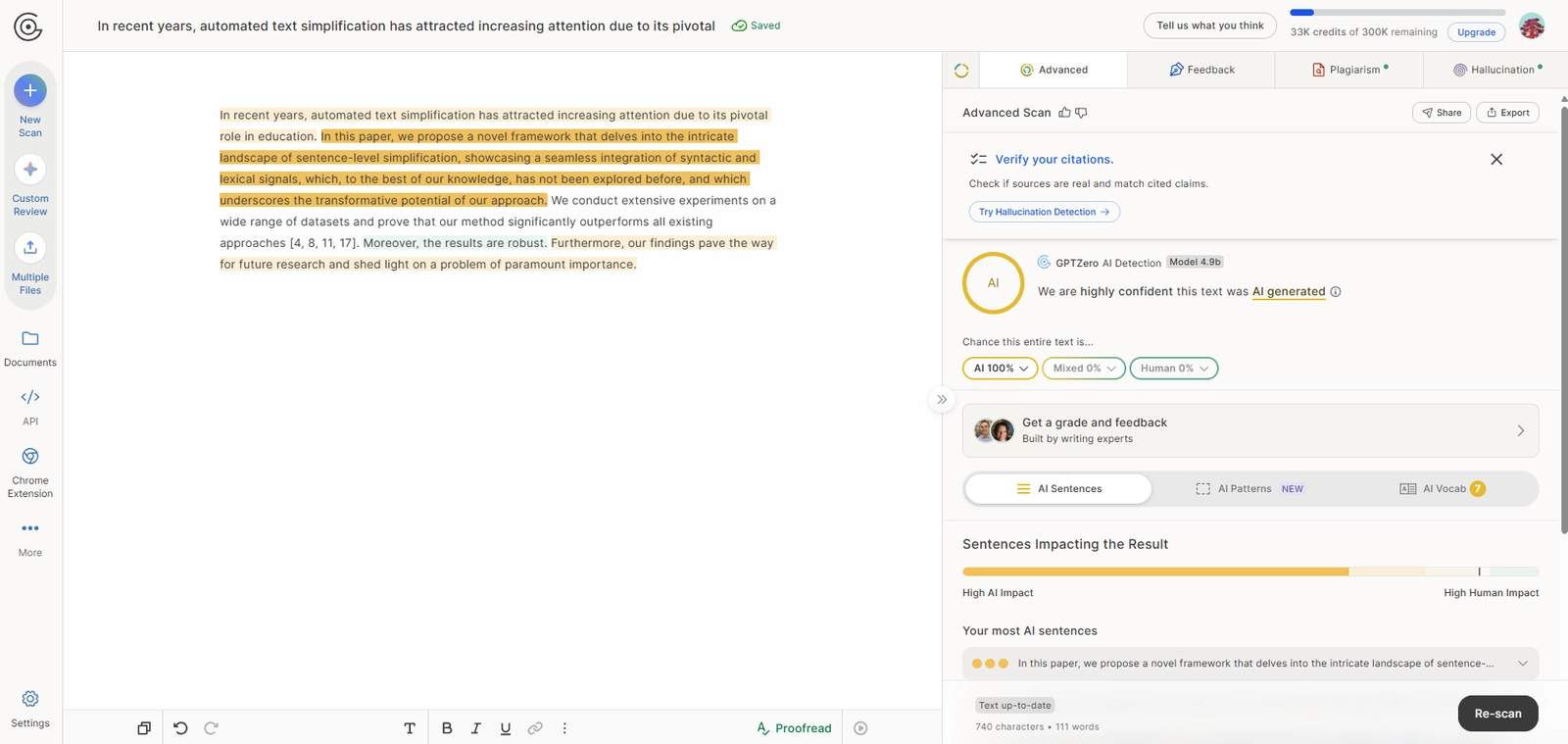
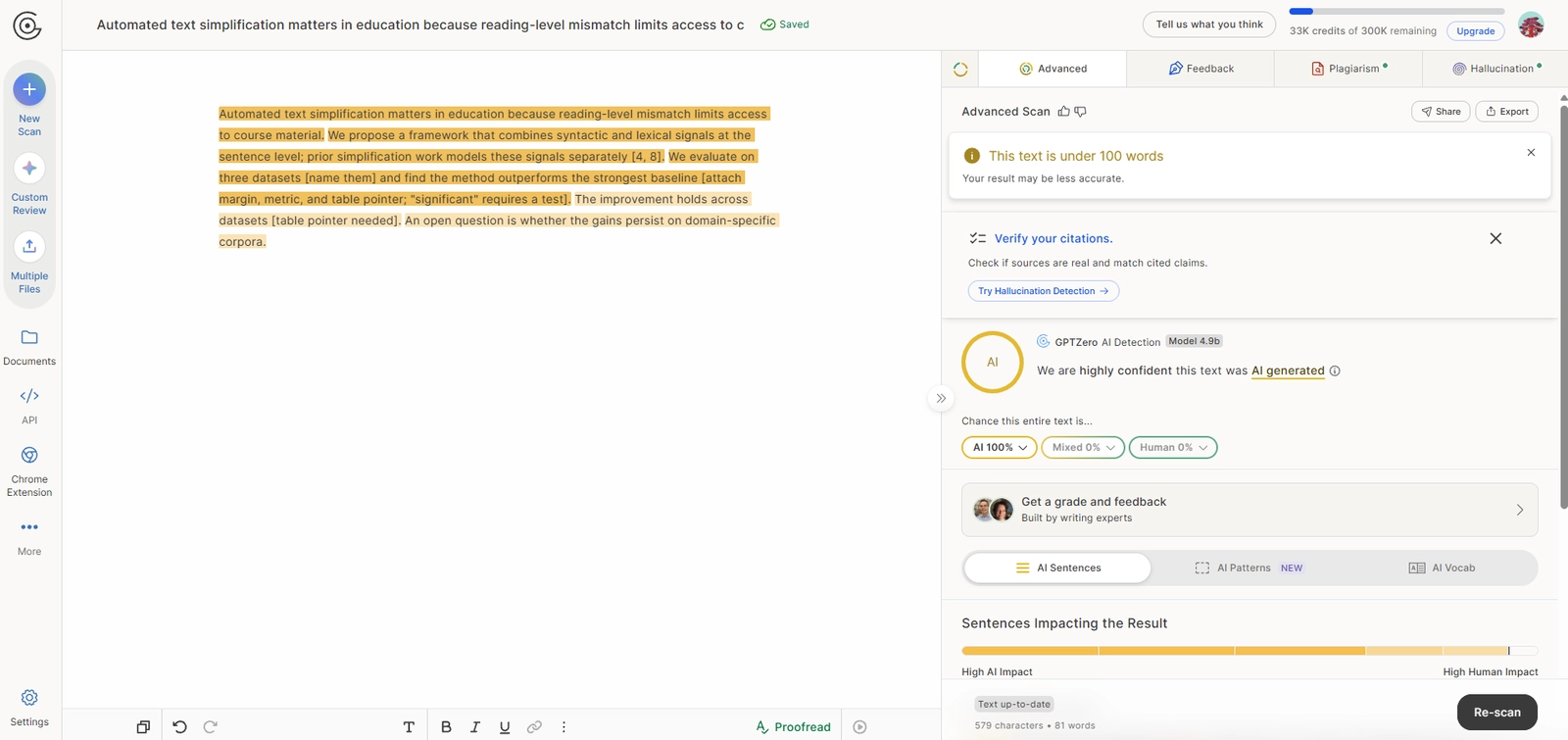
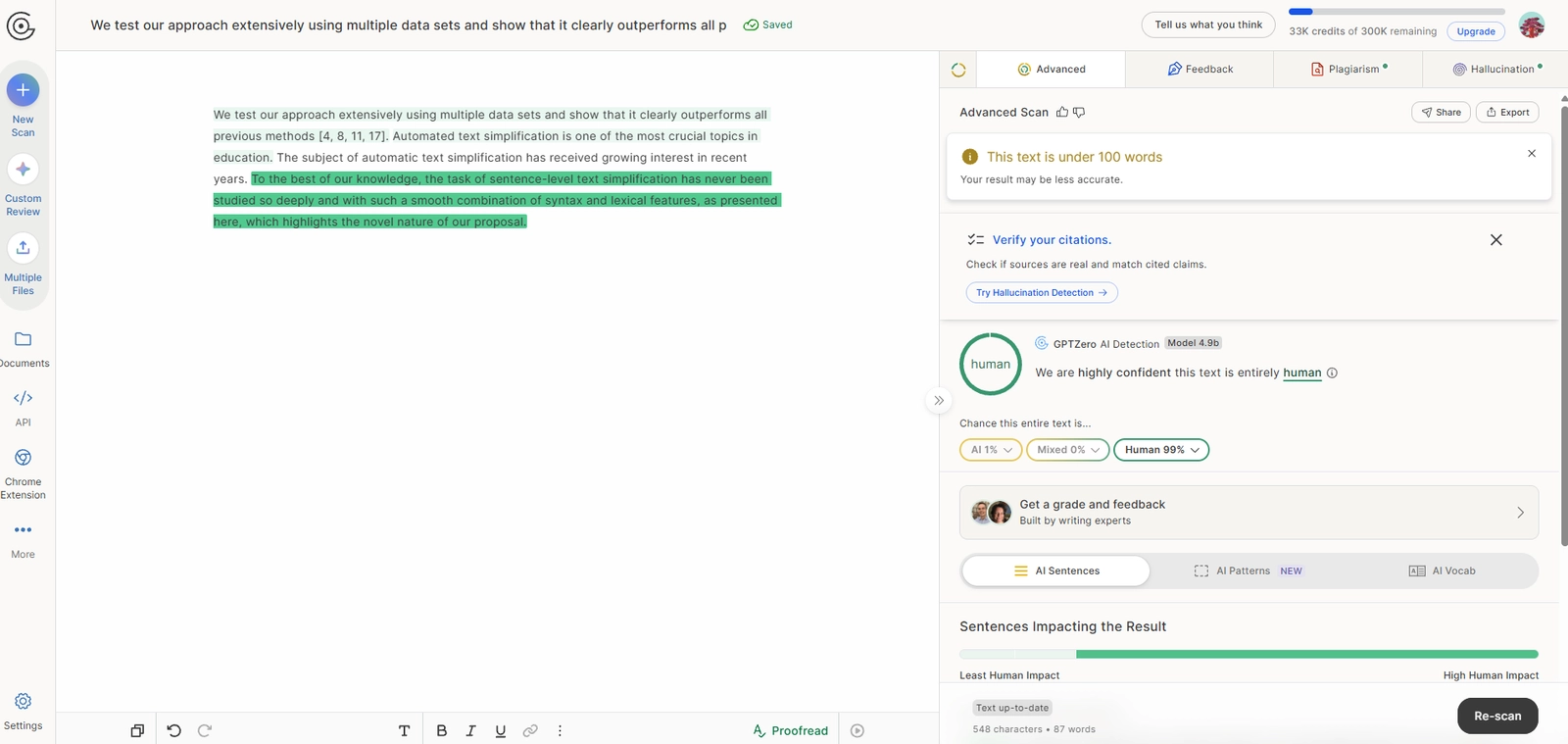
The rewrite was better prose by the skill's own criteria. The opener became a concrete problem statement, the vocabulary was reduced to plain academic English, and the overclaims were annotated with evidence pointers. GPTZero still classified the MorphMind AI rewrite as AI at 100%, unchanged from the original and at the same stated confidence. The same source paragraph, after being humanized by the TextPulse humanizer, was classified as 'human' with 99% confidence by GPTZero.
Our working paper Do AI Models Speak Human? scored 120 texts from four flagship AI models on GPTZero, written under three prompts of increasing sophistication, including a detailed brief on the properties that separate human academic prose from assistant prose. The instructions were based on the surface features, and on a 47 feature stylometric spectrum the texts changed from 148 under a plain prompt to 30 under the more detailed prompt, with the human passages at 10. The detector verdicts did not change at all. All 120 AI texts received an AI probability of 100% under every prompt and from every model, and all ten human passages received a probability of 0%.
Preference tuning restricts the distribution a model samples from, and an instruction or an editing skill conditions that restricted distribution without replacing it, so it is unchanged. A probability based detector reads the underlying token distribution more than the surface stylometry, so an AI model that edits AI text produces human-like stylometry, but it is still within a machine's token distribution, and so the detector score remains 'AI'. MorphMind was not tuned on human text, and it directs a generative model to re-edit generative output.
The TextPulse engine is trained on human-written research papers, and the same study found that one humanization changed the texts by a mean of 47 spectrum points toward the human end, while at the same time preserving 97 percent of the meaning, and produced 'human' scores on GPTZero where prompting an AI model to rewrite AI generated text alone did not achieve any 'human' scores at all.
TextPulse vs MorphMind Academic Humanizer
| Question | TextPulse | MorphMind Academic Humanizer |
|---|---|---|
| Built for | Academic documents: theses, manuscripts, coursework | AI-assisted paper drafts and NSF or NIH proposals |
| How it edits | A humanization engine trained on human-written research papers | A skill file directing a general assistant model to re-edit its output |
| Citations | Preserved verbatim across APA, MLA, IEEE, Chicago, Harvard and Vancouver | Stated rule that no number, equation or citation may change |
| Detector evidence | Vendor benchmark on a 2,000 document academic corpus: 92.33% Turnitin AI, 89.12% Originality.ai, 87.91% GPTZero | None stated, and the documentation does not aim at detectors |
| Interface | Browser dashboard, whole documents per humanization | Claude Code session, output as edited text plus a change log |
| Price | Pro $19 a month for 25,000 words, Plus $29 for 50,000, or $169 and $259 billed annually | Free skill, metered model usage behind it |
The Verdict on the MorphMind Academic Humanizer
The Academic Humanizer is the most rigorous free specification of academic AI editing that has been published, the fidelity rules are explicit, the claim to evidence audit addresses a failure mode that commercial humanizers ignore, and the proposal mode encodes genuine grant writing practice. A writer who drafts with an assistant would benefit from reading the six layers once. As an editor the tool is beneficial for researchers.
In a humanizer sense, the tool performs a different task than its name suggests. The output reads more cleanly and still scored 100% AI on GPTZero in our test. This is because an AI model that re-edits AI text changes the stylometry noticeably to the human eye, but it also inherits a highly predictable token distribution, and not a bursty, unpredictable token distribution associated with human writing. And GPTZero is trained to distinguish the two reliably. The documentation is consistent with this, since it promises no detector movement and instructs users to disclose AI use. Its practical and technical requirements restrict the audience to technical researchers who mainly want an editor that changes the stylometry from an AI one to a human one.
For coursework, a thesis or a manuscript that will be read by a research-grade detector, the recommendation is TextPulse. Citations are preserved verbatim across APA, MLA, IEEE, Chicago, Harvard and Vancouver, Freeze Terms holds instrument names and constructs fixed, and statistics survive unchanged. Documents are processed whole, the register is retained at Flesch-Kincaid grade 13 to 18, and the engine is trained on human-written academic, peer-reviewed prose, which is the property the study above shows a prompt cannot offer. The vendor benchmark across a 2,000 document academic corpus reports 92.33% on Turnitin AI, 89.12% on Originality.ai and 87.91% on GPTZero, and each humanization returns an estimated Human Score.
Frequently Asked Questions
Yes. The MorphMind academic humanizer skill file is open source under an MIT license on GitHub, with no account, plan or word cap. The remaining cost is the model that runs it, since a Claude Code session bills through a subscription or metered API usage, so a long manuscript edit has a real cost even though the skill itself does not.
Content strategist at TextPulse, here since the company started. Mark writes the product and technical coverage: how the humanizer works under the hood, what changes in each release, and what a specification actually means for your writing. His reviews of writing software come from using them on real documents rather than reading a feature list.