Scribbr AI Detector Review: What a 78% Score Actually Means
Scribbr's free AI checker posts the best free-tier numbers around: 78 percent accuracy, tied for first, in Scribbr's own published comparison, with the premium tier at 84 percent. The catch is the word "own": the test was designed, run, and graded by the vendor, and the other top free tool belongs to the same parent company. Here is what those numbers rest on, what the premium tier adds, and why a Scribbr pre-check cannot forecast a Turnitin result.
Scribbr's AI detector carries the best headline numbers in the free tier: 78 percent accuracy for the free checker and 84 percent for the premium version. Both figures are real, published, and current. Both also come from a test that Scribbr designed, ran, and scored itself, and that one fact should shape how much weight you give them before pasting a chapter into the box.
Scribbr is not a random detector startup. It began in 2012 as a thesis editing service, and its citation generator and APA guides made it a familiar name to students years before AI detection existed. That reputation is exactly why its AI checker is often the first one students try, and why its score gets more automatic trust than a number from an unknown site. The useful question is narrower than "is Scribbr good": what does that 78 percent actually rest on, and will a Scribbr pre-check predict what Turnitin shows your instructor later? The answers are, respectively, "a small self-run benchmark" and "no," and both are worth understanding in detail.
What the Scribbr AI Detector Is, and Who Actually Uses It
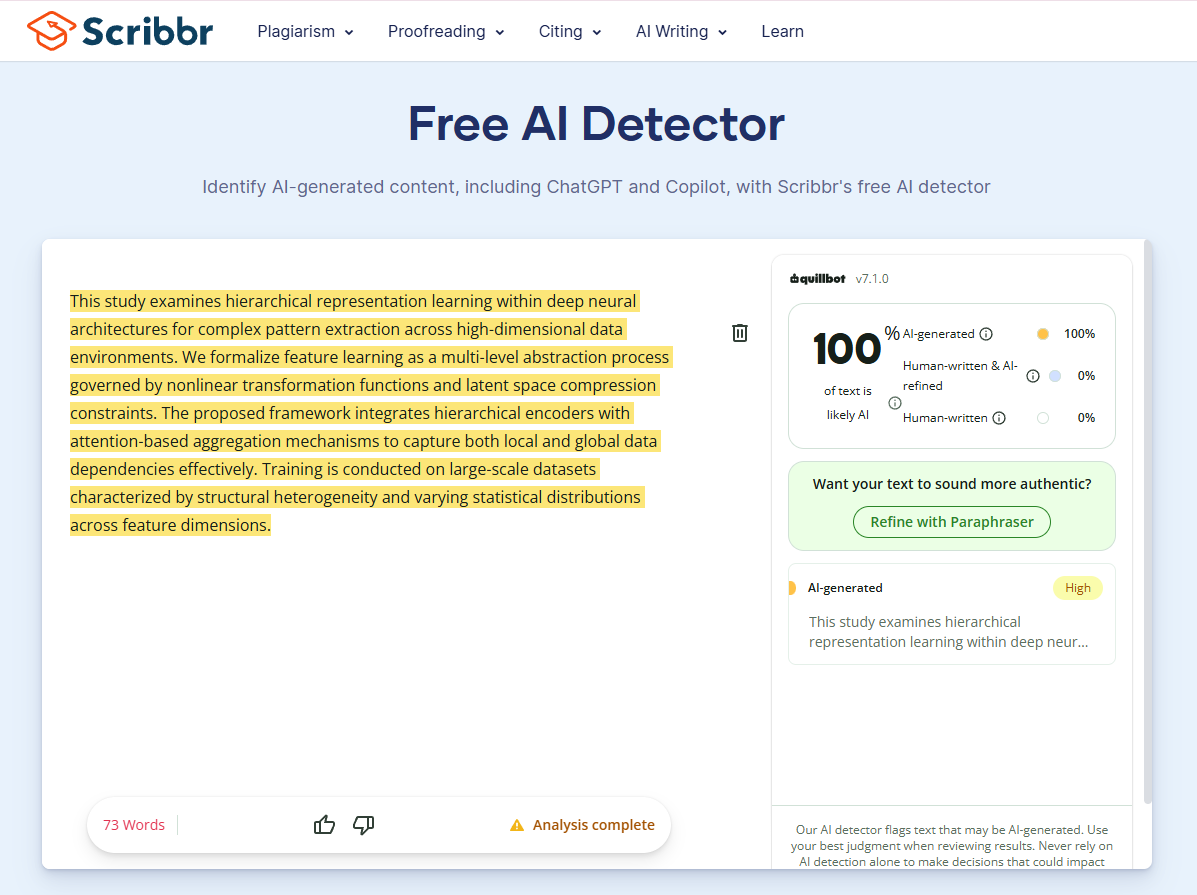
The free Scribbr AI Detector runs in the browser with no account. Scribbr's product page advertises unlimited checks of up to 1,200 words per submission, support for English, Spanish, German, and French, and a three-way classification that labels passages human-written, AI-refined, or AI-generated, with feedback at the paragraph level. Scribbr's own comparison article lists the free limit as 500 words per check instead, one of a few places where the company's pages currently disagree with each other.
The product FAQ is unusually candid about the free tier's ceiling. It states that the free detector catches texts written with GPT-2, GPT-3, and GPT-3.5 "with average accuracy," while high-accuracy detection, including GPT-4, is reserved for the premium version. That sorting matters, because most text anyone would check in 2026 comes from models newer than GPT-3.5. The free tool's primary users are students running a pre-submission check on an essay.
What Scribbr Claims: 78 Percent Free, 84 Percent Premium
The 78 percent figure comes from Scribbr's own comparison of 12 AI detectors, published in April 2026 and revised in July 2026. To its credit, the methodology is disclosed in detail: 30 test texts across six categories, fully human, GPT-3.5, GPT-4, mixed human and AI, and two paraphrased sets, each text 1,000 to 1,500 characters, scored with partial credit for near misses. In that test, Scribbr's premium detector led the field at 84 percent, and Scribbr's free detector tied QuillBot's free detector at 78 percent, with zero false positives recorded for all three.
The same article carries less quotable fine print. The premium tool, the best performer tested, still caught only 60 percent of AI text that had been blended with human writing or run through a paraphrasing tool, which is the kind of text real submissions most often contain. And Scribbr's product page FAQ has not caught up with its own comparison: it still tells visitors that "the highest accuracy we found was 84% in a premium tool or 68% in the best free tool," alongside the admission that "no AI model on the market can guarantee 100% accuracy, including ours."
The Self-Run Test Problem
Everything above is a vendor benchmark. Scribbr picked the texts, defined the scoring bands, ran the scans, and graded its own product, then published a ranking in which its own product finished first. That does not make the numbers false, and the disclosed method is more transparent than most of the industry manages. It does make them a self-run test, which should be read the way you would read any company's internal figures: as a claim to verify, not a result someone else verified.
Two details sharpen the caveat. First, the sample is small: 30 texts in total, only five of them fully human-written, so the zero-false-positives line rests on five documents. Second, the two free tools tied at the top of Scribbr's ranking are corporate siblings. Scribbr's about page states that the company is "a part of QuillBot, within the broader Learneo family of businesses," alongside LanguageTool, and the detector's own product page recommends QuillBot's AI checker as a further option. The free tier's "tie for first place" happened inside one corporate family, in a test that family published.
Independent evidence is thin, mainly because peer-reviewed benchmarks rarely include Scribbr. The most cited academic test of this category, a 2023 multi-university study by Weber-Wulff and colleagues covering 14 detection systems including Turnitin, concluded that the tools tested were "neither accurate nor reliable," showed a systematic bias toward labeling text as human-written, and lost substantial accuracy as soon as text was edited or paraphrased. Scribbr was not among the tools tested, which cuts both ways: it escaped that study's failing grades, but it also means the strongest published numbers about Scribbr's detector remain the ones Scribbr produced about itself. That is the same gap between vendor claims and independent evidence that runs through this entire product category.
Humanize your own paper
Transform your AI-assisted text and make it sound human, without touching important words or citations.
False Positives, and Who Gets Hurt
In Scribbr's own test, none of the five human-written texts were flagged, for the free or the premium tool. Five texts cannot establish a false positive rate; at best the result is consistent with a low one. The Weber-Wulff study's finding that detectors lean toward calling text human suggests the category errs more often by missing AI than by accusing people, but the accusations are the errors that cost someone a hearing, and they do not land evenly. Formulaic academic prose and text by writers working in a second language draw a disproportionate share of flags across detectors, a pattern covered in depth in our page on why AI detectors are biased against non-native speakers. A Scribbr pre-check that reads zero percent is reassurance, not evidence: it is one vendor's estimate, from a tool your institution does not use, and it proves nothing about what a different classifier will say.
Pricing and Access Reality
The free checker is genuinely free: ad-supported, no sign-up, unlimited runs. The premium AI detector is not sold on its own. Scribbr's comparison article describes it as an add-on to the premium plagiarism check, which costs between $19.95 and $39.95 depending on document size, with no word limit on uploads.
The bundling hides a distinction worth knowing. The two products are separate systems. Scribbr's FAQ states that its plagiarism side uses "technology similar to the software used by most universities and publishers," while "the add-on AI detector is powered by Scribbr's proprietary software." A similarity score and an AI score arriving in the same report come from unrelated machinery, and confidence in one says nothing about the other.
Why Your Scribbr Score Will Not Match Turnitin's
The most common way students use this tool is as a Turnitin rehearsal, and that is the use it supports least. Every AI detector is a classifier trained by a different team, on a different corpus, with different decision thresholds and a different tolerance for false positives. Calibration differences mean the same essay can score 2 percent on one tool and 60 percent on another without either tool malfunctioning, and the Weber-Wulff study documented exactly this kind of disagreement across systems. Turnitin's model, which works differently and is visible only to institutions, was tuned with priorities Scribbr's team had no visibility into, and its errors follow their own pattern, covered separately in our analysis of the Turnitin false positive rate. A low Scribbr score the night before a deadline is a data point about Scribbr, not a forecast about Turnitin.
The Verdict, and the Full Comparison
Scribbr's free AI checker is one of the better documented tools in the free tier, from a company with a real academic track record, and its published methodology is more open than most rivals offer. Its headline accuracy is still a self-graded score from a 30-text internal test in which its corporate sibling took the other top spot, its free tier is explicitly weaker on current models by the vendor's own account, and its output cannot be calibrated against the institutional tool that will actually judge your work. Use it as a rough early signal on a draft, and treat any single percentage, from any detector, as an estimate rather than a verdict. To see how Scribbr's numbers stack up against GPTZero, ZeroGPT, Copyleaks, and the rest of the field under one consistent lens, start with our full comparison of AI detectors.
Frequently Asked Questions
In Scribbr's own published comparison, revised in July 2026, the free checker identified 78 percent of 30 test texts correctly and the premium version 84 percent, the top scores in that test. Both figures come from a benchmark Scribbr designed, ran, and scored itself, so they are vendor claims rather than independent results. No major peer-reviewed detector benchmark has included Scribbr, and the company's own FAQ states that no AI model can guarantee 100 percent accuracy.
PhD in natural language processing, with years spent building NLP applications end to end. Moe works on text analysis: lexical and syntactic structure, and what separates machine-generated prose from human prose statistically. He has been experimenting with computational linguistics since the early days of NLTK, spaCy and WordNet, and still writes most of his tooling in Python.