Compilatio AI Detector Review: Europe's Institutional Detector
Compilatio is the detector European universities license where American roundups assume Turnitin: French-built, used by more than 1,100 schools across over 50 countries, and the only major institutional detector a student can run on their own work before submitting. It claims a 94 to 99% reliability rate at catching AI text and under 1% false positives. The one peer-reviewed study to include it ranked it second out of 14 tools, and concluded the tools it tested were neither accurate nor reliable. Here is what the evidence supports.
Compilatio is the AI detector European universities license where American roundups assume Turnitin. It is French-built, it has been in the plagiarism business for over twenty years, and its own site reports more than 1,100 schools equipped across over 50 countries. If you are writing a thesis in France, Belgium, Switzerland or Spain, this is often the software that reads it.
Its accuracy claim is specific: a "94 to 99% reliability rate" at detecting AI-generated passages, with "less than 1% false positives". The one peer-reviewed study to include Compilatio ranked it second out of fourteen tools, behind Turnitin, and concluded that the tools it tested were "neither accurate nor reliable".
Second place in a field the researchers judged unreliable is the tension this review is about. Compilatio also does one thing none of its institutional rivals do: it sells the same detector to the students being assessed, starting at 4.99 euros.
What Is Compilatio, and Who Actually Uses It?
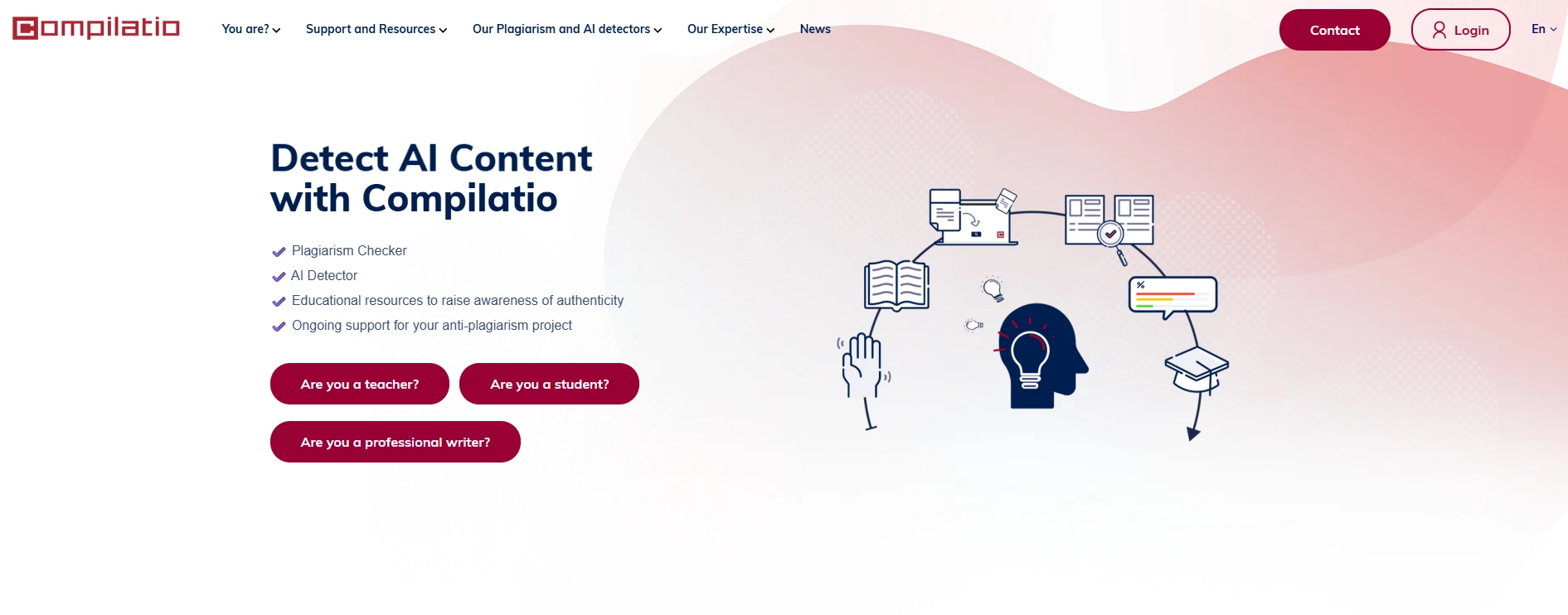
Compilatio sells four products, split by who is holding the document. Magister is the teacher-facing similarity checker. Magister+ adds AI detection, deep rephrasing detection, multilingual and translation detection, and grammar checking on top of it. Studium is the student version, sold in credits. Compilatio Copyright targets professional writers and editors checking work before publication.
The company reports over a million users, presence in more than 50 countries, and that 95% of schools re-subscribe each year. Its servers are in France, which is a genuine selling point for European institutions weighing GDPR obligations before sending student work to a US processor, and it is part of why Compilatio holds French-speaking systems the way Turnitin holds anglophone ones.
What Compilatio Claims About Its Own Accuracy
The vendor's AI detector page states a "94 to 99% reliability rate" for detecting AI-generated passages and "less than 1% false positives", with the range varying by document length, language and academic content type. It says the detector covers more than 35 languages and recognises output from ChatGPT across GPT-5.2, GPT-5.1, GPT-5, GPT-4.5, GPT-4o and GPT-4o Mini, plus Gemini, Claude, DeepSeek and Copilot. The result reaches a teacher as a percentage between 0 and 100 estimating how much of the document was machine-generated.
On its own blog the company puts that number in context: it reports its 2023 detector at "over 70%" accuracy and says reliability has "increased by more than 20%" since. That is a rare thing on a detector's website, a vendor publishing what its product used to score.
The disclaimers are unusually direct too. Compilatio states that "the percentage of AI-generated content should always be interpreted with caution and complemented by human analysis", that "AI detectors can't pretend to be 100% accurate", and that "the final judgment should always rest with educators and students". Set that against rivals advertising 99% certainty with no caveat and it is the more honest presentation in the category. It remains vendor testing, run and reported by the company selling the product.
What Independent Evidence Shows
The study that matters is Weber-Wulff and colleagues in the International Journal for Educational Integrity, which tested fourteen systems: twelve publicly available tools plus the commercial pair Turnitin and PlagiarismCheck. On accuracy, the paper reports that "Turnitin received the highest score using all approaches to accuracy classification, followed by Compilatio and GPT-2 Output Detector". Second of fourteen is the best independent placement Compilatio has.
The paper's verdict on the whole category is harsher than that ranking sounds. Its authors concluded that "the available detection tools are neither accurate nor reliable and have a main bias towards classifying the output as human-written rather than detecting AI-generated text", and that "content obfuscation techniques significantly worsen the performance of tools". A detector that leans toward calling text human-written will look excellent on false positives and miss AI text it should catch, which is the trade-off behind a sub-1% false positive claim.
| Question | What Compilatio publishes | What independent testing established |
|---|---|---|
| Reliability on AI passages | 94 to 99%, from the vendor's own testing | Ranked second of fourteen tools, in a study whose overall finding was that the category is not reliable |
| False positives | Under 1% | No independent figure for Compilatio; the tools tested were biased toward calling text human-written |
| Paraphrased or obfuscated AI | Magister+ markets detection of "deep rephrasing" | Obfuscation "significantly worsened" performance across the tools tested |
| Languages | More than 35 | Not independently benchmarked per language |
Two caveats cut in opposite directions, and both belong in any honest reading. That study ran against 2023-era models, so it says nothing about how the current detector handles GPT-5 output, and Compilatio's own claimed 20-point improvement since then would not appear in it. Against that, the most recent large institutional head-to-head, the 2026 Vrije Universiteit Brussel study that put Pangram, GPTZero, Copyleaks and Turnitin through 160 long academic papers, did not include Compilatio. So its 94 to 99% has no current outside confirmation either way.
Humanize your own paper
Transform your AI-assisted text and make it sound human, without touching important words or citations.
The Rephrasing Claim Is the Interesting One
Most detectors sell one number. Magister+ sells several, and the extra ones target evasion directly. It advertises "detection of deep rephrasing", which it frames as semantic plagiarism, alongside "detection of multilingual similarities/translations" for work rewritten by drafting in one language and translating into another. It also reports the "percentage and location of 'unrecognised language' passages", which is the trick of hiding characters inside a document so text cannot be read by the naked eye.
That feature set is aimed squarely at the two most common ways students try to clear a similarity check: paraphrasing a source and translating one. Whether it works at the rate claimed is exactly what has not been independently tested, and the Weber-Wulff finding that obfuscation significantly worsens detection applies to the tools of that era rather than to this specific feature. What is worth understanding either way is that paraphrasing and AI detection are separate problems, covered in whether Turnitin detects paraphrased text, and that the signals a classifier actually reads are set out in how AI detectors work. Checking a draft's own sentence variation with a free burstiness checker shows more about what a detector reacts to than a vendor's headline percentage does.
Pricing and Access, Including the Part Turnitin Does Not Offer
Studium is sold as analysis credits, one credit per 250 words, valid for six months and usable across several documents. The packs are 20 credits at 4.99 euros for 5,000 words, 80 credits at 12.99 euros for 20,000 words, 160 credits at 19.99 euros for 40,000 words, and 400 credits at 34.99 euros for 100,000 words. A first partial analysis is free, previewing the top three matching sources. Students whose institution already subscribes get 40 free credits a year, roughly 10,000 words.
Magister and Magister+ carry no public price. Institutions request a quote, which is standard for this half of the market.
The access point matters more than the price. A student assessed by Turnitin cannot run Turnitin on their own draft first, and a student assessed by Copyleaks through their LMS usually cannot see the full report their score came from. A student at a Compilatio institution can buy the same AI check for the price of a coffee and read the result before submitting anything. That is the most practically useful fact in this review.
Where Compilatio Fits in the Detector Landscape
Compilatio is the credible European institutional option, and it presents itself more carefully than most of its competitors: a range rather than a single number, a published account of what it used to score, and explicit instructions that the percentage is not a verdict. Those are marks in its favour.
The evidence base is still thinner than the deployment footprint. One peer-reviewed placement, second of fourteen, against 2023 models, in a study that judged the whole category unreliable, is everything independently established about it. The 94 to 99% figure is the vendor's own, and the rephrasing and translation detection that makes Magister+ distinctive has no outside test at all. None of that makes the tool bad. It makes a Compilatio percentage a reason to look closer rather than proof of anything, which is what its own documentation says.
The fairness question applies here as everywhere in the category, and it lands hardest on students writing in a second language, a pattern documented in why AI detectors are biased against non-native English writers. If a score is used against work you wrote yourself, the practical response is set out in how to prove you didn't use AI, and the wider accuracy picture in are AI detectors accurate.
The Full Comparison
Compilatio is one of ten detectors a student, researcher or marker is likely to meet, and the pattern this review found, confident vendor figures out front and a thin independent record behind, repeats across all of them. For how it compares with Turnitin, GPTZero, Copyleaks, Pangram, Originality.ai and the rest on the same evidence-first standard, see the full AI detectors compared guide.
Frequently Asked Questions
Compilatio states a 94 to 99% reliability rate at detecting AI-generated passages and under 1% false positives, from its own testing, and notes the range varies with document length, language and content type. Independently, the one peer-reviewed study to include it, Weber-Wulff and colleagues in the International Journal for Educational Integrity, ranked it second of fourteen tools behind Turnitin, while concluding that the tools tested were neither accurate nor reliable and leaned toward classifying text as human-written. That study used 2023-era models, and no current independent test of Compilatio has been published.
PhD in natural language processing, with years spent building NLP applications end to end. Moe works on text analysis: lexical and syntactic structure, and what separates machine-generated prose from human prose statistically. He has been experimenting with computational linguistics since the early days of NLTK, spaCy and WordNet, and still writes most of his tooling in Python.