Can Turnitin Detect Paraphrased Text?
Yes, Turnitin detects paraphrased text, and it was built to. Its similarity engine catches reworded passages that still overlap with published and previously submitted work, and its AI writing report carries a labelled category for AI-generated text revised with a paraphrasing tool or word spinner. Here is how each system catches it, and why swapping words for synonyms clears neither one.
Yes. Turnitin detects paraphrased text, and it was built to. Two systems inside the same report catch it. The Similarity Report flags passages that still overlap with published work or previously submitted papers after the wording has been changed, which is the job it has done since long before AI writing existed. The AI Writing Report carries its own labelled category for AI-generated text that has been run through a paraphrasing tool or word spinner. Swapping words for synonyms clears neither one.
Which system catches a given passage depends on where the text came from. Reworded material lifted from a source is a similarity problem. Reworded material generated by ChatGPT is an AI writing problem. Plenty of submissions are both at once, and both systems read every submission anyway.
Turnitin Names Paraphrased AI Text as Its Own Category
This is not an inference from how detectors work in general. Turnitin's AI Writing Report splits its percentage into two labelled categories, and the second one is paraphrased AI text.
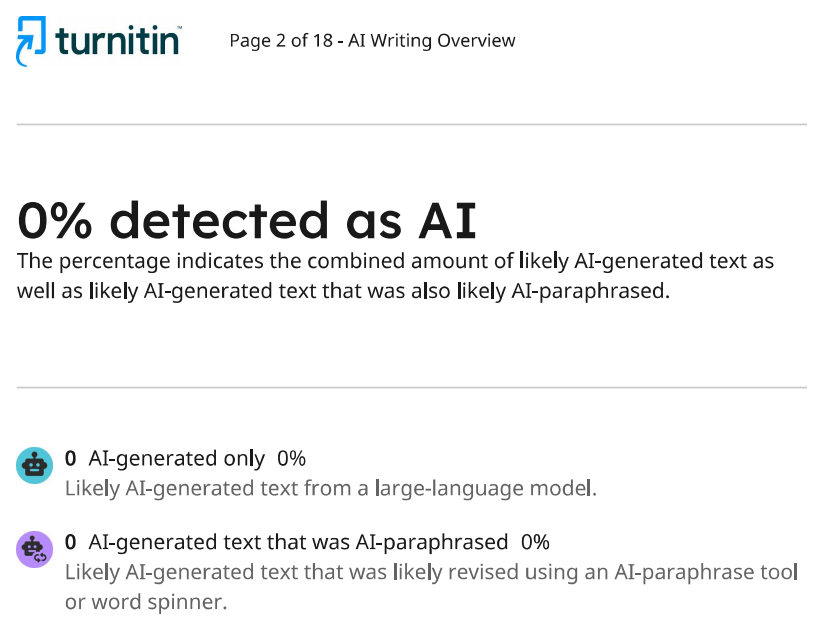
The report defines its headline number as "the combined amount of likely AI-generated text as well as likely AI-generated text that was also likely AI-paraphrased". The second line item is labelled "AI-generated text that was AI-paraphrased" and described as "likely AI-generated text that was likely revised using an AI-paraphrase tool or word spinner".
Turnitin's support documentation answers the question in as many words. Asked directly whether it can detect content paraphrased with an AI paraphrasing tool, its guidance states: "Yes, Turnitin's AI indicator includes detection of AI-generated content that may have been paraphrased using a word spinner/AI paraphrasing tool." A near-identical answer covers text run through a bypasser tool built specifically to rewrite AI output past a detector. Neither produces a separate score. Both feed the same single percentage an instructor sees.
What Each System Catches
| Similarity Report | AI Writing Report | |
|---|---|---|
| What it checks | Whether the text overlaps sources already in Turnitin's database of web content, publications and student papers | Whether the prose reads as statistically typical of machine-generated writing |
| Catches paraphrasing of | Someone else's published or submitted work | AI-generated drafts, including ones revised by a paraphraser or bypasser |
| Effect of a synonym pass | Lowers the percentage, but leaves distinctive terms, quotations and sentence structure matching | Leaves the score largely where it was, because the classifier reads sentence pattern rather than word choice |
| Where it shows up | A percentage plus match groups naming each source | One percentage, split into AI-generated only and AI-paraphrased |
The two reports are separate products with separate numbers, and a paper can be clean on one and flagged on the other. TextPulse covers that split in full in its comparison of Turnitin's similarity score against its AI score, and the mechanics of the classifier itself in how Turnitin detects AI writing.
Humanize your own paper
Transform your AI-assisted text and make it sound human, without touching important words or citations.
The Similarity Side: Reworded Text Still Overlaps
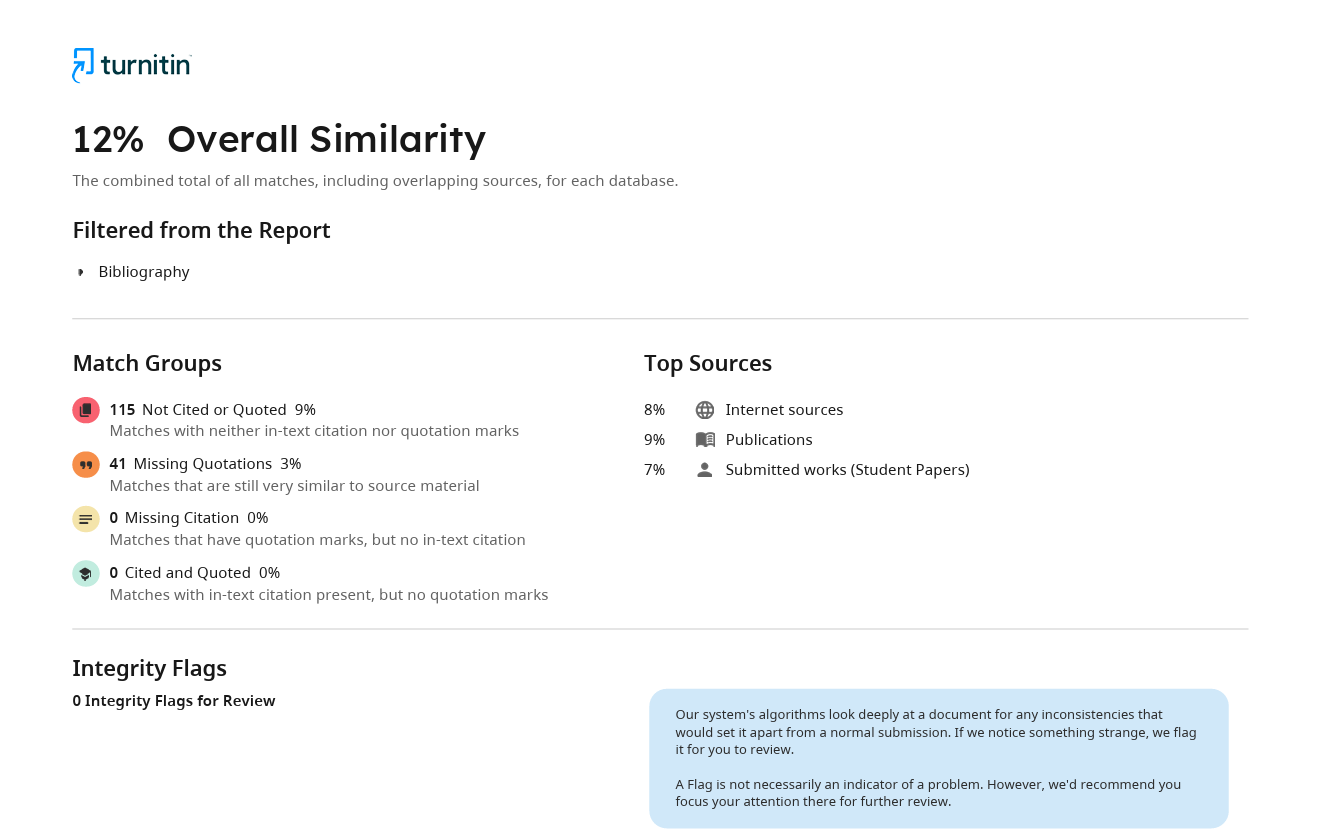
Similarity checking is a matching exercise. Turnitin compares a submission against its repository of web content, publications and previously submitted papers, and reports how much of it overlaps something already indexed. Change enough wording and the exact strings being compared shrink, so the percentage falls. That is real, and it is the reason paraphrasing tools exist.
What survives the swap is the part students underestimate. Technical terms, proper nouns, cited figures and direct quotations carry over unchanged because there is no synonym for them. So does sentence structure, when only the connecting words get replaced. Turnitin reports overlap as match groups, each naming its source, which is what separates a properly quoted passage from a reworded one.
Rewording a source while keeping its sentence order and supporting detail is called patchwriting, and it is treated as a form of plagiarism in most university policies whether or not the similarity percentage drops. Markers trained to recognise it often spot it by eye, because an argument that follows a source paragraph for paragraph reads like one regardless of vocabulary. A low number is not the same as clean work, which is the point of TextPulse's guide to what counts as a good Turnitin score.
The AI Side: A Synonym Pass Does Not Move the Score
The AI writing indicator never compared your paragraph against a source, so there is no match for a synonym to break. It scores prose sentence by sentence for how closely it fits the statistical pattern of machine-generated writing: word predictability, sentence rhythm, and the generic phrasing a language model reaches for by default.
Substituting words leaves nearly all of that in place. The sentence keeps its length, its order, and the same stock connective tissue between clauses. This is why running an AI draft through a paraphrasing tool and watching the AI score stay put is such a common experience. The vocabulary changed. The pattern the classifier scores did not, so the text is still being read as machine-written, exactly as Turnitin's paraphrase category says it should be.
Sentence Length Distribution Survives the Rewrite
Machine-drafted prose settles into a narrow band of sentence lengths, because a model predicting one token at a time has no reason to make sentence four shorter than sentence three. Human writing scatters instead: a nineteen-word sentence, then a six-word one, then a thirty-two-word one carrying a claim and its qualification together. GPTZero's own explainer names this directly, defining burstiness as a measure of how much writing patterns and text perplexities vary across a document.
A synonym swap moves a sentence's length by a word or two, and it moves every sentence by a similarly small amount, so the distribution holds its shape. A paragraph running eighteen, nineteen, seventeen and twenty words before a pass will run within a word or two of that same flat profile afterwards.
This is measurable without going near a detector. A free burstiness checker reports how much sentence-level variation a passage carries, and running the same paragraph through it before and after a paraphrase pass shows the number barely moving while the vocabulary changes completely.
Clause Order and Transitions Survive It Too
Clause order is the second structural feature a paraphraser leaves alone, and it is more visible to a reader than sentence length is. Machine prose tends to front the topic, state the claim, then attach a qualifying clause at the end, over and over. "While the sample size was limited, the results suggest" and "Although further research is needed, the findings indicate" are the same sentence wearing different words.
A paraphrasing tool will convert "while" into "although" and "suggest" into "show". It will not decide that the qualification belongs in its own short sentence three lines later, or that the hedge should be cut entirely. That is an editorial judgement about what the paragraph is arguing, and a substitution engine has no view on the argument.
Transitions are the third and the most visible. Models reach for a small, stable set of connectives at the joins: however, additionally, furthermore, in addition. A paraphraser swaps one of them for another member of the same set, so the classifier still sees a stock transition from the expected distribution in the expected position. That is the signal it was reading before the rewrite started.
| Feature a classifier reads | Changed by a paraphrase pass | Why |
|---|---|---|
| Individual word choice | Yes, substantially | The only feature a substitution engine is built to change |
| Sentence length and its variance | Barely | Substituted words are close in length, so the profile holds |
| Clause order within a sentence | Rarely | Reordering changes emphasis, which the meaning constraint discourages |
| Connectives at the joins | Swapped inside the same small set | One stock transition replaces another stock transition |
| Predictability of the next word | Slightly | A rarer synonym is less expected, but the frame around it stays as predictable as before |
| Specific evidence and detail | No | A rewrite cannot add material that was never in the draft |
What Actually Changes the Result
Both systems are reacting to different symptoms of the same shallow rewrite, so the fix is the same for both: change the writing, not the words. That means restructuring sentences rather than reordering their contents, varying sentence length deliberately, cutting the generic connectives a model defaults to, and adding supporting detail specific enough that it could only have come from the source material you actually read. Similarity falls because the structure no longer tracks the source. The AI score falls because the pattern the classifier scores is gone.
A paraphrasing tool cannot do that work, and the difference between the two categories of tool is worth understanding before paying for either, which TextPulse covers in AI humanizer versus paraphraser. Checking a draft's own word-level predictability with a free perplexity checker shows the pattern a classifier reacts to more usefully than a score alone does.
TextPulse's AI humanizer for students works on the structural side of the problem, rebuilding sentence rhythm, length variation and clause order instead of swapping individual words, which is the gap a synonym-only pass leaves wide open. For coursework specifically, humanizing an AI essay for college covers the workflow end to end, and whether Turnitin detects DeepSeek answers the same question for a different model.
None of this changes what a course's AI use policy permits, and no rewriting approach settles a score after the fact. The test worth applying before submitting anything is whether you could explain, sentence by sentence, why the work in front of you says what it says.
Related research: whether an AI model can be told to write like a person is tested in Do AI Models Speak Human?, a TextPulse Research working paper in which four flagship models were given a detailed style brief and a human example, then scored on a stylometric spectrum and on GPTZero against real journal prose.
Frequently Asked Questions
Yes. Its similarity engine compares a submission against web content, publications and previously submitted papers, so reworded passages that still overlap a source keep matching on distinctive terms, quotations and sentence structure. Separately, its AI writing report carries a labelled category for AI-generated text that was revised with an AI paraphrasing tool or word spinner, which Turnitin's own documentation confirms it is built to flag.
PhD in natural language processing, with years spent building NLP applications end to end. Moe works on text analysis: lexical and syntactic structure, and what separates machine-generated prose from human prose statistically. He has been experimenting with computational linguistics since the early days of NLTK, spaCy and WordNet, and still writes most of his tooling in Python.