Sapling AI Detector Review: A Developer Tool in an Academic World
Sapling's AI detector comes from an NLP tooling company, not an integrity company, and it shows: a public API, per-sentence perplexity scores and a Chrome extension built for triage work. Its independent record is the widest we have reviewed, from zero false positives in Scribbr's test to a 90 percent false positive rate in a 2025 Texas A&M study. That volatility, not any single score, is the finding.
Sapling's AI detector holds one of the strangest independent records in this category. In Scribbr's published detector comparison, last updated in July 2026, it scored 68 percent overall with zero false positives, making it one of the most accurate free tools in that test. In a 2023 arXiv benchmark, the same detector missed most of the AI-generated samples it was shown. And in a 2025 study out of Texas A&M, it flagged 90 percent of the human-written samples as AI. One product, three independent tests, three verdicts that barely resemble one another.
That spread is not a reason to dismiss Sapling, and it is not unique to Sapling. It is the clearest single illustration we have found of a rule that applies to every detector review, including this one: a point estimate from any single test of any detector generalizes poorly, because the result depends as much on what was fed in as on the tool doing the reading.
Sapling is also a different kind of company from most names in this space, and that difference explains a good deal of how the detector behaves and who it was actually built for. Here is what the tool is, what the vendor claims, what the independent record shows, and why academic writers in particular tend to misread what its numbers mean.
A Detector Built by an NLP Tooling Company, Not an Integrity Company
Sapling's main business is not AI detection. The company sells language model tooling for customer-facing teams: autocomplete, grammar suggestions and response drafting that sit inside Gmail, Zendesk, Salesforce and ServiceNow, plus an API and SDK pitched at developers who want to add those features to their own products. The AI detector is one tool in that suite, not the company's flagship.
That origin shows everywhere in the product, and it makes Sapling the most developer-oriented detector of the tools we have reviewed. There is a public API with real documentation. There is a Chrome extension that checks text where it lives rather than in a paste box. And the results pane does something most consumer detectors hide: alongside the overall fake score, it highlights individual sentences with low perplexity, the per-sentence version of the same statistical measurement covered in our explainer on what perplexity means in AI detection.
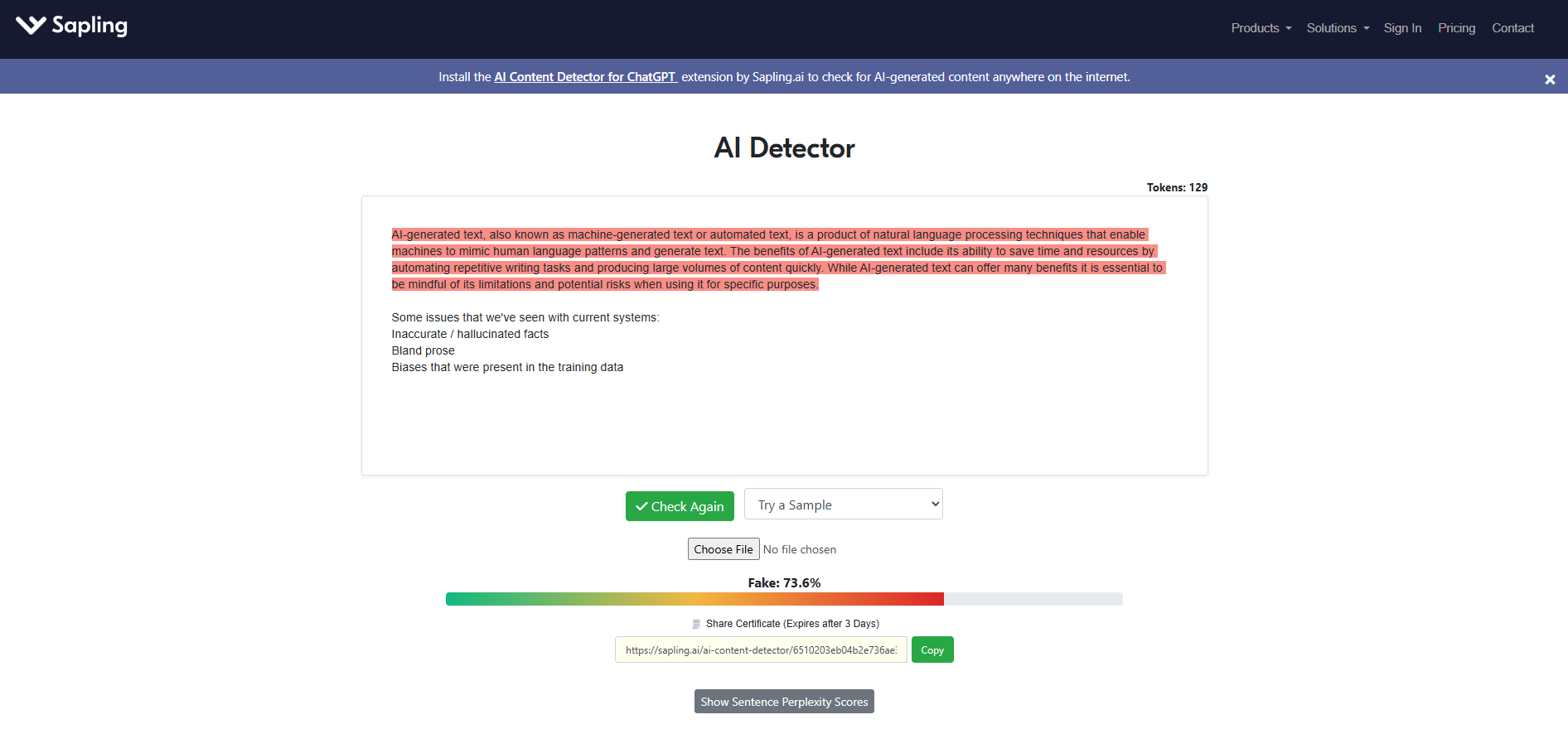
Per-sentence output is genuinely useful, but for a specific job: triage. It tells an editor or a reviewer which passages to look at first. It does not tell anyone who wrote those passages, and Sapling's own presentation, probabilities per token rolled up into sentence scores, is honest about that in a way headline percentages are not.
What Sapling Claims
The company's own product page claims a "97%+ detection rate for AI-generated content" and a false positive rate on human writing of less than 3 percent, and attaches a qualifier worth taking seriously: both figures apply to longer texts, and shorter texts or certain content types "may have different accuracy rates." The page describes the method as a Transformer, the same architecture that generates AI text, computing the probability that each token in the input was machine-produced, and the vendor states the system has been updated for recent models including GPT-5, Claude 4.5 and Gemini 2.5. All of that is published on Sapling's AI detector page, and all of it is a vendor's claim about its own product, with no external test set or methodology attached to the numbers.
What Independent Testing Shows
Three independent results, from three different years and three different kinds of tester, frame the real range.
| Test | What was measured | Result for Sapling |
|---|---|---|
| Scribbr detector comparison (updated July 2026) | AI and human texts, scored against other detectors | 68% overall, caught all GPT-3.5 texts and over half of the GPT-4 texts, zero false positives |
| Akram, arXiv benchmark (2023) | Multi-domain dataset: articles, abstracts, stories, news, reviews | 66.6% overall accuracy; on AI-generated text, precision of 86 but recall of 40 |
| Farmer et al., Texas A&M student research journal (2025) | AI, human and hybrid samples | 100% of AI samples caught; 90% of human samples falsely flagged |
Read individually, each test supports a different verdict. Scribbr's result describes a cautious, reasonably capable free tool that would rather miss AI than accuse a person. The 2023 arXiv study by Akram, which benchmarked six commercial detectors on a multi-domain dataset, found the same cautious profile from the other side: Sapling's recall of 40 on AI-generated text means it let roughly six in ten AI samples through, while its precision of 86 means that when it did flag something, it was usually right. The Texas A&M result describes the opposite tool entirely: one that caught everything and accused nearly everyone.
The honest reading is not that one of these tests is correct and the others are wrong. It is that detector performance is conditional on text type, text length, model vintage and scoring threshold, and a single review, however careful, samples one point in that space. This is the same pattern documented across the category in our review of whether AI detectors are accurate at all, and Sapling simply displays it with unusual clarity.
False Positives, and Who the Volatility Hurts
The 90 percent false positive figure from the 2025 Texas A&M study deserves a moment, because it is the kind of number that ends up quoted without context in both directions. It does not mean Sapling flags 90 percent of all human writing; Scribbr's test, run on different texts, recorded zero false positives from the same product. It means that on that study's particular human samples, the tool read nearly everything as machine-made. Somewhere between those two results sits every real user's document, and no one can say in advance where.
That uncertainty lands hardest on academic writers, for a structural reason. Sapling's detector was built and tuned inside a company whose paying customers check business content: support replies, marketing copy, communications at scale. In that workflow, a false positive costs a second look. In a university misconduct process, a false positive costs an accusation. Academic users who pre-check a thesis chapter with an industry triage tool are borrowing an instrument calibrated for a different cost of error, and then comparing its output against institutional systems that work differently again, as our explainer on how Turnitin detects AI sets out. A mismatch between the two scores is not evidence that either tool is broken. It is evidence that they were never measuring against the same threshold in the first place.
Humanize your own paper
Transform your AI-assisted text and make it sound human, without touching important words or citations.
Pricing and Access
Access is one of Sapling's genuine strengths. The vendor's page states that the free checker accepts up to 2,000 characters per query, roughly 300 to 400 words, with no signup required, and that paid subscribers can check up to 100,000 characters. The API is publicly documented for developers who want programmatic access, which remains rare in this category, where most competitors reserve their APIs for enterprise sales conversations. For a student, the practical implication of the free cap is that a full paper has to be checked in fragments, and short fragments are exactly where the vendor's own accuracy qualifier applies.
Where Sapling Fits
Sapling occupies a specific niche: the detector for people who want machine-readable output rather than a verdict page. If the job is scanning a high volume of incoming text and deciding what deserves human attention, per-sentence probabilities delivered over an API are the right shape for the problem. If the job is deciding whether one student wrote one essay, nothing in Sapling's design, pricing or independent record supports that use, and the company's modest, hedged product page never quite claims it does. TextPulse's position on this is the same as for every tool we review: a probability score is a place to start reading, not a finding about a person.
The Verdict, and the Full Comparison
Sapling's detector is a well-built triage instrument from a serious NLP company, with the most honest output format in the category and an independent record too volatile to summarize in one number. Treat its 97 percent claim as a vendor's internal figure, treat any single review's score, good or bad, as one sample from a wide distribution, and treat its per-sentence highlights as a reading guide rather than a ruling. To see how it stacks up against Turnitin, GPTZero, ZeroGPT and the rest of the field under one consistent method, see our full AI detector comparison.
What Our Own Research Found
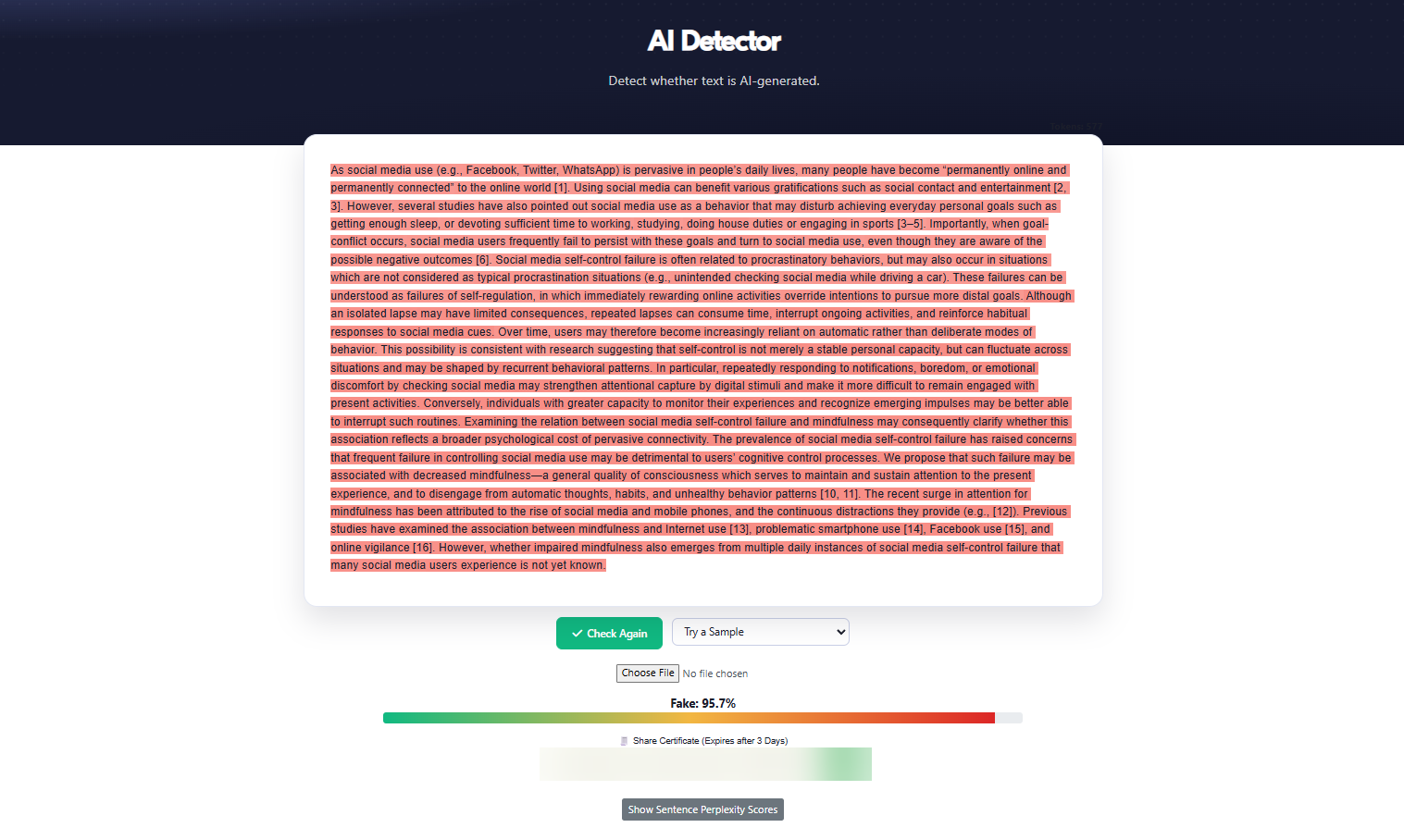
In the TextPulse Research detector agreement study, nine commercial AI detectors rated the same 90 academic texts. One was a 455-word hybrid text: a human-written opening and closing around a 168-word AI-generated middle. Sapling scored this text 95.7% AI, while verdicts from the other tools on the same words ranged from 0% to 95.7% AI. The full paper, corpus, and per-tool score matrix are open access at TextPulse Research.
Frequently Asked Questions
Independent results vary widely. Scribbr's comparison, updated in July 2026, scored Sapling at 68 percent overall with zero false positives, one of the best free tool results in that test. A 2023 arXiv benchmark by Akram measured 66.6 percent accuracy with a recall of only 40 on AI text, and a 2025 Texas A&M student research study found it flagged 90 percent of human samples as AI. The vendor's own page claims a 97%+ detection rate, but that figure is the company's internal claim, not an independent result.
PhD in natural language processing, with years spent building NLP applications end to end. Moe works on text analysis: lexical and syntactic structure, and what separates machine-generated prose from human prose statistically. He has been experimenting with computational linguistics since the early days of NLTK, spaCy and WordNet, and still writes most of his tooling in Python.