What Is Perplexity in AI Detection?
Perplexity is the number a language model produces to describe how surprised it was by your word choices. This post traces the metric to its 1977 origin, works through the formula, and explains why the same passage can score differently depending on which model is doing the reading.
Search for perplexity and AI detection together, and several of the top results turn out to be about an unrelated product: an AI-powered search engine that also happens to be named Perplexity. The metric a detector actually reports shares nothing with that company except the word. It comes from speech recognition research decades older than GPTZero or the search engine, and it measures something narrower than either: how surprised a language model is by the words already on the page.
So what is perplexity in AI detection? Perplexity is a score that describes how well a language model predicted the exact words in a passage, produced by averaging the model's own probabilities and converting the result into a single number. A low score means the model kept guessing correctly. A high score means it kept getting surprised.
The idea is older than any AI detector on the market, and on its own it says nothing about who wrote a document. Once the arithmetic behind the number is visible, a score on a report stops looking like a verdict and starts looking like what it actually is: a description of word choice.
What is perplexity in AI detection?
Perplexity is a measurement borrowed from language modeling. It scores how well a model predicted the specific words that appear in a passage and reports that score as a single number. Detectors apply the same measurement to a submitted document: a low number, meaning the model's guesses matched the actual words closely, reads as a mark of machine authorship, and a high number reads as a mark of human authorship. Nothing about the calculation reads the document's argument, its citations, or its subject matter. It only reads how expected each word was, one at a time.
Detectors did not invent this measurement. They borrowed a tool that speech recognition and machine translation systems had already used for decades to judge how well a model predicted ordinary language, and repurposed it as a proxy for authorship, a job it was never originally built to do.
None of this has anything to do with the unrelated search engine mentioned earlier. The perplexity a detector reports is never a company and never capitalized: it is a plain statistical property of a sequence of words, computed fresh from whatever text it is given.
How perplexity is actually calculated
The computation traces back further than any AI product. Frederick Jelinek, Robert Mercer, Lalit Bahl and James Baker introduced perplexity in 1977 to measure how difficult a speech recognition task was for a statistical model, decades before anyone applied the term to an essay or a lab report. The definition has not changed since.
At each position in a document, the model outputs a probability for the word that actually comes next, something like 0.72 for a common transition or 0.03 for an unusual one. Perplexity averages the logarithms of those probabilities across the whole passage, then reverses the average with an exponent.
The exponent in there's doing more than it seems. Averaging log probabilities is exactly what we do when we calculate the cross-entropy, which is the information-theoretic way of saying how many bits you need to encode a sequence given the predictions made by a model. But perplexity translates the count of bits back into something we can understand better: an effective number of choices, rather than an abstract count of bits.
What survives that arithmetic has a clean, almost physical reading. A model that is completely certain every time produces a perplexity of 1, the floor of the scale. A model that treats every position as an even toss-up between eighty equally likely words produces a perplexity of 80.
Most real documents land somewhere behind those two extremes, and where exactly depends on the writer, the subject, and which model is doing the reading.
Humanize your own paper
Transform your AI-assisted text and make it sound human, without touching important words or citations.
Why human writing tends to score differently
A model's expectations are built entirely from what came before, one word at a time. After the phrase 'the treatment group showed a statistically', the overwhelming majority of well-formed continuations are 'significant', and a model trained on a large volume of scientific writing assigns that word a high probability without hesitation. A human writer reaching the same phrase might land on 'significant' too, because the phrase itself is a fixture of the genre. The gap opens up elsewhere: in the noun chosen two sentences later, the aside added in parentheses, the number reported to an odd decimal place instead of a round one.
None of that's a trick. When a person writing about real data tries to reach for the exact number, the precise qualifier, the slightly narrower word, they're reaching for things that are true of the work instead of true of the genre. And every one of those choices costs the model a little bit more surprise. Surprise is what the score is built to add up.
The inference is doing more work than the measurement can support. Perplexity measures predictability directly. It infers authorship only by assuming predictable writing is rare among humans and common among models, an assumption that is usually reasonable and occasionally wrong in a specific, identifiable way, since predictability is a property text can have for reasons that have nothing to do with who typed it.
Why the same passage can score differently
The score is also less portable than it looks, because it is never measured in a vacuum. Perplexity is always computed against one specific reference model's training, and that dependency creates problems no single definition can show on its own.
| Factor | What changes | Why it happens |
|---|---|---|
| Which model is doing the reading | The same paragraph can score low on one model and high on another | Perplexity is only ever measured against one model's training data, and different models were trained on different text |
| Whether the passage is widely reproduced text | A famous historical document or a textbook definition can score as low-perplexity even when a person typed every word of it into the detector | Pangram Labs points to the Declaration of Independence as an example: it is quoted so often in training data that a model finds every sentence of it unsurprising |
| Whether the detector can see token probabilities at all | Closed commercial models such as ChatGPT, Gemini and Claude do not expose the per-word probabilities perplexity needs | Detectors approximate the score with a stand-in open model instead of computing perplexity against the model that actually produced the text |
None of this makes the number meaningless, only riskier to trust as a verdict on its own. GPTZero's own documentation once published a rough rule of thumb, a perplexity above 85 reading as more likely human, but a single vendor's threshold on one model doesn't transfer to a different tool measured against a different one. A detector reporting a single score is compressing all of the factors above into one figure without saying which of them did the work.
What a perplexity score actually tells you
Commercial detectors fold perplexity together with sentence-level patterns, classifier training and several other signals before they ever print a single number on a report. The fuller picture of how AI detectors actually work is covered separately, and it explains where the rest of that number comes from.
Sentence-to-sentence rhythm is a related but separate signal, covered on its own terms by the burstiness checker, and it looks at how much variation there is across a passage rather than at any single word.
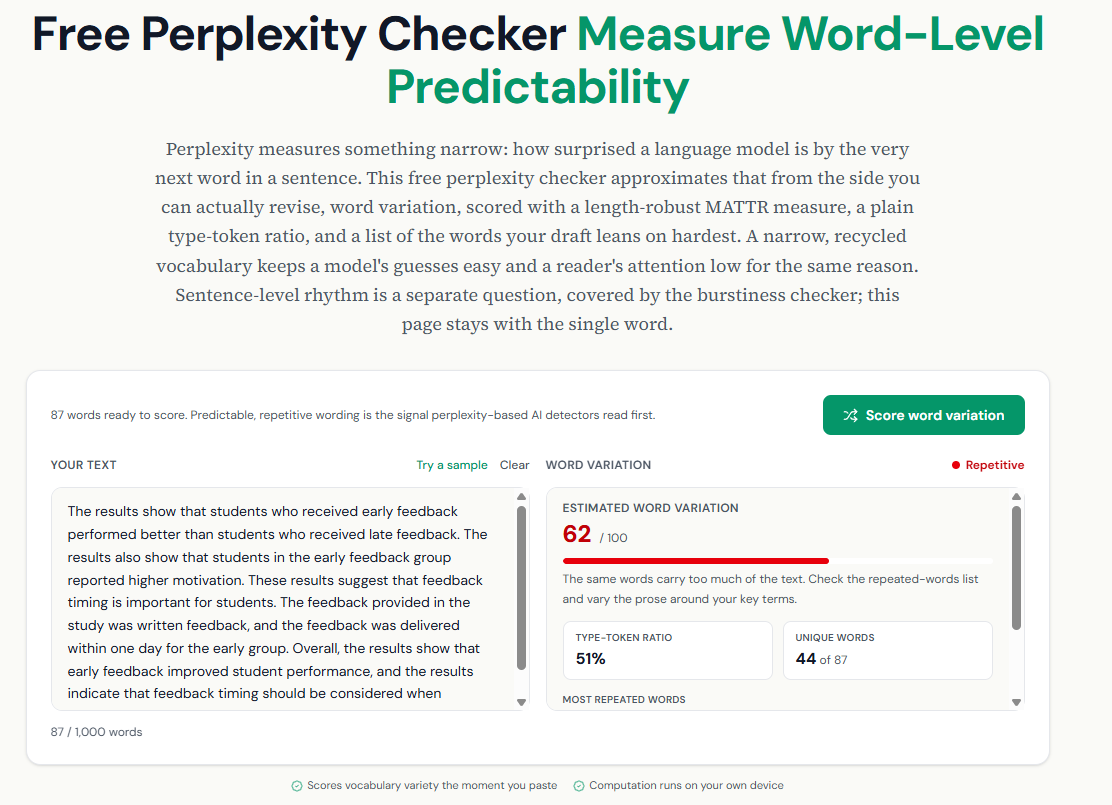
None of these numbers can prove who wrote a document, including the estimated Human Score TextPulse computes from a submitted draft, which describes the text rather than delivering a verdict on it. A simplified version of the same idea, vocabulary variety rather than full model probability, powers the free perplexity checker on this site, worth trying against a paragraph whose origin is already known before trusting what a report says about someone else's.
The perplexity checker sits alongside the rest of TextPulse's free tools, so a full pass over a draft, vocabulary, rhythm and everything else, does not need a dozen separate tabs open at once.
Perplexity is one of two statistics these systems lean on. The other is burstiness, the variation in sentence length and structure across a passage, and underneath both sits the token probability arithmetic that produces the score in the first place.
A number on a report is the end of a long chain of arithmetic, not the start of an argument about who wrote something. The more interesting question, once the arithmetic stops being mysterious, is what specifically made a document surprising or predictable in the first place, and that is a question about the writing itself.
Related research: whether an AI model can be told to write like a person is tested in Do AI Models Speak Human?, a TextPulse Research working paper in which four flagship models were given a detailed style brief and a human example, then scored on a stylometric spectrum and on GPTZero against real journal prose.
Frequently Asked Questions
No. Perplexity in AI detection is a decades-old statistical measurement from language modelling, describing how predictable a passage of text is to a model. Perplexity AI is an unrelated company that makes an AI-powered search product. The two share a name and nothing else, and confusing them will not help you make sense of a detector's report.
PhD in natural language processing, with years spent building NLP applications end to end. Moe works on text analysis: lexical and syntactic structure, and what separates machine-generated prose from human prose statistically. He has been experimenting with computational linguistics since the early days of NLTK, spaCy and WordNet, and still writes most of his tooling in Python.