AI Humanizer Formal Tone: How the Voice Filter Keeps Academic Text Objective
Academic writing is neutral and objective, and most humanizers rewrite it into 'you' and 'we'. The TextPulse voice filter preserves the person of your draft: formal academic, first or second.
An AI humanizer formal tone problem is easy to spot. A methods paragraph goes in as "Data were collected from twelve teachers" and comes out as "We collected data from twelve teachers". An essay comes back telling the reader what "you" will find. TextPulse solves it with a voice filter in the TextPulse AI Humanizer. Four settings decide which grammatical person the humanized text may use, so the formal, objective tone of academic writing is preserved from the first sentence to the last.
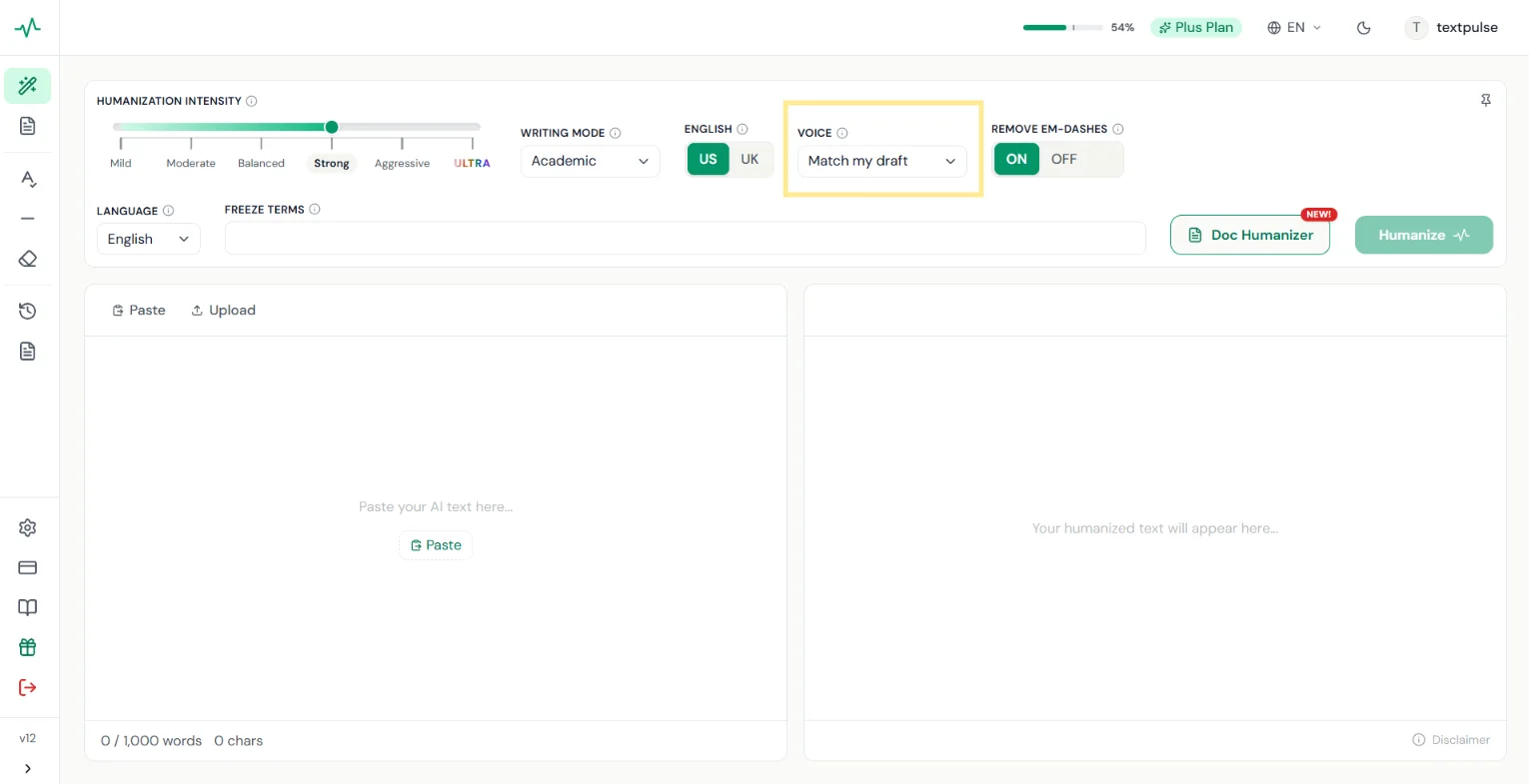
The four settings are Formal academic, First person only, Second person only and Match my draft. The engine detects which person your draft is written in and limits the output to that person, or to the one you select. The filter is part of the Plus plan. This post covers what a formal tone is, why universities and journals require it, and where humanizers lose it. It then explains each setting, shows three before-and-after examples, and pairs the filter with the writing mode and the intensity.
What a formal academic tone is, and why "you" and "I" break it
A formal academic tone is impersonal and objective. Sentences are about the research: the sample, the procedure, the measurement, the result. "Participants completed the questionnaire in a quiet room." "The model explained 42% of the variance." The writer does not appear, and the reader is never addressed.
Universities and journals require this register because it separates evidence from opinion. "The intervention reduced waiting times by 18%" is a claim the reader can check against the table. "I found that the intervention reduced waiting times" frames the same fact as a personal observation, and "you can see that waiting times fell" hands the judgment to the reader. Marking rubrics for essays and dissertations list academic register as a criterion, and journals describe the expected style in their instructions to authors.
There are exceptions, and they are specific. Reflective assignments in nursing, education and social work ask for the first person. Several journals in psychology and the life sciences accept "we" for what the authors did, and some style guides prefer it to "the researchers". The second person has no place in any of them. A paper that says "you" has stopped reporting and started instructing.
The practical rule for a writer is short. Find out which person the submission requires, write the draft in it, and keep every tool in the chain from changing it. A paraphraser, a grammar checker and a humanizer can each move the register, and the humanizer is the one that rewrites the most. The post on passive voice in the methods section covers the related decision between "the sample was analyzed" and "we analyzed the sample".
AI humanizer formal tone: where general humanizers lose it
A humanizer rewrites sentences so that they read less like model output, and most humanizers learned what human writing looks like from the open web. Blog posts, product pages, forum answers and newsletters are written to a reader, in the second person, with the writer's opinions in the first. That is the register such a model reproduces when it is asked to make text sound natural.
On a formal paragraph the effect is predictable. Passive constructions become active ones with a new subject: "The samples were stored at 4°C" turns into "We stored the samples at 4°C". Hedged findings turn into direct address: "The results suggest a modest effect" turns into "You can see a modest effect in the results". Each sentence is still true, and the AI score may well fall, but the paragraph is no longer formal, and the whole document has to be read again for pronouns.
The writer pays for this in editing time. A 9,000-word literature review humanized this way needs a line-by-line check for "you", "we", "I", "our" and "your", plus a repair of every sentence that changed its subject. That is the editing most people were trying to avoid when they opened a humanizer. General humanizers suit newsletters and product copy well, and academic prose needs an engine that preserves its register.
How the TextPulse voice filter works
The voice filter is the Voice dropdown in the humanizer dashboard, between the English toggle and the Remove em-dashes switch. It applies to the whole text in a humanization, and the Doc Humanizer uses the same setting when you humanize a whole Word document.
| Setting | The output may use | What is blocked | Typical use |
|---|---|---|---|
| Match my draft | The persons your draft already uses | Any person the draft does not use | The default; mixed drafts, quoted interviews |
| Formal academic | The third person only | "I", "we", "our", "you", "your" | Theses, dissertations, journal manuscripts |
| First person only | "I", "we", "my", "our" | "You", "your" | Reflective essays, personal statements, cover letters |
| Second person only | "You", "your" | "I", "we", "my", "our" | Study guides, tutorials, handbooks, marketing copy |
Match my draft is the default. The engine detects the person your draft uses, first, second or third, and the output may use only that. A formal draft comes back formal, and a reflective essay comes back in the first person. A draft that mixes "we" with an interview quote in the second person comes back with both preserved.
The three fixed settings go one step further and name the person. Formal academic blocks the first and second person outright. First person only preserves "I", "we", "my" and "our" and blocks "you". Second person only preserves "you" and "your" and blocks "I" and "we".
The filter does not convert. A draft has to be in the person you choose, and a conflict stops the humanization before any words are charged. Select Formal academic on a text that contains "you", and the dashboard shows a message asking you to remove the second person or switch to Match my draft. The check masks Roman numerals such as "Phase I" and names in title case, so a "Type I error" is never read as a pronoun. A cited title such as (You Are Not So Smart, 2011) is masked the same way. A draft in the wrong person can be converted first with the free First to Third Person Converter, and the humanizer then preserves the converted text.
Formal academic on a background paragraph
The draft is a background paragraph from a clinical research proposal, written in the third person with two citation groups. It was humanized in Academic mode with Voice set to Formal academic.
The draft
Not all individuals who use cannabis regularly develop CWS, and withdrawal severity varies across exposure patterns and clinical populations. Consequently, a candidate risk-stratification instrument must assess multiple potentially relevant constructs rather than classify patients solely according to the presence or absence of cannabis use. Established instrument-development methods recommend defining the target construct, identifying its relevant domains, generating evidence-informed candidate items, and establishing content validity before subsequent clinical and psychometric testing (Boateng et al., 2018; Terwee et al., 2018).
Humanized with Formal academic
Some people who use cannabis regularly do not develop CWS, and some cannabis users develop less severe withdrawal symptoms than others. An instrument used for stratifying risk should evaluate several potentially important constructs and not rely on a dichotomous classification of patients based on whether they are cannabis users or not. According to established procedures in instrument development, it is recommended that the target construct is defined, the pertinent domains are identified, evidence-based candidate items are generated, and content validity is established before any further clinical and psychometric evaluation (Boateng et al., 2018; Terwee et al., 2018).
The register is preserved. "Not all individuals who use cannabis regularly develop CWS" became "Some people who use cannabis regularly do not develop CWS". The recommendation was recast as "it is recommended that the target construct is defined". Both citation groups are preserved verbatim, and the output has no "we", "I" or "you" in it.
Humanize your own paper
Transform your AI-assisted text and make it sound human, without touching important words or citations.
Match my draft on a personal statement
The draft is a paragraph from a personal statement for a community services degree, written in the first person. It was humanized in Academic mode with Voice at the default, Match my draft.
The draft
I chose to study the Bachelor of Community Services because I have always been interested in supporting people and making a positive difference in their lives. My previous experience in the care sector helped me realise that I enjoy working with people from diverse backgrounds and supporting them according to their individual needs. I wanted to further develop my knowledge and skills in areas such as counselling, community development, disability, ageing, and social support. I believe that this degree will provide me with the skills and experience I need to build a meaningful career in which I can contribute to the wellbeing of individuals and the wider community.
Humanized with Match my draft
The Bachelor of Community Services was an excellent choice for me as it has allowed me to follow my passion of helping people in need and making a positive impact on people's lives. Through my past work experiences in the care industry, I realized that I enjoyed working with people from different backgrounds and providing support based on their individual requirements. The degree allows me to gain new skills and knowledge in fields like counseling, community development, disability, aging and social support. I feel that I will be able to establish a fulfilling career where I am able to make a contribution towards improving people's lives and contributing to the greater good.
The engine detected the first person and blocked the second. "I chose to study" became "was an excellent choice for me", and "helped me realise" became "I realized". "I believe that this degree will provide me" became "I feel that I will be able to". Ten first-person pronouns went in and ten came out, and no "you" was added. First person only applies the same block with the person named in advance.
Match my draft on a management explainer
The draft is a paragraph from a management essay that addresses the reader directly, in the second person. It was humanized in Academic mode with Voice at the default, Match my draft.
The draft
The informal organization drifts when the words managers use to describe team members' performance (e.g., 'committed,' 'engaged,' or 'proactive') correlate more closely with whether an employee was present in the office than with how much work they contributed. The informal organization is aligned with the formal organization when the words used to describe performance refer to specific contributions and outcomes regardless of where an employee is working. To audit your own informal organization, all you need to do is this: Ask your managers to describe the performance of their top three team members without referencing availability, presence, or responsiveness. See what they can and cannot say about those team members. That will tell you exactly what they are judging them on.
Humanized with Match my draft
When the words that managers use to describe their team members' performance (e.g., 'committed,' 'engaged,' or 'proactive') correlate more strongly with whether or not an employee is physically present in the office than they do with their actual contribution to the organization, the informal organization drifts. When the words that managers use to describe their team members' performance refer to specific contributions and outcomes irrespective of where they are working, then the informal organization is aligned with the formal organization. Auditing your own informal organization is as simple as this: All you have to do is ask your managers to describe the performance of their top three team members without reference to their availability, presence, or responsiveness. See what they can and cannot say about these team members. That will tell you exactly what they are judging them on.
The second person is preserved and the first is blocked. "To audit your own informal organization, all you need to do is this" became "Auditing your own informal organization is as simple as this". "Ask your managers" and "That will tell you exactly what they are judging them on" are preserved. The two definition sentences were rewritten as "When ..., the informal organization drifts", and the output has no "I" or "we" in it. Second person only applies the same block with the person named in advance.
Pairing the voice filter with the writing mode and the intensity
The voice filter is one of three settings that decide the register of the output, and the three work together. The writing mode sets the style. Academic expands contractions, applies hedging and preserves citations, General keeps a neutral everyday style, and Corporate, Creative and Blog/SEO adjust the tone for their content. The intensity sets how deep the rewrite goes, from Mild to ULTRA, and the post on the intensity levels covers each step. The voice filter then decides which person the output may use, whatever the mode and the intensity do with the sentences.
For a thesis chapter or a manuscript, the usual combination is Academic mode, Balanced and Formal academic. For a reflective essay or a personal statement, Academic mode with First person only. For a tutorial or a handbook, General mode with Second person only. Citations, numbers and frozen terms are preserved verbatim under every combination, as the post on a humanizer that preserves citations describes.
The filter works on English text. The voice filter, the full intensity slider, the Doc Humanizer and every writing mode are included in Plus. The Pro plan humanizes in Academic mode at Balanced with the default voice, Match my draft. A draft that needs a more formal register before it is humanized can go through the free Academic Tone Converter first.
Why TextPulse added the voice filter
The voice filter came from user requests, and there were a lot of them. The most common report was a humanized thesis chapter that addressed the examiner as "you". The next most common was a methods section that came back as "we measured" and "we found" for a journal that asks for the passive. The requests came from many disciplines, and each one described the same shift from an objective register to a personal one.
TextPulse is one of the few humanizers with a control for grammatical person. The engine was fine-tuned on human-written research papers, so the formal register is where it starts. The filter adds a rule the model cannot override: the output uses the person of the draft, or the person you select, and no other.
Frequently Asked Questions
Write the draft without "I", "we" or "you", select Academic mode, and set Voice to Formal academic. That is the AI humanizer formal tone setting in TextPulse: the humanized output cannot use the first or second person, so the register of the draft is preserved. If the draft contains any of those pronouns, the humanizer stops and asks you to remove them or switch to Match my draft.
Content strategist at TextPulse, here since the company started. Mark writes the product and technical coverage: how the humanizer works under the hood, what changes in each release, and what a specification actually means for your writing. His reviews of writing software come from using them on real documents rather than reading a feature list.