BypassGPT AI Humanizer Review
BypassGPT meters by daily runs and words per request instead of a monthly word pool: 1,000 words per request on the free tier, 10,000 on Starter at $19 a month or $9 billed annually. Two things set it apart from the category, a Citation Protection toggle and a check that runs your output through seven third party detectors and reports each verdict back. This review judges it for academic documents, where the metering model and the absence of per style citation handling both matter.
BypassGPT rewrites machine written text and meters you by daily runs and words per request instead of a monthly word pool. The free tier gives 1,000 words per request across 10 runs a day. Starter costs $19 a month, or $9 a month billed annually, and lifts that to 10,000 words per request across 50 daily runs. Two features separate it from the category: a Citation Protection toggle on the main screen, and a check that runs your output through seven third party detectors and reports each verdict back to you.
It suits a writer making frequent short passes, a paragraph or a section at a time. This review judges it on academic documents: a thesis chapter, a manuscript going out to review, coursework a marker reads with your reference list open beside it.
What Universities Actually Allow
Editing your own draft with an AI tool is permitted at most institutions, and the published rules govern disclosure. Elsevier's policy on generative AI in writing permits authors to use these tools to improve readability and language, requires the use to be declared, and holds the human authors responsible for the result. No model is listed as an author.
University codes apply the same standard to students, where undeclared use is the breach. That leaves you one question after a humanizing pass: does the text still cite what you actually read? Our AI disclosure statement template gives the wording departments expect.
Why AI Drafts Need Humanizing
A raw model draft carries two problems. The prose is generic in a way readers notice before they can name it: sentences of even length, the same few connectives doing all the joining, hedges stacked until a finding merely may potentially suggest something. Our list of AI words and phrases shows how narrow that vocabulary is.
The second problem is mechanical. Turnitin, GPTZero, Originality.ai and Pangram score how predictable a passage is against what a language model would have chosen next, and generated prose is predictable by construction. Those systems read for probability, never for meaning. How AI detectors work sets out the measurement.
How AI Humanizers Work
- Varying sentence structure. Sentence length variance is measured directly, so this moves a detector score more than anything else does. Breaking a run of even twenty word sentences into a mix of short and long changes the statistical shape of the passage along with its wording.
- Replacing model typical vocabulary. On its own this changes texture and leaves structure alone. It is also the mechanism most likely to damage a technical document, because a rewriter hunting for variety cannot tell a stylistic word from a defined term.
- Adjusting register. General tools aim at conversational prose, which is the wrong target for a methods chapter. The line between rewriting and word swapping is drawn in AI humanizer vs paraphraser.
What BypassGPT Is
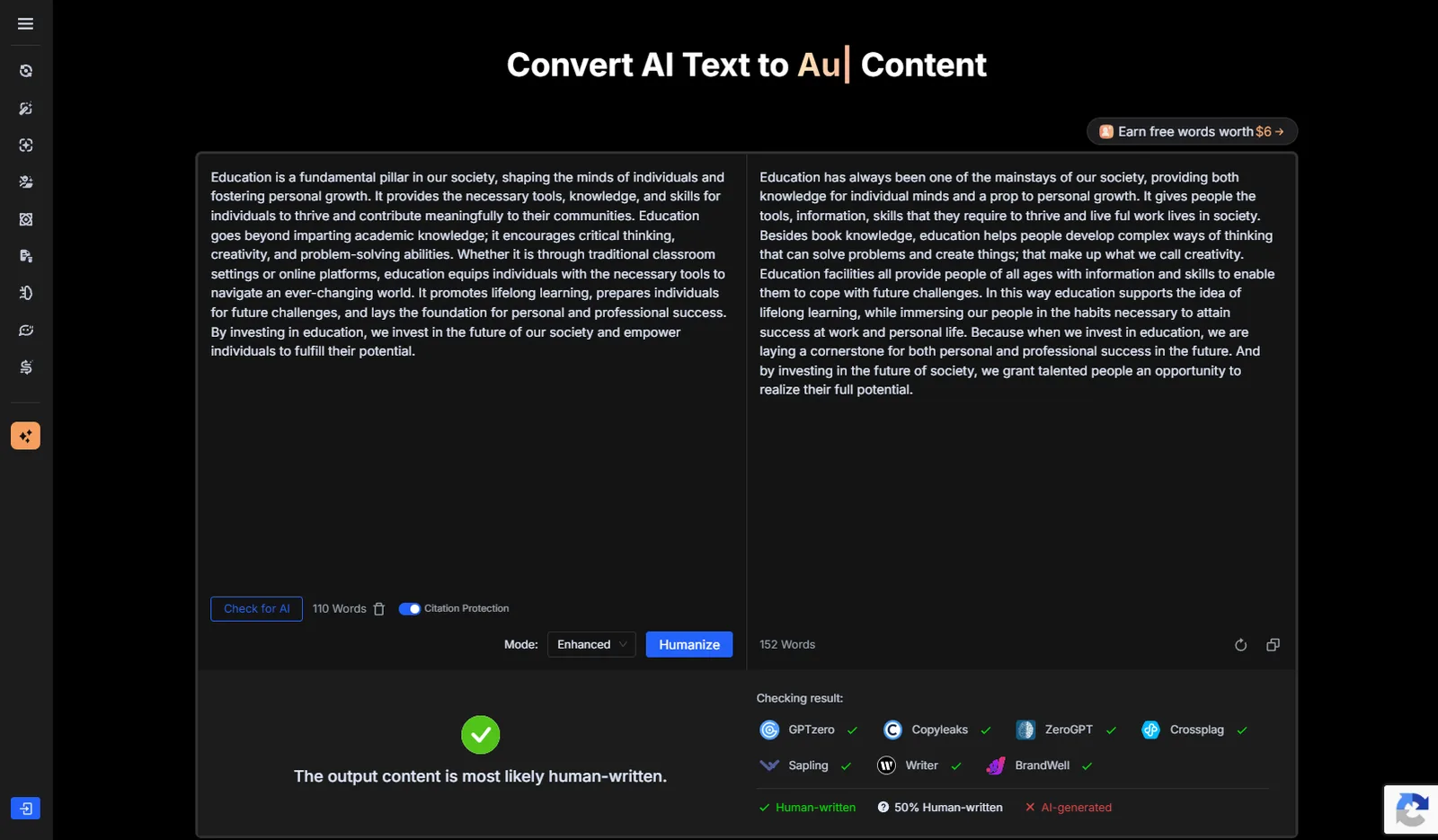
The core product is a single rewrite pass. Text goes into a box, the humanizer runs, and the output comes back with the option to check it against detectors before you use it. There is no document workspace around it.
One point of confusion first. BypassGPT and HIX Bypass are unrelated products made by different companies, and listicles conflate them constantly. If a roundup treats the two as one tool, or credits a feature of one to the other, discount the rest of that page.
The engine is described no more precisely than the category norm: no stated method, no named training approach, no measured pass rate against named detectors. Reddit testing put it at around 67%, in the same band as Humbot, and described the same behaviour: surface level rewriting rather than structural change.
The Seven Detector Check
BypassGPT runs your rewritten text through seven third party detectors and reports what each one returned. Most humanizers publish a confident claim and no measurement. This one hands you seven independent readings on your own output, and that deserves credit.
Read those verdicts carefully, because detectors disagree sharply with each other. A study in the International Journal for Educational Integrity ran 160 academic papers of over 4,000 words through four systems: Pangram flagged 97.5% of the fully AI generated papers and 92.5% of the humanized ones, while Turnitin flagged none of the fully generated set and half of the humanized set. Seven clean verdicts from seven tools your institution does not run, on one passage out of a whole document, is encouraging but no more than that.
BypassGPT also publishes a large library of reviews of rival humanizers. Those pages rank, so you will meet them in search results while comparing tools. They are marketing written by a competitor of everything they assess, so treat them as advertising rather than neutral reviews.
The Feature Set
- Humanizer. The core rewrite, metered per request and per day.
- Citation Protection toggle. An explicit switch for leaving references alone, which most one click tools do not offer at all.
- Seven detector check. Output run through seven third party detectors, with each verdict reported back to you.
- Free tier without commitment. 1,000 words per request across 10 humanizations a day, enough to test a real section.
The Citation Protection toggle is a real point in its favour. Most tools at this price treat a parenthetical reference as ordinary text and give you no way to say otherwise.
Humanize your own paper
Transform your AI-assisted text and make it sound human, without touching important words or citations.
Who BypassGPT Is For
The metering answers this question. Daily runs and a words per request ceiling suit someone who rewrites often and in small pieces: 10 passes a day on the free tier, 50 on Starter, 150 on Pro. For a content writer working through short sections all week, that shape is generous.
A chapter fits it badly. A 9,000 word chapter has to be split into requests, each rewritten without sight of the others, and the seams are where terminology drifts and register shifts between sections. A monthly word pool at least lets you run a document in one piece.
BypassGPT Pricing and Plans
| Plan | Price | Words per request | Daily runs |
|---|---|---|---|
| Free | No cost | 1,000 words | 10 a day |
| Starter | $19 a month, or $9 billed annually | 10,000 words | 50 a day |
| Pro | $39 a month | 10,000 words | 150 a day |
The annual price is the number to notice. Starter is $19 monthly or $9 billed annually, so a year costs less than half the rolling rate. Decide whether you will still be rewriting text in ten months.
Spend the free tier well. 1,000 words per request is a real section. Run text that resembles your actual work, citations left in and technical vocabulary intact, with Citation Protection on. Then read the output against the input line by line, checking surnames, page numbers and instrument names.
Citations, Terminology, Statistics and Register
Citations
A toggle states an intention; documented handling of each reference format is a different matter. A rewriter can leave a parenthetical such as (Nakamura and Fielding, 2020, p. 62) in place and still fold it into the sentence as narrative attribution, drop the page locator, or treat a numeric IEEE bracket the way it treats an author date APA parenthetical. BypassGPT documents no per style behaviour, so you only find out what the toggle protected by reading the output.
Terminology and statistics
There is no term lock. A rewriter hunting for variation treats a validated instrument name as a synonym opportunity, and randomly assigned becoming randomly distributed is a different claim about your method. Effect sizes, intervals and formulas sit inside sentences the rewriter is free to restructure, and a wrong number reads exactly as well as a right one. Split a document across requests and each pass makes those decisions independently.
Register
Natural sounding output is right for a blog post and wrong for a literature review. Nothing in the interface sets an academic register target, so output settles into general readable prose, a step down in formality from where a thesis sits.
How It Scored in Our Testing
Detector movement is the strength. Output gets past the Turnitin AI indicator often enough to be useful, and it is where BypassGPT performs above the category average.
Grammar is acceptable but never clean. Rewrites produce the occasional broken agreement or awkward join, where a phrase was swapped without the surrounding clause being adjusted.
Citations land in the middle. The toggle earns that much, with no per style documentation behind it and no way to see what it protected until you read the result.
Key terms survive sometimes. Nothing lets you name a term and lock it, and splitting a long document across requests multiplies the chances of a construct coming back two ways.
Tone settles into general readable prose. There is no scholarly register target and no control that sets one.
The dashboard is functional. The detector check is a genuinely good addition, and it sits in a workspace with no document management and no revision history. Language coverage is adequate, with no academic specific handling for writing in a second language.
BypassGPT Alternatives
- Undetectable AI. General content at volume, with monthly word pools and a refund if output is flagged.
- Humbot. Fixed monthly word allowances instead of daily runs, with Expand and Shorten modes alongside its standard rewrite.
- StealthGPT. Built for SEO and copywriting output at volume, with a refund promise attached.
- QuillBot Humanizer. Sensible for people already paying for the QuillBot paraphrase suite.
- Smodin. Aimed at students already using its citation and essay tools.
All five are designed for general content, which is why the same gaps recur across them. For a thesis or a journal manuscript, where citations, terminology, statistics and register all have to survive the rewrite intact, use TextPulse. Our comparison of the humanizer field puts every option side by side.
TextPulse vs BypassGPT
| Comparison | TextPulse | BypassGPT |
|---|---|---|
| Built for | Academic documents: theses, manuscripts, coursework | Frequent short passes on general text |
| Published detector evidence | Vendor benchmark on a 2,000 document academic corpus: 92.33% Turnitin AI, 89.12% Originality.ai, 87.91% GPTZero | A seven detector check on your own output, with each verdict reported |
| Citation handling | Preserved verbatim across APA, MLA, IEEE, Chicago, Harvard and Vancouver | A Citation Protection toggle, with no per style behaviour described |
| Terminology and statistics | Freeze Terms lock any construct or instrument name; figures preserved automatically | None stated |
| Register | Trained on peer reviewed human writing, held at Flesch-Kincaid grade 13 to 18 | General readable prose, with no academic target |
| Metering | Whole documents in one pass, so no seams where terminology drifts | Daily runs with a words per request ceiling |
| Price | Pro $19 a month for 25,000 words, Plus $29 for 50,000, or $169 and $259 billed annually | Free tier, Starter $19 monthly or $9 billed annually, Pro $39 |
The Verdict on BypassGPT
BypassGPT earns two pieces of real credit. Putting a Citation Protection toggle on the main screen means somebody understood that references are a category of text a rewriter should treat differently. Reporting seven detector verdicts back to the user is the more unusual of the two, and it reverses the category habit of asserting undetectability while offering nothing to check it against. For a writer making frequent short passes on general content, the free tier is generous at 1,000 words per request, and the annual Starter rate of $9 a month is cheap.
The limits are structural. Daily run metering with a words per request ceiling means a chapter arrives in pieces, and pieces are where terminology drifts and register shifts. The toggle covers references in principle, while an academic document needs documented behaviour: per referencing style, per locked term, per number.
For work carrying a reference list, use TextPulse. Citations and reference entries survive a pass verbatim in APA, MLA, IEEE, Chicago, Harvard and Vancouver. Freeze Terms lock any construct or instrument name before the rewrite starts. Statistics and formulas are preserved automatically. Register stays inside the Flesch-Kincaid grade 13 to 18 band, and documents process whole, so terminology does not drift between fragments. Pro costs $19 a month for 25,000 words and Plus costs $29 for 50,000, or $169 and $259 billed annually. The vendor benchmark across a 2,000 document academic corpus reports 92.33% on Turnitin AI, 89.12% on Originality.ai and 87.91% on GPTZero. TextPulse reports an estimated Human Score on every pass and promises nothing about a detector's verdict on your chapter.
Frequently Asked Questions
It works for short general passes and struggles on a referenced document. The Citation Protection toggle shows somebody noticed the problem, but no per style handling is documented for APA, MLA, IEEE, Chicago, Harvard or Vancouver. Daily run metering with a words per request ceiling also forces a chapter into fragments, each one rewritten without sight of the others, and fragments are where terminology drifts.
Content strategist at TextPulse, here since the company started. Mark writes the product and technical coverage: how the humanizer works under the hood, what changes in each release, and what a specification actually means for your writing. His reviews of writing software come from using them on real documents rather than reading a feature list.