Does Grammarly Trigger AI Detection?
Yes, Grammarly gets flagged by Turnitin when you rephrase heavily with it: its rewrites are AI-generated, they push your prose toward AI-typical wording, and Turnitin has a category built for machine-paraphrased text. Screenshots of it happening on a real manuscript, every feature scored for risk, and what to use instead.
Yes. Grammarly does get flagged by Turnitin when you rephrase heavily with it. Grammarly's rewriting features are powered by AI, so every accepted rewrite puts AI-generated wording into your draft, and enough of them raise the share of your text that reads as AI. Turnitin even has a dedicated category for the result: text "likely generated and modified by an AI paraphraser or word spinner". The screenshots below show the mechanism happening on a real manuscript. The one safe zone is the correction layer, spelling, punctuation and grammar fixes, which changes too little of the sentence to register.
The Evidence: Grammarly Rewriting Toward AI Wording
Both screenshots come from a Grammarly review pass over a human-written economics manuscript. In the first, Grammarly replaces "which can reduce" with "thereby reducing" and reorders "the consumers' perspective" into "the perspective of consumers".
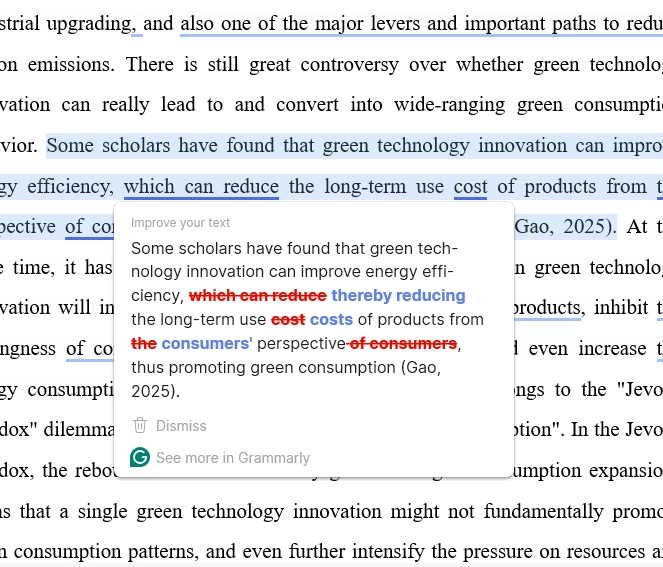
In the second, the same review pass proposes "underscoring" in place of "which highlights". "Underscoring" is one of the most recognizable AI-typical words in academic prose.
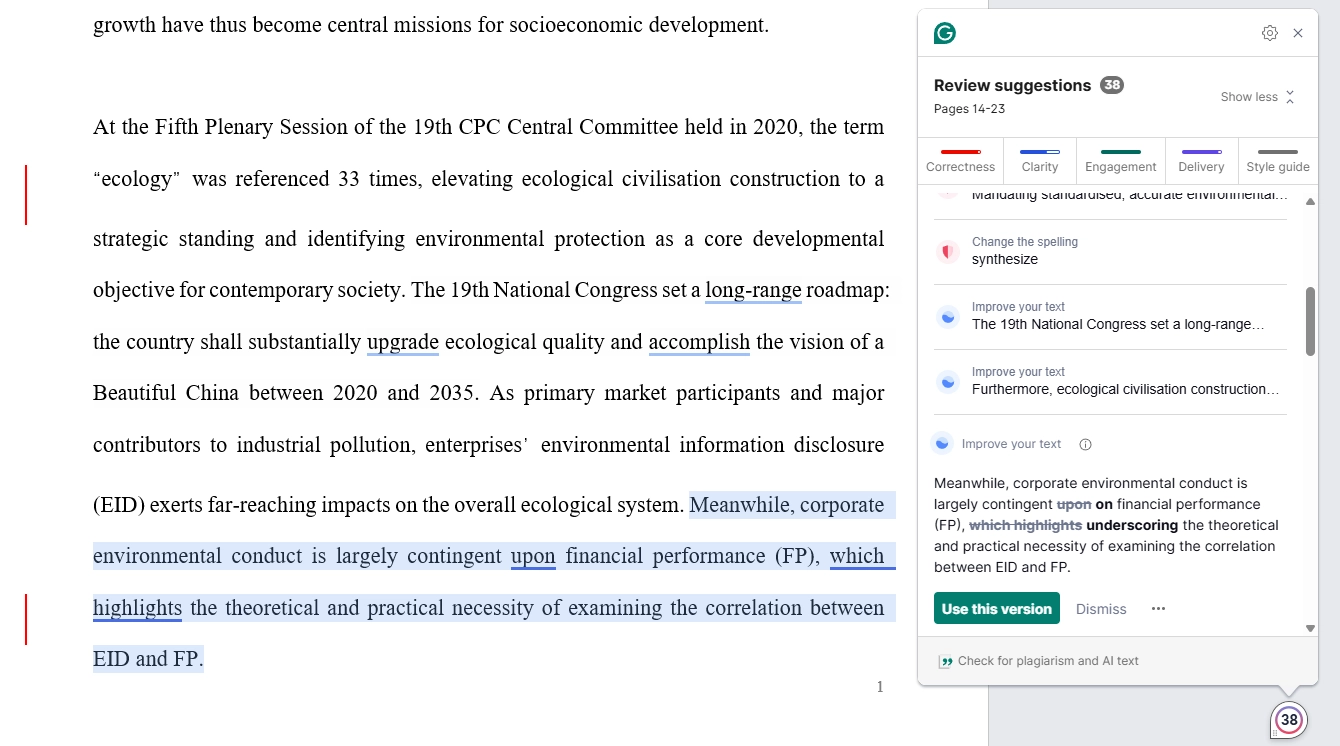
Each suggestion is fine on its own. Accept a few dozen and the statistical profile of the document changes: sentence rhythm becomes more uniform, connectives turn formal, and words like "thereby", "moreover" and "underscoring" accumulate. That profile is what Turnitin scores, because Grammarly writes with AI, so its rewrites land on AI wording. A heavily Grammarly-rephrased draft is machine-paraphrased text, and machine-paraphrased text is exactly what the AI-paraphrased category catches.
Every Grammarly Feature, Scored for Risk
| Grammarly action | What changes in the text | Effect on an AI writing score |
|---|---|---|
| Spelling and typo correction | A character or two inside an existing word | None; length, structure and word choice are unchanged |
| Punctuation and agreement fixes | Punctuation marks and inflected endings | None; the sentence keeps its shape |
| Single-word suggestion | One word in the same slot of the same sentence | Negligible on its own; AI-typical word choices accumulate across many accepts |
| Full-sentence rewrite | Clause order, sentence length and several word choices at once | Raises it, and the risk grows with every rewrite accepted in one passage |
| Tone adjustment across a paragraph | Several sentences rewritten toward one register | Raises it fastest; whole passages come back from the generator at once |
Why Heavy Rephrasing Gets Flagged and Corrections Do Not
Turnitin does not look for Grammarly by name. Its AI writing indicator reads the finished text only: it splits the document into overlapping segments of a few hundred words, scores each sentence from 0 for human to 1 for AI, and averages across the document. What it measures is sentence shape across whole passages. A comma or a spelling fix leaves that input unchanged, which is why corrections are safe. A rephrase replaces your sentence with one a model generated, and forty model-generated sentences in a section look like a model wrote the section, because one did. The full mechanics are in our walkthrough of how AI detectors work.
Grammarly's own product confirms the dividing line. Its Authorship feature logs text in four separate categories: typed by you, generated via AI, edited with Grammarly, and copied from a website. Grammarly tracks its own edits as a distinct category precisely because they are not the same thing as text you typed, and its rewrite features sit on the generated side of that line in the way that matters to a classifier: the words come from a model.
Humanize your own paper
Transform your AI-assisted text and make it sound human, without touching important words or citations.
What About Grammarly's Own AI Detector and Humanizer?
Grammarly sells both sides of the detection question, and its own pages set the expectations. Its AI detector claims 99% detection accuracy while the FAQ beneath the claim states that "No AI detector is 100% accurate"; running a draft through it gives you a preview from one classifier, not a prediction of Turnitin's. Its AI Humanizer is built for tone and voice in general writing, with preset styles and a custom voice, and it states no detector pass rates. The full comparison against a purpose-built academic humanizer is in TextPulse vs Grammarly.
If Your Draft Was Already Flagged
Put the number in context before anything else. Turnitin's guidance says its model "may not always be accurate" and "should not be used as the sole basis for adverse actions against a student", and it publishes a sentence-level false positive rate of around 4%. Bring your process evidence: dated drafts, comments, source history, and the Authorship report if it was switched on. The fuller procedure is in how to prove you did not use AI, and what disclosure looks like in practice is in our AI use policy guide.
If You Need the Score Down, Use the Right Tool
Heavy Grammarly rephrasing moves a draft in the wrong direction: toward AI wording. Moving it the other way, toward the statistical patterns of human academic writing, is a humanizer's job. TextPulse's academic AI humanizer was built for exactly this document: it rewrites toward human patterns, preserves in-text citations and reference entries across APA, MLA, IEEE, Chicago, Harvard and Vancouver, locks technical terms with freeze terms, and publishes measured pass rates of 92.33% on Turnitin AI, 89.12% on Originality.ai and 87.91% on GPTZero. Keep Grammarly for what it is safe at, catching typos, or use our free grammar checker for the same job with zero generated sentences involved. One quieter risk on the way out: editing tools can leave in-text citations that stop matching the reference list, which no detector flags and every marker checks.
Frequently Asked Questions
Yes, when you rephrase heavily with it. Grammarly's rewriting features are AI-powered, so accepted rewrites fill your draft with AI-generated wording, the exact profile Turnitin scores, and its report separately flags text revised by an AI paraphraser. Plain corrections, spelling, punctuation and grammar fixes, change too little of the sentence to register.
Content strategist at TextPulse, here since the company started. Mark writes the product and technical coverage: how the humanizer works under the hood, what changes in each release, and what a specification actually means for your writing. His reviews of writing software come from using them on real documents rather than reading a feature list.