Grammarly AI Humanizer Review
Grammarly's AI Humanizer is an agent inside the writing suite, built by linguists for tone and voice across six languages, free to start and included in Grammarly Pro at $12 a month. It holds academic tone better than any humanizer we ran and moves a Turnitin reading less than any of them. This review explains why that combination follows from what Grammarly built the tool for, and what it means for a thesis chapter.
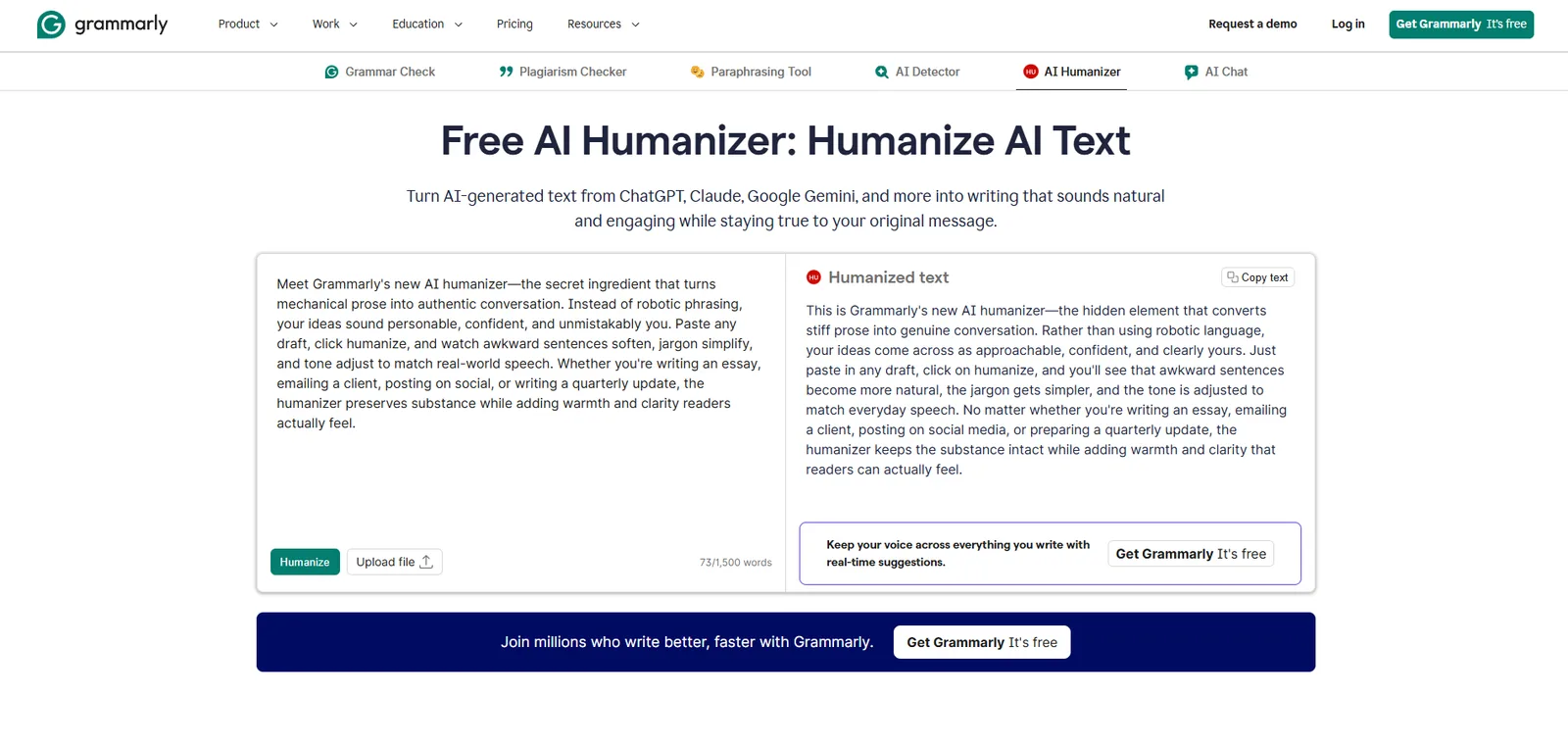
Grammarly's AI Humanizer is an agent inside the Grammarly writing suite. It takes text that reads as machine generated and rewrites it toward a tone you pick: four preset styles, plus a custom voice trained on a sample of your own writing. Grammarly says linguists built it. It humanizes in six languages, English, Spanish, French, German, Portuguese and Italian, starts free with a Grammarly account, and Grammarly Pro costs $12 a month.
This review judges the Humanizer alone, and judges it for academic work: a thesis chapter, a manuscript, a report a detector will read. The rest of the suite is context. Grammarly built its tools around declaring AI use rather than hiding it, and that design decision explains most of what follows.
What Universities Actually Allow
Oxford treats undeclared use as the breach and permits the assistance itself. Nearly every published rule has that shape, and the permissions are wider than most researchers assume.
COPE's position on authorship and AI tools starts from responsibility. Software cannot be accountable for a piece of work, so a named human author must be, and must say what the tool did. Nature permits AI assistance in writing and refuses to list a model as an author for the same reason. Our AI disclosure statement template gives wording you can adapt, and humanizing sits after that declaration.
Why AI Drafts Need Humanizing
Two problems, and the first is that raw model prose is generic. Sentence length holds a narrow band, connectives go flat, hedges stack until a claim commits to nothing, and paragraphs close on a formulaic summary of the sentence before them. Our list of AI words and phrases covers the vocabulary that gives it away.
The second problem is measurement. Turnitin, GPTZero, Originality.ai and Pangram do not read for meaning. They score how predictable each word is given the words before it, and generated prose is highly predictable, because that is what generation optimises for. Our guide to how AI detectors work covers the mechanics.
Turnitin's documentation states that its AI indicator covers text that has been humanized or passed through a bypasser, and Turnitin separately flags text "likely revised using an AI-paraphrase tool or word spinner". A crude rewrite can move a draft from one flag into the other.
How AI Humanizers Work
- Sentence structure. Varying length and construction moves detector readings most, because that variance is measured. Human writing swings from nine words to thirty and back, while model output holds a narrow band.
- Vocabulary. Replacing model typical wording such as "underscoring", "thereby", "pivotal" and "intricate".
- Register. Matching formality to the setting. General tools aim at conversational, and a methods section rewritten to sound approachable reads as an undergraduate blog post.
What Grammarly's AI Humanizer Is
It is an agent inside the writing suite, running next to the grammar checker, the AI detector and the citation tools. Grammarly says linguists built it, and the output is clean, idiomatic and consistent.
How the rewrite engine works
Four preset styles cover the usual tone range. The custom voice option trains on a sample of your own writing, so the rewrite lands closer to how you normally write.
Six languages, and who they leave out
The Humanizer covers English, Spanish, French, German, Portuguese and Italian. For a business team that is decent coverage, and for a global research population it is narrow: no Mandarin, Arabic, Hindi, Japanese or Korean, and no Nordic or Slavic language. The gap matters, because non native writers are the group detectors treat worst. Liang and colleagues, publishing in Patterns, ran 91 TOEFL essays by non native English speakers through seven detectors and recorded an average false positive rate of 61.3%. A researcher who drafts in an uncovered language and works into English is the most likely to be wrongly flagged and the least served here.
Who uses it
Grammarly's Humanizer page frames the purpose as tone and voice for general writing: essays, reports and proposals, marketing copy, support messages. The page also tells users to follow the appropriate guidelines for acknowledging AI use.
The transparency features around it
Authorship labels text by where it came from: typed by you, generated via AI, edited with Grammarly, or copied from a website, and shows a reviewer what percentage of a document is original, AI written or copied. That is a disclosure instrument, and a good one. Grammarly also ships an AI detector claiming 99% detection accuracy, while the FAQ on the same page states that "No AI detector is 100% accurate" and that no detector can conclusively determine whether AI produced a text.
Why a disclosure stack is weak at hiding
Put the three parts side by side and the intent is clear. The Humanizer adjusts tone, Authorship records where every passage came from, and the AI detector shows what a reviewer would see. Together they make AI use visible and declarable, which is what COPE and university policy ask for. As a detector bypass, which is what a student staring at a Turnitin report wants, it is the wrong tool.
Where the Rewrites Lean AI Typical
Grammarly's rewriting is AI powered, and it shows in the words it reaches for. The screenshots below come from a pass over a human written economics manuscript, so every suggestion is Grammarly's own preference.
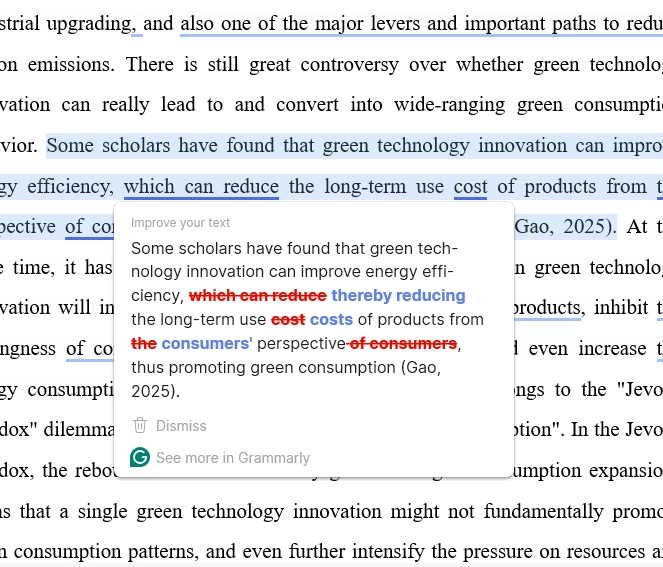
Two changes sit in that card. "Which can reduce" becomes "thereby reducing", and "the consumers' perspective" is reworded into "the perspective of consumers". Both are correct, and both are more formal than what the author wrote. "Thereby" plus a participle is one of the most model typical constructions in academic English. Accept the pair and the sentence gets flatter, which is the property a predictability score measures.
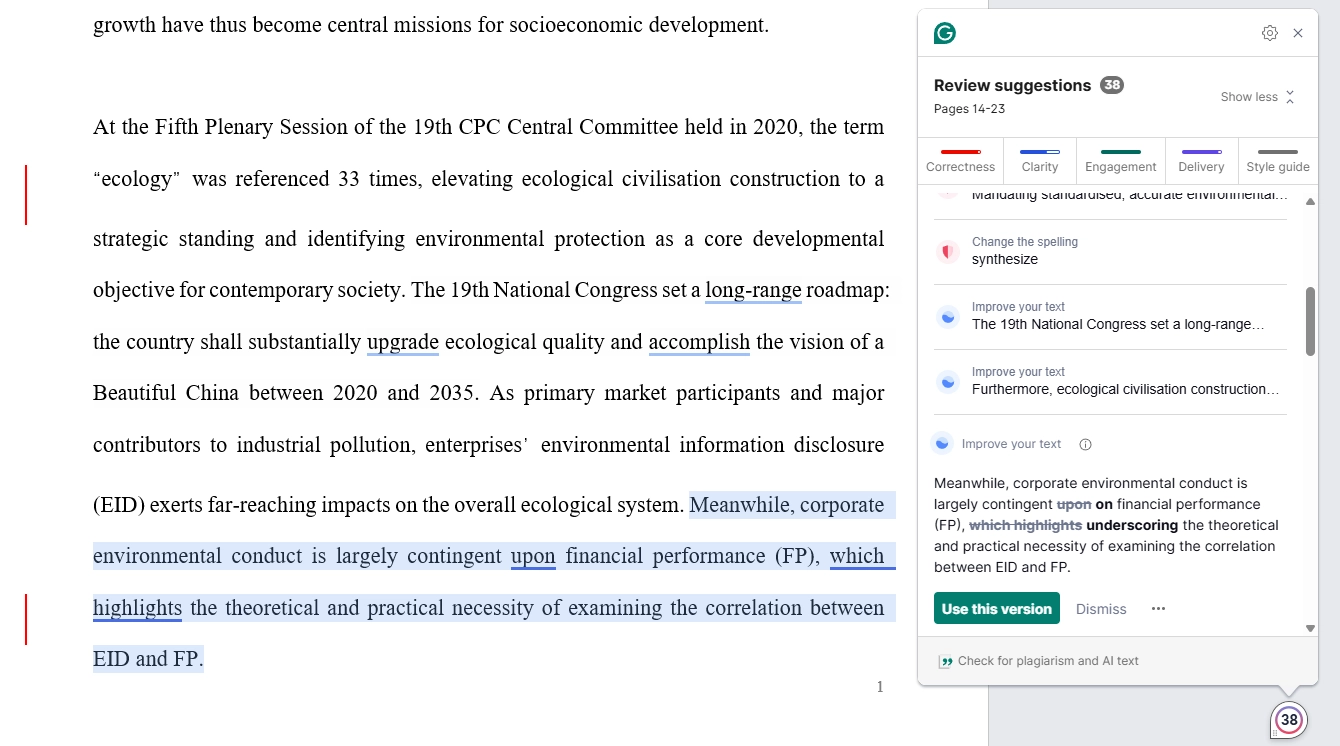
The panel carries 38 suggestions on one manuscript, among them "underscoring" in place of "which highlights". The problem is cumulative. Accept the reasonable ones down the list and a human draft has been rewritten in the vocabulary of a language model, and heavily AI rewritten prose is what lands in Turnitin's "likely revised using an AI-paraphrase tool or word spinner" category.
Humanize your own paper
Transform your AI-assisted text and make it sound human, without touching important words or citations.
Grammarly Humanizer Pricing
The Humanizer carries no price of its own. The suite it sits inside sets the price.
| Plan | Price | What it covers |
|---|---|---|
| Free | $0 with a Grammarly account | The Humanizer starts free once you have an account |
| Grammarly Pro | $12 a month | The paid tier of the suite it runs inside |
For a writer already paying for Grammarly, the Humanizer adds nothing to the bill. Buying it for one dissertation means taking on a whole suite to reach one agent that was never designed around your document type.
Citations, Terminology, Statistics and Register
Grammarly's Humanizer pages describe none of the four: no citation handling, no terminology locking, no academic register band, and no detector pass rates stated for the Humanizer.
- Citations. In text citations and reference entries have to come back exactly as they went in, down to the page number.
- Terminology. If "perceived behavioural control" becomes "a sense of control over behaviour" in one paragraph, your methods no longer describe a single variable.
- Statistics. An engine free to reword a sentence is free to reword the clause carrying the number.
- Register. A tone preset aims at a feel. Academic register is a measurable band.
TextPulse is built around those four: citations preserved verbatim across six referencing styles, freeze terms that lock any construct or instrument name before the pass, statistics and chemical formulas preserved automatically, and register held at the Flesch-Kincaid grade 13 to 18 band. Its vendor benchmark on a 2,000 document academic corpus reports 92.33% passing Turnitin AI, 89.12% Originality.ai and 87.91% GPTZero.
How It Scored in Our Testing
Turnitin results were the weakest of any humanizer we ran, tied with QuillBot's Humanizer. Rewritten passages kept enough model typical structure for the indicator to hold, which is what an engine tuned for tone rather than for statistical unpredictability produces.
Academic tone was the strongest result in the set, and nothing else came close. Output stayed formal and consistent from paragraph to paragraph, with none of the conversational drift that pulls general humanizers apart in a discussion section.
Grammar, citations and key terms all came back strong: sentences clean, references mostly intact, terminology largely preserved. Mostly and largely are the operative words. Nothing puts a reference entry out of scope or locks a construct name, so consistency across a long document is luck rather than design.
The Humanizer is an agent applied to a passage instead of a workspace for a document. There is nowhere to hold a chapter and no terminology list beside the text. Six languages beats most humanizers and falls short of a research group's range.
Tone at the top of the field and Turnitin at the bottom sums this review up. Our best AI humanizer roundup carries the wider comparison, where Undetectable AI returned the strongest Turnitin results.
Grammarly Humanizer Alternatives
- Undetectable AI. General content at volume, with monthly word pools and a refund if output is flagged.
- QuillBot Humanizer. Inside a paraphrasing suite, so it suits writers who already subscribe.
- WriteHuman. Short form general writing, returning several variations to pick between.
- Phrasly. General student and marketing drafts, with a document editor attached.
All four are built for general content, the scope Grammarly's Humanizer occupies, so none of them answers the academic question. For a thesis chapter or a manuscript, use TextPulse.
TextPulse vs Grammarly Humanizer
| What you are comparing | TextPulse | Grammarly AI Humanizer |
|---|---|---|
| Built for | Academic documents: theses, manuscripts, reports | Tone and voice in general writing: essays, proposals, marketing copy |
| Detector evidence | Vendor benchmark on a 2,000 document academic corpus: 92.33% Turnitin AI, 89.12% Originality.ai, 87.91% GPTZero | No pass rates stated for the Humanizer |
| Citations | Verbatim across APA, MLA, IEEE, Chicago, Harvard and Vancouver | Not described |
| Terminology | Freeze terms lock constructs and instrument names | No locking described |
| Register | Held at the Flesch-Kincaid grade 13 to 18 band | Four preset styles plus a custom voice |
| Capacity per pass | Whole documents, with no seams between fragments | An agent applied to the text you hand it |
| Price | Pro $19 a month for 25,000 words, Plus $29 for 50,000, or $169 and $259 billed annually | Free to start, Grammarly Pro $12 a month |
The Verdict on Grammarly
Grammarly's AI Humanizer is a capable tone and voice tool for general and business writing. The custom voice is a good idea executed well, six languages is wider reach than most humanizers offer, and Authorship helps with the disclosure that university and publisher policy requires. If you polish proposals, marketing copy or support messages, and you already pay $12 a month for Grammarly Pro, use it.
For an academic draft facing a detector, two things decide against it. Its rewriting is AI powered, so it moves prose toward the register detectors are trained to flag, as the "thereby reducing" and "underscoring" suggestions show on text a human wrote. And it protects nothing an academic document depends on: no citation handling, no terminology locking, no register band, no stated pass rates.
For a thesis chapter or a manuscript, use the TextPulse academic AI humanizer. Citations survive verbatim across six referencing styles, freeze terms hold your constructs in place, statistics and formulas pass through untouched, register stays inside the Flesch-Kincaid grade 13 to 18 band, and the document processes whole so terminology does not drift. Pro costs $19 a month for 25,000 words and Plus costs $29 for 50,000, or $169 and $259 billed annually, all listed on the TextPulse pricing page. No humanizer can guarantee a result on your specific document, and TextPulse reports an estimated Human Score instead of claiming one. Whichever tool you use, declare the assistance and cite the model where your style guide requires it.
Related research: the humanizers discussed above are compared head to head in A Controlled Comparison of AI Text Humanizers on Academic Writing, a TextPulse Research working paper with open data and code.
Frequently Asked Questions
For tone and voice it works well, and it is aimed at a different document. Grammarly frames the Humanizer around essays, proposals, marketing copy and support messages, and its pages describe no citation handling, no terminology locking and no academic register band. A thesis needs references preserved verbatim, constructs held fixed and formality kept inside a defined band, which is what an academic humanizer is designed to deliver.
Content strategist at TextPulse, here since the company started. Mark writes the product and technical coverage: how the humanizer works under the hood, what changes in each release, and what a specification actually means for your writing. His reviews of writing software come from using them on real documents rather than reading a feature list.