HumanizerAI Pro Review
HumanizerAI Pro is a free browser rewriter with no paid tier, no word pool and no signup wall, controlled by a rewrite level slider running from Quality through Balanced to Max. It advertises a 100% bypass rate with no corpus, date or named detector attached to the figure. This review judges it for academic work: theses, manuscripts and coursework.

HumanizerAI Pro costs nothing. There is no paid tier, no word pool, no account to create and no signup wall in front of the box. You paste text in, pick a rewrite level, and read the output. For a one off paragraph that is a genuine convenience, and the tool is a capable rewriter for the price.
It is aimed at casual rewrites, and no academic handling is described anywhere on it. This review judges it for academic work: theses, manuscripts and coursework, where the reference list gets checked as closely as the prose. The sections below cover what the free tier does well and where it fails on a long document.
What Universities Actually Allow
Oxford's guidance on using AI in study treats these tools as part of the study toolkit and sets the boundary at unacknowledged use, with disclosure and the student's own understanding of the work as the conditions. Elsevier and Nature apply the same standard to authors: use the tool for language and readability, declare it, and do not list a model as an author. Most university policy has that shape, turning on disclosure.
Departments treat undeclared use as the breach. A submission whose sources no longer match what the writer read is a problem whether or not the tool was declared. Our AI disclosure statement template covers the wording.
Why AI Drafts Need Humanizing
Two problems send writers to these tools. The first is stylistic. Raw model prose is generic in a way readers register before they can name it, with sentences of near uniform length, the same few connectives doing all the joining, and hedges stacked until a claim commits to nothing. Our list of AI words and phrases shows how narrow the vocabulary is.
The second problem is mechanical. University grade detectors, Turnitin, GPTZero, Originality.ai and Pangram among them, do not read for meaning. They score how predictable a passage is against what a language model would have chosen next, and generated prose scores as highly predictable. How AI detectors work sets out the measurement.
Light paraphrasing solves neither problem. Turnitin's documentation states that its AI indicator covers text that has been humanized or run through a bypasser, and that it separately flags text likely revised using an AI paraphrase tool or word spinner.
How AI Humanizers Work
- Varying sentence structure. This moves detector scores most, because sentence length variance is measured directly. Breaking a run of even twenty word sentences into a mix of six words and thirty changes the statistical profile of a passage.
- Replacing model typical vocabulary. The recurring lexicon of generated prose is a signal on its own. Swapping it changes the texture of a paragraph and leaves the shape alone.
- Adjusting register. Most general tools aim at conversational prose, which is the wrong target for a methods chapter. AI humanizer vs paraphraser covers the difference.
What HumanizerAI Pro Is and How the Rewrite Level Works
The tool is a single page: an input box, a control for how hard to rewrite, and an output box. The control is its best feature. It is a rewrite level slider running from Quality at one end, through Balanced, to Max at the other, and it makes the central trade of this category explicit instead of burying it inside a model.
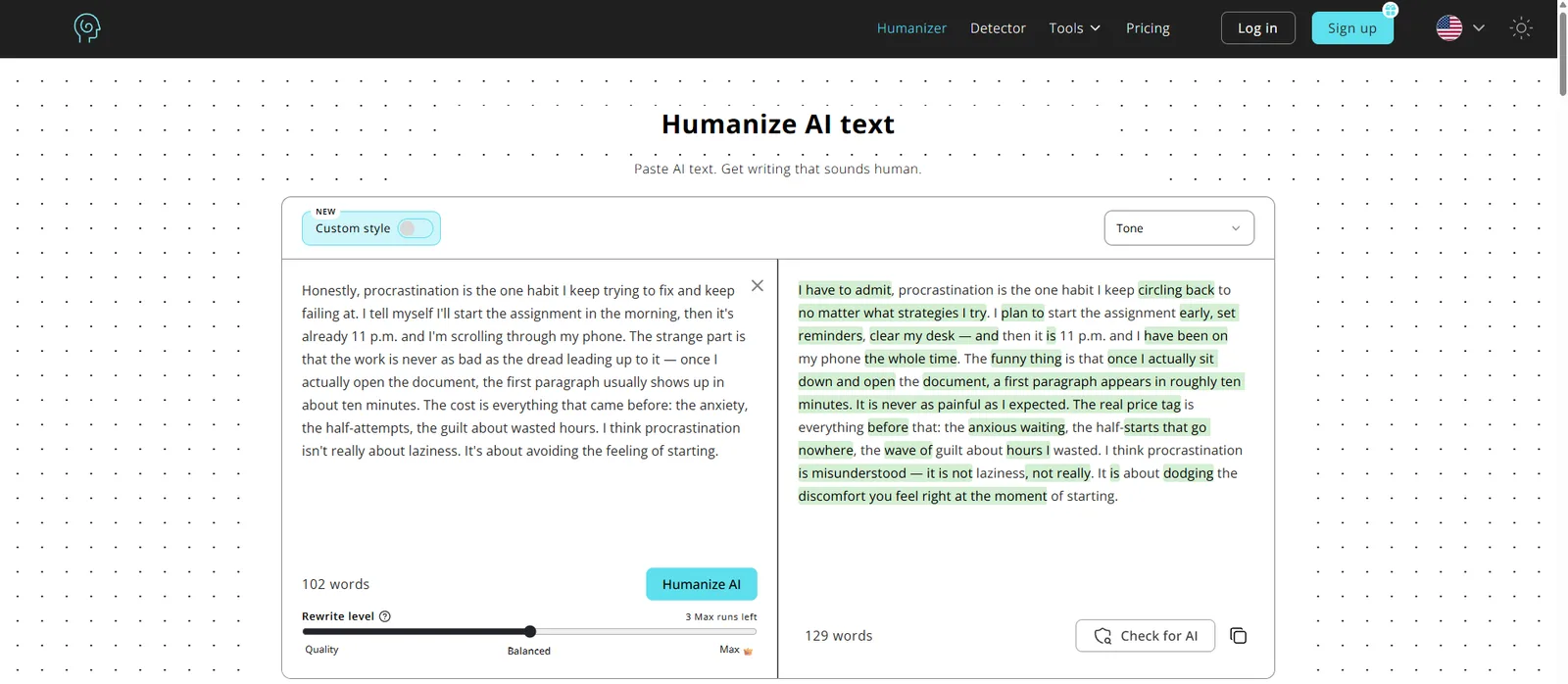
Every humanizer makes that trade. Rewriting harder moves a passage further from the statistical profile a detector is scoring, and further from what you wrote, which is where meaning gets bent and sentences get clumsy. Most tools pick a point on that curve for you. Putting the slider in front of the user is the more transparent design, and for academic text it means starting at the Quality end. Every step toward Max is another decision the model makes about your sentences, and another chance for a term, a number or a citation to come back subtly wrong.
The Feature Set and Who It Is For
- Browser rewriter. A paste in box and an output box, with nothing to install.
- Rewrite level slider. Quality, Balanced and Max, trading output quality against how aggressively the text is changed.
- Unlimited processing. No word pool and no per run charge.
- No signup wall. Nothing to create before the first run.
- No paid tier. There is no upgrade, so nothing sits behind one.
The natural audience is someone with a paragraph, a few minutes and no wish to enter an email address. For a blog intro or a short general essay it does the job well. A researcher with a manuscript needs a different set of guarantees, and none of them are described here.
HumanizerAI Pro Pricing and Plans
| Plan | Price | Word allowance | What it includes |
|---|---|---|---|
| Free | No cost | Unlimited processing | The rewrite level slider, with no signup wall |
| Paid tier | None offered | Not applicable | Everything the tool does sits on the free tier |
An unlimited free tool is worth testing because testing costs nothing. Put a real paragraph through it, citations left in and technical vocabulary intact, at each of the three rewrite levels, then compare the three outputs against your original line by line. A clean sample only shows you that the tool produces fluent English.
Humanize your own paper
Transform your AI-assisted text and make it sound human, without touching important words or citations.
What Free With No Revenue Costs You
Two consequences follow from a price of zero.
The first is model size. Free tools run on smaller models than paid engines, because inference is the main cost of running one, and smaller models usually show it on long or technical passages. A 6,000 word discussion chapter with defined terminology and a running citation load is where the difference appears: repetition creeps in, technical distinctions flatten, and the thread between paragraphs loosens.
The second is maintenance. Detectors retrain, so a humanizer is being tuned against a moving target, and keeping pace costs engineering time that has to be paid for somehow. A tool with no revenue has little to invest in that, which makes today's result a weak predictor of next term's.
The 100 Percent Bypass Claim
HumanizerAI Pro claims a 100 percent bypass rate, published with no corpus, no date and no named detector. A pass rate is a fraction: documents cleared, divided by documents submitted, against a specific detector on a specific date. Change any of those three and the number changes. A rate published without them is a marketing figure.
The evidence that does exist points the other way. In a study published in the International Journal for Educational Integrity, 160 academic papers of over 4,000 words were run through Pangram, GPTZero, Copyleaks and Turnitin. Pangram flagged 92.5% of the humanized papers, Turnitin flagged 50% of them, and all four cleared 100% of the human written papers. Detectors disagree by wide margins, and at least one catches most humanized academic writing, which is why no tool can promise 100% of anything.
Citations, Terminology, Statistics and Register
The tool documents no academic handling, and the output behaves accordingly.
Citations
To a rewriter with no citation rule, a parenthetical like (Borg and Steiner, 2022, p. 114) is ordinary revisable text. The surname can drift by a letter, the parenthetical can fold into the sentence as narrative attribution, the page number can vanish because the sentence reads more smoothly without it. Each edit produces competent prose, and each one breaks a reference a marker will check against your list. Moving the slider toward Max raises the odds on all three.
Terminology and statistics
Without a term lock, a rewriter hunting for variation treats a validated instrument name as a synonym opportunity, and "randomly assigned" becomes "randomly distributed", a different claim about your method. Numbers are the same problem: effect sizes, intervals and formulas sit inside sentences the rewriter is free to restructure, and a wrong number reads as fluently as a right one.
Register
Academic tone is the weakest of the tool's results, and the most predictable. A tool built for casual rewrites aims at output that sounds relaxed and human, which is right for a message and wrong for a literature review. There is no register target to set, so the drift is toward plainer, chattier prose than an examiner expects.
How It Scored in Our Testing
Turnitin results were the tool's strongest showing and genuinely good for a free engine. The rewrite changes the statistical shape of a passage rather than only its wording, which is more than several paid tools in this category manage. The interface is the other strong result, earned by restraint: one page, one slider, no configuration to work through.
Grammar came back above the middle and better than several paid rivals. Citations and key terms were adequate, which for referenced work is not good enough: most citations surviving most of the time still means some break silently. Non English samples were adequate as well. Academic tone was the weakest measure, for the reason above.
That is a real showing for a free tool. It is still a poor basis for a thesis, because the two measures a referenced document depends on most, citations and key terms, sit at adequate with no documented behaviour behind them.
HumanizerAI Pro Alternatives
- Undetectable AI. General content at volume, sold as monthly word pools, with a refund if output is flagged.
- QuillBot Humanizer. Sensible for people already paying for the QuillBot paraphrase suite.
- WriteHybrid. A word pool tool for content teams, with a recurring free tier of 500 words a month.
- Smodin. Aimed at students already using its citation and essay tools, from around $5 a month.
All four are general content designs, so none of them changes the academic answer. For documents carrying a reference list, where citations, locked terminology, statistics and register all have to survive as described behaviour, use TextPulse. Our comparison of the humanizer field puts the wider category side by side.
TextPulse vs HumanizerAI Pro
| Question | TextPulse | HumanizerAI Pro |
|---|---|---|
| Built for | Academic documents: theses, manuscripts, coursework | Casual one off rewrites |
| Citations | Preserved verbatim across APA, MLA, IEEE, Chicago, Harvard and Vancouver | No citation handling described |
| Terminology | Freeze Terms locks any construct, instrument name or technical phrase | No term lock offered |
| Register | Trained on peer reviewed writing, held at Flesch-Kincaid grade 13 to 18 | No register target to set |
| Rewrite strength | Tuned for academic text, with documents processed whole | A slider from Quality through Balanced to Max |
| Published detector evidence | Vendor benchmark on a 2,000 document academic corpus: 92.33% Turnitin AI, 89.12% Originality.ai, 87.91% GPTZero | A 100% claim with no corpus, date or named detector |
| Price | Pro $19 a month for 25,000 words, Plus $29 for 50,000, or $169 and $259 billed annually | Free, with no paid tier |
The Verdict on HumanizerAI Pro
HumanizerAI Pro is a better free tool than its price suggests. Its Turnitin results and its interface are the two strongest things about it, and both would be creditable on a paid product. The rewrite level slider hands the user the quality against aggression trade instead of making it silently, which is a design choice most paid rivals have not copied. For a paragraph you need loosened up in two minutes, with nothing to sign up for, it is a sensible thing to open.
The limits are structural. The 100 percent claim has no corpus, date or detector behind it, so there is nothing in it to check. A free engine runs on a smaller model, which shows on long technical passages. A tool with no revenue has little to spend on keeping pace as detectors retrain, so this term's result is a weak predictor of next term's.
For work that carries references, use TextPulse. Citations are preserved verbatim across APA, MLA, IEEE, Chicago, Harvard and Vancouver. Freeze Terms hold instrument names and constructs fixed through the pass. Statistics and formulas are preserved automatically. Documents process whole, so terminology does not drift between fragments, and register stays inside Flesch-Kincaid grade 13 to 18. Pro costs $19 a month for 25,000 words and Plus costs $29 for 50,000, or $169 and $259 billed annually.
The vendor benchmark behind those behaviours runs across a 2,000 document academic corpus and reports 92.33% on Turnitin AI, 89.12% on Originality.ai and 87.91% on GPTZero. TextPulse reports an estimated Human Score on each pass and makes no promise about a detector's verdict on your chapter. Those are stated figures with a stated corpus, and they are what a decision about a thesis should rest on.
Related research: the humanizers discussed above are compared head to head in A Controlled Comparison of AI Text Humanizers on Academic Writing, a TextPulse Research working paper with open data and code.
Frequently Asked Questions
Not for referenced work. The tool has no academic handling of any kind, so citations, instrument names and statistics are ordinary rewritable text to it, and every silent change to one is an error a marker will find. For a short general essay or a paragraph that needs loosening up, it is a reasonable free option that costs nothing to open and nothing to try.
Content strategist at TextPulse, here since the company started. Mark writes the product and technical coverage: how the humanizer works under the hood, what changes in each release, and what a specification actually means for your writing. His reviews of writing software come from using them on real documents rather than reading a feature list.