Netus AI Humanizer Review
Netus AI is a content marketing suite where humanizing is one tool among many, all of them spending from a single credit pool priced at one credit per ten words. Plans start free with 50 credits, then run at $14, $30, $59 and $99 a month. This review covers the credit arithmetic, what the rewriter leaves alone, and how it handles a document that carries a reference list.
Netus AI is a content marketing suite, and humanizing is one tool on the account rather than the whole product. Paraphrasing, summarising, readability analysis, keyword extraction, email writing and SEO article generation sit beside the rewriter, and every one of them spends from the same balance. Credits are priced at one per ten words. A free account opens with 50 credits, which is 500 words through the humanizer.
That structure suits a marketing team producing articles, emails and landing pages from one login, and the platform advertises 36 languages to go with it. This review judges Netus AI for academic work: theses, manuscripts and coursework, where the reference list gets checked as closely as the prose. Two things decide that outcome, citation handling and a terminology lock, and Netus AI offers neither.
What Universities Actually Allow
Editing your own draft with an AI tool is permitted at most institutions, and the published rules govern disclosure.
Elsevier's policy on generative AI in writing permits these tools for improving readability and language, requires the use to be declared, and rules out listing a model as an author, because authorship carries responsibilities a tool cannot hold. Nature's editorial policy sets the same two conditions. Universities apply the same logic to coursework and treat undeclared use as the breach.
Two obligations follow. Say what the tool did, and confirm that the text it returned still says what your sources say. Our AI disclosure statement template covers the first. This review is about the second.
Why AI Drafts Need Humanizing
Raw model prose has a texture readers notice before they can name it: sentences of near-identical length, the same few connectives doing all the joining, hedges stacked until no claim commits to anything. Our list of AI words and phrases shows how narrow the working vocabulary really is.
The second problem is measurement. Turnitin, GPTZero, Originality.ai and Pangram do not read for meaning. They score how predictable a passage is against what a language model would have chosen next, and generated prose scores as predictable. Our guide to how AI detectors work sets out the mechanics.
Paraphrasing on its own moves neither problem far, which matters here because Netus AI sells a paraphraser and a humanizer side by side. Turnitin's documentation states that its AI indicator covers text that has been humanized or passed through a bypasser, and that it separately flags text likely revised using an AI paraphrase tool or word spinner. Our guide to AI humanizer vs paraphraser separates the two jobs. No humanizer can promise a detector outcome on a specific document.
How AI Humanizers Work
- Varying sentence structure. Sentence-length variance is one of the numbers a detector reads, which makes this the change with the largest effect. Uniform sentences rewritten into a mix of short and long alter the shape of a passage, not only its vocabulary.
- Replacing model-typical vocabulary. Second in effect. The recurring lexicon of generated prose is a strong signal on its own, and swapping it changes texture while leaving structure alone.
- Adjusting register. Third, and the place general tools go wrong for academic users. Most aim at conversational output because most of their customers write marketing copy, and conversational is the wrong target for a methods chapter.
What Netus AI Is and How Its Credits Work
Netus AI is a suite. The humanizer takes text you paste in and returns a rewritten version, and the same account generates SEO articles, paraphrases, summarises, extracts keywords, analyses readability and writes emails. Every one of those tools draws on one balance at one credit per ten words, so the humanizer competes for budget with six other functions.
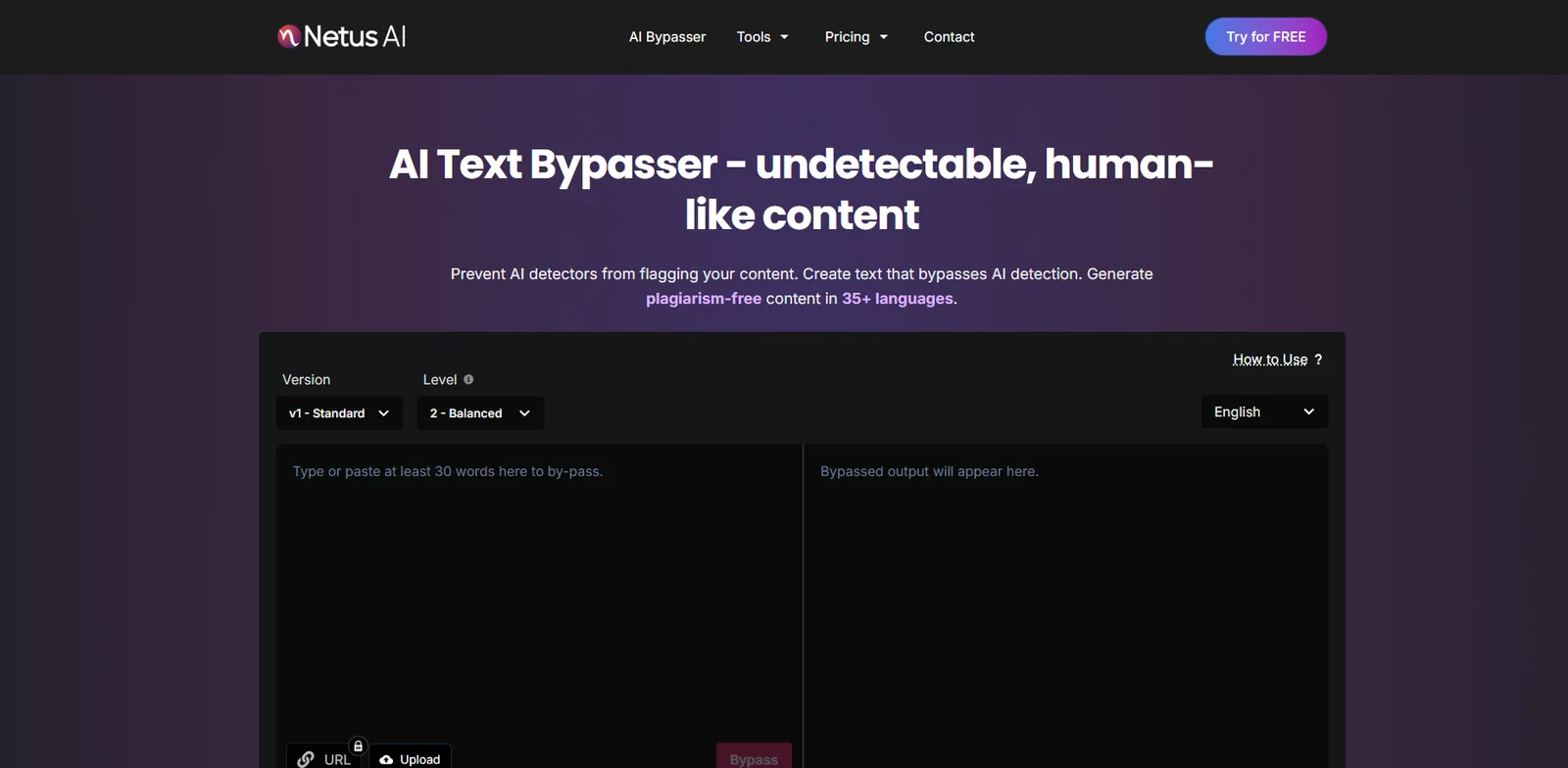
The rewriter gives you two controls where most humanizers give one: model version and aggression level. That deserves credit. Aggression on its own is a blunt dial, and separating it from the engine lets you hold rewrite strength steady while changing the model, or hold the model steady and ease off the rewriting. Where light editing is enough, that combination keeps more of your own phrasing.
The Shared Credit Trap
Do the arithmetic before you subscribe. Basic costs $14 a month for 1,500 credits, which is 15,000 humanizer words if the humanizer is the only tool you run. It will not be, because the same credits buy article generation, paraphrasing, summarising and everything else in the suite. A month spent generating articles is a month with fewer humanizer words.
For a marketing team that trade is reasonable. The tools serve one workflow, and the balance moves to wherever the week's work sits. A researcher gets the worse end of it. You will never open the SEO article generator or the email writer, so part of every payment buys capacity in tools you do not want. A thesis chapter needs one job done to a fixed number of words, and a shared pool fits that badly.
Humanize your own paper
Transform your AI-assisted text and make it sound human, without touching important words or citations.
Who Netus AI Is For
Marketing teams are the target. Keyword extraction, SEO article generation and email writing describe a content workflow. If your week involves producing web copy at volume and rewriting some of it, the suite is coherent and the shared pool works in your favour.
Researchers are a poor fit. Nothing in the tool set addresses citations, locked terminology or academic register, because the product was built for a different buyer. Netus AI is a marketing platform, and the vendor makes no secret of it.
Netus AI Pricing and Plans
Pricing runs monthly, with a free tier to test on.
| Plan | Price per month | Credits | Humanizer words if spent only on humanizing |
|---|---|---|---|
| Free | Free | 50 credits | 500 words |
| Basic | $14 | 1,500 credits | 15,000 words |
| Higher tier | $30 | More credits than Basic | Shared with every other tool |
| Higher tier | $59 | More credits again | Shared with every other tool |
| Top tier | $99 | The largest allowance | Shared with every other tool |
Those word figures in the right-hand column hold only if the humanizer is the sole tool you run, which is the opposite of how the product is designed to be used. Spend the free 50 credits on a passage that resembles your real writing: citations in, instrument names intact, one statistic in place. A clean unreferenced paragraph comes back fluent and teaches you very little.
Citations, Terminology, Statistics and Register
Citations, terminology, statistics and register are the four places an academic document breaks in a rewrite. Netus AI protects none of them.
Citations
Netus AI has no citation handling, so a parenthetical like (Adeyemi and Kowalski, 2020, p. 47) is ordinary text to the rewriter. A surname drifts by a letter. A page number vanishes when the sentence is restructured. A parenthetical folds into narrative attribution. Each result reads as competent prose, and each one breaks a link a marker can check in seconds against your reference list.
Terminology and statistics
There is no term lock, so a rewriter hunting for variation treats a validated instrument name as an opportunity. "Randomly assigned" becomes "randomly distributed", a different claim about your method. Effect sizes, confidence intervals and formulas sit inside sentences the rewriter can restructure, and a wrong number reads as fluently as a right one.
Register
The suite is tuned for content that has to read easily. Readability analysis sitting next to the humanizer tells you what the product optimises for, and easy reading is the wrong target for a literature review, where the expected band is Flesch-Kincaid grade 13 to 18.
How It Scored in Our Testing
The rewriter works. Output came back with a changed statistical profile, which is what a detector measures, and Turnitin results were the strongest part of its performance. Grammar was clean, without the mechanical slips heavier rewriters produce, which is consistent with a tool built to ship publishable web copy.
Citations were the first academic gap. Nothing in the product recognises a reference as a protected object, so damage happens silently and you find it during a proofread, if you find it at all. Key terms were the second gap, from the same cause: with no lock available, the rewriter varies vocabulary indiscriminately, and construct names and instrument titles are exactly the vocabulary that has to stay fixed. Academic tone landed in a general register, well short of the band a thesis sits in.
The dashboard is broad, and that costs time. The humanizer is one panel among many, the credit balance is a shared number you reason about before every run, and a researcher who wants one job done navigates tools built for someone else. Thirty-six advertised languages is real coverage, though coverage does not guarantee output quality. Test your own language first.
Netus AI Alternatives
- Undetectable AI. General content at volume, sold as monthly word pools rather than shared credits, and it produced the strongest Turnitin results of any humanizer we ran.
- Phrasly. A humanizer with a document editor attached, so drafting and rewriting sit behind one login.
- StealthWriter. Sentence-level inspection with alternative rewrites, for writers who want to approve every change.
- QuillBot Humanizer. Costs nothing extra if you already pay for the QuillBot paraphrase suite.
All four are built for general content, which is why the same gaps recur across them. For a thesis or a journal manuscript, use TextPulse. The wider field is compared in our guide to the best AI humanizer.
TextPulse vs Netus AI
| Comparison | TextPulse | Netus AI |
|---|---|---|
| Built for | Academic documents: theses, manuscripts, coursework | Content marketing, with humanizing as one tool among many |
| Published detector evidence | Vendor benchmark on a 2,000 document academic corpus: 92.33% Turnitin AI, 89.12% Originality.ai, 87.91% GPTZero | None stated |
| Citation handling | Citations and reference entries preserved verbatim in APA, MLA, IEEE, Chicago, Harvard and Vancouver | None named |
| Terminology and statistics | Freeze Terms locks any construct or instrument name; statistics and formulas preserved automatically | Ordinary rewritable text |
| Register | Peer-reviewed training data, held at Flesch-Kincaid grade 13 to 18 | General register, tuned for readability |
| What your money buys | Humanizing capacity for documents | Shared credits across humanizing, article generation, paraphrasing and more |
| Price | Pro $19 a month for 25,000 words, Plus $29 for 50,000, or $169 and $259 billed annually | Free with 50 credits, then $14, $30, $59 and $99 a month |
The Verdict on Netus AI
Netus AI is a capable content marketing suite. Separating model version from aggression level gives you more control over a rewrite than most humanizers offer, output is clean enough to publish, Turnitin results held up, and 36 advertised languages is genuine breadth. If your work is web copy, email and SEO articles, one balance across seven tools from $14 a month is a sensible way to buy.
For academic documents the requirements change. The product has nothing to offer on citations or controlled vocabulary; nothing in the tool set addresses either one. The credit arithmetic also works against a researcher: a month spent generating articles is a month with fewer humanizer words, and part of every payment buys tools you will never open.
For work carrying a reference list, use TextPulse. Citations and reference entries survive a pass verbatim in APA, MLA, IEEE, Chicago, Harvard and Vancouver. Freeze Terms locks a construct or instrument name before the rewrite starts, so the version that renames it is never generated. Statistics and formulas are preserved automatically, documents process whole rather than in fragments, and register is held at Flesch-Kincaid grade 13 to 18. Pro costs $19 a month for 25,000 words and Plus costs $29 for 50,000, or $169 and $259 billed annually. The vendor benchmark across a 2,000 document academic corpus reports 92.33% on Turnitin AI, 89.12% on Originality.ai and 87.91% on GPTZero. TextPulse reports an estimated Human Score on each pass and makes no promise about a detector's verdict on your chapter.
Frequently Asked Questions
No. Netus AI has no citation handling, no terminology lock and no academic register band, which fits a suite built for marketing teams. A parenthetical, an instrument name and a reported figure are all ordinary rewritable text to it. For a thesis chapter or a journal manuscript, use TextPulse, which preserves citations across six referencing styles and holds output between Flesch-Kincaid grade 13 and 18.
Content strategist at TextPulse, here since the company started. Mark writes the product and technical coverage: how the humanizer works under the hood, what changes in each release, and what a specification actually means for your writing. His reviews of writing software come from using them on real documents rather than reading a feature list.