GPTinf AI Humanizer Review
GPTinf is a budget humanizer built on credits, so if the first pass falls short you pay to run the text through the same engine again. Paid tiers sit at $4.99, $12.49 and $29.99 a month, with a one time free allowance of 240 words. This review judges it for academic writing, where repeated passes compound drift and citations have no protection.

GPTinf is a budget AI humanizer built on credits, and the re-run defines it: if the first pass does not move a detector score far enough, you spend credits sending the same text through again. Paid tiers sit at $4.99, $12.49 and $29.99 a month, and a one time free allowance of 240 words lets you see the output before you pay anything.
It suits occasional users on a small budget: someone rewriting a short piece, a writer cleaning up general copy, anyone testing whether a humanizer moves a score before committing to something bigger. This review judges it on academic work, where the reference list gets checked as carefully as the prose.
What Universities Actually Allow
The rules are more permissive than most students expect, and stricter about one thing. Oxford's guidance for students treats generative AI as a study aid to be used openly and within the terms of the assessment. In almost every code of practice the breach is undeclared use.
Journal policy lands in the same place. Elsevier permits these tools to improve readability and language provided the paper carries a declaration, and Nature refuses to list a model as an author because an author has to be answerable for the work. That changes what you should demand from a humanizer. Once you are permitted to use AI and required to say so, the question is whether the text is still true: whether the parenthetical still names the author you read, whether the figures still match the table. Our AI disclosure statement template covers the wording departments expect.
Why AI Drafts Need Humanizing
Two problems push writers toward these tools, and only one is about detectors. Raw model prose reads as generic in a way people notice before they can explain it: sentences of uniform length, connectives collapsed into the same few joins, hedges stacked until a claim commits to nothing. Our list of AI words and phrases shows how narrow that vocabulary is.
The second problem is mechanical. Turnitin, GPTZero, Originality.ai and Pangram score how predictable a passage is against what a language model would have chosen next, and generated text scores as highly predictable. How AI detectors work sets out the measurement.
Those scores are softer than they look. Weber-Wulff and colleagues tested 14 detection tools and concluded they are neither accurate nor reliable, with a bias toward labelling output as human written. That cuts both ways: a passing score proves less than the vendor implies, and a flag on your own writing proves less than your department implies.
How AI Humanizers Work
- Varying sentence structure. Sentence length variance is measured directly, so this moves a detector score more than anything else does. Breaking a run of even twenty word sentences into a mix of short and long changes the statistical shape of a passage along with its wording.
- Replacing model typical vocabulary. Alone it changes texture and leaves structure alone. It is also the mechanism most likely to damage a technical document, because a rewriter hunting for variety cannot tell a stylistic word from a defined term.
- Adjusting register. Most general tools aim at conversational prose, which is the wrong target for a methods chapter. Loosening an academic paragraph lowers a detector score and damages the paper.
What GPTinf Is and How the Credit Model Works
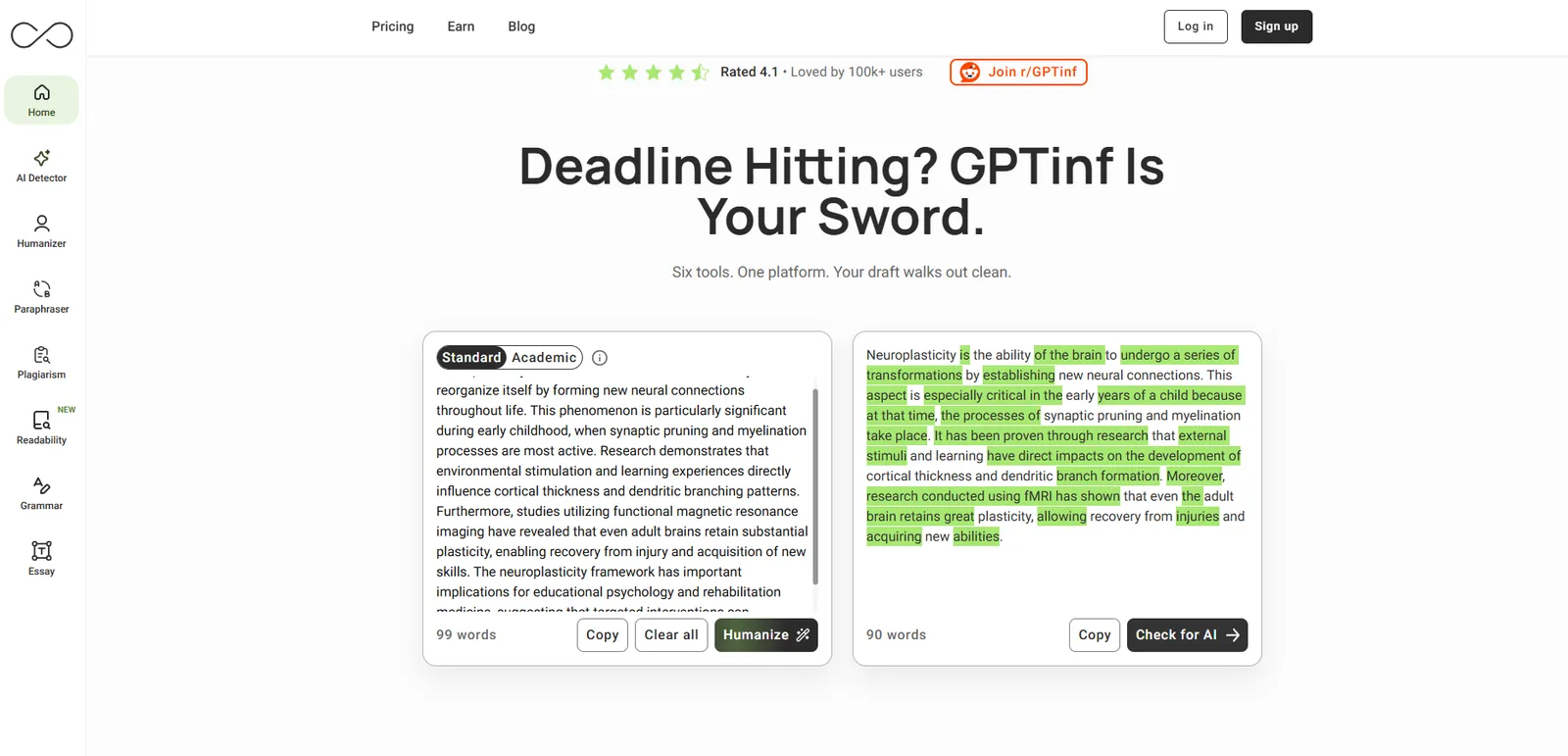
GPTinf is a text box, a mode selector and a rewrite button, sold cheaply. You paste text, choose how the tool should treat it, and get a rewritten version back with the changes marked. The metering is what separates it from most tools at this price: usage draws on credits instead of a flat word cap, and those credits can be spent sending the same passage through again.
The re-run design is unusually honest. Most humanizers present a single pass as a finished result. GPTinf concedes that one pass may not be enough and gives you a lever: spend more credits and go again. There is no pretence of a better engine on the second attempt. It is the same engine, applied to text it has already altered.
For short general text that works acceptably, because nothing in a few hundred words of blog copy has to stay exactly as written. For a chapter it works poorly, because drift compounds. Pass two rewrites pass one, so you end up comparing the newest output against the most recent version instead of against your draft.
Academic Mode and Highlighted Rewrites
Two design decisions deserve real credit, because very few tools in this price band make them.
A named Academic mode sits alongside the Standard one. Most humanizers offer a single register, or a strength slider that says how far the rewrite travels without saying what it travels toward. Naming an academic setting gives you something to select other than more aggression.
Every rewritten phrase is highlighted. It sounds cosmetic, but it is the more useful of the two features. The core risk in any humanizing pass is a silent change: a surname altered by a letter, a hedge removed so a tentative finding reads as settled, a defined term swapped for a near synonym that means something else in your field. Highlighting makes those checkable.
Highlighting shows what changed; it does not tell you whether the change was safe. On a long document the volume of highlights becomes its own problem, and every one of them is yours to check.
The Feature Set
- Credit based humanizer. The core rewriter, metered in credits instead of a flat word count.
- Re-run passes. The same text can be sent through again, drawing on the same balance.
- Standard and Academic modes. A named register choice instead of one generic output.
- Change highlighting. Every rewritten phrase is marked so you can see what the tool did.
- Free allowance. A one time 240 words without payment, enough to judge the output.
What is missing matters as much. GPTinf describes no citation handling, no register target beyond the mode name, and no term lock to hold an instrument name in place before the rewrite starts.
Humanize your own paper
Transform your AI-assisted text and make it sound human, without touching important words or citations.
Who GPTinf Is For
The pricing tells you who this is for. An entry tier under five dollars a month is aimed at people who use a humanizer occasionally, which is a real and underserved group. For that user the credit model is an advantage: you are not paying for capacity you will never use, and a disappointing result has a cheap remedy.
GPTinf Pricing and Plans
The free allowance is one time, so spend it deliberately.
| Plan | Price | Notes |
|---|---|---|
| Free allowance | No payment | 240 words, one time only |
| Entry tier | $4.99 a month | Credits for rewriting, with re-runs drawn from the same balance |
| Middle tier | $12.49 a month | The regular use option in the range |
| Top tier | $29.99 a month | The heaviest use option in the range |
Because credits pay for re-runs as well as first passes, your real capacity depends on how often you go again. Spend the 240 free words on your actual writing, citations left in and vocabulary intact. A clean sample of general prose only tells you the output is fluent, which was never in doubt.
Citations, Terminology, Statistics and Register
Citations
GPTinf describes no citation handling. To a rewriter with no citation rule, a parenthetical such as (Okonkwo and Reyes, 2021, p. 87) is ordinary text, as open to revision as any other string. A surname can drift by a letter, and a parenthetical can fold into the sentence as narrative attribution and lose the page number. Each edit produces competent prose and a reference that no longer matches your list. Highlighting helps, and the burden of catching it stays with you on every pass. More in can Turnitin detect paraphrased text.
Terminology and statistics
Without a term lock, a rewriter looking for variation treats a validated instrument name as an opportunity. Randomly assigned becomes randomly distributed, a different claim about your method. Effect sizes, intervals and formulas sit inside sentences the rewriter is free to restructure, and a wrong number reads as fluently as a right one. Multiply that by the number of passes you run.
Register
An Academic mode aims at the right target, and it is more than most budget tools offer. But the mode states no reading level band or grade range, and the gap between essay prose and a submitted manuscript is exactly what an examiner reads for.
How It Scored in Our Testing
Multilingual output is stronger than the category average, and it is the easiest thing about GPTinf to overlook, because multilingual quality is usually where cheap tools collapse.
The dashboard is clean. The mode choice is visible instead of buried, and the highlighting makes the output legible instead of handing you a wall of new text to diff yourself.
Detector movement and grammar are both respectable. The rewriter moves scores and the output is generally clean, which is what the re-run model is built to deliver.
Key terms survive more often than not, though without a term lock that is a tendency, never a guarantee.
Citations and academic tone are the weak points. These are the two measures that decide a document with a reference list, and they describe the tool accurately: usable prose, no protection for the parts that cannot change.
GPTinf Alternatives
- Undetectable AI. General content at volume, with monthly word pools and a refund if output is flagged.
- QuillBot Humanizer. Sensible for people already paying for the QuillBot paraphrase suite.
- StealthGPT. Built for SEO and copywriting at volume.
- Phrasly. Pairs a humanizer with a document editor, aimed at general writers and students.
All four are general content designs, so none of them changes the academic answer. For a thesis or a journal manuscript, where citations, terminology and register have to survive the rewrite, use TextPulse. Our comparison of the humanizer field puts the options side by side.
TextPulse vs GPTinf
| Comparison | TextPulse | GPTinf |
|---|---|---|
| Built for | Academic documents: theses, manuscripts, coursework | Short general text on a small budget |
| Published detector evidence | Vendor benchmark on a 2,000 document academic corpus: 92.33% Turnitin AI, 89.12% Originality.ai, 87.91% GPTZero | None stated |
| Citation handling | Preserved verbatim across APA, MLA, IEEE, Chicago, Harvard and Vancouver | None described; rewritten phrases are highlighted so you can check them |
| Terminology control | Freeze Terms lock any construct, instrument name or technical phrase | None stated |
| Register | Trained on peer reviewed human writing, held at Flesch-Kincaid grade 13 to 18 | A named Academic mode, with no stated reading level target |
| Capacity per pass | Documents processed whole, so no seams where terminology drifts | Credit metered, with re-runs spending from the same balance |
| Price | Pro $19 a month for 25,000 words, Plus $29 for 50,000, or $169 and $259 billed annually | $4.99, $12.49 or $29.99 a month, with a one time 240 word free allowance |
The Verdict on GPTinf
GPTinf earns more credit than its price suggests. A named Academic mode is more than most tools in this category offer, and highlighting every rewritten phrase means you can check its work instead of trusting it. Multilingual output holds up better than the category average. At $4.99 a month, someone rewriting short general text occasionally is getting a fair deal.
Re-runs create a specific problem on a long document. Each pass takes the previous pass as its input, so drift compounds: the second rewrite works on the first rewrite. On 300 words of general copy that costs nothing. On a chapter with a reference list and a table of results, there is no citation rule and no term lock to limit the damage.
For academic documents, use TextPulse. Citations and reference entries survive verbatim across APA, MLA, IEEE, Chicago, Harvard and Vancouver. Freeze Terms lock any construct, instrument name or technical phrase before the rewrite begins, so you decide what must not change. Statistics and formulas are preserved automatically, output is held in the Flesch-Kincaid grade 13 to 18 band, and documents process whole so terminology does not drift between fragments. Pro costs $19 a month for 25,000 words and Plus costs $29 for 50,000, or $169 and $259 billed annually. The vendor benchmark across a 2,000 document academic corpus reports 92.33% on Turnitin AI, 89.12% on Originality.ai and 87.91% on GPTZero. TextPulse reports an estimated Human Score on every pass and promises nothing about a detector's verdict on your chapter.
Related research: the humanizers discussed above are compared head to head in A Controlled Comparison of AI Text Humanizers on Academic Writing, a TextPulse Research working paper with open data and code.
Frequently Asked Questions
It suits short general text better than referenced work. GPTinf offers a named Academic mode and highlights every phrase it rewrote, and both of those help. It has no citation handling and no term lock, so parentheticals, instrument names and statistics are ordinary rewritable text to it. The highlighting shifts the burden of catching every change onto you, on every pass.
Content strategist at TextPulse, here since the company started. Mark writes the product and technical coverage: how the humanizer works under the hood, what changes in each release, and what a specification actually means for your writing. His reviews of writing software come from using them on real documents rather than reading a feature list.