Ryne AI Humanizer Review
Ryne AI is a student platform rather than a standalone humanizer, bundling rewriting with AI chat, an essay composer, a note taker and a built-in AI report, all metered in shared coins. Plans run from a free tier at 250 words per run to Emerald at $39.99 a month with 1,500. This review judges it for academic writing, where the words per run ceiling and the content type gap both matter.
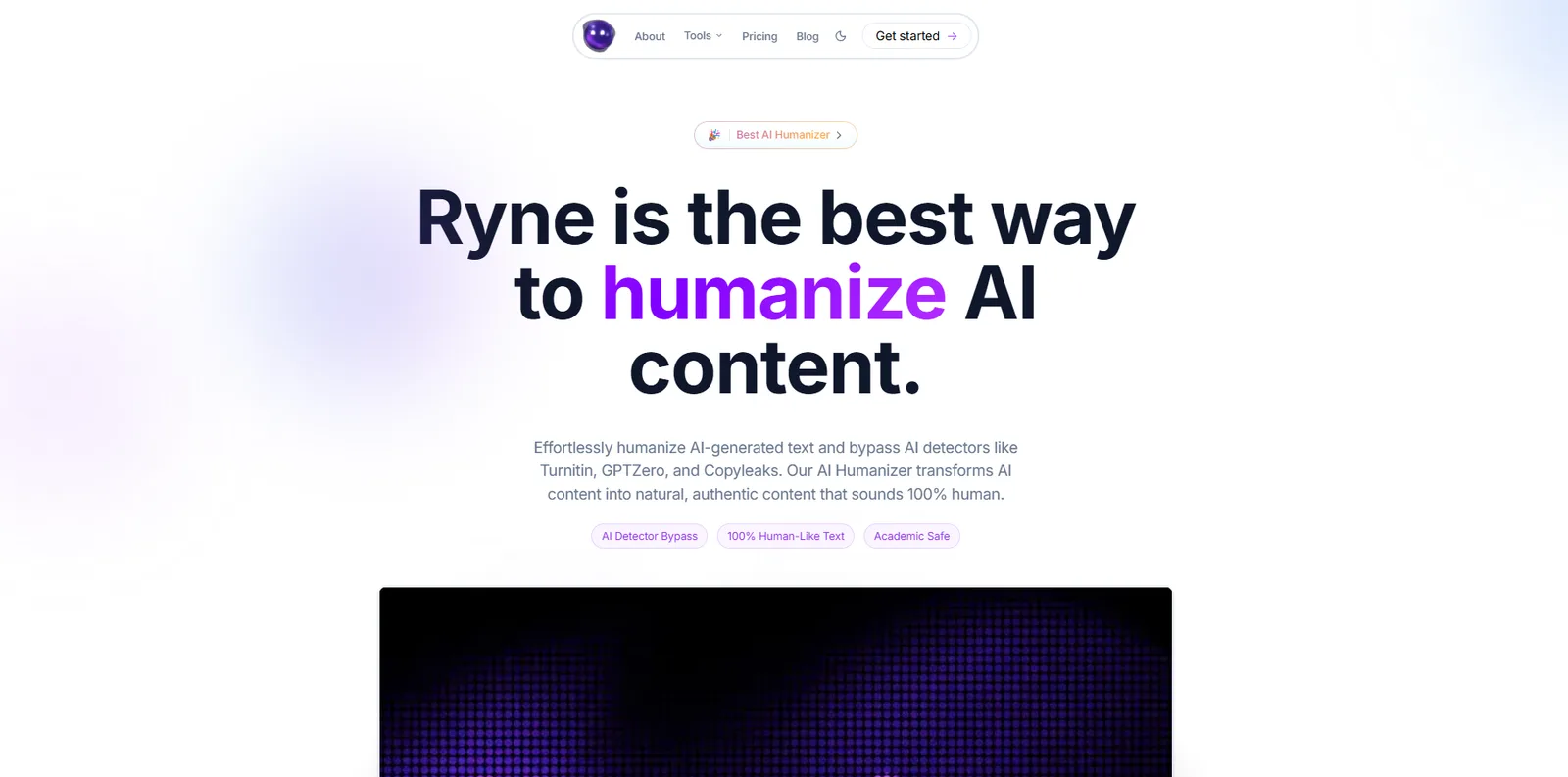
Ryne AI is a student platform rather than a standalone humanizer. The rewriter sits alongside multi-model AI chat, an essay composer, a note taker and a built-in AI report, and everything draws on the same balance of coins. The company claims more than 2.3 million students. The free tier caps a rewrite at 250 words, Sapphire at 750 and Emerald at 1,500.
It suits an undergraduate who wants one bundled account instead of four subscriptions, and who works in pieces short enough to fit a single run. This review judges it on academic work, where the reference list gets checked as carefully as the prose.
What Universities Actually Allow
Almost every code of practice turns on declaration. Elsevier's policy on generative AI permits these tools to improve readability and language, requires authors to disclose the use, and holds the humans responsible for the result. No model can be listed as an author. Oxford applies the same standard to students, treating AI as a study aid to be used openly within the terms of the assessment.
University codes follow the same logic: the breach is not declaring. Once you are allowed to use AI and required to say so, the question moves from concealment to accuracy: does a citation still point at the paper you read, is a construct still named correctly, does the number in your discussion still match the table. Our guide to how to cite ChatGPT covers the referencing side.
Why AI Drafts Need Humanizing
Two problems push students toward these tools. Raw model prose reads as generic in a way people notice before they can explain it: sentences of uniform length, connectives collapsed into the same few joins, hedges stacked until nothing commits. Our list of AI words and phrases shows how narrow that vocabulary is.
The second problem is mechanical. Turnitin, GPTZero, Originality.ai and Pangram score how predictable a passage is against what a model would have chosen next, and they never read for meaning. How AI detectors work sets out the measurement.
Detectors also disagree with each other more than students expect. A study at Vrije Universiteit Brussel ran 160 academic papers of over 4,000 words through four systems. Pangram flagged 97.5% of fully AI generated papers and 92.5% of humanized ones, while Turnitin flagged none of the AI generated set and half of the humanized set. All four cleared 100% of the human written papers.
How AI Humanizers Work
- Varying sentence structure. Sentence length variance is measured directly, so this moves a detector score more than anything else does. Breaking a run of even twenty word sentences into a mix of short and long changes the statistical shape of a passage along with its wording.
- Replacing model typical vocabulary. Alone it changes texture and leaves structure untouched, and it is the mechanism most likely to damage a technical document.
- Adjusting register. Most general tools aim at conversational prose, because most of their customers are writing something other than a methods chapter.
What Ryne AI Is and How the Coin Economy Works
The product is a workspace rather than a text box. You can chat with several models, draft an essay in the composer, keep notes, run a passage through the humanizer and check it against the built-in AI report, all behind one login. Every one of those actions spends from the same pool of coins, and unused coins roll over instead of expiring.
Shared metering has a real advantage. You are buying one subscription and using all of it, which is a fair deal for a student who would otherwise pay four vendors. It has a downside too. A morning spent chatting with models comes out of the same balance that pays for rewriting, so heavy use of the rest of the platform eats into your humanizing budget.
Content type changes the result. Third party testing reports a marked gap: meaningful improvement on creative text, and very little on academic and factual writing. That pattern is typical of a rewriter tuned for fluency. Creative prose has room to move, because almost any sentence can be restructured without breaking anything. Academic prose does not, because the terminology is fixed, the hedging is deliberate and the citations cannot move.
The Built-In AI Report
The report is the best thing in the bundle. Checking your own draft before submission is sound practice. A student who has never seen an AI report has no idea which parts of their writing read as machine generated, and that gap is where most panic comes from: the flag arrives after submission, too late to act on.
Having the check beside the draft also shortens the loop. You rewrite a paragraph, see whether the reading changed, and learn something about your own prose while doing it. Many standalone humanizers do not offer it.
Two limits apply. Reports are rationed by plan, one a month on Sapphire and three on Emerald, so this is not something you run on every revision. And any single system gives one opinion: the Brussels figures show four detectors reaching sharply different conclusions on the same papers. Treat a clean report as one opinion rather than a guarantee, and read can Turnitin detect paraphrased text for what happens next.
Humanize your own paper
Transform your AI-assisted text and make it sound human, without touching important words or citations.
The Feature Set and Who It Is For
- Humanizer. The rewriter, capped by words per run and metered in coins.
- Multi-model AI chat. Several models behind one interface.
- Essay composer. Drafting inside the platform instead of pasting text in.
- Note taker. Material captured alongside the draft.
- Built-in AI report. A check on your own draft before you submit it.
- Rollover coins. Unused balance carries forward instead of expiring.
The intended buyer is an undergraduate consolidating tools. For essay length work, having the draft, the rewriter and the report in one place is genuinely convenient, and rollover coins suit a term where the workload arrives in bursts. The further your work moves from that shape, toward a long referenced document, the less the bundle gives you.
Plans, Coins and the Words Per Run Ceiling
The free Amethyst tier gives 100 coins, English only, and 250 words per run, enough to see the texture of the output.
| Plan | Monthly | Annual | What it includes |
|---|---|---|---|
| Amethyst | Free | Free | 100 coins, English only, 250 words per run |
| Sapphire | $29.99 a month | $19.99 a month, billed at $167.99 a year | 10,000 coins, all languages, 750 words per run, one AI report a month |
| Emerald | $39.99 a month | $29.99 a month, billed at $251.99 a year | Unlimited coins, 1,500 words per run, three AI reports |
| Ruby | $109.99 a month | $99.99 a month | The top tier in the range |
Unlimited coins on Emerald do not remove the ceiling that matters. The constraint on a long document is words per run, and 750 words on Sapphire or 1,500 on Emerald means a chapter goes through in pieces, each rewritten with no knowledge of the pieces around it.
Terminology drifts across those segments. A construct rendered one way in the first segment can come back differently in the fourth, because nothing carried the earlier choice forward, and a definition stated in your introduction stops matching its use in your discussion. The result reads acceptably paragraph by paragraph and inconsistently across the whole document.
Citations, Terminology, Statistics and Register
Citations
To a rewriter with no citation rule, a parenthetical such as (Halvorsen and Adeyemi, 2020, p. 42) is ordinary text, as open to revision as any other string. A surname can drift by a letter, and a parenthetical can fold into the sentence as narrative attribution and lose its page number. Each edit gives you competent prose and a reference that no longer matches your list, and it does so silently.
Terminology and statistics
Without a term lock, a rewriter looking for variation treats a validated instrument name as an opportunity. Randomly assigned becomes randomly distributed, a different claim about your method. Effect sizes, intervals and formulas sit inside sentences the rewriter can restructure, and a wrong number reads as fluently as a right one.
Register
Fluent conversational output suits an essay but not a literature review. A tool that lowers the reading level to sound more human moves your writing away from the register an examiner expects, and Ryne sets no academic register target.
How It Scored in Our Testing
Grammar is the weak point. That matters more than it sounds. A humanizer that leaves grammatical damage behind creates work instead of saving it, and in a marked document the errors are visible to the person grading it. Anything out of the rewriter needs reading line by line before submission.
The dashboard costs you time. A workspace holding chat, composing, notes, rewriting and reporting has more surface to navigate than a single purpose tool, and with shared coin metering the cost of an action is not always obvious at the moment you take it.
Detector movement and key terms are the strongest parts. The rewriter does move detector scores, and key terms survive more often than not, though without a term lock that is a tendency and never a guarantee.
Citations, academic tone and language coverage land in the middle. Those are the three measures that decide whether a rewrite is usable on referenced work, and they line up with the content type gap reported elsewhere: this tool does more for creative writing than for academic text.
Ryne AI Alternatives
- Smodin. The nearest comparison, a student suite bundling citation and essay tools.
- QuillBot Humanizer. Sensible for people already paying for the QuillBot suite.
- Undetectable AI. General content at volume, with a refund if output is flagged.
- GPTinf. A budget option metered in credits, with a named academic mode.
All four are general or student designs, so none changes the academic answer. For a thesis or a journal manuscript, where citations, terminology and register have to survive the rewrite, use TextPulse. Our comparison of the humanizer field puts the options side by side.
TextPulse vs Ryne AI
| Comparison | TextPulse | Ryne AI |
|---|---|---|
| Built for | Academic documents: theses, manuscripts, coursework | Undergraduates wanting one bundled account |
| Published detector evidence | Vendor benchmark on a 2,000 document academic corpus: 92.33% Turnitin AI, 89.12% Originality.ai, 87.91% GPTZero | A built-in AI report you run yourself, rationed by plan |
| Citation handling | Preserved verbatim across APA, MLA, IEEE, Chicago, Harvard and Vancouver | None stated |
| Terminology control | Freeze Terms lock any construct, instrument name or technical phrase | None stated |
| Register | Trained on peer reviewed human writing, held at Flesch-Kincaid grade 13 to 18 | No academic register target named |
| Capacity per pass | Documents processed whole, so no seams where terminology drifts | 250 words free, 750 on Sapphire, 1,500 on Emerald |
| Price | Pro $19 a month for 25,000 words, Plus $29 for 50,000, or $169 and $259 billed annually | Free tier, then $29.99, $39.99 or $109.99 a month, less annually |
The Verdict on Ryne AI
Ryne AI is a coherent product for the student it was designed for. Putting the draft, the chat, the notes and the rewriter behind one login removes real friction, rollover coins are fairer than an allowance that expires monthly, and the built-in AI report is genuinely useful. Checking your own work before submission is sound practice, and a platform that makes it easy is teaching a good habit.
Two things count against it for research writing. The words per run ceiling of 750 on Sapphire and 1,500 on Emerald splits anything chapter length into fragments rewritten in isolation, which is where terminology drifts. And third party testing reports meaningful improvement on creative text and very little on academic and factual writing, the category a thesis is made of. Grammar is the weakest part of the output, and it is the part a marker sees first.
For academic documents, use TextPulse. Citations and reference entries survive verbatim across APA, MLA, IEEE, Chicago, Harvard and Vancouver. Freeze Terms lock any construct, instrument name or technical phrase before the rewrite begins, so you decide what must not change. Statistics and formulas are preserved automatically, output is held in the Flesch-Kincaid grade 13 to 18 band, and documents process whole instead of in word capped runs. Pro costs $19 a month for 25,000 words and Plus costs $29 for 50,000, or $169 and $259 billed annually. The vendor benchmark across a 2,000 document academic corpus reports 92.33% on Turnitin AI, 89.12% on Originality.ai and 87.91% on GPTZero. TextPulse reports an estimated Human Score on every pass and promises nothing about a detector's verdict on your chapter.
Frequently Asked Questions
It is built for undergraduate coursework rather than for referenced research documents. The rewriter caps each run at 750 words on Sapphire and 1,500 on Emerald, so a chapter goes through in fragments rewritten in isolation, and no citation handling or term lock is described. Third party testing also reports meaningful improvement on creative text and very little on academic and factual writing.
Content strategist at TextPulse, here since the company started. Mark writes the product and technical coverage: how the humanizer works under the hood, what changes in each release, and what a specification actually means for your writing. His reviews of writing software come from using them on real documents rather than reading a feature list.