QuillBot AI Humanizer Review
QuillBot's Humanizer is a rewriting feature inside QuillBot Premium, listed at $4.17 a month billed annually alongside the paraphraser, grammar checker and citation generator. It edits carefully but sits at the bottom of our Turnitin results, because the engine underneath it was built to paraphrase. This review covers what Premium buys, what the detection evidence shows, and where the Humanizer sits on a document with a reference list.
QuillBot's Humanizer is a rewriting feature inside QuillBot Premium, listed at $4.17 a month billed annually. You paste text that reads as machine written and it returns the same content rewritten to sound natural. It occupies one tab of a suite that also carries the paraphraser, the grammar checker, a plagiarism checker, a citation generator and an AI detector.
This review judges the paid Humanizer on academic work: thesis chapters, journal manuscripts, coursework that carries a reference list. The rest of the suite is context here. The Humanizer edits carefully but does little to move detector scores, and the sections below explain why both behaviours come from the same design.
What Universities Actually Allow
AI assistance in academic writing is permitted at most institutions, on one condition: disclosure. COPE's position on authorship and AI tools states the principle most directly. A tool cannot take responsibility for the work, so a named human author must, and that author has to say what the tool did.
Publishers apply the same logic. Elsevier permits generative AI to improve readability and language when the manuscript carries a declaration. The working rule for your own draft is straightforward: the ideas, the analysis and the sources stay yours, and the assistance is declared. Our AI disclosure statement template gives wording you can adapt for a methods section.
Why AI Drafts Need Humanizing
A raw model draft carries two problems. The first is generic prose: uniform sentence length, connectives rotating through the same short set, hedges stacked until a claim says nothing, and paragraphs closing on a summarising line that adds no information. Your supervisor notices that before any software does, and our list of words and phrases that mark AI writing covers the vocabulary that gives it away.
The second problem is measurement. Turnitin, GPTZero, Originality.ai and Pangram do not hunt for banned vocabulary. They score how predictable the text is: given everything so far, how likely was the next word. Generated prose scores as highly predictable because prediction produced it, which how AI detectors work sets out in detail.
There is a trap here, though. Turnitin separately flags text "likely revised using an AI-paraphrase tool or word spinner". A pass that shuffles vocabulary and leaves the underlying rhythm alone can trip that category, so a weak humanizing pass adds a flag instead of clearing one.
How AI Humanizers Work
- Varying sentence structure. This moves detector readings most, because sentence length variance is measured directly. Human academic writing mixes a fourteen word sentence with a thirty six word one, and model output holds a narrow band.
- Replacing model typical vocabulary. Swapping out the words generated prose overuses: "tapestry", "crucial role", "testament to". It helps a human reader, and on its own it changes the words while the pattern underneath stays where it was.
- Adjusting register. General tools aim at conversational prose, which is the wrong target for a methods section. A chapter rewritten to sound chatty has traded one wrong register for another.
What the QuillBot Humanizer Is
The Humanizer rewrites AI generated text so it reads less like machine output. It shares its engine lineage with QuillBot's paraphraser, the company's core technology, which swaps vocabulary and restructures sentences while holding the meaning steady.
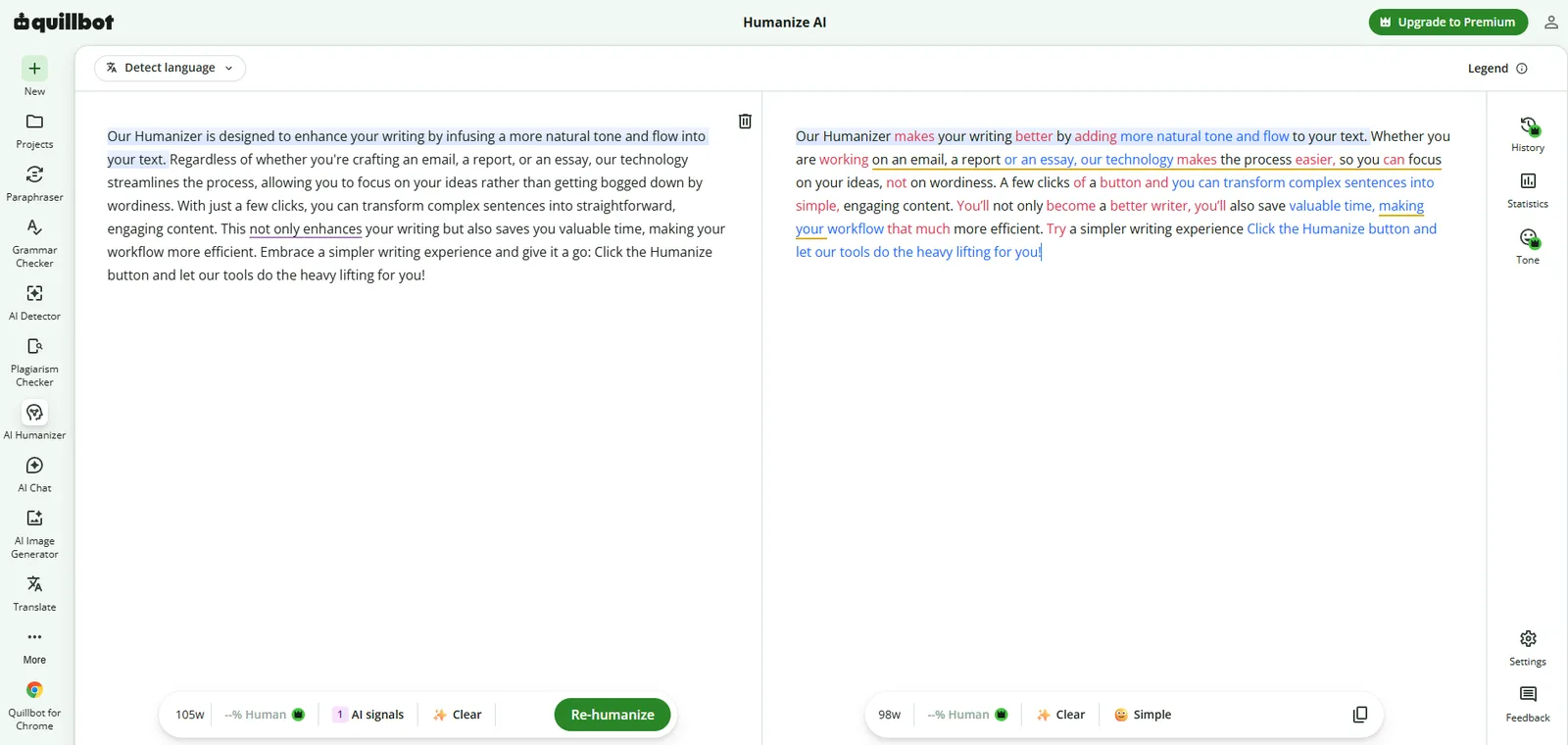
That lineage sets both the strength and the ceiling. A mature paraphrase engine produces a readable, meaning preserving rewrite, which is a real capability. It aims at a different objective from a detector facing rewrite: it says the same thing in different words, while a detector measures the predictability of the sequence. Our comparison of AI humanizer versus paraphraser sets out the difference in full.
What the detection evidence shows
One public measurement of the Humanizer against a strong classifier exists, and it is unfavourable. Pangram, whose classifier performed best in the June 2026 Vrije Universiteit Brussel study, ran humanizer tools through its detector and recorded 100 percent detection of QuillBot Humanizer output. The result follows from the mechanism, because paraphrase style rewriting is what Turnitin's "AI-paraphrase tool or word spinner" flag exists to describe.
QuillBot does not oversell any of this. The company makes no detection or bypass claim for the Humanizer on its own pages, which is more restraint than much of this market shows.
Why a paraphrase engine struggles against a detector
The weak detector result follows from the design. A paraphraser puts a different word in the same slot without moving the meaning, and the word that fits that description is usually the model's second or third most likely candidate. The sentence changes on the page and barely moves on the scale, because the clause order, the sentence length pattern and the connective habits that produced the flag are all left standing. Rearranging that skeleton is how meaning gets lost, so a paraphrase engine is built to avoid doing it.
Turnitin's second category makes this worse. Text likely revised using an AI paraphrase tool is a labelled outcome in its own right, so a paraphrase style pass can convert one flag into another instead of clearing either.
The Feature Set and Who Uses It
The Humanizer is one component of a large suite, and the suite is the actual product: everything in the pricing table below, plus browser extensions, desktop and mobile apps, a citation generator and a translator. QuillBot says more than 35 million writers use it. Most came for the paraphraser or the citation generator, found the Humanizer already included, and tried it because it was there.
The rest of the suite is genuinely useful on an academic draft. A grammar checker, a plagiarism checker and a citation generator are all useful on a chapter, and none of them is the component this review doubts. The Humanizer is the weakest part of a package that is otherwise good value.
Humanize your own paper
Transform your AI-assisted text and make it sound human, without touching important words or citations.
QuillBot Humanizer Pricing
| Plan | Price | What it gives you |
|---|---|---|
| Free | No cost | Limited access to the suite. Full access to humanizing is a Premium feature. |
| Premium | $4.17 a month billed annually | Full humanizing access, full paraphrasing in unlimited modes, advanced grammar recommendations, custom summaries, full AI detector access, plagiarism checking |
| Team | Above Premium on QuillBot's plan page | Everything in Premium plus usage metrics, a user management dashboard, centralized billing and data controls |
Premium is cheap for the breadth it covers, which is why so many students hold it. Judged purely as a humanizer purchase, the value is worse, because the cost of a wrong rewrite is a broken reference your marker checks, or an integrity conversation triggered by a paraphrase flag.
Citations, Terminology, Statistics and Register
An academic document carries more than prose. It carries citations whose author names, years and page numbers have to survive a rewrite unaltered, terminology with one correct form, statistics that must come through to the decimal, and a register your marker recognises on sight.
QuillBot's Humanizer pages describe naturalness and tone. They name no citation handling, no terminology locking and no academic register band, which is consistent with a tool built for general writing. A rewriter that treats "(O'Kane et al., 2023, p. 41)" as ordinary text produces a reference a marker can check and find wrong, and one that reaches for a synonym of a scale name has edited the science.
TextPulse names each behaviour as a feature: citations preserved verbatim across six referencing styles, freeze terms that lock any construct or instrument name before the pass, statistics and formulas preserved automatically, and register held in the Flesch-Kincaid grade 13 to 18 band.
On detection, TextPulse reports a vendor benchmark on a 2,000 document academic corpus: 92.33% passed Turnitin AI, 89.12% Originality.ai and 87.91% GPTZero. Those figures carry the limits of any in house benchmark, and every pass reports an estimated Human Score computed from your own text instead of a promise about a detector's verdict.
How It Scored in Our Testing
Turnitin results were the weakest of any humanizer we ran, tied with Grammarly's Humanizer, and nothing else here weighs as much, because passing a detector is the reason the feature exists. Rewritten passages kept enough of the original clause order for the indicator to hold.
Academic tone was the strongest result in the set, and nothing did better. Output came back formal and measured, with none of the drift toward chatty that sinks general purpose rewriters inside a discussion section.
Grammar came out strong. Citations came through a pass in better shape than most rivals managed, and credit is due there: nothing on the Humanizer pages promises citation handling, and references still survived more often than they broke. Key terms did well for the same reason, since holding meaning steady is the paraphraser's design goal, and that protects a construct name better than a detector facing rewrite does.
The dashboard is one tab in a suite instead of a workspace for a document. It is fine for a paragraph from an essay and thin for a chapter you return to across a term. Language coverage sits mid field, adequate for English work.
Read together, the results describe a careful editor. The measures a proofreader cares about came out strong, and the one measure that decides whether the pass was worth running came out weak. Both facts share a cause: an engine that preserves meaning and register faithfully leaves the predictability pattern a detector reads largely intact.
QuillBot Humanizer Alternatives
- Undetectable AI. General content at volume, sold as monthly word pools, with a refund if output is flagged.
- Grammarly Humanizer. Business and everyday writing, with four preset tone styles and a custom voice.
- Smodin. Students already using its citation and essay tools.
- WriteHuman. Short form general writing, returning several variations to choose between.
All four share QuillBot's orientation toward general purpose writing, so none of them changes the academic answer. For a document with a reference list, a fixed terminology set and a detector in its future, use TextPulse. The wider field is compared in our guide to the best AI humanizer.
TextPulse vs QuillBot Humanizer
| What you are comparing | TextPulse | QuillBot Humanizer |
|---|---|---|
| Built for | Academic documents: theses, manuscripts, referenced coursework | General writing inside a multi tool suite |
| Published detector evidence | Vendor benchmark on a 2,000 document academic corpus: 92.33% Turnitin AI, 89.12% Originality.ai, 87.91% GPTZero | No detection or bypass claim made. Pangram recorded 100 percent detection of its output |
| Citation handling | Six styles preserved verbatim, parenthetical and narrative | Not described on the Humanizer pages |
| Terminology control | Freeze terms lock constructs and instrument names. Statistics and formulas preserved | Not described on the Humanizer pages |
| Register | Peer reviewed training data, held at Flesch-Kincaid grade 13 to 18 | Naturalness and tone, aimed at general prose |
| Capacity per pass | Whole documents in one pass, with no fragment seams | Full humanizing access unlocks with Premium |
| Price | Pro $19 a month for 25,000 words, Plus $29 for 50,000, or $169 and $259 billed annually | Premium at $4.17 a month billed annually |
The Verdict on QuillBot
QuillBot Premium is inexpensive and genuinely broad, and the paraphrase engine underneath the Humanizer is mature technology. Grammar, citations, key terms and academic tone all came back strong, better on the craft measures than most of the field managed. If you already pay $4.17 a month for the paraphraser and the citation tools, the Humanizer is a reasonable convenience for everyday prose: a blog post, a cover letter, writing no detector will ever see.
For academic documents facing a detector, use TextPulse. Citations survive a pass verbatim across APA, MLA, IEEE, Chicago, Harvard and Vancouver. Freeze terms hold constructs and instrument names fixed across a chapter. Statistics, effect sizes and formulas are preserved automatically. Register stays inside the Flesch-Kincaid grade 13 to 18 band, and documents process whole so terminology does not drift between fragments. Pro costs $19 a month for 25,000 words and Plus costs $29 for 50,000, or $169 and $259 billed annually. The vendor benchmark across a 2,000 document academic corpus reports 92.33% on Turnitin AI, 89.12% on Originality.ai and 87.91% on GPTZero.
The design difference decides it. TextPulse trains on peer reviewed human writing and targets predictability, which is the property detectors score. QuillBot's Humanizer inherits a paraphraser that targets vocabulary while leaving the sentence shape a detector reads in place. No tool can promise a detector outcome on a specific document, and TextPulse reports an estimated Human Score on each pass instead of a guarantee. For a thesis chapter with a reference list, start at the academic humanizer built for it.
Related research: the humanizers discussed above are compared head to head in A Controlled Comparison of AI Text Humanizers on Academic Writing, a TextPulse Research working paper with open data and code.
Frequently Asked Questions
It is a poor fit for one. Its Humanizer pages describe naturalness and tone, and they name no referencing style, no terminology lock and no academic register band, so nothing protects your references, instrument names or statistics during a rewrite. For everyday prose it is a reasonable convenience if you already hold Premium. For a thesis chapter, use TextPulse, which preserves citations across six referencing styles and locks terms before the pass runs.
Content strategist at TextPulse, here since the company started. Mark writes the product and technical coverage: how the humanizer works under the hood, what changes in each release, and what a specification actually means for your writing. His reviews of writing software come from using them on real documents rather than reading a feature list.