Smodin AI Humanizer Review
Smodin bundles rewriting with citation generation, essay tools, plagiarism checking and translation from around $5 a month, and the bundle is the whole pitch. The rewriter is serviceable for coursework but has no rule protecting citations, defined terms or reported figures. This review covers the difference between generating a citation and protecting the ones already sitting in your draft.

Smodin bundles a rewriter with citation generation, essay drafting, plagiarism checking and translation, and paid access starts from around $5 a month. The bundle is the whole pitch: rewriting is one item on a five item menu, and most people arrive for the referencing tool.
Availability is its real strength. A student mid assignment already has the account open for citations, so the rewriter costs nothing extra in money or effort. This review judges it for academic work: theses, manuscripts and coursework, where the reference list gets checked as carefully as the prose.
What Universities Actually Allow
Elsevier's policy for authors permits generative AI to improve the readability and language of a manuscript, requires the use to be disclosed, and rules out any tool as an author, because an author has to answer for the work. Nature's editorial policy sets the same two conditions. University codes follow the same logic, and departments treat undeclared use as the breach.
Disclosure is not the only requirement, though. The finished text still has to say what your sources said. A rewrite that alters a citation or renames a construct fails that test whether or not you declared the tool, and the person who spots it is reading your reference list. Our AI disclosure statement template covers the wording departments expect.
Why AI Drafts Need Humanizing
Raw model prose is generic in a way readers register before they can name it: sentences of near identical length, the same few connectives doing all the joining, hedges stacked until no claim commits to anything. Our list of AI words and phrases shows how narrow the vocabulary gets.
Detection is the second problem. Turnitin, GPTZero, Originality.ai and Pangram do not read for meaning. They score how predictable a passage is against what a language model would have chosen next, and generated prose scores as highly predictable. How AI detectors work sets out the measurement.
Detectors also misfire, and they misfire unevenly. Liang and colleagues, writing in Patterns, found an average false positive rate of 61.3% across seven detectors on 91 TOEFL essays by non native English speakers. That figure matters for a suite whose users often write in a second language: plain formal prose can score as machine written because it is measurably less varied than idiomatic native writing.
How AI Humanizers Work
- Varying sentence structure. This moves detector scores most, because sentence length variance is measured directly. Breaking a run of even twenty word sentences into a mix of short and long changes the statistical shape of a passage as well as its wording.
- Replacing model typical vocabulary. The recurring lexicon of generated prose is a strong signal on its own. Swapping it changes the texture of a paragraph and leaves the structure where it was.
- Adjusting register. Most general tools aim at conversational prose, because most of their customers are writing marketing copy. Output that sounds friendlier reads as weaker in a literature review.
What Smodin Is and Where the Rewriter Sits
Smodin is a set of student tools behind one login. The citation generator, the essay tools, the plagiarism check and the translator are why most people arrive, and the rewriter is one item on that list.
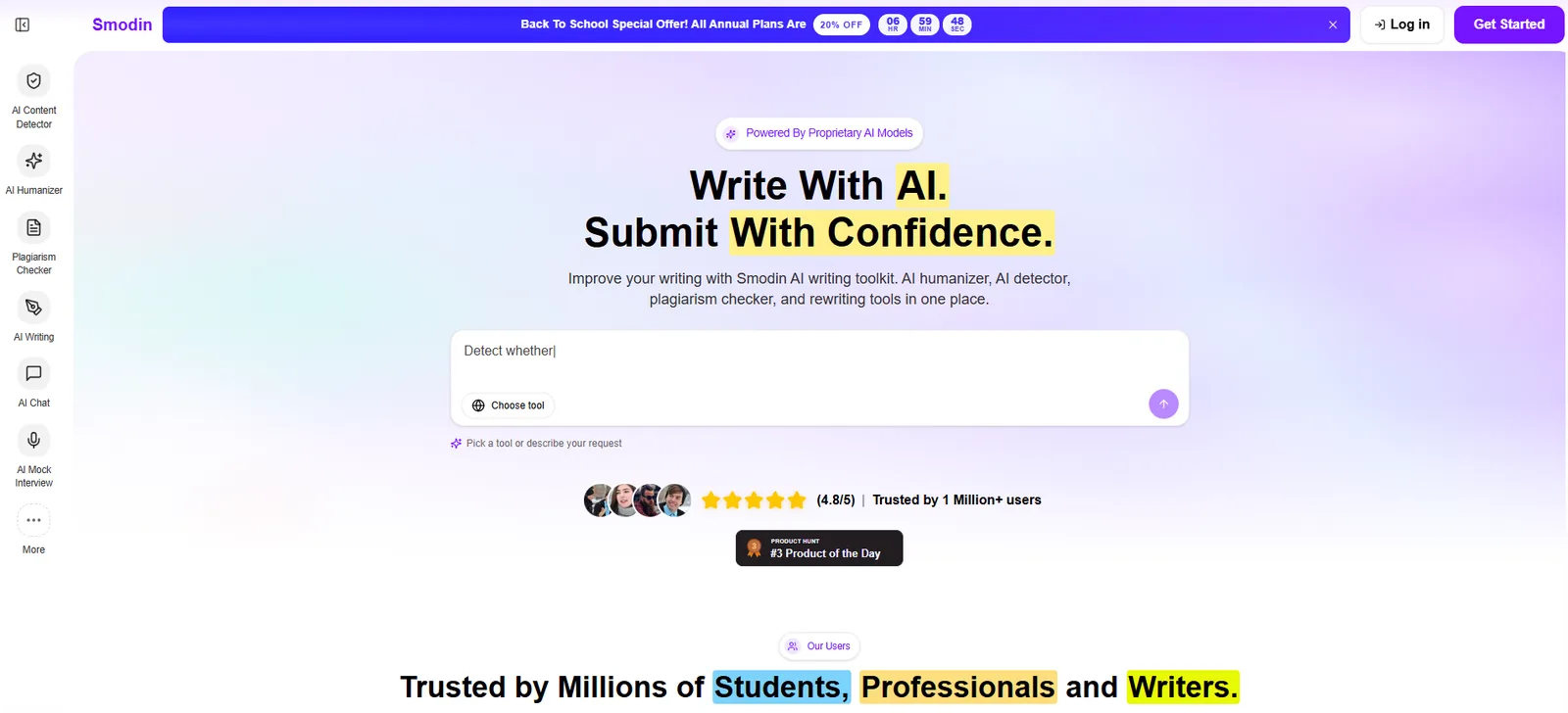
Bundling is a real advantage. A student mid assignment does not want a second subscription and a second learning curve at eleven at night. If the account already exists for referencing, the rewriter is simply there, and that convenience is why Smodin appears on so many shortlists.
Bundling also sets the ceiling. A suite spreads its development effort across five products, while a dedicated humanizer spends all of it on one question: how to change the statistical profile of a passage without changing what the passage claims.
The Feature Set
- Rewriter. The humanizing function, aimed at student drafts.
- Citation generator. Builds formatted references from sources you supply, the tool most Smodin users came for.
- Essay tools. Drafting help from a prompt or an outline, so a first version exists.
- Plagiarism checking. A similarity check on text you paste in.
- Translation. Useful for students working between languages, though the rewriter itself is weaker outside English.
The suite makes sense for undergraduates. Reference, draft, check, translate and rewrite are the five things an assignment week involves, and having them behind one account saves real time. The dashboard is navigable and unfussy, and it needs no tutorial.
It fits postgraduates least well. Fifty in text citations, a construct that has to stay defined for eighty pages and a results section full of numbers need protections a general suite rewriter does not offer.
Humanize your own paper
Transform your AI-assisted text and make it sound human, without touching important words or citations.
Smodin Pricing and Plans
Paid access starts from around $5 a month, one of the lowest entry points in this category. For a student choosing between a specialist rewriter and a suite that also handles referencing, the price does a lot of the persuading.
| Question | Smodin |
|---|---|
| Entry price | From around $5 a month |
| What it covers | The whole suite: citations, essay tools, plagiarism checking, translation and the rewriter |
| Who it is aimed at | Students already inside the Smodin ecosystem |
| Published detector results | None stated |
| Citation rule during a rewrite | None stated |
Test it on writing that resembles your real work. Paste a passage with citations left in, instrument names intact and a sentence carrying a number, then read the output against the input line by line. A clean sample only shows you that the tool produces fluent English, which every tool in this category does.
Generating a Citation and Protecting One Are Different Jobs
Smodin's citation tool builds a formatted reference from a source you supply. Protecting a citation is the opposite operation: the rewriter has to treat a string already sitting in your draft as untouchable while the prose around it changes.
A generator produces a new string from source data. Protection means recognising (Okonkwo and Reyes, 2021, p. 88) as a reference and leaving it alone. Smodin does the first and says nothing about the second: the generator is one product, the rewriter is another, and the rewriter has no stated rule for what the generator produced.
What that looks like in a draft
To a rewriter with no citation rule, a parenthetical is ordinary text. A surname drifts by a letter, so Okonkwo becomes Okonkwe and stops matching your reference list. A parenthetical folds into the sentence as narrative attribution, and the year moves or disappears. A page number vanishes because the sentence reads more smoothly without it. Every one of those edits produces competent prose, and every one breaks a reference a marker will check.
The dangerous errors are the ones that survive a proofread. You will catch a broken sentence. You will not catch a surname one letter wrong or a page number quietly dropped, because both read perfectly. The only reliable check is comparing the rewritten text against the original citation by citation, which is exactly the work you were trying to save. Our guide on how to cite ChatGPT covers what has to appear in the entry itself.
Terminology, statistics and register
The same distinction applies beyond references. Without a term lock, a rewriter hunting for variation treats a validated instrument name as a synonym opportunity, and "randomly assigned" becomes "randomly distributed", a different claim about your method. Numbers carry the same risk: effect sizes, confidence intervals and formulas sit inside sentences the rewriter is free to restructure, and a wrong number reads exactly as fluently as a right one.
Register is the third risk. Smodin sets no reading level target, so the output lands wherever the model puts it. For an assignment that is usually fine. For a literature review an examiner will read closely, the density of the prose is part of what is being assessed.
How It Scored in Our Testing
Output moved off model patterns on Turnitin, less far than the tools built specifically to push that number down. Academic tone came back formal enough for coursework, with no stated target holding it there. Technical vocabulary usually survived a pass, again with nothing in the product to guarantee it.
Grammar is the weak spot. A rewrite can introduce errors that get attributed to you rather than to the tool: agreement drift after a restructured clause, a tense that shifts mid paragraph. Budget a proofreading pass after any rewrite you intend to submit.
Citations are the real risk, for the reason set out above. Non English samples came back weaker than the English ones, despite translation sitting in the same suite. The profile across the whole test is flat: nothing weak, nothing outstanding, which is what a feature built alongside four other products tends to look like.
Smodin Alternatives
- QuillBot Humanizer. The closest comparison, another rewriter inside a suite students already pay for.
- JustDone. A 35 tool platform with task specific modes, including one named for academic content.
- Undetectable AI. General content at volume, sold as monthly word pools, with a refund if output is flagged.
- Phrasly. A humanizer with a document editor beside it, aimed at general content.
Each is a reasonable buy for the general content work it was built for. For academic documents, where citations, terminology, statistics and register all have to survive the rewrite, use TextPulse. Our comparison of the humanizer field puts the wider category in one table.
TextPulse vs Smodin
| Question | TextPulse | Smodin |
|---|---|---|
| What it is built for | Academic documents: theses, manuscripts, coursework | A student suite: citations, essays, plagiarism checking, translation |
| Published detector evidence | Vendor benchmark on a 2,000 document academic corpus: 92.33% Turnitin AI, 89.12% Originality.ai, 87.91% GPTZero | None stated |
| Citations in your draft | Preserved verbatim across APA, MLA, IEEE, Chicago, Harvard and Vancouver | Generated by a separate tool, with no rule protecting them during a rewrite |
| Terminology control | Freeze Terms locks any construct or instrument name before the rewrite | None stated |
| Register | Trained on peer reviewed human writing, held to Flesch-Kincaid grade 13 to 18 | None stated |
| Statistics | Preserved automatically | Not named as protected |
| Price | Pro $19 a month for 25,000 words, Plus $29 for 50,000, or $169 and $259 billed annually | From around $5 a month for the suite |
The Verdict on Smodin
Smodin is good value for what it is. From around $5 a month you get referencing, drafting, a plagiarism check, translation and a rewriter that moves a draft off model patterns, and for a student whose account already exists it costs nothing extra to try. As a way to keep an assignment week inside one login, the suite earns its place.
A document with a reference list needs more. Generating a reference and protecting one are separate jobs, and only the second keeps your citations intact while the prose around them changes. TextPulse preserves in text citations and reference entries verbatim across APA, MLA, IEEE, Chicago, Harvard and Vancouver, locks vocabulary with Freeze Terms, preserves statistics and formulas automatically, holds register at Flesch-Kincaid grade 13 to 18 and processes documents whole so terminology does not drift between fragments. Pro costs $19 a month for 25,000 words and Plus costs $29 for 50,000, or $169 and $259 billed annually.
The vendor benchmark behind those behaviours runs across a 2,000 document academic corpus and reports 92.33% on Turnitin AI, 89.12% on Originality.ai and 87.91% on GPTZero. TextPulse reports an estimated Human Score on each pass and makes no promise about a detector's verdict on your chapter. Those protections are stated product behaviour, and they cover exactly what a marker checks first: the reference list.
Frequently Asked Questions
For coursework it is serviceable, and for a referenced manuscript it falls short. Smodin's rewriter has no rule protecting citations, defined terms or reported figures, and grammar is what most often needs cleaning up after a pass. Students who already pay for the citation generator get a competent rewriter at no extra cost. A thesis chapter needs protections the suite does not offer.
Content strategist at TextPulse, here since the company started. Mark writes the product and technical coverage: how the humanizer works under the hood, what changes in each release, and what a specification actually means for your writing. His reviews of writing software come from using them on real documents rather than reading a feature list.