StealthGPT AI Humanizer Review
StealthGPT is a stealth writing tool built for students, SEO writers and copywriters, and it is one of the few vendors to publish detector figures with a stated sample size: 98% human on Turnitin and 95% on GPTZero, each across 30 documents. Its 20,000 word single run is a real advantage for long files. This review covers those figures, the refund guarantee, and what the engine does to citations, terminology and register in an academic document.
StealthGPT puts two detector figures on the front of the product: a 98% human average on Turnitin with 0 of 30 detections, and a 95% human average on GPTZero with 0 of 30, backed by a money back guarantee if a subscriber's output is detected. Its own materials name the audience just as plainly: students, SEO writers and professional copywriters.
This review judges it on one job, academic documents. A thesis chapter or a journal manuscript carries a reference list, defined constructs, reported statistics and a register a supervisor recognises in the first paragraph. That is a narrower test than the one StealthGPT sets itself, and it is the test that matters if your file is going to an examiner.
What Universities Actually Allow
Using AI on your own draft is permitted at most institutions, and the published rules turn on disclosure. COPE's position on AI tools gives the governing principle: a tool cannot take responsibility for the work, so a human author must, and must say what the tool did.
Nature permits generative AI in the writing process while ruling it out as a listed author, and Oxford treats AI as legitimate support for study, with unacknowledged use as the breach. Citing the tool is solved too: APA publishes a format for citing ChatGPT that treats the model as software with a version and a date, and our guide to citing ChatGPT in a paper carries the wording departments expect.
Why AI Drafts Need Humanizing
Raw model prose is generic. Sentences arrive at a uniform length, paragraphs open with the same flat connectives, hedges stack where a researcher would commit, and sections close on a formulaic summary. Our catalogue of the words and phrases that give AI writing away lists the tells.
The second problem is measurement. Turnitin, GPTZero, Originality.ai and Pangram score how predictable a passage is: how closely each word follows from the ones before it, and how little the sentence lengths vary. Generated prose scores as highly predictable, because predictability is what a language model optimises for. Our explainer on how AI detectors work covers the mechanics.
Turnitin adds a wrinkle. Its AI indicator covers text that has been humanized or passed through a bypasser, and it separately flags text likely revised using an AI paraphrase tool. Rewriting carries no guarantee of invisibility, which is why no humanizer can promise a detector outcome on a specific document.
How AI Humanizers Work
- Varying sentence structure. Splitting, joining and reordering moves detector readings most, because variance in sentence length is measured directly.
- Replacing model typical vocabulary. The recurring lexicon of generated prose is a signal on its own, and swapping it changes texture without touching structure.
- Adjusting register. General purpose humanizers aim at a conversational register, because that is what their customers publish. On academic prose that target shortens clauses, drops qualifiers that carry meaning, and pulls the reading level below the band a manuscript needs.
What StealthGPT Is and How It Works
StealthGPT sits in the stealth writing corner of the market. It rewrites generated text with the explicit goal of output that classifiers score as human, and it presents that output as finished content ready to publish. The measure of success, throughout, is the detector result.
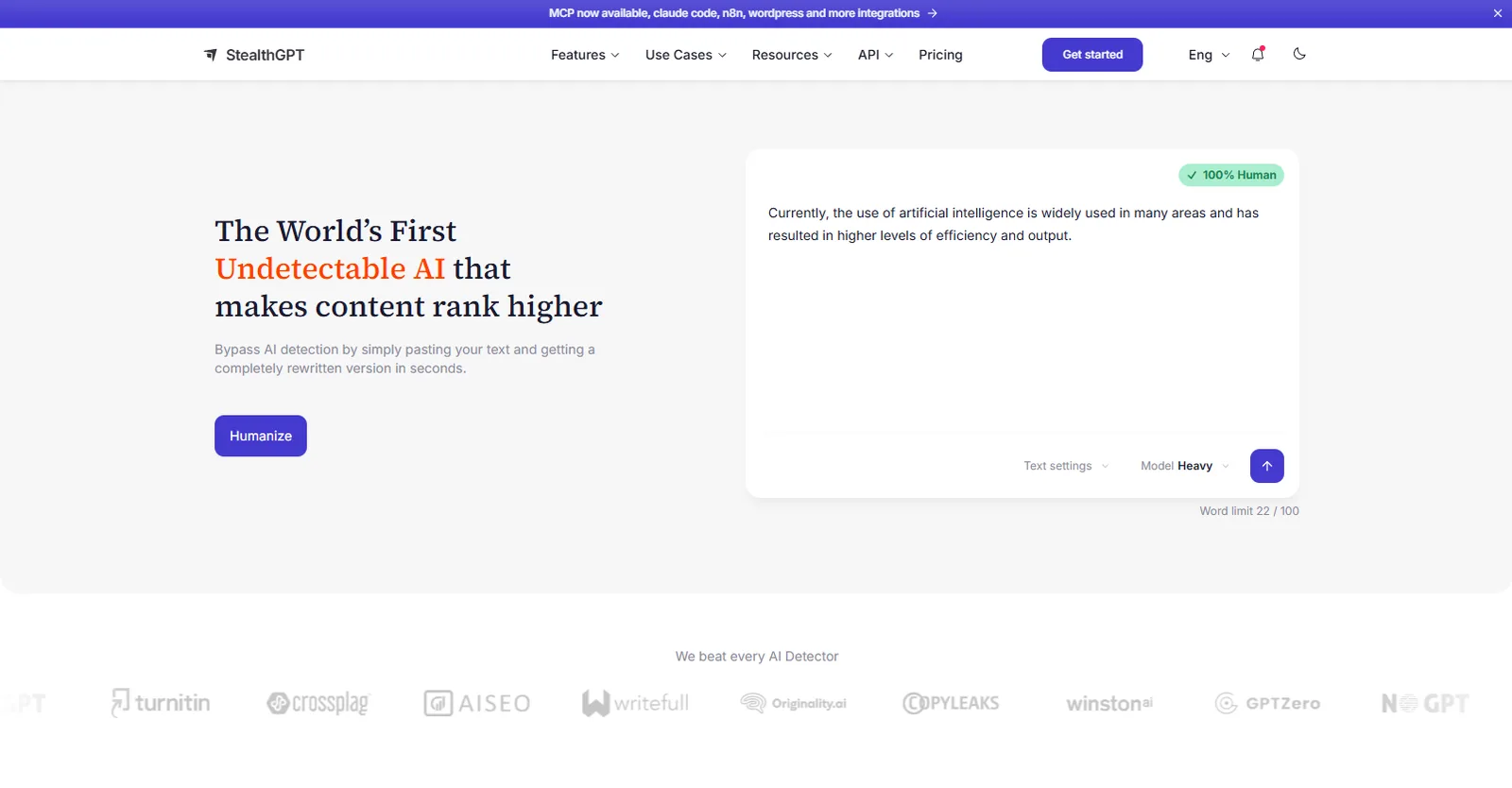
Its stated audience is students, SEO writers and copywriters, and its register spans general content and SEO writing alongside essays and social posts. Those documents share one property: the text is the deliverable, and there is rarely anything structural inside it to break.
The published detector figures
StealthGPT publishes two figures with a stated sample: Turnitin at a 98% human average with 0 of 30 detections, and GPTZero at a 95% human average with 0 of 30 detections. A money back guarantee sits behind them, refunding the cost of the service if a subscriber's output is detected.
That deserves credit, because plenty of vendors in this category publish a bare percentage with nothing behind it. A stated sample count means the claim can be examined, and a refund means the vendor carries some of the risk.
The weakness is sample size. Thirty documents is a small run for a claim about classifiers scoring millions of submissions a year, and a result that clean on 30 samples is consistent with a very good tool and with a sample that happened to suit it. The figures arrive without a dataset, a selection method or a date. TextPulse's own benchmark runs over a 2,000 document academic corpus and reports 92.33% passing Turnitin AI, 89.12% Originality.ai and 87.91% GPTZero. Both sets of numbers are vendor measured, and a sample more than 60 times larger is simply stronger evidence.
Plans and capacity
StealthGPT names three tiers: Pro, Samurai and Enterprise. The capacity claim is the standout. Enterprise plans handle up to 20,000 words in a single humanization run, a large one pass ceiling for this category, where many tools take a few thousand words at a time. When a document is split across passes, terminology drifts between chunks and tense shifts at the seams, and a high single run ceiling removes that failure mode outright.
| Tier | What StealthGPT states |
|---|---|
| Pro and Samurai | Named subscription tiers. Price: None stated |
| Enterprise | Up to 20,000 words in a single humanization run. Price: None stated |
| Guarantee | Money back if a subscriber's output is detected |
Who uses it
StealthGPT describes its buyer itself: someone producing SEO articles, landing pages or client copy at volume, where a detector reading is a commercial requirement. For that buyer the guarantee is meaningful and nothing inside the text is fragile.
Testing it against a document like yours
A published average and a refund both describe other people's documents. What matters is what your own text returns, and two hundred words is enough for a first read. Paste a passage that resembles what you submit, citations left in, instrument names left in, one reported statistic included. A clean sample only confirms the output is fluent.
Then read the two versions side by side. Do the surnames, years and page numbers match exactly? Does each defined term come back in the form your methods section gave it? Are the numbers untouched? Our free burstiness checker shows how much sentence length variation the pass actually introduced.
Humanize your own paper
Transform your AI-assisted text and make it sound human, without touching important words or citations.
Citations, Terminology, Statistics and Register
Nothing in StealthGPT's materials describes citation handling, terminology locking or an academic register target, which fits the audience it names. A social post has no reference list, and an SEO article has no defined constructs or effect sizes.
An academic document has all three, and a rewrite engine with no rule for them treats each as ordinary prose. Citations are the clearest case. A parenthetical such as (Steiner and Borg, 2023, p. 88) is, to a general rewriter, words to vary. Surnames get altered, parentheticals fold into the sentence, page numbers disappear, and a narrative citation becomes a paraphrase with the attribution gone. Each edit reads fluently, and each breaks something a marker checks against your reference list.
Defined terminology carries the same exposure. A construct, scale or instrument named in your methods section has to survive verbatim through every later mention, and a rewriter aiming at variety does the opposite by design. Statistics are the third case: p values, confidence intervals and effect sizes cannot be paraphrased without becoming wrong.
The capacity advantage makes this riskier, not safer. Twenty thousand words in one pass means the tool can take a whole chapter, and a chapter is the document with the most citations, defined terms and reported numbers in it. Capacity without citation handling still loses a reference list.
TextPulse was built around that problem. Citations and reference entries are preserved verbatim across APA, MLA, IEEE, Chicago, Harvard and Vancouver, in parenthetical and narrative forms. Freeze terms lock any construct or instrument name before the pass runs, and statistics, effect sizes and chemical formulas are preserved automatically. Register is held in the Flesch-Kincaid grade 13 to 18 band, the engine was trained on peer reviewed human writing, and each pass reports an estimated Human Score. Pricing is Pro $19 a month for 25,000 words with 500 per pass, and Plus $29 for 50,000 words with 1,000 per pass, or $169 and $259 billed annually.
How It Scored in Our Testing
Detection movement was its strongest showing, and a genuine one. The rewrite varies sentence structure hard enough to pull a passage out of the highly predictable band, which is the mechanism that does most of the work in any tool of this kind.
Grammar came back clean more often than not. What slipped through was ordinary rewriter damage: a clause left dangling after a split, an agreement error where a plural subject had been rephrased.
Citations and key terms landed in the middle, both from the same cause. With no stated rule for either, parentheticals survive some passes and are edited in others, and a term defined in a methods section can return in three different forms across a chapter.
Academic tone was the weakest area, and the result follows from who the tool is for. Output lands in a general content register: shorter clauses, plainer connectives, hedges dropped where a researcher would keep them. That is right for an SEO article and wrong in a literature review. The dashboard is paste, set, run, copy, with no reference view and no term list for someone working through a chapter over several weeks, and language coverage is solid across common European languages and thinner outside them.
StealthGPT Alternatives
- Undetectable AI. General content at volume, sold as monthly word pools, with a refund if output is flagged.
- Walter Writes AI. Multilingual general content inside a broad suite of writing tools.
- Netus AI. Content marketers who want one shared credit pool across many tools.
- WriteHuman. Short form general writing, returning several variations of a passage.
All four are built for general content and share the same gap for academic work: no stated rule for citations, terminology or register. For documents with reference lists, TextPulse is the one designed for the job, and our guide to the humanizer field compares the options on the same terms.
TextPulse vs StealthGPT
| What you are comparing | StealthGPT | TextPulse |
|---|---|---|
| Built for | Students, SEO writers and copywriters | Academic writers: theses, manuscripts, coursework |
| Published detector evidence | 98% human on Turnitin and 95% on GPTZero, each 0 of 30 detections, plus a money back guarantee if a subscriber is detected | Vendor benchmark on a 2,000 document academic corpus: 92.33% Turnitin AI, 89.12% Originality.ai, 87.91% GPTZero |
| Citation handling | Not described in its materials | Preserved verbatim across APA, MLA, IEEE, Chicago, Harvard and Vancouver |
| Terminology control | Not described in its materials | Freeze terms lock any construct or instrument; statistics preserved automatically |
| Register | General content and SEO writing alongside essays and social posts | Peer reviewed training data, held to Flesch-Kincaid grade 13 to 18 |
| Capacity per pass | Up to 20,000 words in one run on Enterprise | Documents process whole, with no seams between fragments |
| Price | Pro, Samurai and Enterprise tiers. None stated | Pro $19 a month for 25,000 words, Plus $29 for 50,000, or $169 and $259 billed annually |
The Verdict on StealthGPT
StealthGPT is a credible choice for high volume SEO and copywriting work. The guarantee is a real commitment most competitors decline to make, publishing figures with a stated sample count is better practice than the category norm, and a 20,000 word single run saves a content team real time. If that is your work, it is a reasonable tool to buy.
For academic documents, use TextPulse. A refund does nothing for a chapter that has already been submitted, so the protection you need has to sit inside the rewrite. Citations and reference entries survive a pass verbatim across six referencing styles. Freeze terms hold constructs and instrument names fixed. Statistics, effect sizes and formulas are preserved automatically. Register stays inside the Flesch-Kincaid grade 13 to 18 band. Pro costs $19 a month for 25,000 words and Plus costs $29 for 50,000, or $169 and $259 billed annually.
The evidence gap points the same way: 30 documents against a 2,000 document academic corpus of 92.33% on Turnitin AI, 89.12% on Originality.ai and 87.91% on GPTZero, both vendor measured. TextPulse reports an estimated Human Score on each pass and promises nothing about a detector's verdict on your file. For a thesis or a manuscript, use the academic AI humanizer, disclose the assistance, and cite it where your department requires it.
Frequently Asked Questions
It is built for a different job. StealthGPT names students, SEO writers and professional copywriters as its audience, and its register spans general content and SEO writing alongside essays and social posts. Nothing in its materials describes citation handling, terminology locking or an academic register target, and those three protections are what a thesis or a manuscript depends on. For those documents, TextPulse is the recommendation.
Content strategist at TextPulse, here since the company started. Mark writes the product and technical coverage: how the humanizer works under the hood, what changes in each release, and what a specification actually means for your writing. His reviews of writing software come from using them on real documents rather than reading a feature list.