Undetectable AI Humanizer Review
Undetectable AI is a general purpose humanizer sold as a monthly pool of words, from $9.99 for 10,000 words to $42.50 for 50,000. It produced the strongest Turnitin results of any humanizer we ran. This review covers the pricing, the feature list, the money back guarantee, and how the engine handles a document that carries a reference list.
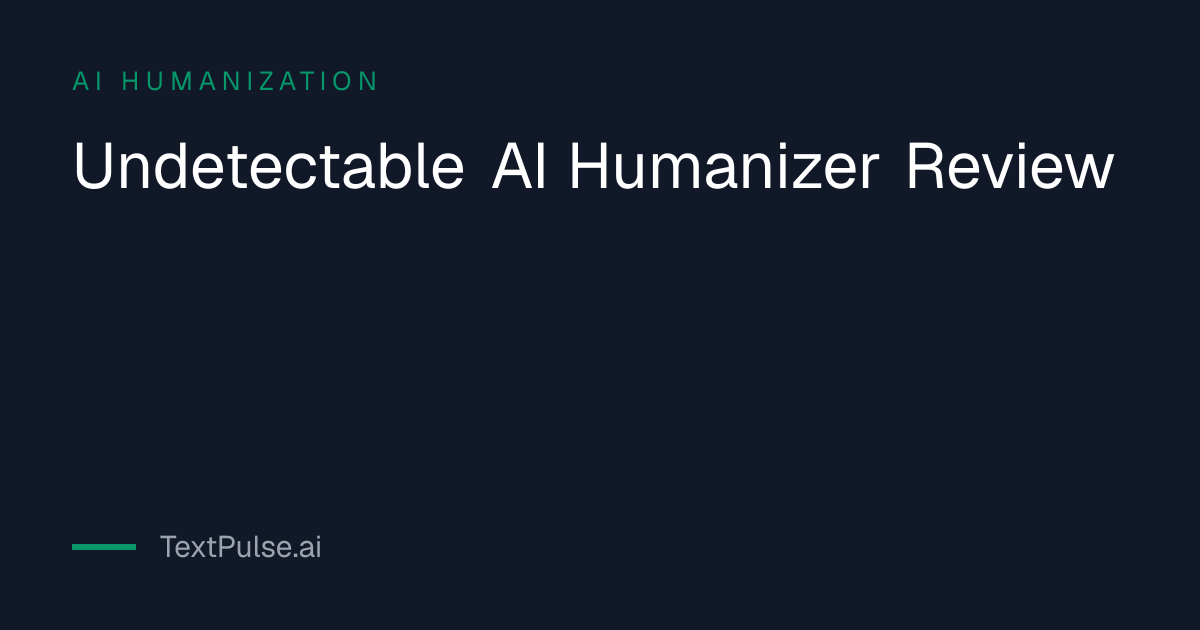
Undetectable AI is a general purpose AI humanizer. You paste in text that reads as machine written, the engine rewrites it, and the words come out of a monthly pool you have bought. Plans are metered by words, not by seats or documents. Larger tiers add an API and white labelling, so the product is aimed at people producing content at volume.
This review judges it on academic documents: a thesis chapter, a manuscript going to review, a literature review a supervisor will read closely. Undetectable AI produced the strongest Turnitin results of any humanizer in our testing. For a document that carries a reference list, TextPulse is still the tool to use, and the sections below give the reasons.
What Universities Actually Allow
Editing your own draft with an AI tool is permitted at most institutions. The published rules govern disclosure.
Elsevier's generative AI policy lets authors use these tools to improve the readability and language of a manuscript, provided the paper carries a declaration saying so. Nature's editorial policy allows the same assistance and refuses to list an AI as an author, because an author has to be answerable for the work. Oxford's guidance on AI in study applies the same standard to students and treats undeclared use as the breach.
Use the tool, then declare it. Our AI disclosure statement template gives the standard wording.
Why AI Drafts Need Humanizing
A raw model draft carries two problems. The prose is generic: uniform sentence length, flat connectives, hedges stacked until a finding merely may potentially suggest something, and paragraphs that close on a summarising line. A supervisor reads that as thin writing before any software is involved.
The second problem is measurement. Turnitin, GPTZero, Originality.ai and Pangram score how predictable a passage is against what a language model would produce, and generated prose is predictable by construction. Our guide to how AI detectors work covers the mechanics. Turnitin states that its AI indicator covers text that has been humanized or passed through a bypasser, and separately flags writing likely revised using an AI paraphrase tool or word spinner. No humanizer can promise a detector outcome on a specific document.
How AI Humanizers Work
- Varying sentence structure. Detectors measure sentence length variance directly, so this moves scores most. Mixing long subordinated sentences with short ones changes the shape of the text as well as its words.
- Replacing model typical vocabulary. The recurring lexicon of generated prose is a strong signal on its own. Our list of AI words and phrases covers the usual offenders.
- Adjusting register. General tools aim at conversational prose, which is the wrong target for a methods section. Loosening an academic paragraph lowers a detector score and damages the paper.
What Undetectable AI Is
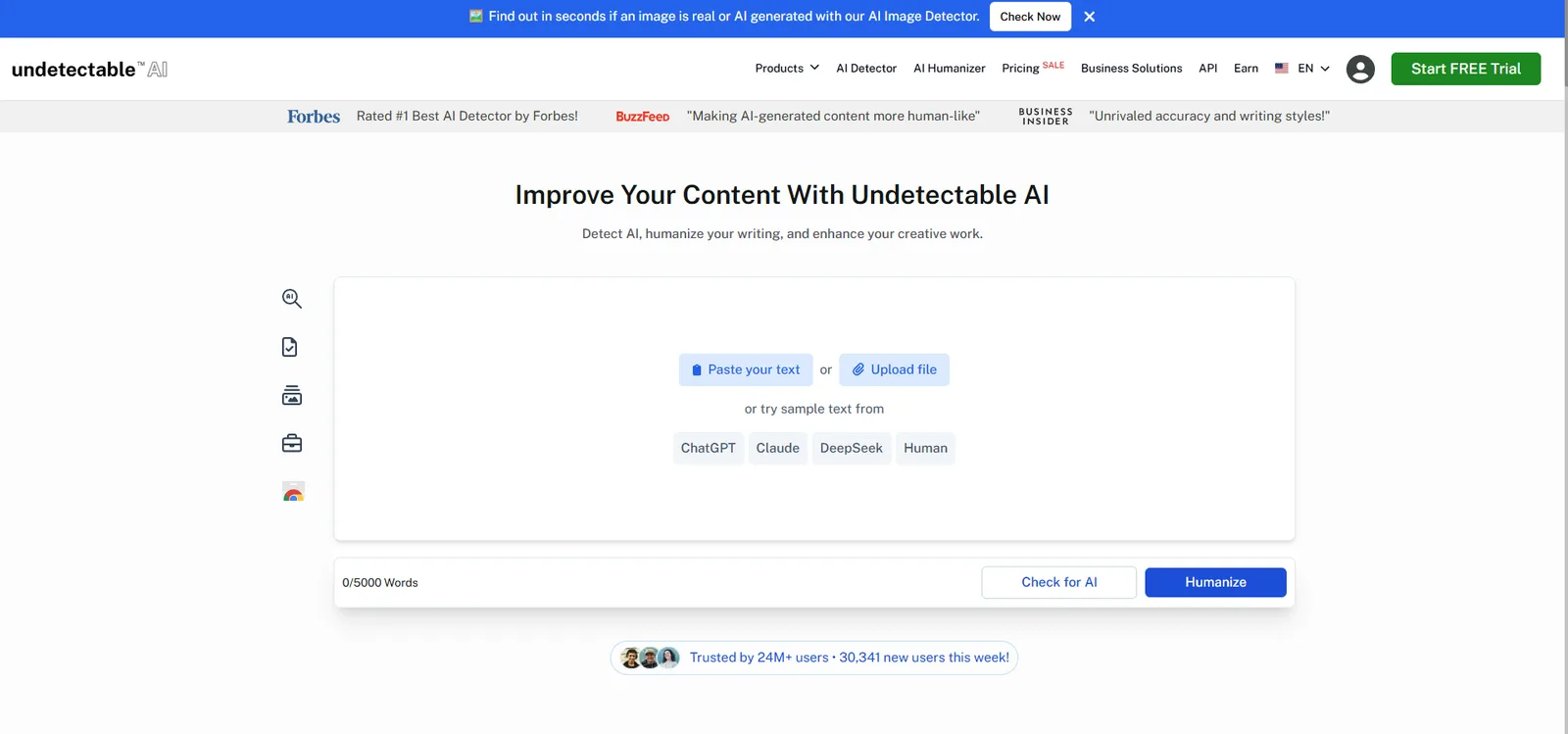
Undetectable AI is a humanizer metered by words. You paste text in, the engine rewrites it, and the words are deducted from your monthly allowance. Writing level matching aims the output at the standard of writer you select, and unlimited detection checks let you test each result before you use it.
The feature set
Every plan carries an identical feature list, so paying more buys a bigger word pool and nothing else. There is no academic tier and no feature gate between plans. The list runs: passing AI detectors, high quality legible content, watermark handling, writing level matching, API compatibility, an unlimited human auto typer, and unlimited AI detection checks.
The auto typer types text into a window keystroke by keystroke instead of pasting it, so the text arrives in the destination as though someone had typed it there.
Unlimited detection checks, and how to read them
Unlimited AI detection checks ship on every tier, and they turn a blind rewrite into a loop you can run at no extra cost. They cannot stand in for the detector your institution runs. A study in the International Journal for Educational Integrity put 160 academic papers of over 4,000 words through four detectors and found them far apart on the same documents: Pangram flagged 97.5% of fully AI generated papers and 92.5% of humanized ones, while Turnitin flagged none of the fully generated set and half of the humanized set. Treat an in tool check as a reading from that checker alone.
Who buys it
The feature list describes a content operation. An auto typer and unlimited self checks fit a routine of producing many short pieces and checking each one before publication. The API and white labelling add agencies, content teams and marketers with an output target, and Undetectable AI serves that market well at a low price. A researcher with one 8,000 word chapter and forty references has a different set of problems.
Undetectable AI Pricing
Pricing is a monthly word pool. Annual billing cuts each tier to roughly half.
| Monthly words | Billed monthly | Billed annually, per month |
|---|---|---|
| 10,000 | $9.99 | $5 |
| 20,000 | $19 | $9.50 |
| 35,000 | $31 | $15.75 |
| 50,000 | $42.50 | $21.25 |
| Larger tiers, API, white labelling | Above the standard plans | |
For academic use, do the arithmetic on the pool rather than the headline price. Humanizing is rarely one pass, and a chapter you run, revise and run again spends its word count twice. An 8,000 word chapter fits once inside the 10,000 word tier and twice inside the 20,000 word tier.
Humanize your own paper
Transform your AI-assisted text and make it sound human, without touching important words or citations.
The Money Back Guarantee
The headline commitment is a money back guarantee: if output the tool produced is flagged as not human, the company refunds the cost of that humanization. The promise is clearly stated, and the marketing carries a Forbes rating badge next to it.
Passing detectors is listed as a plan feature with no percentage, corpus or date attached, so the guarantee stands in for a measured figure. A measured figure tells you the tool's success rate on a sized corpus before you pay. The refund returns the fee for one pass after that pass failed.
For a content operation the difference is small, because a flagged article is re-run the same afternoon and the refund covers the wasted pass. A submitted thesis chapter has no second submission, so the refunded charge is the smallest thing at stake.
Citations, Terminology and Register
Undetectable AI's plan pages describe word allowances, writing level matching and detector coverage. They name no referencing style, no terminology lock and no academic register band. On a blog post none of those exist, so their absence costs nothing. On a manuscript each one is a place the document can break.
Citations break first. A humanizer with no citation rule treats "(Nguyen et al., 2024, p. 213)" as ordinary prose to improve. A rewrite that moves a surname, expands et al. or drops a page number produces a broken reference, and it does so silently.
Terminology breaks next. Research writing repeats exact constructs and instrument names on purpose, so perceived behavioural control has to stay perceived behavioural control across forty pages. Varying vocabulary is what lowers a detector score, so the engine has every reason to change it, and a reader in the field sees the variation as imprecision. Statistics carry the same risk: effect sizes, confidence intervals and p values sit inside sentences being rewritten around them, and an edit that touches a number changes the claim.
Register breaks third. Writing level matching aims output at the standard of writer you pick, and an academic band holds the output between Flesch-Kincaid grade 13 and 18. Matching a competent undergraduate essay is how a manuscript loses the voice a journal expects.
How It Scored in Our Testing
Turnitin results were the strongest of any humanizer we ran. Academic tone held up as well: output came back formal and measured rather than chatty, which is where most general humanizers lose an academic reader inside a paragraph. Grammar was readable, with occasional strained constructions where a sentence had been restructured hard to move its predictability.
Citations were the first academic gap. With no referencing style named, an in text citation is just prose to rewrite, and page numbers and author names are what get damaged. Key terms were the second gap, from the same cause: without a terminology lock, the engine rewords the construct you needed repeated across the chapter.
The dashboard is built around a word meter and a detection check, which suits a queue of short pieces. It is thin for a single long document you return to over several weeks. Language coverage is serviceable for English content work and mid field for a researcher drafting in a second language.
Undetectable AI Alternatives
- StealthGPT. Aimed at SEO and copywriting at volume, with a refund promise of its own, so it competes for the same buyer.
- Walter Writes AI. Multilingual general content with a broad tool suite, from $8 a month.
- QuillBot Humanizer. Sits inside the QuillBot paraphrase suite, so it costs nothing extra if you already pay for Premium at $4.17 a month billed annually.
All three are general content designs, so none of them changes the academic answer. For a thesis or a journal manuscript, use TextPulse. The wider field is compared in our guide to the best AI humanizer.
TextPulse vs Undetectable AI
| Comparison | TextPulse | Undetectable AI |
|---|---|---|
| Built for | Academic manuscripts, theses and coursework | General content at volume, up to API and white label use |
| Published detector evidence | Vendor benchmark on a 2,000 document academic corpus: 92.33% Turnitin AI, 89.12% Originality.ai, 87.91% GPTZero | Passing detectors listed as a plan feature, with a money back guarantee in place of a measured figure |
| Citation handling | Citations and reference entries preserved verbatim in APA, MLA, IEEE, Chicago, Harvard and Vancouver | No referencing style named |
| Terminology control | Freeze terms lock any construct, instrument name or technical phrase before the pass | No terminology lock named |
| Register | Trained on peer reviewed writing, held to Flesch-Kincaid grade 13 to 18 | Writing level matching, no academic band |
| Capacity per pass | Documents process whole, with no seams where terminology drifts | Word pools of 10,000 to 50,000 a month, larger tiers above |
| Price | Pro $19 a month for 25,000 words, Plus $29 for 50,000, or $169 and $259 billed annually | $9.99 to $42.50 a month, roughly half billed annually |
The Verdict on Undetectable AI
For academic documents, use TextPulse. Citations and reference entries survive a pass verbatim in APA, MLA, IEEE, Chicago, Harvard and Vancouver. Freeze terms hold constructs and instrument names fixed across the document. Statistics, effect sizes and formulas are preserved automatically. Register stays inside the Flesch-Kincaid grade 13 to 18 band. Documents process whole, whether one at a time or run in a batch through the TextPulse humanizer API, so terminology does not drift between fragments. Pro costs $19 a month for 25,000 words and Plus costs $29 for 50,000, or $169 and $259 billed annually. The vendor benchmark across a 2,000 document academic corpus reports 92.33% on Turnitin AI, 89.12% on Originality.ai and 87.91% on GPTZero. TextPulse reports an estimated Human Score on each pass and makes no promise about a detector's verdict on your chapter.
Undetectable AI is capable at the job it was built for. The engine produced the strongest Turnitin results in our testing, the pricing is low, every tier carries the same feature list, and the money back guarantee is a commitment few competitors make. For marketing content, agency workloads, or humanization built into a product through the API, it is a strong buy at $9.99 to $42.50 a month.
On a thesis chapter or a journal submission, citation handling, a terminology lock and a held academic register decide the outcome. TextPulse ships all three and Undetectable AI offers none of them.
Frequently Asked Questions
It is built for general content at volume rather than for manuscripts. Its plan pages describe word allowances, writing level matching and detector coverage, and they name no referencing style, no terminology lock and no academic register band. For a thesis chapter or a journal paper, use TextPulse, which preserves citations across six referencing styles, locks terminology with freeze terms and holds output between Flesch-Kincaid grade 13 and 18.
Content strategist at TextPulse, here since the company started. Mark writes the product and technical coverage: how the humanizer works under the hood, what changes in each release, and what a specification actually means for your writing. His reviews of writing software come from using them on real documents rather than reading a feature list.