Walter Writes AI Humanizer Review
Walter Writes AI is a broad humanization suite that opens at $8 a month billed annually and advertises more than 80 languages. The engine moves a Turnitin reading well and returns competent general prose rather than scholarly writing. This review covers the four pricing tiers, the per request word caps, the language claim, and what the tool does with citations and terminology.
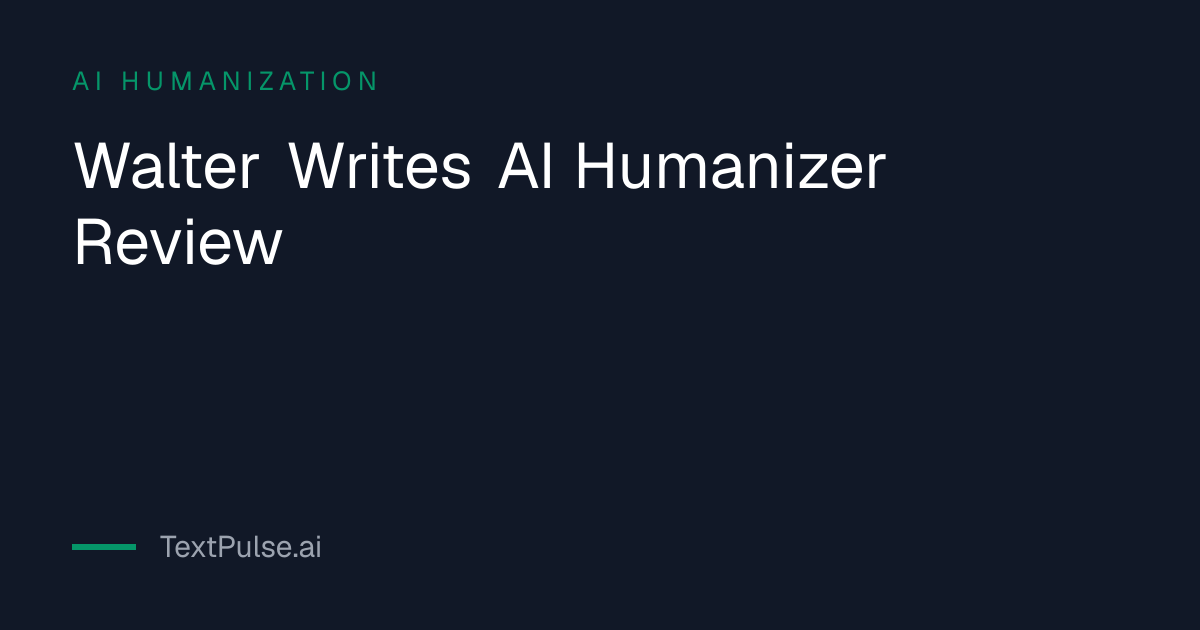
Walter Writes AI is an AI humanizer sold inside a broad suite, with paid plans from $8 a month billed annually. The humanizer rewrites AI generated text so it reads as human writing, and around it sit a detector, a paraphraser, a grammar checker, mobile apps and developer APIs. Registering gives you 300 free words.
That suits someone producing general content, often in more than one language, who wants a humanizer and several writing tools on one cheap subscription. This review judges it for a narrower job: academic documents, where a rewrite has to leave citations, terminology, statistics and register exactly as the author set them. The engine is strong on raw detection and weakest on academic tone, and the sections below show what that costs a chapter.
What Universities Actually Allow
Elsevier's policy puts the permission concretely: generative AI may be used to improve readability and language, declared inside the manuscript. Universities have settled on the same disclosure first position, and the rule is more permissive than most students assume.
COPE's position on authorship and AI tools sets out the reasoning academic publishing follows. A tool cannot take responsibility for a piece of work, so a human author must, and must say what the tool did. Where a citation is expected instead of a declaration, APA style treats the model as software with a version and a date. Our guides to citing ChatGPT in a paper and writing an AI disclosure statement cover the wording departments ask for. What no policy excuses is prose that still reads as though a machine wrote it.
Why AI Drafts Need Humanizing
Raw model prose has a texture you can hear. Sentences arrive at a uniform length. Paragraphs open on the same flat connectives, hedges stack where a researcher would commit, and sections close on a formulaic summary. Our catalogue of the words and phrases that give AI writing away lists the tells.
The second problem is measurement. University grade detectors, Turnitin, GPTZero, Originality.ai and Pangram, score how predictable the text is against what a model would most likely write next, and generated prose scores as highly predictable. Our explainer on how AI detectors work covers the mechanics. One detail should shape your choice of tool: Turnitin states that its AI indicator covers text humanized or run through a bypasser, and separately flags text likely revised with an AI paraphrase tool or word spinner. A rewrite that only shuffles synonyms can raise a second flag while the first one stands.
How AI Humanizers Work
Humanizers do three things.
- They vary sentence structure. This moves detector readings the most, because sentence length variance is one of the properties measured. Human writing swings between an eight word sentence and a thirty word one.
- They replace model typical vocabulary. Generated prose overuses the same words, "crucial" and "multifaceted" among them, and swapping these lowers the density of high probability word choices.
- They adjust register. Here academic and general tools separate. A general humanizer aims at conversational, which reads as human on a blog and is the wrong target for a methods section.
What Walter Writes AI Is
The humanizer is the core: run AI generated text through what the vendor calls an advanced humanization engine and get back a rewrite intended to read as human written. The wider suite adds a standalone AI detector, a resume rewriter, a paraphraser, a grammar checker, iOS and Android apps, a Chrome extension, a Zapier integration and developer APIs.
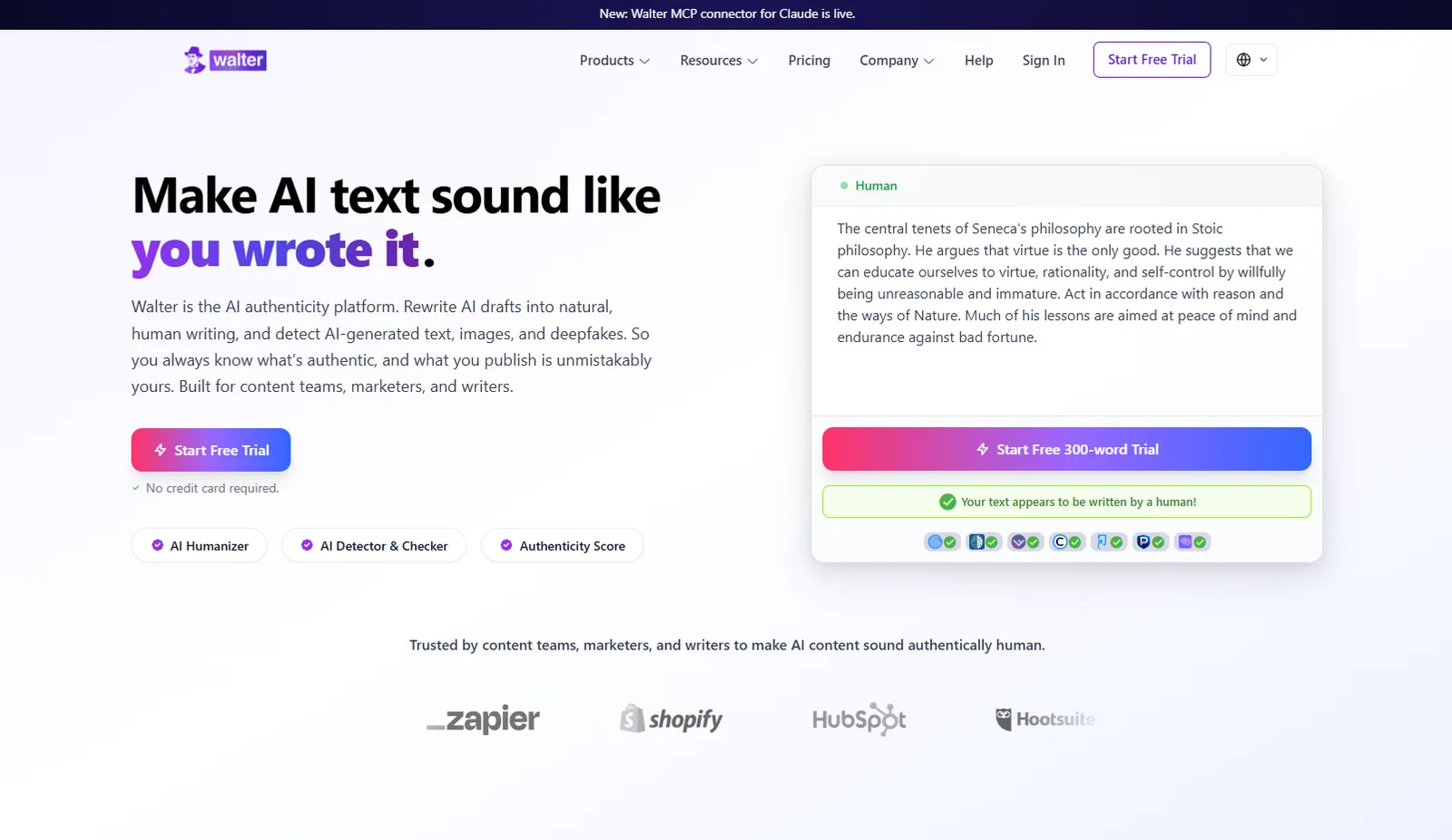
Two structural points matter before the prices. The feature list is identical on every paid tier: advanced humanization engine, plagiarism free content, a built in AI detector, MCP server access, more than 80 languages, and watermark removal. Starter buys the same engine as Teams, so money buys capacity and never capability. Capacity itself means two numbers: a monthly word pool, and a hard cap per request.
Who buys it
Large word pools, a browser extension, a resume rewriter and mobile apps describe someone producing a steady stream of shortish pieces in several languages, and the Teams tier at $99 a month extends that to a small content team with ten seats.
Walter Writes AI Pricing
Four tiers, quoted at the annual rate. Billed monthly each costs more, and the vendor puts the annual saving at up to 43 percent. Registration gives 300 free words, enough to judge tone but not enough to test behaviour on a real document.
| Plan | Price (annual) | Words per month | Cap per request | Seats |
|---|---|---|---|---|
| Starter | $8 a month | 30,000 | 750 words | 1 |
| Pro | $13 a month | 70,000 | 1,500 words | 1 |
| Elite | $26 a month | 200,000 | 2,000 words | 1 |
| Teams | $99 a month | 500,000 | 2,000 words | 10 |
The cap matters more than the pool
For academic work the deciding number is the per request cap. A dissertation chapter runs 8,000 to 12,000 words. On Starter, at 750 words a request, one chapter takes a dozen or more passes, and even at the top the ceiling is 2,000 words.
Splitting a document has a cost. Each pass sees only its own fragment and cannot know how a construct was rendered three fragments earlier. A term humanized one way in section one returns another way in section four, tense drifts, and a sentence carrying a narrative citation can be cut at a boundary.
What to check after a split pass
Those seams are yours to reconcile, and each of these has to be checked across the whole document instead of inside a fragment.
- Every defined construct and instrument name, against the wording you defined it with the first time.
- Tense in methods and results, where a shift at a seam shows up soonest.
- Citations sitting near a split, narrative ones first, since the author surname is part of the sentence there.
- Reported numbers, effect sizes and units, which a general rewriter has no reason to treat as fixed.
Humanize your own paper
Transform your AI-assisted text and make it sound human, without touching important words or citations.
Citations, Terminology and Register
Walter Writes AI plan pages describe word allowances and tool access. They name no referencing style, no terminology lock and no academic register target, which is consistent with a product built for general content.
Nothing commits the engine to leaving an in text citation untouched, so a rewrite may reword the sentence around it or move a narrative citation into a parenthetical. Nothing locks a defined construct, an instrument name or a reported statistic, so a validated scale can come back as a plausible synonym, which is a serious error in a methods section even though it reads well. If your document carries no reference list, none of that costs you anything.
TextPulse names each of those as a feature: citations preserved verbatim across six referencing styles, freeze terms that lock any construct or instrument name before the pass, statistics and formulas preserved automatically, and register held at the Flesch-Kincaid grade 13 to 18 band.
Breadth, Languages and the Bundled Detector
The 80 language claim
Language breadth is Walter Writes' strongest card. More than 80 languages is real reach, and for general content in a less served language it may decide the purchase. But a count says nothing about depth in any one language. Fluency is the easy part, and fluency is all a count measures.
What depth in a language actually means
An example makes it concrete. German scholarly prose runs heavily nominal, prefers the passive where English would name an agent, and marks reported speech with a subjunctive form a general rewriter has no reason to preserve. Flatten those into everyday word order and the text stops sounding like a dissertation. Conventions diverge too: several German language traditions carry references in footnotes instead of parentheses, so a rewrite that restructures the sentence can leave the note attached to the wrong clause.
A count captures none of that. It tells you the engine returns fluent sentences in a language. Whether they hold the register an examiner in that language expects is a separate question, and for an academic buyer it is the only one that matters.
The built in detector
Every paid tier bundles an AI detector, which is useful workflow: humanize, check, adjust, check again, without paying a second vendor. A bundled self check reports what one detector thinks of one passage on one day, while a published benchmark is a measurement across a corpus, disclosed with its method.
How It Scored in Our Testing
Turnitin results were the best thing about the tool, and worth stating plainly: the engine moves text far enough to shift a Turnitin AI reading. Only a few tools did better, with Undetectable AI returning the strongest Turnitin results. Raw detection was never the weak point here.
Academic tone was the deciding weakness. Output came back at the bottom of the field, reading as competent general prose instead of scholarly writing. That is precisely what a tool built for content teams and marketers should produce, and precisely what a methods section cannot use.
Citations held up better than terminology, and no stated rule governs either, so both describe a tendency and neither is a guarantee. A defined construct that returns as a plausible synonym is a substantive error a proofread will not catch, because the sentence still reads perfectly well.
Grammar sat mid field, with readable output carrying the small slips a proofread clears, and the interface does nothing for an academic workflow. The most revealing result was language: more than 80 languages advertised, and a middling reading of what the non English output was actually like. Reach and depth are separate measurements, and only one of them appears in the marketing.
The pattern is consistent: strong where the product is aimed, weak where an academic document needs it, and those weak measures are exactly what TextPulse is built around.
Walter Writes AI Alternatives
- Undetectable AI suits general content at volume, with monthly word pools and a refund if output is flagged.
- QuillBot Humanizer suits existing QuillBot subscribers, inside a suite they already pay for.
- Phrasly suits general student and marketing drafts, and adds a document editor.
- Rephrasy suits students on fixed budgets, with a 24 hour pass and a lifetime licence.
All four share Walter Writes AI's scope: general content priced on volume, so none of them changes the academic answer. For academic documents, where citations, terminology and register have to survive the pass, TextPulse is built for the job, and the wider field is compared in our guide to the best AI humanizers.
TextPulse vs Walter Writes AI
| What you are comparing | TextPulse | Walter Writes AI |
|---|---|---|
| Built for | Academic documents: theses and manuscripts | General multilingual content in a broad suite |
| Register | Held at the Flesch-Kincaid grade 13 to 18 band | Competent general prose, no academic target named |
| Published detector evidence | Vendor benchmark on a 2,000 document academic corpus: 92.33% Turnitin AI, 89.12% Originality.ai, 87.91% GPTZero | Bundled detector for self checking |
| Citation handling | Preserved verbatim across APA, MLA, IEEE, Chicago, Harvard and Vancouver | No referencing style named |
| Terminology control | Freeze terms lock any construct or instrument name, and statistics are preserved | No terminology lock named |
| Capacity per pass | Documents process whole, with no seams between fragments | 750 to 2,000 words per request |
| Languages | Academic register held in the languages supported | More than 80 languages advertised |
| Price | Pro $19 a month for 25,000 words, Plus $29 for 50,000, or $169 and $259 billed annually | $8 to $99 a month billed annually |
The Verdict on Walter Writes
Walter Writes AI offers genuine breadth for the money. A humanizer, a detector, a paraphraser, a grammar checker, apps and developer APIs, opening at $8 a month with more than 80 languages behind them, is a lot of product, and its Turnitin results say the engine works. For general content across several languages it is a sensible buy.
For academic documents, use TextPulse, for two reasons. The first is capacity: chapters process whole instead of in 750 to 2,000 word pieces, so there are no seams to reconcile afterwards. The second is that the behaviours an academic document depends on are protected by name. Citations survive verbatim across six referencing styles, freeze terms lock any construct or instrument name, statistics and effect sizes come through untouched, and register is held at the Flesch-Kincaid grade 13 to 18 band. Pro costs $19 a month for 25,000 words and Plus costs $29 for 50,000, or $169 and $259 billed annually.
The vendor benchmark on a 2,000 document academic corpus is published: 92.33% passed Turnitin AI, 89.12% Originality.ai and 87.91% GPTZero. No tool, ours included, can promise what a detector will say about one document, and every TextPulse pass reports an estimated Human Score computed from your own text. If your document carries a reference list, start with the academic AI humanizer for researchers.
Related research: the humanizers discussed above are compared head to head in A Controlled Comparison of AI Text Humanizers on Academic Writing, a TextPulse Research working paper with open data and code.
Frequently Asked Questions
Four tiers, billed annually: Starter at $8 a month for 30,000 humanizer words with a 750 word cap per request, Pro at $13 for 70,000 words with a 1,500 word cap, Elite at $26 for 200,000 words with a 2,000 word cap, and Teams at $99 for 500,000 words, ten seats and a 2,000 word cap. Monthly billing costs more, with the annual saving put at up to 43 percent. Registration gives 300 free words.
Content strategist at TextPulse, here since the company started. Mark writes the product and technical coverage: how the humanizer works under the hood, what changes in each release, and what a specification actually means for your writing. His reviews of writing software come from using them on real documents rather than reading a feature list.