WriteHuman AI Humanizer Review
WriteHuman is a polished general humanizer that starts at $12 a month billed annually and returns two to five rewrite variations per request. It is unusually candid about its own limits, telling users to reread the output and check the facts. For academic work the real limit is the words per request cap, which splits a chapter into fragments you then reconcile yourself.
WriteHuman is an AI humanizer that starts at $12 a month billed annually. You paste machine generated text and it returns rewritten versions meant to read as though a person produced them. The vendor calls it "the premium AI humanizer for serious writing", and the product is well made: an AI detector on every plan, plus an AI image detector, a word counter, a Chrome extension, a REST API and an MCP connector, across more than 40 languages.
This review judges it for one job, academic writing: a referenced chapter, a methods section, a literature review. Those documents carry citations, defined constructs, reported statistics and a register that has to hold from the first page to the last.
What Universities Actually Allow
The rule at most institutions is disclosure. Elsevier allows generative AI to improve readability and language provided the manuscript carries a declaration. Nature permits generative AI in writing and refuses to list a model as an author, because authorship carries accountability software cannot hold. COPE reaches the same place from the other direction: a tool cannot take responsibility for the work, so a human author must, and must say what the tool did.
The position is simple. Use the tool, say you used it, and cite the model where your style guide asks. See how to cite ChatGPT and our disclosure statement template.
Why AI Drafts Need Humanizing
Two separate problems. The first is that raw model prose is generic: sentence lengths cluster in a narrow band, connectives go flat, hedges stack until a claim says nothing, and paragraphs close on a formulaic summary. A supervisor will not mention detectors, they will say the writing has no voice.
The second is detection. Turnitin, GPTZero, Originality.ai and Pangram score how predictable each next word is given everything before it, and generated prose is predictable by construction, as explained in how AI detectors work. Turnitin's documentation also states that its AI indicator covers text that has been humanized or passed through a bypasser, and separately flags text likely revised using an AI paraphrase tool. A rewrite gives you no exit from detection, and no humanizer, ours included, can promise a detector outcome on a specific document.
How AI Humanizers Work
- Varying sentence structure. This moves detector readings most, because sentence length variance is directly measured.
- Replacing model typical vocabulary. Swapping words and connectives that appear far more often in generated prose than in human writing. On its own it is cosmetic.
- Adjusting register. Changing formality, hedging and complexity to match a target reader.
Most humanizers aim at conversational register, which suits a newsletter and fails a thesis. The output then reads as an undergraduate summary of your own argument.
What WriteHuman Is and How the Rewrite Engine Works
WriteHuman rewrites a block of text and hands back more than one version. The count is a plan feature: two on the entry tier, three in the middle, five at the top.
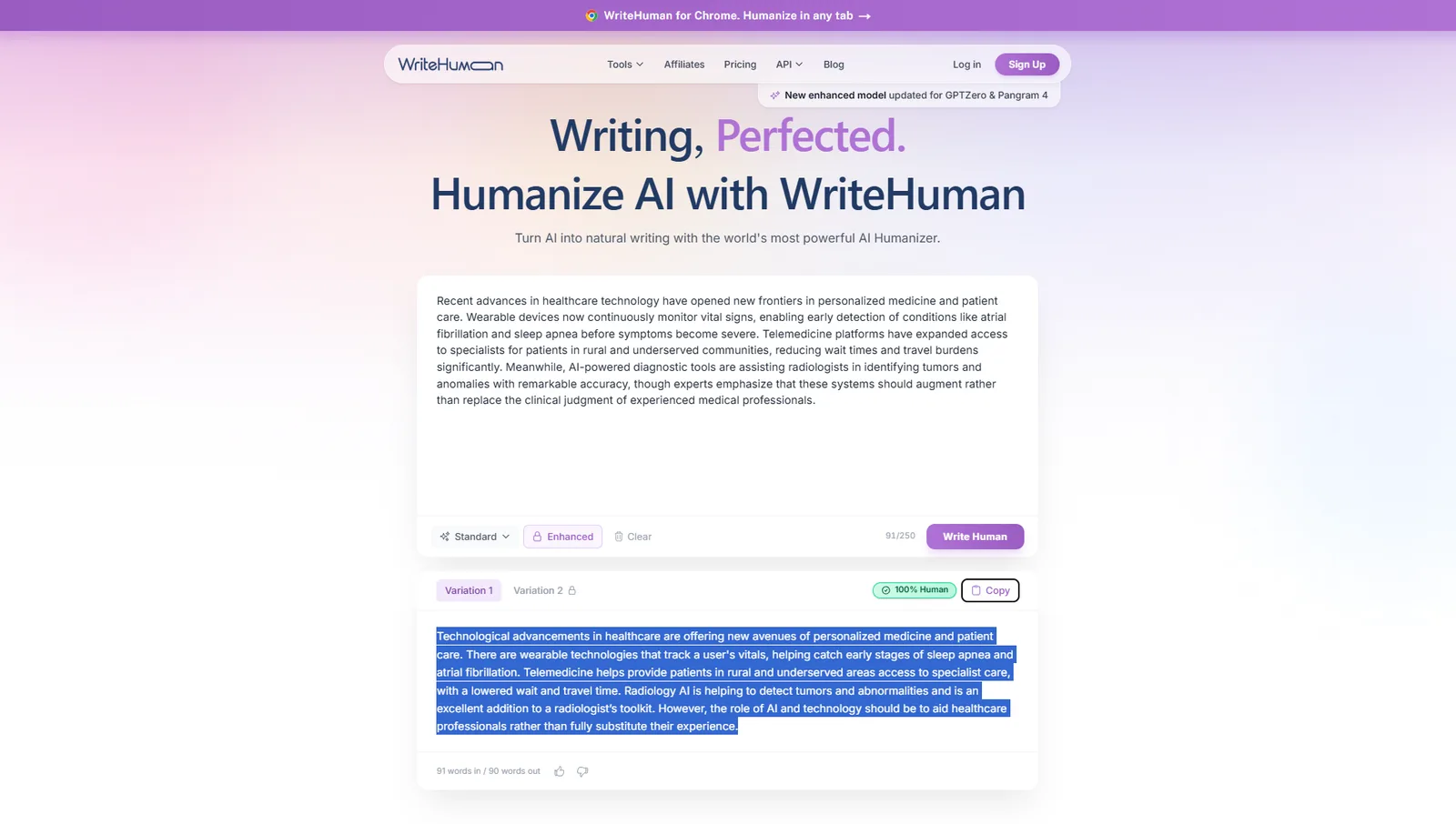
The vendor is unusually candid about what that rewrite is. Its own pages say the rewriter "doesn't create new ideas", and tell users to "reread the results, double-check the facts, and edit as you would with any first draft". That is a fairer account of the category than most rivals offer, and it deserves credit.
The leaderboard claim, and what measured studies show
Against that candour, the marketing rests on first place on a "Humanizer Leaderboard" that cites no methodology and no sample. Treat it as marketing. Independent work gives a better sense of where humanized text actually sits. A study in the International Journal for Educational Integrity ran 160 academic papers of more than 4,000 words through Pangram, GPTZero, Copyleaks and Turnitin. Pangram flagged 92.5% of the humanized papers and Turnitin flagged 50% of them, while all four cleared 100% of the human written papers. Results vary enormously by detector, and no humanizer, TextPulse included, can promise you a specific outcome.
The feature set
Every plan includes full access to the humanizer and the built in AI detector, plus AI detection checks and MCP access, so detection sits outside the upgrade path. Around that sit the AI image detector, word counter, Chrome extension, REST API and MCP connector. On Ultra, MCP access is capped at 1,000 a month.
Who buys it
Short form general writing: marketing copy, web pages, newsletters, social posts, and student work that arrives in small pieces instead of chapters. A content team wiring a humanizer into its pipeline through the API is the buyer this feature list was drawn for.
Humanize your own paper
Transform your AI-assisted text and make it sound human, without touching important words or citations.
WriteHuman Pricing
The plans meter two ways at once, requests per month and words per request. Both apply simultaneously, and the second decides whether the tool fits a thesis.
| Plan | Billed annually | Annual total | Requests per month | Words per request | Variations |
|---|---|---|---|---|---|
| Basic | $12 a month | $144 | 80 | 600 | 2 |
| Pro | $18 a month | $216 | 200 | 1,200 | 3 |
| Ultra | $36 a month | $432 | Unlimited | 3,000 | 5 |
Billed monthly each tier costs more, and the vendor frames annual billing as three months free. Ultra removes the request ceiling, which sounds generous, except the request ceiling was never the real constraint.
The words per request cap is the real limit
For academic work the monthly request count barely matters, and the per request word cap decides everything. A 4,000 word chapter does not fit in one Pro request. It splits into four separate 1,200 word requests, each processed with no knowledge of the others.
Every join between those fragments is a seam, and seams are where academic writing breaks. Terminology drifts, because nothing obliges fragment three to keep calling it "perceived organisational support" when fragment one chose different phrasing. Tense shifts, so a results paragraph that began in past tense resumes in present. A citation can land on a boundary, with the author name in one fragment and the year in the next. On Basic it is sharper still, since 600 words turns that chapter into roughly seven fragments.
Multiple variations move quality control to you
Several versions per request help on a headline. On a long document they multiply the work: that chapter on Pro is four requests at three variations each, which is twelve fragments to read, judge, choose between and stitch into one argument. The variations move quality control onto you.
Working inside the cap if you use it anyway
The fragments are manageable with discipline. Split at section boundaries and never mid paragraph. Keep a terminology sheet beside the editor and check every construct name against it after each request. Check reference heavy paragraphs against your reference manager, since a rewritten narrative citation is the error a marker sees first. Then reread across each join for tense. None of it is difficult, and all of it is work the tool has handed to you.
Citations, Terminology, Statistics and Register
WriteHuman's pages describe no citation handling, no terminology locking and no academic register target. Those sit outside the scope of a product built for general writing. References are therefore safe only if the rewrite happens to leave them alone. Narrative citations, "Alvarez and Brooke (2019) argued that", are a grammatical part of the sentence, so a rewriter restructuring that sentence is working directly on the citation.
Terminology has the same problem. If your instrument has one correct name, every synonym substituted is an error a marker can see, and across fragments they multiply. Statistics have to pass through untouched, because a rewritten p value is a data problem and no longer a style problem. Register is the least visible risk, since conversational output in a discussion section is easy to read and impossible to submit. WriteHuman's answer to all four is its advice to reread and check, which is sound advice and entirely manual.
TextPulse handles the same four inside the pass: citations preserved verbatim across six referencing styles, freeze terms that lock any construct or instrument name before the rewrite, statistics and chemical formulas preserved automatically, and register held at the Flesch-Kincaid grade 13 to 18 band.
How It Scored in Our Testing
The workspace was the strongest part of the tool. Two to five versions per request makes the interface useful, because you compare and pick instead of resubmitting the same block hoping for something better, and the detector sits on every plan.
Academic tone held a formal register better than most general rewriters, though it aims at readable professional prose rather than the grade 13 to 18 band a thesis sits in. Turnitin results landed ahead of the tone focused tools and behind the specialists: sentence structure moves enough to shift the reading on some passages, and the variations give you a second and third attempt at a paragraph that does not shift.
Grammar, citations and key terms were mid field. Sentences came back clean with occasional stiffness, and references and construct names survived when the rewrite left them alone and drifted when it did not. Across the four fragments of one chapter, that is a gamble rather than a plan. More than 40 languages is real breadth, though the non English output quality was mid field.
WriteHuman sits above the tone only tools and below the academic specialists, and the wider comparison is in our best AI humanizer roundup, where Undetectable AI posted the strongest Turnitin results.
WriteHuman Alternatives
- Undetectable AI. General content at volume, with monthly word pools and a refund if output is flagged.
- QuillBot Humanizer. Suits existing QuillBot subscribers, sitting inside a suite they already pay for.
- Grammarly Humanizer. Business and everyday writing, with tone and voice presets.
- StealthWriter. For writers who want to inspect and pick each sentence rewrite.
Each is a general purpose rewriter, the category WriteHuman occupies, so none of them changes the answer for a referenced document. For an academic manuscript the tool built for the job is TextPulse.
TextPulse vs WriteHuman
| What you are comparing | TextPulse | WriteHuman |
|---|---|---|
| Built for | Academic documents: theses, chapters, journal manuscripts | Short form general writing, 40 plus languages |
| Detector evidence | Vendor benchmark on a 2,000 document academic corpus: 92.33% passed Turnitin AI, 89.12% Originality.ai, 87.91% GPTZero | First place on a "Humanizer Leaderboard", with no methodology, sample or numeric figure |
| Citations | Preserved verbatim across APA, MLA, IEEE, Chicago, Harvard and Vancouver | No citation handling described |
| Terminology | Freeze terms lock any construct or instrument name before the pass | No terminology locking described |
| Register | Held at the Flesch-Kincaid grade 13 to 18 band | No academic register target described |
| Capacity per pass | Documents process whole, so there are no seams | 600 words on Basic, 1,200 on Pro, 3,000 on Ultra |
| Quality control | Handled inside the pass, with an estimated Human Score on the result | Two to five variations for you to read, judge and stitch |
| Price | Pro $19 a month for 25,000 words, Plus $29 for 50,000, or $169 and $259 billed annually | $12 to $36 a month billed annually, more billed monthly |
Capacity per pass is the row that matters most. Processing a document whole removes the seam problem: one pass, one set of terminology decisions, one tense, one hedging level throughout.
The Verdict on WriteHuman
WriteHuman is polished, and its candour about its own limits is to its credit. Telling users that the rewriter does not create new ideas, and that output needs rereading and fact checking, is a more accurate account of the category than most sales pages give. If you write short form general content, work across many languages, or want a humanizer wired in through the API or MCP connector, it does that job well from $12 a month, and only the Ultra tier at $36 a month gives a word ceiling that longer pieces fit inside.
For a referenced academic chapter, use TextPulse. WriteHuman's candour about its limits does not remove them. WriteHuman asks you to check your own citations, terminology and facts after every request, and one 4,000 word chapter on Pro is twelve pieces of manual verification before you have a single draft. TextPulse handles those requirements inside the pass, and processes the document at once so there are no seams. Pro costs $19 a month for 25,000 words and Plus costs $29 for 50,000, or $169 and $259 billed annually, all listed on the TextPulse pricing page. The vendor benchmark on a 2,000 document academic corpus reports 92.33% passing Turnitin AI, 89.12% Originality.ai and 87.91% GPTZero, and every pass returns an estimated Human Score computed from your own text instead of a guarantee about a detector's verdict. Disclose the assistance in your methods, and start at the humanizer for researchers.
Frequently Asked Questions
It is built for a different job. WriteHuman describes no citation handling, no terminology locking and no academic register target, and its plans cap each request at 600, 1,200 or 3,000 words, so a chapter has to be split into fragments. Its own guidance tells you to reread the output and check the facts afterwards. For a referenced document, TextPulse processes the file whole and preserves citations, terminology and statistics during the pass.
Content strategist at TextPulse, here since the company started. Mark writes the product and technical coverage: how the humanizer works under the hood, what changes in each release, and what a specification actually means for your writing. His reviews of writing software come from using them on real documents rather than reading a feature list.