Is ZeroGPT Accurate?
ZeroGPT's own FAQ claims a rate pushing toward 98 percent on internal testing, and separately admits that formulaic writing can read as AI regardless of who wrote it. Here is what the company states about its method, what independent testing on this exact product has found, and what a free score is actually useful for.
ZeroGPT accuracy, by the company's own current claim, is a rate "pushing toward >98% on internal evaluations," a figure the company acknowledges comes from testing it ran on itself rather than from an outside lab. That single qualifier, internal, is most of what a reader needs before treating any free detector's percentage as settled fact.
ZeroGPT is one of the most-used free AI detectors, largely because it costs nothing and returns an answer in seconds. The same gap between vendor claims and independent testing that shows up across AI detectors generally shows up here too. What follows is what the company currently states about its own accuracy and method, what that method appears to actually measure, and why a tool like this tends to misfire in specific, predictable ways on the kind of writing academic readers submit.
What Is ZeroGPT Accuracy, According to the Company?
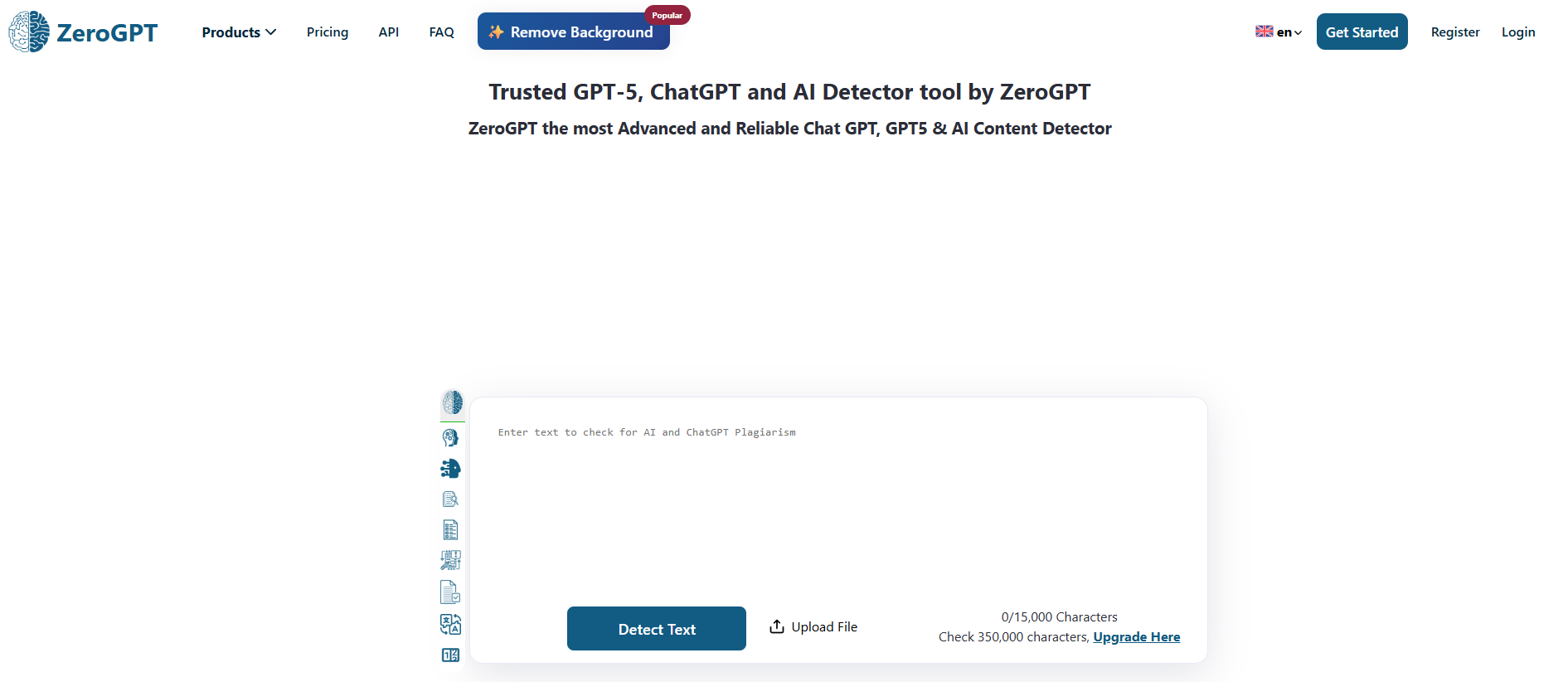
ZeroGPT's own FAQ states that the company "delivers industry-leading accuracy and is continuously improved to maintain best-in-class performance, pushing toward >98% on internal evaluations." That is a vendor's claim about its own product, tested by the company itself, phrased with real hedging built into the wording: "pushing toward" a number is not the same statement as reaching and holding it, and "internal evaluations" means no outside party has published a matching figure. Nothing on the page states how large that internal test set was, what it contained, or who outside the company reviewed the methodology.
The company recommends at least 150 to 200 words of text for a stable result, with 500 to 1,000 words or more improving reliability further, and states directly that very short or heavily edited snippets "carry fewer signals." That single disclosure matters more than the headline percentage. It is the vendor's own acknowledgement that the score is only as trustworthy as the input is long and untouched, a condition a real submission does not always meet.
What Method Is ZeroGPT Actually Using?
ZeroGPT calls its underlying system DeepAnalyse, described on its own site as a "multi-stage methodology designed to optimize accuracy while minimizing false positives and negatives" that reads a text "from the macro level to the micro one." Its FAQ describes something more specific underneath the branding: an analysis of "token patterns, burstiness, entropy, and ensemble classifier features trained on mixed datasets."
Burstiness and entropy are not unique to ZeroGPT. They are the same statistical properties, how much sentence length and rhythm vary, and how predictable each next word is, that TextPulse's own explainer on how AI detectors work covers as the general mechanism behind this whole category of tool. A free perplexity checker shows that same underlying number directly, without asking a writer to trust any single vendor's percentage first.
Humanize your own paper
Transform your AI-assisted text and make it sound human, without touching important words or citations.
Why Does Academic Writing Trip These Detectors Up?
The ZeroGPT FAQ puts it this way: "highly polished, formulaic, or low-entropy writing can resemble AI." Academic prose is designed for highly polished, formulaic, low-entropy writing. A methods section, a literature review and a formal cover letter all reward the conventional phrase over the inventive one, because convention is what makes the document usable to its reader in the first place, and that convention is precisely the low-entropy pattern the vendor's own disclosure names as a risk.
Independent, peer-reviewed testing shows why this failure mode lands harder on some writers than others. A 2023 Stanford study ran seven widely used detectors, ZeroGPT among them, against 91 real TOEFL essays written by non-native English speakers and 88 essays written by US eighth-graders. ZeroGPT flagged 48 percent of the TOEFL essays as AI-generated, against 0 percent of the eighth-grade essays, the same direction of error every detector in that study showed, just at a different size.
Nothing about that gap is unique to ZeroGPT, and nothing about it is new information. It is the same non-native-writer bias pattern documented across the detector industry, covered in more depth on TextPulse's own page on why AI detectors are biased against non-native speakers. What the gap shows specifically about a free consumer tool is that the vendor's own disclosed limitation, low-entropy writing reads as machine-made, is not hypothetical. A peer-reviewed test caught it happening on this exact product years before the company's current FAQ named the mechanism in its own words.
Can a Free Detector Score Prove Anything About One Document?
Not on its own. A ZeroGPT percentage is not proof of anything about a specific document, in either direction. It's one model's estimate, built on internal testing the company has not published in a form anyone outside the company can check, applied to writing whose length, editing history and genre all shift the reading in ways the vendor's own FAQ already acknowledges. Treating a single free score as a verdict asks more of that score than the company issuing it claims for it.
What a score is genuinely useful for is narrower and more mundane: a quick, no-cost read on where a draft currently sits on the same kind of statistical measurement a paid institutional tool also runs, before anyone else sees it. TextPulse's free tools cover that same ground directly, without asking a writer to guess which of several free detectors' scores to trust first.
Accuracy figures hide who the errors land on and what triggers them. Knowing when to use a, an and the removes one of the patterns that draws a flag, and what a false positive actually means is set out separately.
None of this makes ZeroGPT's number meaningless, and none of it makes the number sufficient on its own. A score is a starting estimate, produced by a method the company describes only in outline and has not opened to outside testing, on writing whose genre alone can move the result before anyone involved has done anything wrong. The two words carrying the most information on that FAQ page are not the percentage. They are the hedges sitting right next to it: internal, and pushing toward. A free score is a starting point for a conversation about a draft, not a closing argument in one.
What Our Own Research Found
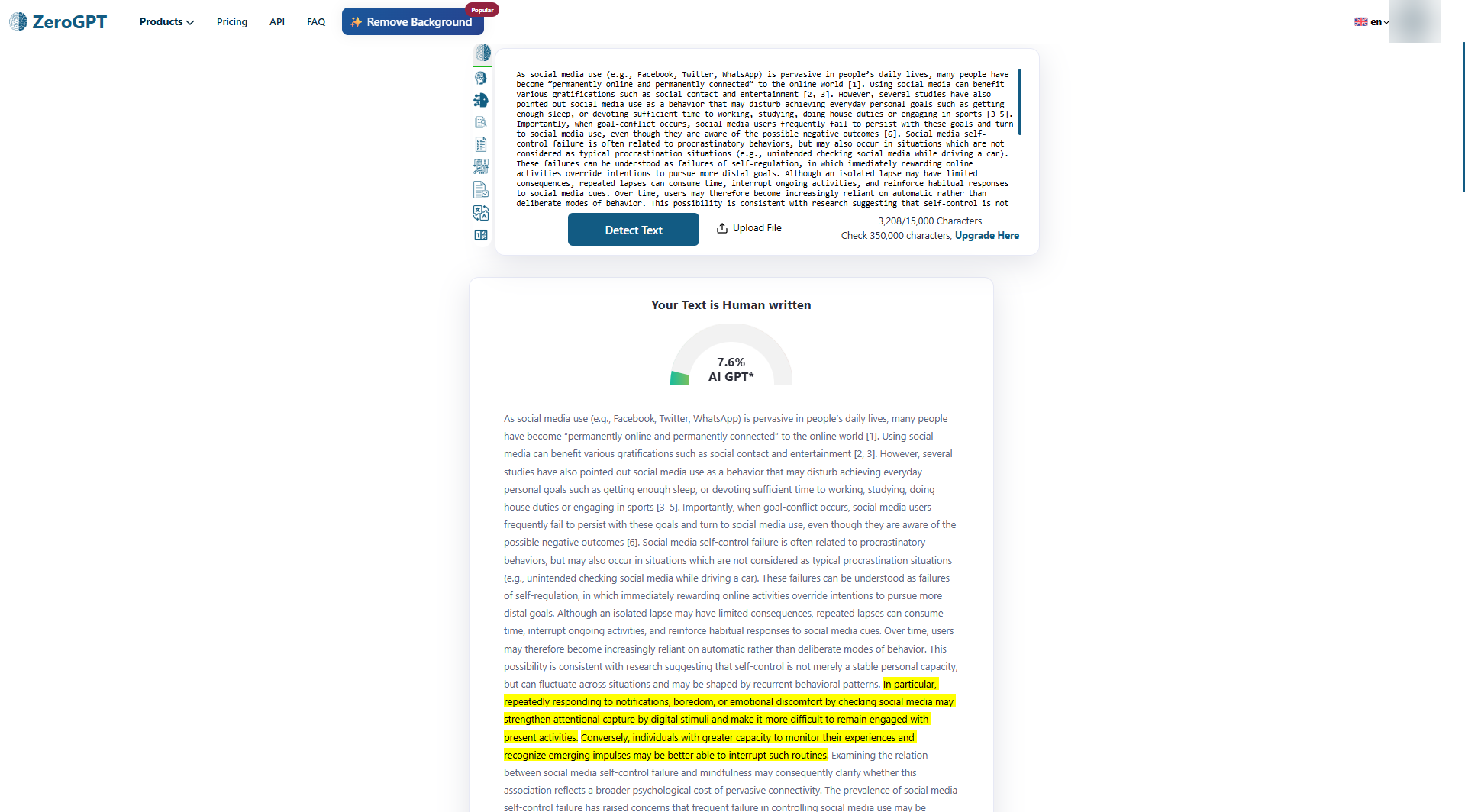
In the TextPulse Research detector agreement study, nine commercial AI detectors rated the same 90 academic texts. One was a 455-word hybrid text: a human-written opening and closing around a 168-word AI-generated middle. ZeroGPT scored this text 7.6% AI, while verdicts from the other tools on the same words ranged from 0% to 95.7% AI. The full paper, corpus, and per-tool score matrix are open access at TextPulse Research.
Frequently Asked Questions
ZeroGPT accuracy, by the company's own current claim, reaches a rate "pushing toward >98% on internal evaluations." That figure comes from testing the company ran on its own product, not from an outside lab, and the vendor's own FAQ separately notes that highly polished or formulaic writing can read as AI-generated regardless of who wrote it.
PhD in natural language processing, with years spent building NLP applications end to end. Moe works on text analysis: lexical and syntactic structure, and what separates machine-generated prose from human prose statistically. He has been experimenting with computational linguistics since the early days of NLTK, spaCy and WordNet, and still writes most of his tooling in Python.