AI humanizer for Arabic
Arabic academic writing has its own AI tells: calque openers, stacked hedges, and a flattened rhythm that Modern Standard Arabic does not normally use. Here is how those tells show up, how universities across the Arab world are responding, and what a humanizer needs to preserve when the source language is Arabic.
Academic writing in Arabic increasingly starts as a chatbot draft, then gets revised before submission. If you are searching for an arabic ai humanizer, the problem is usually specific: a thesis chapter, a journal manuscript, or a graded assignment that reads correctly in Modern Standard Arabic but still triggers a detector. Arabic academic prose has its own formal register, and models trained mostly on English tend to flatten that register into repetitive, uniform patterns. This post explains what makes AI-generated Arabic detectable, how universities across the Arab world are responding, and what a humanizer needs to preserve when the source language is Arabic.
Detectors built for English text now score Arabic passages too, and Arabic carries its own set of tells: a formal register that generation models flatten into repeated phrasing, calque openers borrowed from English filler, and paragraph rhythm that reads too even to be a native writer's prose. The sections below cover where those patterns show up, how AI detection is actually used across Egypt, Saudi Arabia, the UAE and neighboring countries, and how TextPulse handles Arabic text without disturbing citations or technical terms, as part of a wider multilingual AI humanizer built for exactly this kind of academic work.
Why AI Text Gets Flagged in Arabic
Arabic academic writing is conducted almost exclusively in Modern Standard Arabic, the formal literary register rather than any spoken dialect, and it favors verbal nouns and balanced parallel clauses for emphasis. Generated text often keeps that vocabulary while losing the rhythm behind it. A frequent tell is a calque opener that translates English throat-clearing directly into Arabic, mirroring the stock English opener that frames every essay around a fast-moving, ever-changing world. Another is a formulaic transition that opens nearly every paragraph with the same phrase, functioning the way 'it is worth noting that' does in English, and signaling a template rather than an argument being built.
Two more patterns stand out in generated Arabic. The first is heavy nominalization, stacking a verbal noun onto a verb the language already provides on its own, which reads as stiff and over-formal even by the standards of academic Arabic. The second is a formulaic conclusion that restates the introduction almost word for word, closing the piece the same way it opened rather than synthesizing what came before. These sit inside a broader set of words that give away ChatGPT across languages generally, and Arabic has its own local versions of the pattern.
Sentence rhythm is the hardest tell to fix by hand. Native Modern Standard Arabic writing varies clause length deliberately, using balanced parallel construction for emphasis rather than uniformity. Generated Arabic tends to produce sentences of near-identical length paragraph after paragraph, which reads smoothly but flatly to a trained eye and, increasingly, to a detector trained on exactly that kind of statistical regularity in sentence structure.
What AI-Sounding Arabic Looks Like
The table below shows a short passage generated in the pattern described above, next to a humanized version that keeps the same claim and the same research gap. English glosses sit alongside each row so the difference is legible even without reading Arabic script. Reading the two rows side by side shows the actual edit: the opener and the stacked hedges are cut, and the closing restatement is replaced with a direct sentence, while the underlying claim about prior research and the study's aim stays exactly the same.
| AI-sounding Arabic | After humanizing |
|---|---|
| في عالمنا المعاصر الذي يشهد تطورا متسارعا في مجال التكنولوجيا، تجدر الإشارة إلى أن الذكاء الاصطناعي يعد من أهم الأدوات التي أحدثت تحولا جذريا في مجال التعليم العالي. كما أنه من الجدير بالذكر أن العديد من الدراسات السابقة قد تناولت هذا الموضوع من زوايا مختلفة. وختاما، فإن هذه الدراسة تسعى إلى سد هذه الفجوة البحثية. | دخل الذكاء الاصطناعي إلى التعليم العالي وغيّر كثيرا من ممارساته. تناولت دراسات سابقة هذا الموضوع من زوايا متعددة، لكن الفجوة التي تحاول هذه الدراسة سدها ما زالت قائمة. |
| English gloss: In our current era of rapid technological change, AI is among the most important tools that have brought radical transformation to higher education; many prior studies have addressed this topic from different angles; finally, this study seeks to fill this research gap. | English gloss: Same claim and same research gap, but the throat-clearing opener and stacked hedges are cut, and the argument is condensed into two direct sentences while keeping the same facts. |
AI Detection in Egypt, Saudi Arabia, and the Gulf
Turnitin is the detector most Arab universities already had in place for plagiarism, and its AI-writing indicator has become the default first check when a submission looks off. GPTZero, Originality.ai and Copyleaks are also cited in regional academic-integrity discussions, though adoption varies by institution and department. A pattern also documented in Turkish academic writing shows up here too: detector adoption tends to move faster in STEM and business faculties, where English-medium instruction is common, than in humanities departments that grade largely in Arabic.
Faculty response has generally been mixed rather than uniformly restrictive. A published study of academics at King Saud University found broad awareness of ChatGPT alongside calls for responsible use, suggesting guided integration in at least some Saudi departments rather than an outright ban. Elsewhere, examination bylaws that predate generative AI, built for plagiarism rather than AI-generated text, are being stretched to cover undisclosed AI use instead of being replaced with dedicated policy. That gap between old rules and a new problem is common across the region, not unique to any one country.
For a student or researcher, the practical result is similar regardless of which detector a given university runs: a manuscript that reads as templated Arabic, with the tells described above, is more likely to get flagged for a manual review, even when the underlying research and argument are entirely the writer's own. Preserving the argument while removing the template is the actual task, separate from evading detection outright.
Humanize your own paper
Transform your AI-assisted text and make it sound human, without touching important words or citations.
University Policies on AI-Generated Writing
Few universities in the region have published a dedicated, standalone generative AI policy as of the 2025 to 2026 academic year. Most rely on existing academic integrity or examination regulations, extended by interpretation to cover undisclosed AI use. The summaries below reflect what is publicly documented, not a claim about unpublished internal guidance.
| University | Country | Policy stance |
|---|---|---|
| King Saud University | Saudi Arabia | Published research shows broad faculty awareness of ChatGPT and calls for guided use. |
| Cairo University | Egypt | General exam bylaws ban non-original submissions, generally understood to cover undisclosed AI text; no dedicated GenAI policy confirmed. |
| United Arab Emirates University | United Arab Emirates | Student conduct code treats undisclosed AI-generated text as an integrity matter, in line with broader UAE Ministry guidance; exact policy wording unconfirmed. |
| University of Baghdad | Iraq | Public documentation is limited; general Iraqi higher-education guidance treats undisclosed AI submissions similarly to plagiarism, not verified at the institutional level. |
| Hassan II University of Casablanca | Morocco | Moroccan guidance discourages undisclosed AI-generated theses; the university's academic integrity charter appears to align, no dedicated policy confirmed. |
| University of Jordan | Jordan | Academic integrity rules require original authorship, and administrators have discussed AI's risks publicly; no formal GenAI-specific policy confirmed. |
Journals and Citation Culture
Arabic-language and bilingual journals serving this readership include the Journal of King Saud University, which publishes multidisciplinary science in English from a largely Arabic-speaking author base, and Majallat Jami'at Dimashq, Damascus University's journal for humanities and economics research in Arabic. Kuwait University's Al-Majalla al-'Arabiyya lil 'Ulum al-Insaniyya covers humanities, Cybrarians Journal in Egypt covers library and information science, and Majallat al-'Ulum al-Tarbawiyya wa al-Nafsiyya covers education and psychology across the region. The Jordan-based International Journal of Arabic-English Studies publishes bilingual work in applied linguistics and translation, reflecting how much Arabic academic output sits between two languages.
Citation styles vary by field more than by country. APA, seventh edition, is dominant across most Arab universities and gets adapted for right-to-left formatting and transliteration of Arabic author names. Chicago-style footnotes persist in humanities and Islamic studies, following an older footnoting convention, and MLA shows up in some Gulf-region English-language departments. Many theses keep separate, bilingual reference lists for Arabic and Latin-script sources rather than merging them into one alphabetized list. A humanizer that reformats or drops any of that structure creates more cleanup work at the final formatting stage than it saves.
How TextPulse Works as an Arabic AI Humanizer
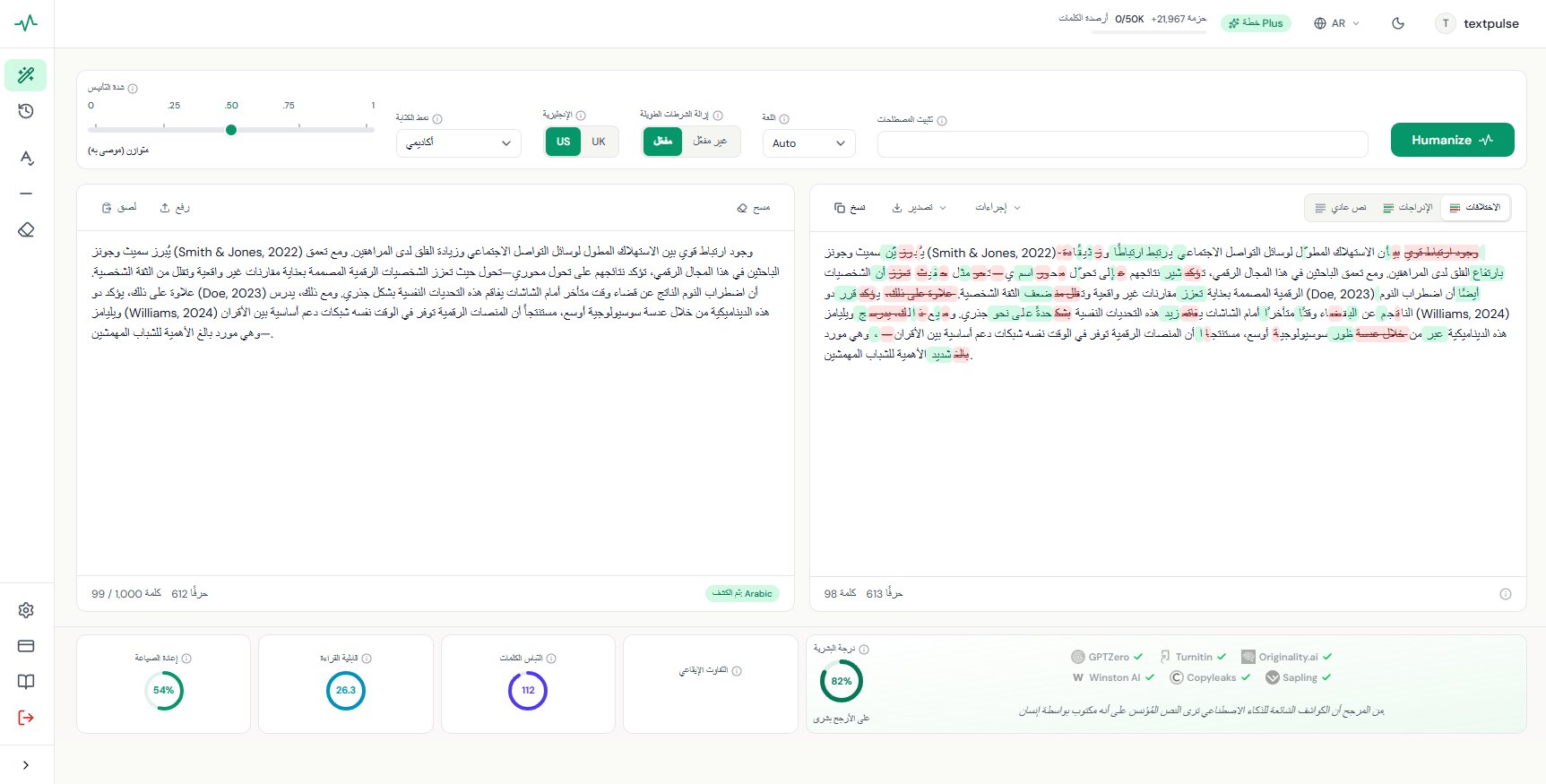
TextPulse runs in a multilingual mode that processes Arabic directly rather than translating it into English and back, which is what produces many of the calque patterns described earlier in the first place. Citations, numbers, transliterated names and technical terms are held in place while the surrounding sentence structure is rewritten, so a reference list or a bilingual glossary does not need to be rebuilt afterward. The output keeps Modern Standard Arabic register rather than drifting toward a simplified or informal register partway through a document.
The point is to remove the calque openers, the stacked hedges, and the uniform sentence rhythm that make a passage read as templated in the first place, regardless of which detector version eventually scores it. For a writer working in Arabic, that means a manuscript that sounds like their own academic voice, carries the same argument and the same citations, and does not need a second pass to fix formatting the humanizer disturbed.
Frequently Asked Questions
Yes, an arabic ai humanizer built for Modern Standard Arabic handles the register almost all Arabic academic writing uses, regardless of the writer's home dialect. It does not require or produce dialectal Arabic, since that would be inappropriate for a thesis or journal submission. The tool adjusts sentence rhythm and removes calque phrasing while keeping the formal register intact.
PhD in natural language processing, with years spent building NLP applications end to end. Moe works on text analysis: lexical and syntactic structure, and what separates machine-generated prose from human prose statistically. He has been experimenting with computational linguistics since the early days of NLTK, spaCy and WordNet, and still writes most of his tooling in Python.