Multilingual AI Humanizer: One Engine, 60+ Languages
TextPulse runs as a single engine across more than 60 languages, but detector adoption, register norms, and citation habits differ from country to country. This hub explains why language-specific humanization matters and links to in-depth guides for 15 languages, from Indonesian to Hindi.
TextPulse solves a problem that English-only tools cannot touch. We're now seeing academic writers writing in ChatGPT in dozens of languages. Each language has its own detector field, its own register preferences, and its own clues to writing that sounds like a machine wrote it. An English-only tool can't handle the informality creep in German or the calque expressions in French or the flattening of cadence that betrays Mandarin output. A multilingual AI humanizer handles it all. TextPulse runs one engine that understands all of it, so a researcher in Jakarta and a researcher in Seoul both get writing that reads as their own voice, not a translation of an English house style.
This post is the hub for TextPulse's language coverage. It explains why AI detection and AI-sounding prose differ from one language to the next, lists the 15 languages covered by dedicated guides, and describes how the free AI humanizer keeps citations, technical terms, and register intact regardless of which language a manuscript is written in. Each guide linked below goes further into detector adoption, university policy, and citation culture specific to that language.
Why humanizing AI text is language-specific
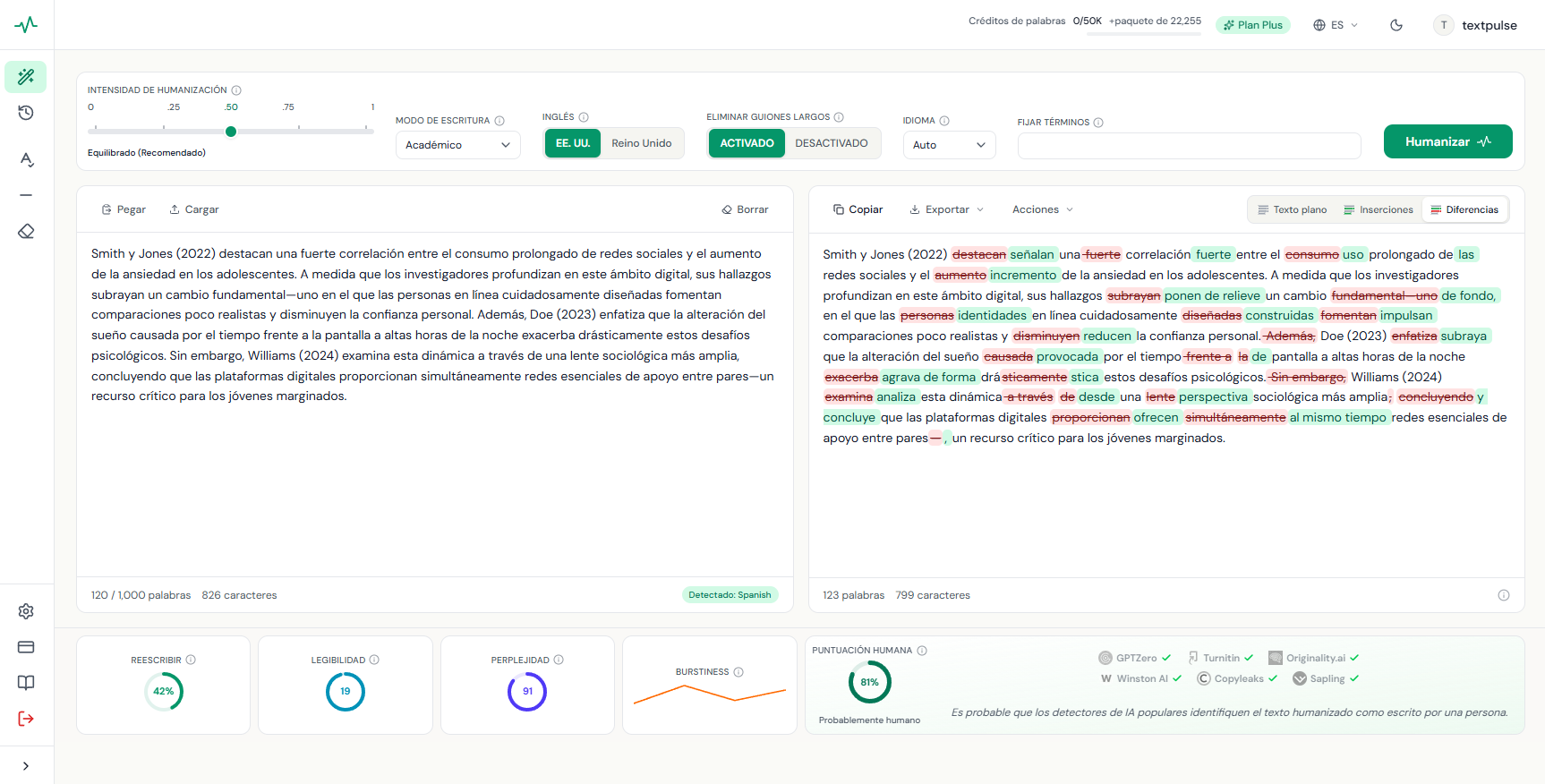
Detectors trained mostly on English behave differently once they read Spanish, Arabic, or Thai. Some plagiarism and AI-detection tools recalibrate thresholds per language, and university policy documents name different detectors depending on the country a program sits in. AI-sounding prose is language-specific too. English ChatGPT output leans on stock transitions and evenly paced sentences, but German output tends to drift into a register too formal for a seminar paper, while Japanese output can flatten register markers that keigo depends on. A humanizer trained only on English tells cannot recognize any of these patterns, because it was never built to look for them.
A common workaround is writing in English, humanizing that English, then translating into the target language. This fails in practice. Translation reintroduces the calques and stiff phrasing that make a paragraph read as machine-generated, and it can shift meaning in technical terms or citation formats along the way. Humanizing has to happen in the language a manuscript is actually written in, working on the sentence structures and register conventions native to that language, rather than on an English draft translated afterward. That is why TextPulse processes each supported language directly instead of routing everything through English first. When a manuscript genuinely does need to change languages, translate it first with an academic translator, then humanize in the target language.
15 in-depth guides, 60 plus supported languages by region
Each language below has its own guide covering detector adoption, university policy, and the tells that give away AI drafting in that language specifically. Our Indonesian guide looks at how Bahasa Indonesia detection is spreading across Southeast Asian universities, while the German walkthrough covers the Sie and du register drift that flags a paper as machine-written. The Spanish guide addresses usted versus tú shifts, the Russian guide covers how Antiplagiat reads AI-generated text, and the Korean guide explains honorific slips that give away ChatGPT drafting. The Japanese guide and the Thai guide round out the coverage for East and Southeast Asia, each built around native-language examples.
Europe
🇩🇪 German · 🇫🇷 French · 🇷🇺 Russian · 🇹🇷 Turkish · 🇮🇹 Italian · 🇵🇱 Polish · 🇺🇦 Ukrainian · 🇷🇴 Romanian · 🇬🇷 Greek · 🇨🇿 Czech · 🇭🇺 Hungarian · 🇳🇱 Dutch · 🇸🇪 Swedish · 🇩🇰 Danish · 🇳🇴 Norwegian · 🇫🇮 Finnish · 🇧🇬 Bulgarian · 🇸🇰 Slovak · 🇷🇸 Serbian · 🇭🇷 Croatian · 🇸🇮 Slovenian · 🇱🇹 Lithuanian · 🇱🇻 Latvian · 🇪🇪 Estonian · 🇦🇱 Albanian
Latin America and Iberia
🇪🇸 Spanish · 🇧🇷 Portuguese
East Asia
🇨🇳 Chinese · 🇯🇵 Japanese · 🇰🇷 Korean
Southeast Asia
🇮🇩 Indonesian · 🇻🇳 Vietnamese · 🇹🇭 Thai · 🇲🇾 Malay · 🇵🇭 Filipino · 🇲🇲 Burmese · 🇰🇭 Khmer · 🇱🇦 Lao
South Asia
🇮🇳 Hindi · 🇧🇩 Bengali · 🇵🇰 Urdu · 🇮🇳 Tamil · 🇮🇳 Telugu · 🇮🇳 Marathi · 🇮🇳 Punjabi · 🇳🇵 Nepali · 🇱🇰 Sinhala
Middle East and Central Asia
🇸🇦 Arabic · 🇮🇷 Persian · 🇮🇱 Hebrew · 🇦🇿 Azerbaijani · 🇰🇿 Kazakh · 🇺🇿 Uzbek · 🇦🇲 Armenian · 🇬🇪 Georgian · 🇦🇫 Pashto
Africa
🇰🇪 Swahili · 🇪🇹 Amharic · 🇳🇬 Hausa · 🇳🇬 Yoruba · 🇳🇬 Igbo · 🇿🇦 Zulu · 🇿🇦 Afrikaans · 🇸🇴 Somali
The remaining guides cover languages with their own detection landscape. The French guide explains the calque phrases that give away a translated-sounding paragraph, and the Arabic guide covers formal-register drift across Modern Standard Arabic academic writing. The Turkish guide and the Persian guide both address the agglutinative structures and formal-register tells that English-trained detectors tend to miss, while the Vietnamese guide and the Portuguese guide cover Brazilian and European academic conventions separately from Southeast Asian ones. The Chinese guide addresses Mandarin sentence rhythm, and the Hindi guide covers Hindi-English code-switching patterns common in Indian university writing.
Humanize your own paper
Transform your AI-assisted text and make it sound human, without touching important words or citations.
How a multilingual AI humanizer stays natural in every language
Register consistency comes first. A humanizer built for academic work has to know that Spanish theses read differently from Spanish blog posts, that German seminar papers keep a formal Sie address throughout, and that Japanese dissertations lean on a written register distinct from spoken keigo. TextPulse holds that register stable across an entire manuscript instead of letting it drift sentence to sentence, which is one of the clearest tells reviewers look for. Citations pass through exactly as written, whether that is APA, GB/T 7714, or a journal-specific style common in a given field, so rewriting never touches a reference list.
Technical terms, proper nouns, and numbers pass through unchanged, because a humanizer that rewrites a chemical name or a statistical value creates errors a supervisor catches immediately. The same rewriting logic runs underneath every supported language, tuned separately for each one's register and detector landscape, which is what makes a single multilingual AI humanizer practical instead of running fifteen separate tools. Coverage keeps expanding as new detectors and new academic norms appear, but the approach stays the same: work directly in the language a manuscript was actually written in.
Working between English and your own language
Many researchers draft in English for journals and in their first language for a thesis or a national outlet. The two workflows meet the same problem from different sides: an English manuscript drafted with AI carries the tells detectors search for in English, while a thesis chapter in Korean or Spanish carries that language's own set. Humanizing each text in the language it was written in, rather than translating and hoping, keeps the argument and the register intact.
The practical rule is simple. Humanize the version you will submit, in the language you will submit it in, and check the result against the detector your institution actually uses. The per-language guides linked above walk through what that detector landscape looks like in each academic culture, from Turnitin's reach in Europe and Southeast Asia to the local tools used in Russia, Korea and China.
Frequently Asked Questions
Yes. TextPulse runs as a multilingual AI humanizer across more than 60 languages, with 15 of them covered by dedicated research on detector adoption and university policy. The rewriting logic adapts to each language's register and citation conventions instead of applying English rules everywhere.
PhD in natural language processing, with years spent building NLP applications end to end. Moe works on text analysis: lexical and syntactic structure, and what separates machine-generated prose from human prose statistically. He has been experimenting with computational linguistics since the early days of NLTK, spaCy and WordNet, and still writes most of his tooling in Python.