Turkish AI Humanizer for Academic Writing
Turkish academic writing has its own AI tells, from stacked -maktadır verb endings to overused connectors like bu bağlamda. This post walks through what those tells look like, how Turkish universities check for AI use, and what published policies actually say.
If you are searching for a Turkish AI humanizer, you are probably a graduate student, a lecturer, or a researcher who drafted part of a paper with ChatGPT and now needs the Turkish to read like your own voice again. This post explains why AI-generated Turkish gets flagged by detectors more often than you might expect, what the actual tells look like in the language itself, and how universities across Turkey and Northern Cyprus are treating undisclosed AI use in coursework and theses right now.
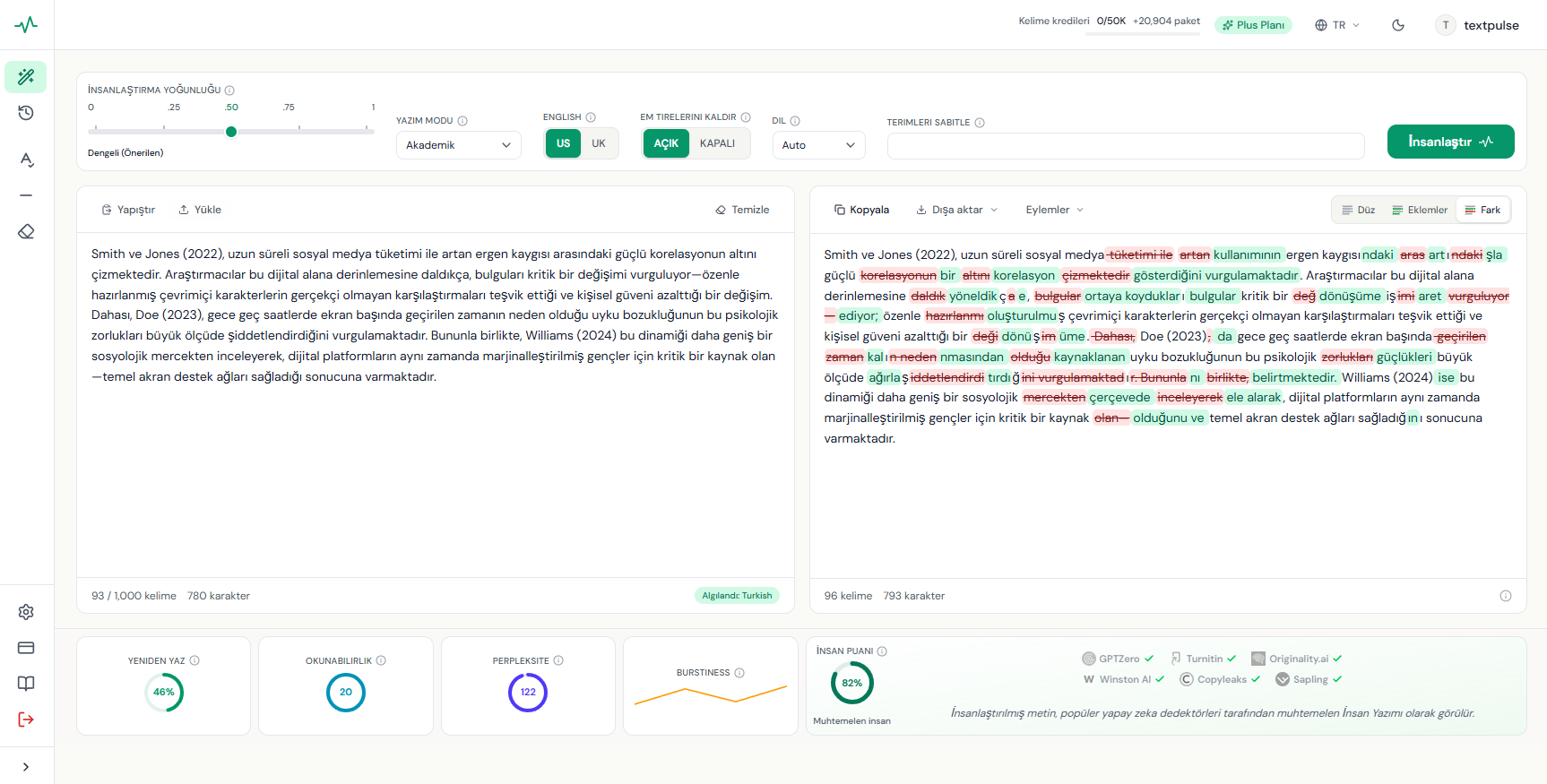
Turkish has its own signature AI tells, separate from the English ones most detection guides describe. There're formal connectors like 'bu bağlamda' or the stacked '-maktadır' verb ending, which show up constantly in AI-drafted Turkish. A native reader will spot these before the text is flagged by the tool because it reads as stiff and repetitive. The sections below cover what those tells look like, how detection tools are used in Turkish higher education, what published university policies actually say, and how a proper humanizing pass keeps citations, terminology, and register intact instead of just paraphrasing words at random.
Why AI text gets flagged in Turkish
AI-drafted Turkish leans hard on a handful of formal connectors that a native writer would space out or drop entirely. 'Bu bağlamda' opens sentence after sentence where a human writer would just start the next clause, and 'bu doğrultuda' does the same job as a plain 'bu yüzden' but sounds noticeably stiffer. Turnitin's AI writing indicator and similar detectors pick up on this kind of repetition because it is a strong statistical signal, not because the model understood the topic. These are the same kinds of words that give away ChatGPT in English text, just localized to Turkish morphology and connector choice.
The stacked '-maktadır' verb ending is another giveaway: 'göstermektedir', 'belirtmektedir', 'ifade etmektedir' lined up sentence after sentence instead of the varied tenses a Turkish academic writer normally reaches for. ChatGPT also tends to produce the calque opener 'İşbu çalışmada' where a native writer would simply say 'Bu çalışmada'; 'işbu' is a legal-register word that has almost no place in a research article. The redundant intensifier pairing 'hem... hem de' shows up in nearly every comparison the model draws, even when a single connector would carry the sentence perfectly well.
Beyond individual words, the rhythm gives AI-drafted Turkish away. Human academic writing varies sentence length, sometimes short and declarative, sometimes long and layered with subordinate clauses. AI output tends to settle into a narrow band of medium-length sentences, each closing on the same passive, formal note, which makes long stretches of text feel monotonous even when every individual sentence is grammatically correct. A detector does not need to understand the argument to notice that pattern; it just needs to measure how predictable the next word is, and stacked connectors plus uniform rhythm make Turkish AI text easy to predict.
What AI-sounding Turkish looks like
Read the first row in Turkish if you can, and the second row for an English gloss of what each version actually says. The table below reveals a short passage in both forms: the kind of Turkish ChatGPT produces by default, and a humanized rewrite that keeps the same claims.
| AI-sounding Turkish | After humanizing |
|---|---|
| Bu bağlamda, yapay zeka teknolojilerinin akademik yazın üzerindeki etkisi son yıllarda önemli bir rol oynamaktadır. Bu doğrultuda, araştırmacılar hem verimlilik hem de özgünlük açısından çeşitli zorluklarla karşılaşmaktadır. Sonuç olarak, bu çalışmada söz konusu zorlukların sistematik bir şekilde ele alınması amaçlanmaktadır. | Yapay zeka teknolojileri son yıllarda akademik yazını epey değiştirdi. Araştırmacılar bir yandan verimlilik kazanıyor, öte yandan özgünlük konusunda zorlanıyor. Bu çalışma, söz konusu zorlukları sistematik biçimde ele almayı amaçlıyor. |
| English gloss: AI technology has played an important role in academic writing in recent years, and researchers face challenges balancing efficiency and originality. | English gloss: the humanized version keeps the same claims but drops the stacked calque connectors and repetitive -maktadır endings for shorter, more naturally varied sentences. |
AI detection in Turkey and Northern Cyprus
Turnitin is the detector most Turkish universities already license for plagiarism checks, and its AI writing indicator now runs alongside that similarity score for most institutions using the platform. Graduate theses submitted through the national YÖK Thesis Center go through iThenticate as a matter of routine, so Turkish graduate students are already used to having their writing checked for originality before an AI-detection layer even enters the picture. GPTZero is used less often at the institutional level, though awareness of it is growing among individual instructors who run informal checks on their own.
Because plagiarism screening was already routine before generative AI became widespread, most Turkish institutions folded AI-detection scores into existing similarity-report workflows rather than building a separate process from scratch. That matters practically: a paper that trips the AI writing indicator gets flagged inside the same report an advisor already reviews for citation overlap, so there is no extra step where AI concerns quietly go unnoticed. Writers who know their draft leaned on ChatGPT for structure or phrasing have good reason to check how the finished Turkish reads before submission, not just whether the citations are correct.
Humanize your own paper
Transform your AI-assisted text and make it sound human, without touching important words or citations.
University policies
Published, verifiable AI-use policies are still uneven across Turkish higher education, and the table below reflects that unevenness rather than smoothing it over. Some institutions have issued explicit generative-AI frameworks; for others, no dedicated policy document could be verified, and oversight likely falls to individual departments or the university's general academic-integrity code instead. Treat every line as policy as published in the 2025-2026 academic year, since these frameworks are still being written and revised.
| University | Policy stance |
|---|---|
| Koç University | Published university-wide GenAI framework: coursework use allowed only with an instructor's explicit authorization per assignment; unauthorized use is an academic-integrity violation and permitted use requires citation. |
| Boğaziçi University | School of Foreign Languages (YADYOK) states AI-completed homework and assignments are not accepted for evaluation, under the university's broader academic-integrity principles. |
| Middle East Technical University (METU) | No specific public GenAI policy document verified; oversight likely sits with individual departments and instructors pending firmer central guidance. |
| Istanbul University | No dedicated GenAI policy verified; undisclosed AI use is presumed to fall under existing academic-honesty regulations. |
| Bilkent University | No specific published AI-use policy verified; plausibly folded into general honor-code provisions, but this is inferred, not confirmed. |
| Ankara University | No verifiable AI-specific policy found; enforcement of undisclosed AI use likely relies on existing plagiarism and academic-integrity rules. |
Journals and citation culture
Turkish-language academic publishing spans several distinct citation cultures rather than one dominant standard. Humanities and Islamic-studies journals often follow ISNAD, a citation style developed specifically for Turkish and Ottoman-studies scholarship, while social-science and education journals such as Hacettepe Üniversitesi Eğitim Fakültesi Dergisi and Ankara Üniversitesi SBF Dergisi lean toward APA. Medical publishers, including the multi-specialty Türkiye Klinikleri group, generally follow Vancouver-style numbered citation, and library-science outlets like Türk Kütüphaneciliği sit closer to Chicago or Turabian conventions depending on the individual editor's preference.
That range of citation styles is exactly why a rewrite tool that touches citations is a liability in Turkish academic work. A humanizing pass that rewrites sentence structure but leaves ISNAD footnotes, APA parenthetical references, or Vancouver numbering untouched saves a writer from having to redo the reference list by hand after every edit. Folklore and cultural-studies journals like Milli Folklor, along with the broader social-science press, expect that consistency as a baseline, not as an extra feature.
How TextPulse Works as a Turkish AI Humanizer
TextPulse runs the same multilingual AI humanizer engine across all fifteen supported languages, with a Turkish-specific pass tuned to the tells covered above: stacked '-maktadır' endings, overused connectors like 'bu bağlamda' and 'bu doğrultuda', and the flat, uniform sentence rhythm that detectors key on. Citations, university names, statistical figures, and technical terminology are preserved exactly as written, so a rewritten paragraph does not require a separate pass to fix broken references or altered numbers afterward.
Register stays consistent too: formal third-person passive constructions are kept formal, and a casual aside is not suddenly rewritten into stiff academic Turkish or the reverse. Researchers who move between Turkish and Persian-language scholarship face a related set of tells; the AI humanizer for Persian covers those patterns in detail, since Persian academic prose has its own calque phrases and register conventions that differ from Turkish even where the underlying detectors are the same.
Frequently Asked Questions
A properly built Turkish AI humanizer rewrites sentence structure and word choice, not the underlying claims or data in your paper. TextPulse preserves citations, numbers, and technical terms while varying the connectors and verb endings that make AI-drafted Turkish read as repetitive. If a rewrite changes what a sentence actually claims, that is a failure of the tool, not an acceptable trade-off.
Content strategist at TextPulse, here since the company started. Mark writes the product and technical coverage: how the humanizer works under the hood, what changes in each release, and what a specification actually means for your writing. His reviews of writing software come from using them on real documents rather than reading a feature list.