AI Humanizer for Chinese
Chinese academic writing has its own formal register and its own set of AI tells, and mainland detection tools now check for them directly during submission. This piece covers what gets flagged, how universities across China, Taiwan, Hong Kong and Singapore are responding, and where a humanizer needs to be careful with citations and terminology.
This is what happens when you search for a chinese ai humanizer. It starts with a CNKI similarity report, a supervisor's comment, or a journal's submission system flagging a passage as machine-generated. The formal tone of Chinese academic writing has always relied on set four-character phrases and heavy nominalization. But ChatGPT's version of this tone collapses into a tiny subset of recurring openers and transitions that graders and detectors can spot at a glance. More and more students and researchers writing 论文 in mainland China, Taiwan, Hong Kong, or Singapore are finding themselves needing to explain, or rewrite, sections a detector marked as AI-generated before a submission deadline.
This post covers why AI-generated Chinese gets flagged, what the tells actually look like on the page, and how detection and disclosure practices differ across mainland China, Taiwan, Hong Kong, and Singapore. It also covers where Chinese-language journals and citation norms fit in, since a humanizer that disturbs a GB/T 7714 reference number or renumbers a footnote creates more work than the original AI text did. For researchers who write in more than one language, a multilingual AI humanizer that applies the same register-aware process across each one is usually a better fit than switching tools, and the rest of this guide focuses specifically on what Chinese needs.
Why AI Text Gets Flagged in Chinese
Mainland Chinese academic writing keeps a formal, impersonal register built on 成语 set phrases and heavy nominalization, and it moves an argument forward through a fairly narrow set of transition markers. ChatGPT can reproduce isolated sentences in this register convincingly, but it flattens the variation a trained reader expects across a full paragraph. Human writers vary their transitions, their sentence length, and how they open a section; generated Chinese repeats the same handful of stock openers and connectors until the pattern becomes obvious to anyone who reads a large volume of student writing.
Several tells recur across generated Chinese text. Essays open with a formulaic context-setter such as '在...的背景下' before the actual claim arrives, and a hedge like '值得注意的是' precedes points that need no hedging at all. Arguments frequently collapse into a rigid '首先...其次...最后' enumeration even where a natural paragraph would vary its structure, and parallel padding built on '不仅...而且...' inflates a simple point into a longer one. Vague significance claims such as '具有重要意义' or '具有重要作用' appear where a concrete reason would serve the argument better, and the calque '扮演着...的角色' for 'plays a role' shows up in place of a plainer Chinese verb.
The rhythm problem sits underneath the vocabulary problem. Generated Chinese tends to close a section with the mechanical marker '总而言之', and sentence length stays unusually even from one paragraph to the next. That evenness is one of the words that give away ChatGPT across languages, not just in Chinese, and it is often what a detection model picks up on before a human reader consciously notices anything specific.
What AI-Sounding Chinese Looks Like
The pair below shows the same claim written two ways: first in the hedge-heavy pattern common to generated Chinese, then rewritten with the stock opener and the '扮演着...角色' calque removed. The English gloss underneath each version shows what changed for readers who do not read Chinese, since the underlying rhythm and transition density shift more than the surface vocabulary. Both versions make the same claim about urbanization and chronic disease rates, with the same 30 percent figure; only the phrasing and sentence structure differ.
| AI-sounding Chinese | After humanizing |
|---|---|
| 值得注意的是,快速城市化在中国大城市慢性病发病率上升的过程中扮演着至关重要的角色。根据多项研究显示,城市人口中约有30%存在与久坐不动相关的心血管风险因素。此外,城市规划的不足在很大程度上加剧了这一现象,因此有必要采取有效的公共政策加以应对。 | 中国大城市的慢性病越来越多,和快速城市化脱不开关系。研究显示,城市里大约30%的人有久坐引起的心血管风险因素。城市规划没跟上是重要原因之一:绿地少、通勤远、公共交通不够方便。要扭转这个趋势,得靠更实际的公共政策。 |
| Gloss (English): Rapid urbanization plays a crucial role in rising chronic disease rates in major Chinese cities, with about 30% of the urban population showing a cardiovascular risk factor linked to a sedentary lifestyle, worsened by inadequate urban planning. | Gloss (English): Same claim and the same 30% figure, but shorter, more direct sentences and a colon-led list of concrete reasons, dropping stock transitions like 值得注意的是 and 扮演着...角色. |
AI Detection in China, Taiwan, Hong Kong and Singapore
CNKI, the dominant Chinese academic database, runs its own AIGC detection service alongside its long-standing similarity check, and most Chinese-language journals now require a CNKI AI check before a manuscript even reaches peer review. 维普 and 万方, the other two major Chinese database platforms, run comparable AIGC checks of their own, and PaperYY is widely used by students ahead of formal submission to get an early read on their AIGC rate. Turnitin appears mainly in internationally co-published work or programs run jointly with overseas institutions, rather than as the primary check for a mainland Chinese thesis.
Chinese reporting in early 2025 described a broader wave of mainland universities tightening their rules around AI-assisted writing, and that pattern lines up with what CNKI's AIGC service is built to catch: rigid enumeration, mechanical concluding phrases, and the other tells covered above. Detection expectations outside the mainland follow a different path. Taiwan and Hong Kong universities generally rely on existing academic honesty codes rather than a standalone AI-writing policy, and Singapore's institutions publish disclosure-oriented guidance closer to what many Western universities use. A student moving between mainland and Hong Kong or Taiwan programs during the same degree can end up navigating two different detection regimes at once, and Singapore's diaspora of researchers who write across Chinese and other home languages face a related problem: the tells an AI humanizer for Hindi has to catch, register drift, calque phrases, and a formulaic hedge structure, line up closely with what shows up in generated Chinese.
The practical effect for writers is that a passage can pass a CNKI AIGC check and still read as generated to a human grader, or the reverse. The database checks and the human reading are not the same test, and a rewrite aimed only at lowering a reported AIGC percentage without changing the underlying rhythm and hedge patterns tends not to hold up under both.
Humanize your own paper
Transform your AI-assisted text and make it sound human, without touching important words or citations.
University Policies on AI-Generated Chinese
Policy language in this area moves quickly, so the summaries below describe policy as published for the 2025-2026 academic year.
| University | Country | Policy stance (as published 2025-2026) |
|---|---|---|
| Fudan University | China | Issued undergraduate thesis guidelines in late 2024 restricting AI from research design, structure and conclusions, though the academic affairs office described the rules as guidance rather than an outright ban. |
| Peking University | China | Reported to restrict AI use for core academic tasks with penalties that can include degree revocation. |
| Tsinghua University | China | Has engaged actively with AI in its own teaching and holds general academic integrity rules that would cover undisclosed AI-generated text, but a standalone public AI-writing policy was not confirmed here. |
| Renmin University of China | China | Named among the mainland universities discussed in early-2025 reporting on tightened AI usage rules for academic writing, though a specific published policy text was not confirmed. |
| National Taiwan University | Taiwan | Generative AI use appears to be governed by existing academic honesty codes rather than a dedicated AI policy. |
| The Chinese University of Hong Kong | Hong Kong | Has published general guidance encouraging disclosure of AI tool use in coursework. |
Journals and Citation Culture in Chinese Academic Writing
Chinese-language research circulates through journals such as 中国社会科学, the CASS flagship journal for the humanities and social sciences, and 北京大学学报(哲学社会科学版), Peking University's core humanities journal, alongside 中华医学杂志 for medicine and the CSSCI-indexed 图书情报工作 for library and information science. CNKI itself functions as the dominant academic database rather than a journal, and most Chinese journals route submissions through its similarity and AIGC check before a manuscript reaches an editor.
Most citations follow the format of GB/T 7714, the national standard, followed by either CSSCI in-text or footnote citations (mostly in humanities journals) or numbered references following the Vancouver style (some medical journals). A humanizer that rewrites sentence structure without protecting a GB/T 7714 reference number or a footnote marker is a real problem in this environment as a silent change to the citation may be mistaken for a formatting error at best and a more serious issue at worst during review.
How TextPulse Works as a Chinese AI Humanizer
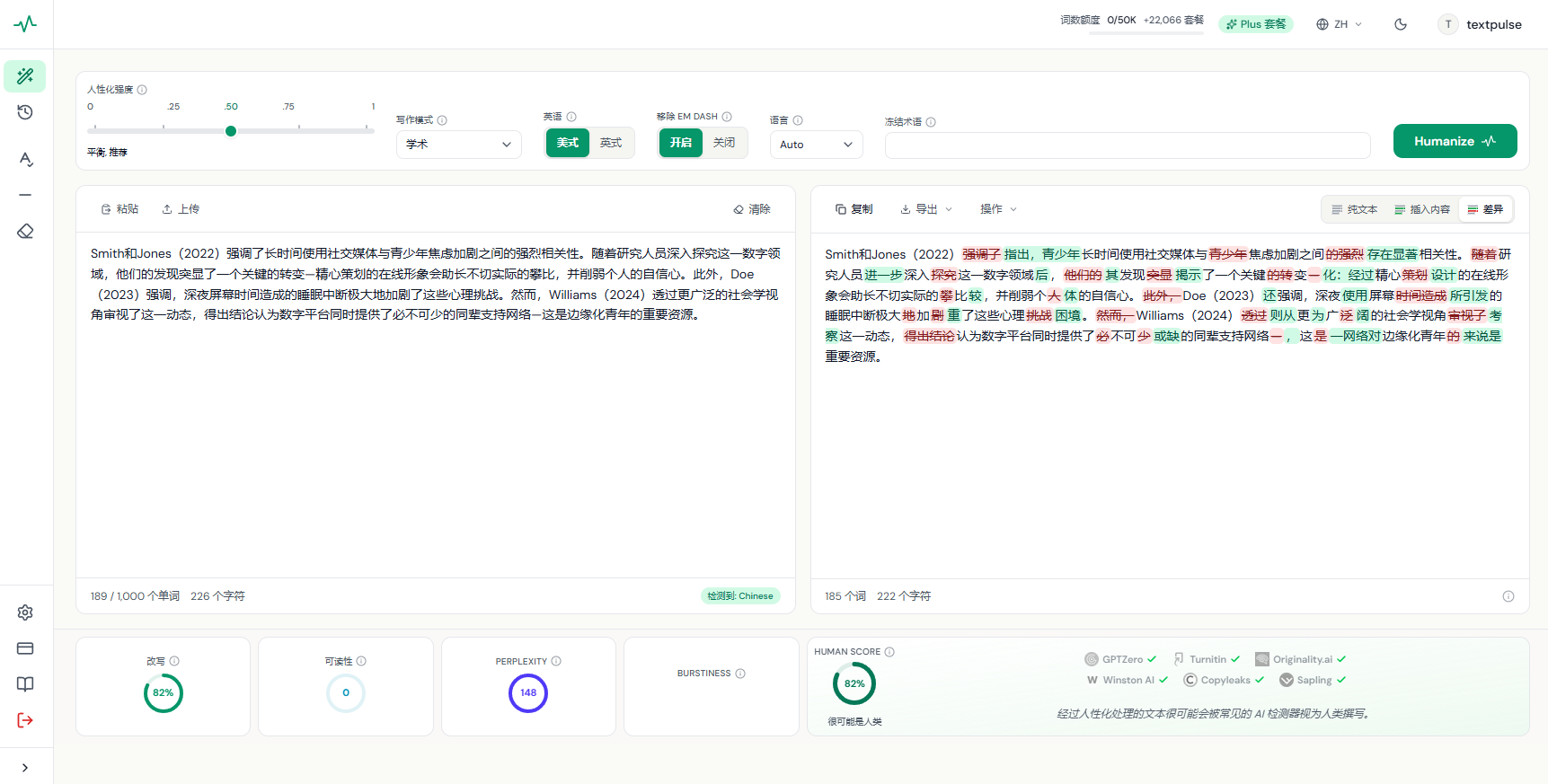
TextPulse's multilingual mode processes Chinese directly rather than translating it into English and back, which is what preserves the register choices, the transition patterns, and the discipline-specific terminology a mainland thesis, a Taiwanese dissertation, or a Hong Kong research paper depends on. Numbers, citations, and technical terms stay untouched during the rewrite, and GB/T 7714 reference numbers and footnote markers are protected rather than rewritten alongside the surrounding prose.
The output keeps the formal register expected in Chinese academic writing rather than drifting toward a casual tone, and it varies transition choice and sentence rhythm the way a human writer naturally would across a longer document. For a mainland thesis heading into a CNKI AIGC check, a Hong Kong paper written for a disclosure-based policy, or a Taiwanese dissertation using traditional characters, the tool applies the same underlying process without flattening the differences that already exist between those academic contexts.
Frequently Asked Questions
Most mainland Chinese journals and many universities now run submissions through CNKI's own AIGC detection service, and 维普 and 万方 offer comparable checks on the other major database platforms. Turnitin mainly appears in internationally co-published work. Taiwan and Hong Kong institutions generally rely on existing academic honesty codes rather than a dedicated AI-writing policy, so checking your own program's current guidance is the safest step.
Content planner and copywriter at TextPulse. Sara runs the blog day to day, from planning and drafting through to publishing. She writes the practical guides: clear explanations of academic writing problems, aimed at the person who actually has to hand something in.