AI humanizer for Hindi
Most Hindi academic writing in India is actually produced in English, but Hindi-medium scholarship still faces its own AI-detection risks. This guide breaks down the calques and stiff openers that give away ChatGPT-drafted Hindi, what Indian and Nepali universities currently say about generative AI, and how a humanizer needs to preserve citations, terms, and register.
A hindi ai humanizer rewrites AI-drafted text, in Hindi or in English, so that university plagiarism cells and AI detectors stop flagging it as machine output. That need is growing across Indian and Nepali campuses, where students and early-career researchers increasingly draft essays, lab reports, and thesis chapters with ChatGPT before editing them by hand. Detectors built mainly for English are catching up on Hindi as well, and institutions running Turnitin through UGC and INFLIBNET subscriptions are starting to treat AI-generated submissions the way they already treat plagiarism. This post covers what actually gets flagged in Hindi academic writing, and what a humanizer needs to keep intact.
Most Indian academic writing, even at universities known for strong Hindi departments, is produced in English. Genuinely Hindi-medium scholarship is concentrated in humanities and social science departments at Hindi-belt universities such as Banaras Hindu University, Allahabad, and Delhi University's Hindi faculties, rather than being the national default. If you are writing your thesis chapter, seminar paper, or literary criticism assignment in Hindi itself, this guide walks through what gives away AI drafting in Hindi prose. If most of your coursework is still in English, our guide to writing in English as a second language covers the equivalent patterns for that side of your work.
Why AI text gets flagged in Hindi
ChatGPT's Hindi output tends toward a stiff, over-formal register even when the assignment calls for something closer to spoken academic Hindi. The clearest tell is heavy reliance on Sanskritized tatsama vocabulary, reaching for a word like 'sargarbhit' where a plainer, mixed-register phrase such as 'bahut upyogi' would read naturally to a Hindi-medium reader. That register mismatch is often the first thing a human reader notices, well before a detector flags anything.
The other tell is structural repetition. AI-generated Hindi leans on a small set of calque openers and connectors: the hedge 'yah dhyaan dene yogya hai ki' (it is worth noting that), the temporal filler 'vartaman paridrishya mein' (in the current scenario), and the conclusion marker 'nishkarshatah' showing up in nearly every essay-length answer. The connector 'iske atirikt' gets used as a default 'additionally' instead of varying transitions, and claims get routed through the passive construction 'dekha ja sakta hai' instead of a direct statement. This is not a Hindi-only pattern: Indonesian academic writing shows a similar reliance on calque phrases and formal register drift.
What AI-sounding Hindi looks like
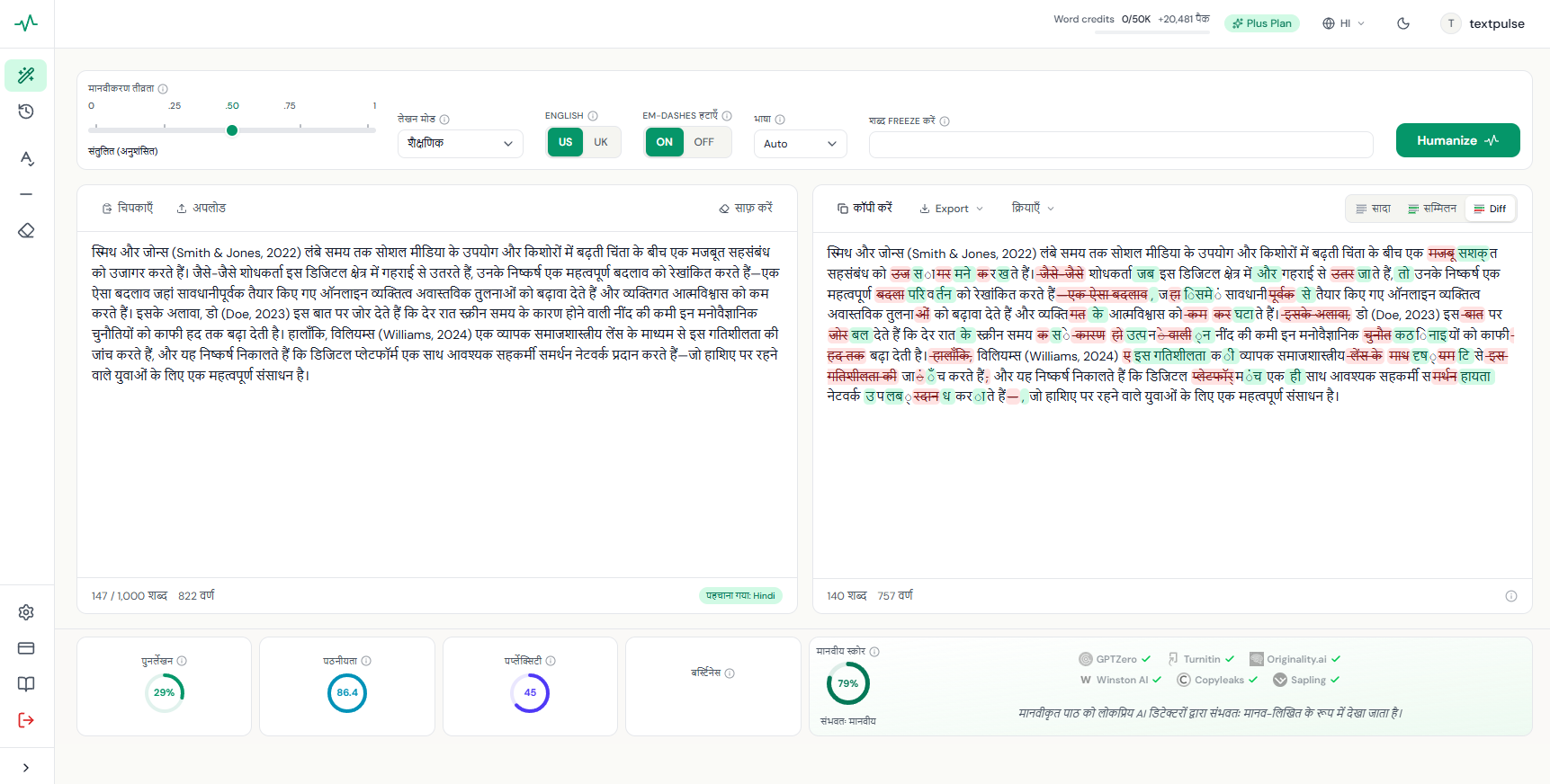
The table below shows the same claim about urban health in India written two ways: first with the calques and passive hedges described above, then rewritten with shorter sentences, a direct claim, and a colon-led list in place of a stacked qualifier. An English gloss beside each version shows what changes and what stays fixed, including the statistic.
| AI-sounding Hindi | After humanizing |
|---|---|
| यह ध्यान देने योग्य है कि तीव्र शहरीकरण भारत के बड़े शहरों में पुरानी बीमारियों के बढ़ते मामलों में एक महत्वपूर्ण भूमिका निभाता है। विभिन्न अध्ययनों के अनुसार, शहरी आबादी का लगभग 30% हिस्सा गतिहीन जीवनशैली से जुड़े हृदय संबंधी जोखिम कारक से ग्रस्त है। इसके अतिरिक्त, अपर्याप्त शहरी नियोजन इस स्थिति को और गंभीर बनाता है, जिससे प्रभावी सार्वजनिक नीतियों को लागू करना आवश्यक हो जाता है। | भारत के बड़े शहरों में पुरानी बीमारियां तेज़ी से बढ़ रही हैं, और इसकी एक बड़ी वजह है तेज़ शहरीकरण। अध्ययनों के मुताबिक शहरी आबादी का करीब 30% हिस्सा ऐसी जीवनशैली जीता है जिसमें शारीरिक गतिविधि कम है और दिल से जुड़े खतरे ज़्यादा। शहरी नियोजन की कमी भी इसमें बड़ी भूमिका निभाती है: हरियाली कम, आना-जाना मुश्किल, सार्वजनिक परिवहन सीमित। बेहतर नीतियों के बिना यह तस्वीर नहीं बदलेगी। |
| English gloss: rapid urbanization plays an important role in the rising burden of chronic disease in major Indian cities, with about 30% of the urban population showing a cardiovascular risk factor linked to a sedentary lifestyle, worsened by inadequate urban planning. | English gloss: same claim and the same 30% figure, broken into shorter, more conversational sentences with a colon-led list of concrete causes, dropping the stiff formal opener and the repeated 'important role' phrase. |
AI detection in India and Nepal
Turnitin is the detector students encounter most often, reaching Indian campuses largely through UGC and INFLIBNET-linked institutional subscriptions and through Shodhganga, the national repository for theses and dissertations. Ouriginal, formerly known as Urkund, is also in use at some institutions. Both tools were built primarily to catch text similarity and are increasingly bundled with AI-writing detection features, though neither publishes detailed accuracy figures for Hindi specifically.
GPTZero is English-tuned, and is reportedly weaker at flagging Hindi-language text than English text, which does not mean Hindi submissions escape scrutiny. Institutional plagiarism cells operating under UGC's 2018 regulations were built to catch copied text and are now being extended to flag AI-generated content as well, so a Hindi assignment that reads as obviously machine-drafted can still draw attention even where the automated tooling behind it is imperfect.
Humanize your own paper
Transform your AI-assisted text and make it sound human, without touching important words or citations.
University policies on AI-assisted writing
Public, university-specific policy on generative AI in Hindi-medium coursework is thin. Most of the institutions below operate under UGC's national anti-plagiarism circular rather than a Hindi-specific AI policy, and where a university has published more, the table notes it. Policy is described here as published across 2025 and 2026 and can change without notice.
| University | Country | Policy stance |
|---|---|---|
| Banaras Hindu University | India | Hindi literature and humanities departments work substantially in Hindi; UGC's national circular applies campus-wide. |
| University of Delhi | India | Colleges have been reported as actively grappling with unethical AI use, though enforcement is described as inconsistent because faculty must screen large volumes of undergraduate work manually. |
| Jawaharlal Nehru University | India | Appears to fall under the same UGC-wide anti-plagiarism framework as other central universities; no JNU-specific public generative AI policy was verified. |
| IIT Delhi | India | Published an initial set of generative AI usage recommendations, described by its director as a first tranche, placing responsibility on students and researchers to verify AI-assisted content. |
| Jamia Millia Islamia | India | Hindi and Urdu-medium humanities programmes operate under the general UGC anti-plagiarism circular; a dedicated generative AI policy was not confirmed. |
| University of Allahabad | India | Long-standing Hindi literature tradition, bound by the national anti-plagiarism circular like other UGC-affiliated universities; a university-specific AI policy statement was not verified. |
Journals and citation culture in Hindi academia
Academic and literary journals published in Hindi focus on a few well-established periodicals. These include Alochana, published by Rajkamal Prakashan, which carries literary criticism and long-form essays; Hans, published by the imprint associated with Premchand, which traces its history back to him; Bhasha, published by the Central Hindi Directorate, focusing on Hindi language studies; and Naya Gyanodaya, covering literary criticism and cultural commentary in the same vein. Scholars interested in having their work in Hindi read globally can also be found in the English-medium Indian Journal of Hindi Studies.
Citation practice in Hindi-medium humanities has no single dominant national standard. Footnote and endnote referencing is the older tradition, and many departments now model their citation practice on English-medium humanities norms and use MLA style instead. APA is increasingly common in Hindi-medium social science departments. Whichever style a department uses, a humanizer that rewrites sentence structure without touching citation markers, footnote numbers, or bibliographic entries matters as much in Hindi departments as anywhere else.
How a Hindi AI humanizer keeps citations and terms intact
TextPulse runs in a multilingual mode that works on Hindi text directly, rather than routing it through English first. That distinction matters for register: rewriting Hindi through an English pass tends to flatten the tatsama-heavy formal register literary criticism needs, or leave social-science prose sounding stiffer than it should. Multilingual mode lets the output keep whichever register the source draft was written in, instead of defaulting to one flat academic voice.
Citations, technical terms, proper nouns, and numbers are preserved exactly as written, so a footnote marker, an APA in-text citation, or a statistic like the 30% urban sedentary-lifestyle figure above comes out of the humanizer unchanged. The tool also varies sentence rhythm and drops the repeated calque openers and passive constructions covered earlier, which is the part that actually needs to change for the writing to stop reading like a direct AI draft.
Frequently Asked Questions
Yes. Code-mixing between Hindi and English is common in Indian academic writing, especially in social science departments, and a hindi ai humanizer built for multilingual text can process mixed-register drafts without forcing everything into one language. TextPulse's multilingual mode keeps terms, citations, and numbers untouched regardless of which language surrounds them.
PhD in natural language processing, with years spent building NLP applications end to end. Moe works on text analysis: lexical and syntactic structure, and what separates machine-generated prose from human prose statistically. He has been experimenting with computational linguistics since the early days of NLTK, spaCy and WordNet, and still writes most of his tooling in Python.