AI Humanizer for French
French academic writing has a distinct formal register, and ChatGPT's version of it is easy to spot once you know the tells. This piece walks through what gets flagged, how universities across the francophone world are responding, and where a humanizer needs to tread carefully around citations and footnotes.
Searching for a french ai humanizer usually means one thing: a professor, a supervisor, or a detection tool has flagged something that reads too smoothly, too generically, or oddly stiff for the writer's usual voice. French academic prose has always leaned formal, but ChatGPT and similar tools push that formality into a narrower, repetitive pattern that trained readers now recognize almost instantly. Students and researchers writing dissertations, mémoires, or journal articles in French increasingly find themselves needing to explain, or rewrite, passages that a detector marked as machine-generated.
This post looks at why AI-generated French gets flagged, what the tells actually look like on the page, and how detection and disclosure rules differ across France, Québec, Belgium, Switzerland, and francophone Africa. It also covers where French-language journals and citation norms fit into the picture, since a humanizer that strips out italicized terms or renumbers footnotes creates more work than the AI text did in the first place. For writers working across more than one language, a multilingual AI humanizer that applies the same register-aware process to each one is usually a better fit than juggling separate tools, and the rest of this guide focuses specifically on what French needs.
Why AI Text Gets Flagged in French
French academic writing keeps a formal, impersonal register: writers favor 'on' or passive constructions over the first-person 'je', and arguments move forward through explicit connectors like 'cependant', 'néanmoins', and 'par conséquent'. ChatGPT can reproduce this register in isolated sentences, but it tends to flatten the variation that trained readers expect. Human writers alternate connector choice and sentence rhythm across a paragraph; generated French repeats the same small set of transitions and hedges until the pattern becomes obvious to anyone who reads a lot of student work.
Several tells recur across generated French. Essays often open with a calque of 'nowadays, with the rapid evolution of', as in 'De nos jours, avec l'évolution rapide des technologies'. Claims get wrapped in a formulaic hedge such as 'il convient de souligner que' before the actual point arrives, and paragraphs lean on 'en effet' as a mechanical filler connector rather than a genuine logical link. Even short essays fall into a rigid 'premièrement... deuxièmement... troisièmement' tricolon, and nominalizations like 'la mise en place de' replace a plainer verb a human writer would reach for instead.
The rhythm problem compounds the vocabulary problem. Generated French tends toward sentences of nearly identical length from one paragraph to the next, closing arguments with a formulaic summary marker like 'en somme,'. That evenness is one of the words that give away ChatGPT across many languages, including French, and it is often what a detector's internal model picks up on before a human reader consciously notices anything odd.
What AI-Sounding French Looks Like
The pair below gives the same claim, written twice-once in the style of the generated French, and once in a style that has been cleaned up by removing the throat-clearing opener and stock connectors. Although the surface words are different, it's the rhythm and the use of connectors that really change. Below are both versions of the claim, along with an English gloss under each one. This allows readers who don't read French to see how the language changes from one version to the other. Both versions make an identical claim about AI's growing role in higher education; only the phrasing and paragraph structure differ.
| AI-sounding French | After humanizing |
|---|---|
| De nos jours, avec l'évolution rapide des technologies numériques, il convient de souligner que l'intelligence artificielle occupe une place de plus en plus importante dans l'enseignement supérieur. En effet, de nombreuses études ont mis en évidence son impact sur les pratiques pédagogiques. En somme, il est essentiel d'examiner cette question de manière approfondie. | L'intelligence artificielle s'impose de plus en plus dans l'enseignement supérieur. Plusieurs études ont déjà montré son effet sur les pratiques pédagogiques, mais la question mérite d'être creusée davantage. |
| Gloss (English): Nowadays, with the rapid evolution of digital technologies, AI is increasingly important in higher education; many studies have shown its impact on teaching practices, so it is essential to examine this question thoroughly. | Gloss (English): Same claim, but the throat-clearing opener and stock connectors are cut, and the argument lands in two direct sentences instead of three formulaic ones. |
AI Detection in France and the Francophone World
Turnitin is the detector most French and Canadian universities already use for plagiarism checks, and many have activated or piloted its AI-writing indicator alongside standard originality reports. France-based institutions also work with Compilatio, a detector built for the French market that markets itself specifically on catching machine-generated submissions in French and other Romance languages. GPTZero and Copyleaks appear in some Canadian and Belgian workflows as a secondary check, particularly for graduate-level dissertations and mémoires where a single flagged section can trigger a full committee review.
Detection practice varies more across the Maghreb and West African francophone countries in the list above. Morocco, Algeria, Tunisia, Senegal, and Côte d'Ivoire have less publicly documented detector adoption at the institutional level, and enforcement often depends on individual faculty rather than a university-wide system. Researchers in these countries frequently move between French and Arabic in the same academic career, and the underlying detection patterns line up closely with what an AI humanizer for Arabic has to handle: register shifts, calque phrases, and a rhythm that AI writing tools flatten in similar ways across both languages.
Humanize your own paper
Transform your AI-assisted text and make it sound human, without touching important words or citations.
University Policies on AI-Generated French
| University | Country | Policy stance (as published 2025-2026) |
|---|---|---|
| Sciences Po Paris | France | Adopted a formal AI doctrine in 2025 that neither bans nor ignores generative AI but regulates its use and requires systematic disclosure of AI-assisted content, per the school's own published statement. |
| Sorbonne Université | France | Appears to follow the broader French Ministry of Higher Education framework, which encourages disclosure of AI assistance rather than an outright ban. |
| Université de Montréal | Canada | Has issued guidelines for directed works, master's theses, and doctoral dissertations stating that undisclosed AI-generated content can violate its responsible conduct and scientific integrity policy, per the university's integrity office. |
| Université Laval | Canada | Academic integrity guidance, in line with other Quebec institutions, generally expects students to disclose generative AI use in assessed work. |
| Université libre de Bruxelles | Belgium | Has published general guidance urging transparency around generative AI use in coursework. |
| Université Mohammed V de Rabat | Morocco | Public information on the university's specific generative AI policy is limited; broader Moroccan higher-education guidance treats undisclosed AI-generated submissions as a plagiarism-adjacent offense, not verified at the institutional level here. |
These policies are described as published for the 2025-2026 academic year and may change without a corresponding public announcement. Several of the statements above rely on general institutional or ministry-level guidance rather than a faculty-specific published policy, and that distinction is noted here rather than smoothed over.
Journals and Citation Culture in French Academic Writing
Research in French is published in journals such as Revue française de sociologie (CNRS and Presses de Sciences Po), L'Année sociologique (PUF), Cahiers de recherche sociologique (Université du Québec à Montréal) or Recherches en didactiques (specializing in pedagogy). Note that citation standards differ between fields. The social sciences and education largely use an adapted version of APA 7th edition, humanities and history lean on the Chicago notes-and-bibliography style, medicine follows Vancouver, and law faculties keep a French legal citation style built on footnotes and 'ibid.'.
A humanizer that rewrites sentence structure without protecting citation markers creates real problems in this environment, since a misplaced footnote number or a silently altered 'ibid.' reference can look like academic misconduct rather than a formatting slip. Journal-specific style also means a rewritten passage needs to keep its discipline's citation convention intact, whether that is an APA parenthetical, a Chicago footnote, or the legal-style footnote chain common in French law faculties. Losing that consistency mid-article is a bigger problem than the original AI-flagged wording.
How TextPulse Works as a French AI Humanizer
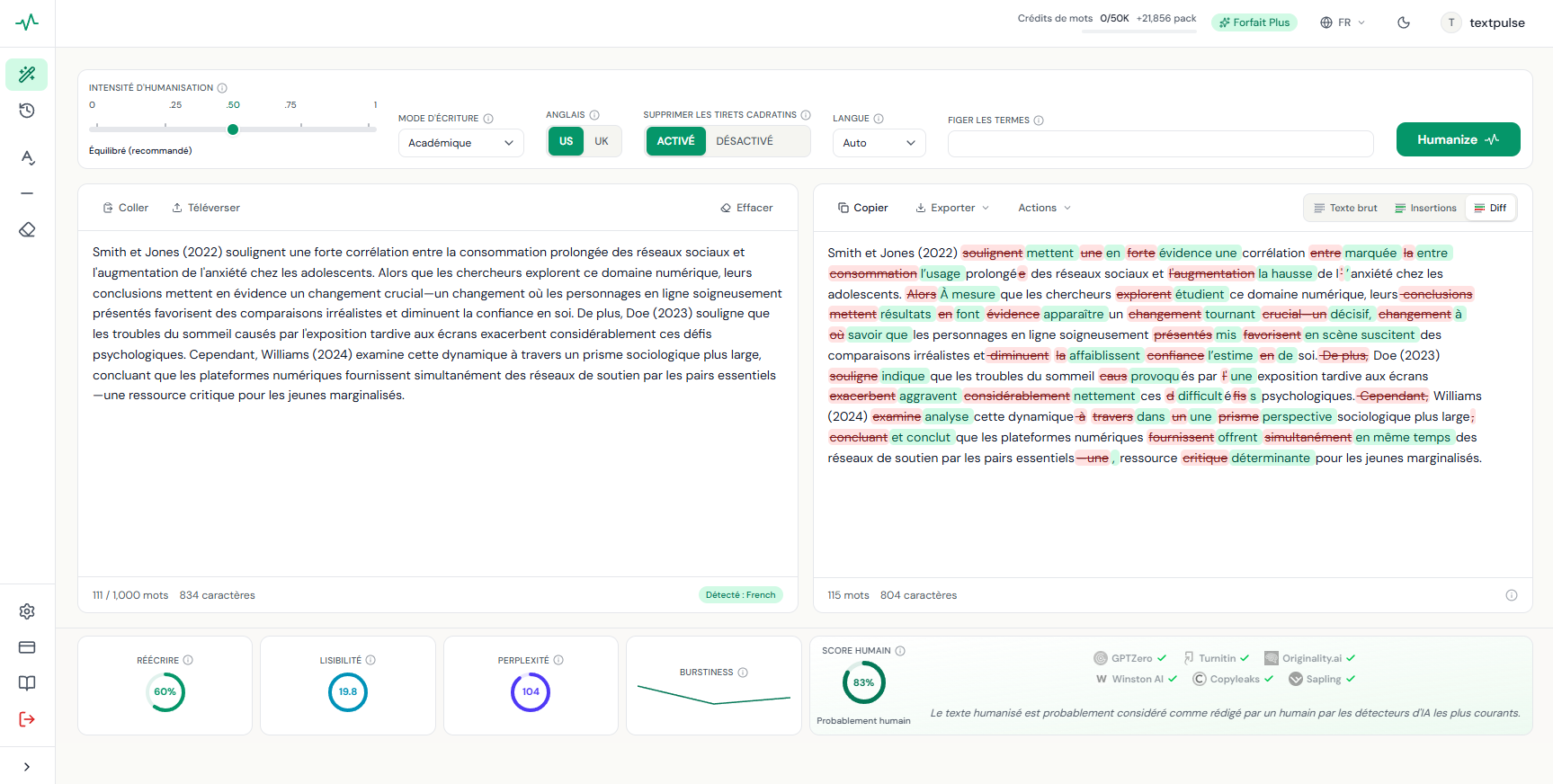
TextPulse's multilingual mode processes French directly rather than translating it into English and back, which is what preserves the register choices, the connector patterns, and the discipline-specific vocabulary a French dissertation or mémoire depends on. Numbers, citations, and technical terms stay untouched during the rewrite, and footnote markers, 'ibid.' references, and APA-style parentheticals are protected rather than rewritten alongside the surrounding prose.
The output keeps the formal, impersonal register expected in French academic writing rather than drifting toward a casual tone, and it varies connector choice and sentence rhythm the way a human writer naturally would across a longer document. For a Québécois mémoire or a Moroccan thesis written partly in French, the tool applies the same underlying process without flattening the register differences that already exist between those academic contexts.
Frequently Asked Questions
Most major French and Canadian universities already run submissions through Turnitin, and many have turned on its AI-writing indicator alongside the standard originality report. Some French institutions also use Compilatio, a detector built specifically for the French-language market. Policies on what happens after a flag vary by university and are not always published in detail, so checking your own institution's current guidance is the safest step.
Content planner and copywriter at TextPulse. Sara runs the blog day to day, from planning and drafting through to publishing. She writes the practical guides: clear explanations of academic writing problems, aimed at the person who actually has to hand something in.