AI Humanizer for German
AI drafting is now routine in Hausarbeiten and dissertation chapters across Germany, Austria, and Switzerland, and detectors have gotten better at reading the specific calques and stacked hedges German-language models produce. This post covers what those tells look like, how seriously universities in the region treat disclosure, and how TextPulse rewrites German academic prose without disturbing footnotes or citation style.
Academic writers across Germany, Austria, and Switzerland increasingly draft with ChatGPT, then need a German AI humanizer to get that text past detectors like Turnitin and GPTZero without breaking their argument, their footnotes, or their tone. This is not a trick to fool a system. Universities in the German-speaking world are treating undisclosed AI drafting as an academic-integrity question, and detection tools built mostly on English training data have started reading German with more precision than most students expect. Knowing what actually gets flagged, and how a proper humanizer differs from a translation tool or a synonym swap, matters more than it did even a year ago.
This post walks through why AI-generated German gets flagged, what that flagged prose actually looks like next to a rewritten version, how seriously universities in Germany, Austria, and Switzerland take AI disclosure, and where TextPulse fits into a German-language thesis or Hausarbeit without disturbing citations, technical terms, or the register a supervisor expects. The tells are language-specific: the calque phrases and stacked hedges that flag German are not the ones that show up in AI-written Spanish or Russian, even though the underlying model behavior driving them is the same.
Why AI Text Gets Flagged in German
The formalism of German academic writing is the result of tradition. The use of long subordinate clauses, high levels of nominalization, and impersonal expressions in the passive voice or using the pronoun 'man' are things you teach your students to do, not something they discover by accident. ChatGPT gets close to this kind of style but goes too far with all those hedges and transitions, which sound tacked on instead of integral. In a properly trained writer, caution would be built into sentence structures. A detector or a supervisor will notice if a piece of writing just piles short cautious phrases on top of a blunt statement. It's a classic sign of an untrained writer. Where a trained writer builds caution into sentence architecture, generated text stacks short formulaic qualifiers on top of an otherwise plain claim, and that stacking pattern is one of the clearest signals a detector or a supervisor picks up on.
The individual tells are specific. Openers like 'In der heutigen digitalen Zeit' announce an essay rather than starting one. Calques of English stock phrases, most obviously 'eine entscheidende Rolle spielen' for 'plays a crucial role', sit oddly next to native German phrasing. Formulaic closers such as 'Zusammenfassend lässt sich sagen, dass' and connectors like 'Darüber hinaus' repeated at the start of consecutive paragraphs are the same habit that gives away ChatGPT in English writing, just carried over into German rather than eliminated. A reader fluent in both languages tends to notice the pattern before noticing any single sentence.
Sentence rhythm carries a similar signal. German prose written by an experienced academic writer varies noticeably: a short declarative claim, then a long sentence carrying two or three subordinate clauses, then a return to something plainer. Generated German tends to sit at a more uniform length and structure across paragraphs, with each section restating its own heading before making a point. None of these tells make a passage unreadable. They make it recognizable, which is a different and more damaging problem for a thesis chapter that is supposed to sound like it came from one person.
What AI-Sounding German Looks Like
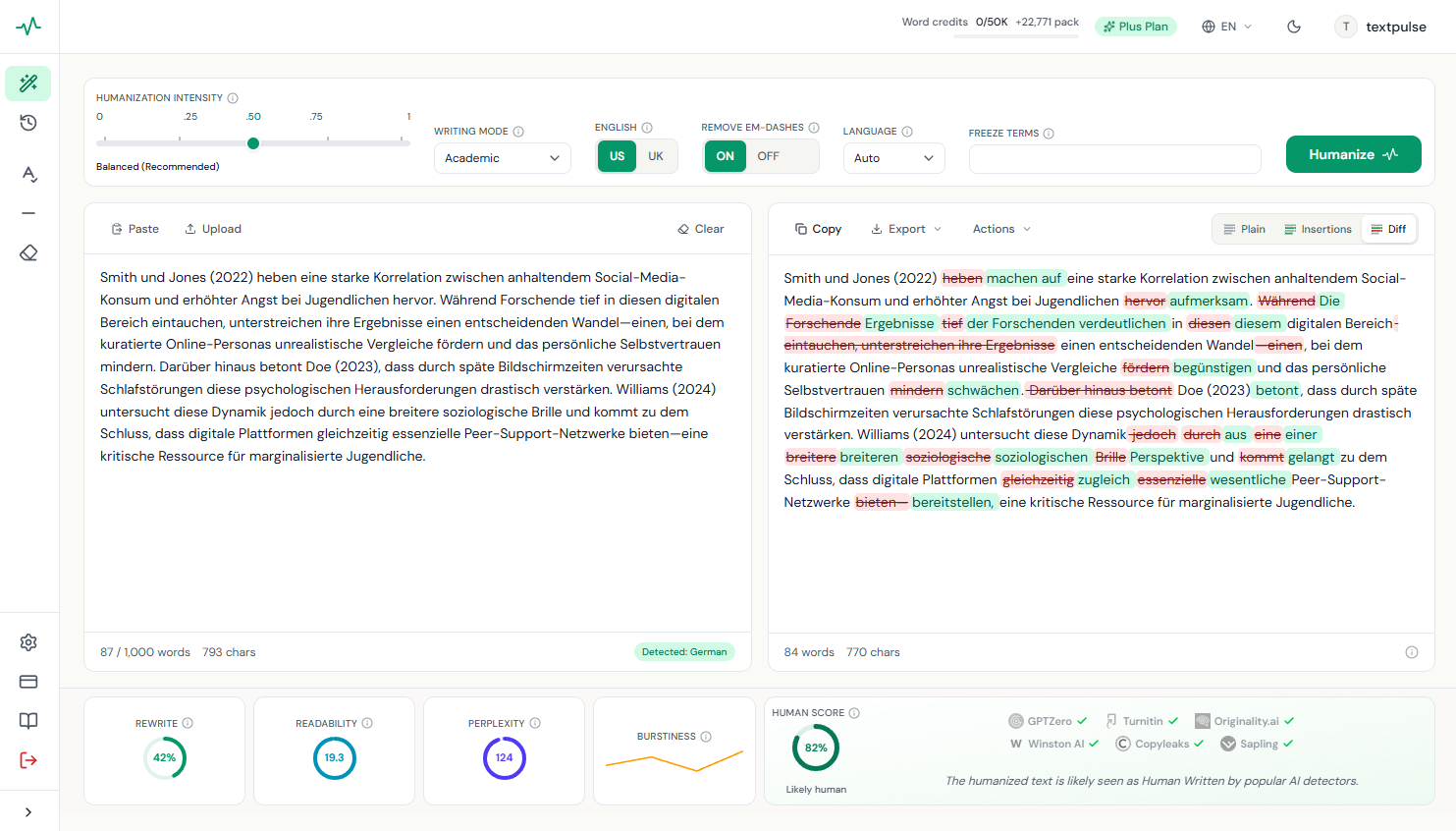
The pattern is easier to see side by side than to describe. The passage below is a short excerpt written in the AI-sounding style just described, paired with a version rewritten to remove the stacked hedges, the calque phrases, and the flat opener while keeping the same underlying claim about students and social media.
| AI-sounding German | After humanizing |
|---|---|
| In der heutigen digitalen Zeit spielt die Nutzung sozialer Medien eine entscheidende Rolle für die Meinungsbildung unter Studierenden. Es lässt sich nicht leugnen, dass digitale Plattformen die Art und Weise, wie junge Menschen Informationen aufnehmen, grundlegend verändert haben. Darüber hinaus ist es wichtig zu betonen, dass sich dieses Phänomen auch auf die akademische Kommunikation auswirkt. | Soziale Medien prägen inzwischen spürbar, wie Studierende sich eine Meinung bilden, vor allem weil digitale Plattformen verändert haben, wie junge Menschen an Informationen kommen. Diese Verschiebung macht sich zunehmend auch in der akademischen Kommunikation bemerkbar, wenn auch nicht bei allen Studierenden gleichermaßen. |
| English gloss: Social media plays a decisive role in shaping student opinion in today's digital age, and this undeniably extends to academic communication as well. | English gloss: Same claim, made more concrete and specific, with the stacked hedges and generic transitions removed and a note that the effect is not uniform across students. |
AI Detection in Germany, Austria, and Switzerland
Turnitin's AI-writing indicator is in wide use across German, Austrian, and Swiss universities, usually as one signal available to instructors alongside a similarity report rather than as an automatic verdict. GPTZero shows up independently in some departments, and PlagAware, a plagiarism checker developed in the German-speaking market, is used by institutions that want a tool built around German-language text specifically rather than one adapted from English. Originality.ai appears less often in official university workflows but is used informally by some supervisors checking a chapter before it reaches a formal review.
How these tools get used varies more than the tools themselves. Some departments run every submission through a detector as standard practice; others reserve it for cases where a supervisor already suspects something. What stays consistent across Germany, Austria, and Switzerland is the expectation of disclosure: guidance documents at multiple universities ask students to name which AI tools they used and for what, rather than banning AI assistance outright. A detector flag on undisclosed AI text becomes an integrity question, not a formatting note, which is the actual stake for anyone drafting with ChatGPT and skipping the disclosure step.
Humanize your own paper
Transform your AI-assisted text and make it sound human, without touching important words or citations.
University Policies on AI-Assisted Writing
The six policies below are drawn from published university guidance and reported cases as of the 2025-2026 academic year. Wording and enforcement vary by faculty and even by individual supervisor within one university, so treat this table as a starting point for checking your own department's current rules rather than as a substitute for reading them yourself.
| University | Country | Policy |
|---|---|---|
| Ludwig Maximilian University of Munich (LMU) | Germany | Published guidance for dissertations requires students to disclose when, where, and to what extent generative AI tools were used, typically via a declaration in the thesis affidavit. |
| Heidelberg University | Germany | Guidance for doctoral work requires disclosure of substantial AI assistance, including text generation and editing, with tools named and AI-generated passages kept distinguishable from the student's own writing. |
| Technical University of Munich (TUM) | Germany | General academic-integrity rules apply to undisclosed AI use; at least one reported case shows a lack of transparency about ChatGPT use had consequences. |
| University of Tübingen | Germany | Reportedly among the first German universities to issue formal generative-AI guidelines, requiring students to clearly mark AI use in coursework. |
| University of Vienna | Austria | Publishes general guidance encouraging transparent, disclosed use of AI tools in coursework. |
| University of Zurich | Switzerland | Guidance is understood to permit disclosed AI assistance, such as language editing, in line with general Swiss university norms; program-level rules vary and were not individually verified. |
Journals and Citation Culture in German-Language Research
German-language scholarship still runs largely on its own journals rather than English-language international ones, particularly in the humanities, law, and much of the social sciences. Zeitschrift für Germanistik covers literary studies, Deutsche Vierteljahrsschrift für Literaturwissenschaft und Geistesgeschichte covers literary and intellectual history, and Politische Vierteljahresschrift and Kölner Zeitschrift für Soziologie und Sozialpsychologie carry political science and sociology work respectively. Zeitschrift für Erziehungswissenschaft serves education research. All five publish primarily in German and expect submissions that read as German academic prose, not as translated English.
Citation convention splits by discipline. Deutsche Zitierweise, the footnote-based citation style, remains dominant in the humanities and law, while APA has become increasingly standard in social sciences and psychology departments, and the older DIN 1505 bibliographic standard still turns up in some fields. A humanizer that rewrites sentence structure without tracking footnote markers or reference formatting will break exactly the citation apparatus a Deutsche Zitierweise manuscript depends on, which is why citation-preserving rewriting matters more here than in fields that lean on a single simple in-text format.
How TextPulse Works as a German AI Humanizer
TextPulse runs a multilingual mode that processes German text directly rather than translating it to English, rewriting it, and translating back, a shortcut that tends to flatten register and introduce phrasing no native speaker would use. Footnotes, DIN and APA references, technical terminology, and numbers are preserved through the rewrite, so a Deutsche Zitierweise dissertation chapter keeps its citation apparatus intact while the surrounding prose changes at the sentence level: shorter openers, varied clause structure, and hedges built into syntax instead of stacked as formulaic phrases.
This is the same underlying engine behind TextPulse's broader multilingual AI humanizer, which applies the same citation-preserving, register-aware approach across the languages academic writers actually submit in, not just German. The goal in every case is the same: keep the argument, the sources, and the terminology exactly as the writer intended, and change only the parts of the prose that read as generated rather than written.
Frequently Asked Questions
Yes, provided it is built to track citation markers rather than only rewrite sentences. TextPulse preserves footnote numbers, Deutsche Zitierweise formatting, and reference lists while rewriting the surrounding prose, so a German AI humanizer used on a thesis chapter should not require rebuilding the bibliography afterward. Check the output against the original citation list once as a habit, not because errors are expected.
Content planner and copywriter at TextPulse. Sara runs the blog day to day, from planning and drafting through to publishing. She writes the practical guides: clear explanations of academic writing problems, aimed at the person who actually has to hand something in.