Spanish AI Humanizer: Why Detectors Flag AI-Written Spanish
Academic Spanish has its own AI tells: calqued phrases, stacked hedges, and a flatter rhythm than a trained reader expects. This post covers what triggers a flag, what universities across Spain and Latin America currently say about disclosure, and what a humanizer needs to preserve to survive review.
If you are searching for a spanish ai humanizer, you have probably run an academic draft through ChatGPT and then watched Turnitin or GPTZero flag it anyway. While AI detectors show different kinds of patterns when processing academic text in English and Spanish, if your AI draft was written using Spanish, it's specific features that won't be detected by a paraphraser trained on English text. What follows is a brief description of why AI-drafted Spanish gets flagged, what the tells actually look like, how universities across Spain and Latin America now handle disclosure, and what a humanizer needs to preserve so the argument and citations survive review intact.
Spanish-language universities are not handling this consistently. Some publish a structured disclosure form students are expected to complete, others rely on general guidance issued through a teaching office, and several have no single university-wide policy at all. That unevenness makes the safer strategy writing that reads as genuinely authored. Readers working across languages can compare notes with the companion piece on AI humanizer for Russian, which covers a different set of register and detection issues entirely.
Why AI text gets flagged in Spanish
Detectors trained on Spanish-language academic writing pick up on patterns that repeat across ChatGPT output no matter the topic. Formal academic Spanish leans on impersonal se constructions to keep an objective tone and hedges claims with modal verbs such as podría or cabría rather than stating them flatly. AI drafts tend to skip that restraint. They open with sweeping frames like En la era digital actual before the actual claim arrives, a habit working researchers rarely reach for, which is exactly why a trained reviewer notices it fast.
A second tell is direct translation of English stock phrases. Juega un papel fundamental en is a calque of plays a fundamental role in, and it shows up in Spanish AI drafts far more than in text a person wrote, because it is a translation habit rather than a natural Spanish construction. Stacked certainty markers compound the problem: No se puede negar que and Es importante destacar que pile emphasis onto claims that do not need it, and Cabe destacar que often repeats across a single paper's paragraphs without adding anything new.
Rhythm is the third giveaway. AI-generated Spanish tends to open consecutive paragraphs with the same flat connector, usually Además, and closes sections with a formulaic En resumen regardless of whether a summary adds anything. Vague time-span filler such as a lo largo de los años shows up with no real referent attached to it. None of these tells alone proves a text was AI-written; what raises the risk is repetition, the same connector opening three paragraphs in a row, or the same hedge twice on one page. The post on words that give away ChatGPT covers the English-language version of the same problem.
What AI-sounding Spanish looks like
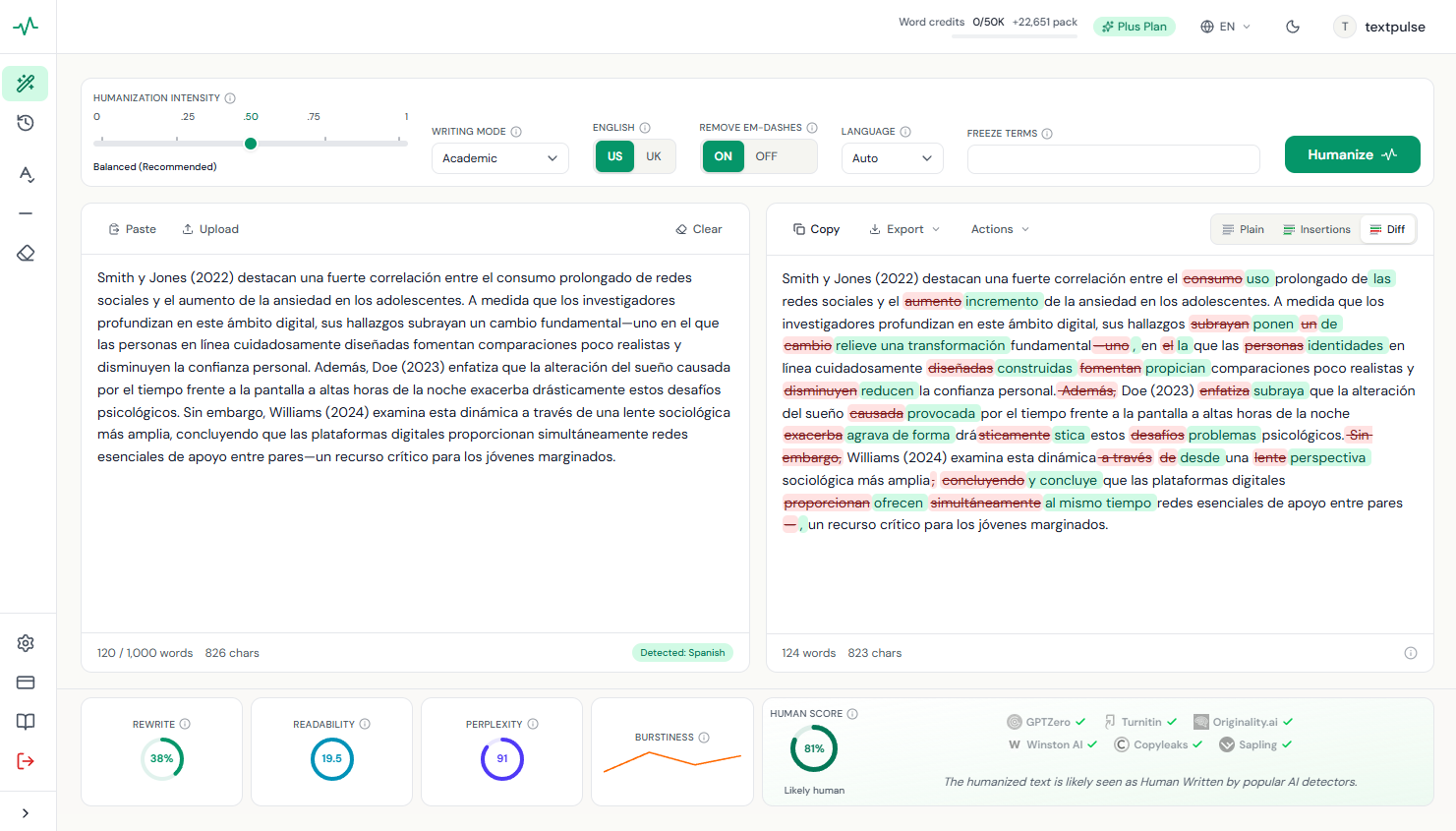
The pair below comes from a single claim about social media's role in shaping student opinion, run first through a typical AI draft and then through humanization. Both rows are in Spanish because that is the language a detector and an academic reviewer are actually reading, and a short English gloss underneath each version explains what changed for readers scanning quickly rather than reading the full passage. Read side by side, the shorter version drops the frame-setting opener entirely, states the claim as something a person actually observed, and adds a qualification about inconsistency across cases instead of a blanket assertion of certainty.
| AI-sounding Spanish | After humanizing |
|---|---|
| En la era digital actual, el uso de las redes sociales juega un papel fundamental en la formación de opinión entre los estudiantes universitarios. No se puede negar que las plataformas digitales han transformado la manera en que los jóvenes acceden a la información. Además, es importante destacar que este fenómeno también repercute en la comunicación académica en general. | Las redes sociales influyen cada vez más en cómo los estudiantes universitarios forman su opinión, sobre todo porque las plataformas digitales han cambiado la forma en que los jóvenes acceden a la información. Ese cambio también se nota en la comunicación académica, aunque no de la misma manera en todos los casos. |
| English gloss: social media plays a fundamental role in shaping opinion among university students in today's digital age, and this undeniably also affects academic communication in general. | English gloss: same claim, made more specific and grounded, with the throat-clearing opener and stacked hedges removed and a note that the effect varies by case. |
AI detection in Spanish-speaking countries
Turnitin's AI-writing detection is the most widely referenced tool at Spanish-language universities across Spain, Mexico, Argentina, Colombia and Chile, and GPTZero, Copyleaks and Compilatio also show up in institutional guidance and student discussions about what actually gets flagged. Adoption is uneven across the region rather than following a single national standard, with some faculties running submissions through a detector by default and others leaving the decision to individual instructors on a course-by-course basis.
What differs by country is less the detector itself and more how a flagged score gets used once it appears. A percentage on a report is rarely treated as proof on its own; it more often triggers a conversation with a student about process and drafting, particularly at institutions that have not published a binding rule on generative AI. That makes the actual writing, not just the score, the thing worth getting right before a paper is ever submitted.
Humanize your own paper
Transform your AI-assisted text and make it sound human, without touching important words or citations.
University policies in Spain and Latin America
| University | Country | Policy stance |
|---|---|---|
| Universidad Complutense de Madrid | Spain | Reported to publish a structured Declaración Responsable sobre Autoría y Uso Ético de la IA template that students are expected to complete disclosing AI tool use, per 2025-2026 reporting. |
| Universidad Autónoma de Madrid | Spain | Has issued a general guide with recommendations for appropriate use of generative AI via its digital teaching office, though it stops short of a single binding rule across all faculties. |
| Universidad Nacional Autónoma de México (UNAM) | Mexico | 2025 reporting describes a growing but uneven presence of generative AI on campus. |
| Pontificia Universidad Católica de Chile | Chile | General academic-integrity policies are presumed to require disclosure of AI assistance in line with broader Chilean higher-education guidance. |
| Universidad de Buenos Aires | Argentina | No single university-wide generative-AI writing policy could be verified for this pass; individual schools reportedly issue their own disclosure guidance. |
| Universidad de los Andes | Colombia | Publishes general academic-integrity guidelines understood to extend to undisclosed AI use. |
Journals and citation culture
Spanish-language academic publishing spans several major fields, each with its own journal. Revista Mexicana de Investigación Educativa, published under COMIE, covers education research; Revista Española de Documentación Científica, from CSIC, covers information science; Cuadernos de Economía, from Universidad Nacional de Colombia, covers economics; Estudios de Psicología, from Fundación Infancia y Aprendizaje, covers psychology; and Revista Chilena de Literatura, from Universidad de Chile, covers literary studies. Between them they represent the range of disciplines where Spanish-language researchers publish and where a flagged draft becomes a real problem.
Citation style tracks discipline more than country. APA dominates in the social sciences, education and psychology across Spain and Latin America, footnote citation still holds in law and parts of the humanities, and Vancouver style governs medicine and health sciences. A humanizer that rewrites sentence structure without touching a citation format is doing the one thing that matters most here, because a paper that loses its citation formatting mid-edit creates a bigger problem than an AI-writing flag ever would on its own.
How TextPulse works as a Spanish AI humanizer
TextPulse's multilingual mode processes Spanish text directly rather than translating it into English, humanizing it, and translating it back, a round trip that reliably damages register and drops details along the way. Citations, technical terms and numbers stay untouched while the surrounding sentence structure changes, so a reference list or a set of statistical results comes out exactly as submitted, unchanged in form even though the prose around them reads differently.
The tool also keeps register consistent with what the draft already establishes, whether that means impersonal se constructions and hedged modal verbs throughout a thesis chapter or a more direct tone in a shorter piece. That consistency matters more in Spanish than in English, because a paper that drifts from formal to casual mid-paragraph reads as more foreign to a reviewer than the original AI tells alone would have.
Frequently Asked Questions
The underlying signals are the same, sentence predictability and repeated patterns, but the patterns themselves differ by language. A Spanish-language AI score reacts to habits like impersonal se overuse, calqued phrases such as juega un papel fundamental en, and repeated frame openers, not the English-specific tells the same detector might flag in a different submission.
PhD in natural language processing, with years spent building NLP applications end to end. Moe works on text analysis: lexical and syntactic structure, and what separates machine-generated prose from human prose statistically. He has been experimenting with computational linguistics since the early days of NLTK, spaCy and WordNet, and still writes most of his tooling in Python.