AI humanizer for Indonesian
Bahasa Indonesia academic writing carries its own AI tells, from grand era openers to stacked hedges that repeat every paragraph. This post breaks down what Indonesian detectors and universities are actually seeing, and how a targeted rewrite removes the pattern without touching citations or data.
Indonesian graduate students draft with ChatGPT as often as their peers everywhere else, and Bahasa Indonesia essays, skripsi chapters, and thesis introductions now pass through the same detectors used for English writing. An Indonesian AI humanizer answers a specific problem: text that reads fluently in Bahasa Indonesia can still carry the calque phrases, stacked hedges, and flat paragraph rhythm that Turnitin and GPTZero learned to flag. This post explains what those tells look like in Indonesian, how universities across the country are responding, and what it takes to rewrite AI drafts so they read as a student's own work instead of a template output.
Bahasa Indonesia has its own register signals, its own hedge phrases, and its own version of the throat-clearing openers that give AI drafts away. Detecting them requires more than a general grammar check, which is why TextPulse built a multilingual AI humanizer rather than an English-only tool, then trained separate passes for languages including Indonesian. The sections below walk through what AI-sounding Indonesian actually looks like, how detection tools and university policy are evolving across Indonesian higher education, and how a targeted rewrite keeps citations, terms, and numbers untouched while removing the tells.
Why AI text gets flagged in Indonesian
In Indonesian academic writing, the formal standard language (bahasa baku) and the use of the di- prefix for impersonal passive constructions are preferred. ChatGPT drafts in Indonesian tend to override the preference for impersonal distance and bahasa baku by using padding instead. Opening lines like 'Dalam era globalisasi ini,' set a grand stage before the actual claim. Other sentences contain stacked hedges, which show certainty rather than prove it, like 'tidak dapat dipungkiri bahwa.' Even if the grammar is correct, native readers notice the mismatch, where the phrasing carries the rhythm of a template rather than a writer working through an argument.
The repetition compounds across paragraphs. 'Hal ini menunjukkan bahwa' opens sentence after sentence as a generic connector, 'memainkan peran penting dalam' substitutes for a specific claim about what something actually does, and 'Perlu dicatat bahwa' throat-clears before a point that could simply be stated. These are the same category of words that give away ChatGPT in English, translated rather than invented, and Indonesian detectors and human readers pick up on the pattern just as reliably. 'Selain itu' opening consecutive paragraphs and a closing 'secara keseluruhan' summary complete the template shape that flags an essay as machine-drafted before a reader even checks the citations.
What AI-sounding Indonesian looks like
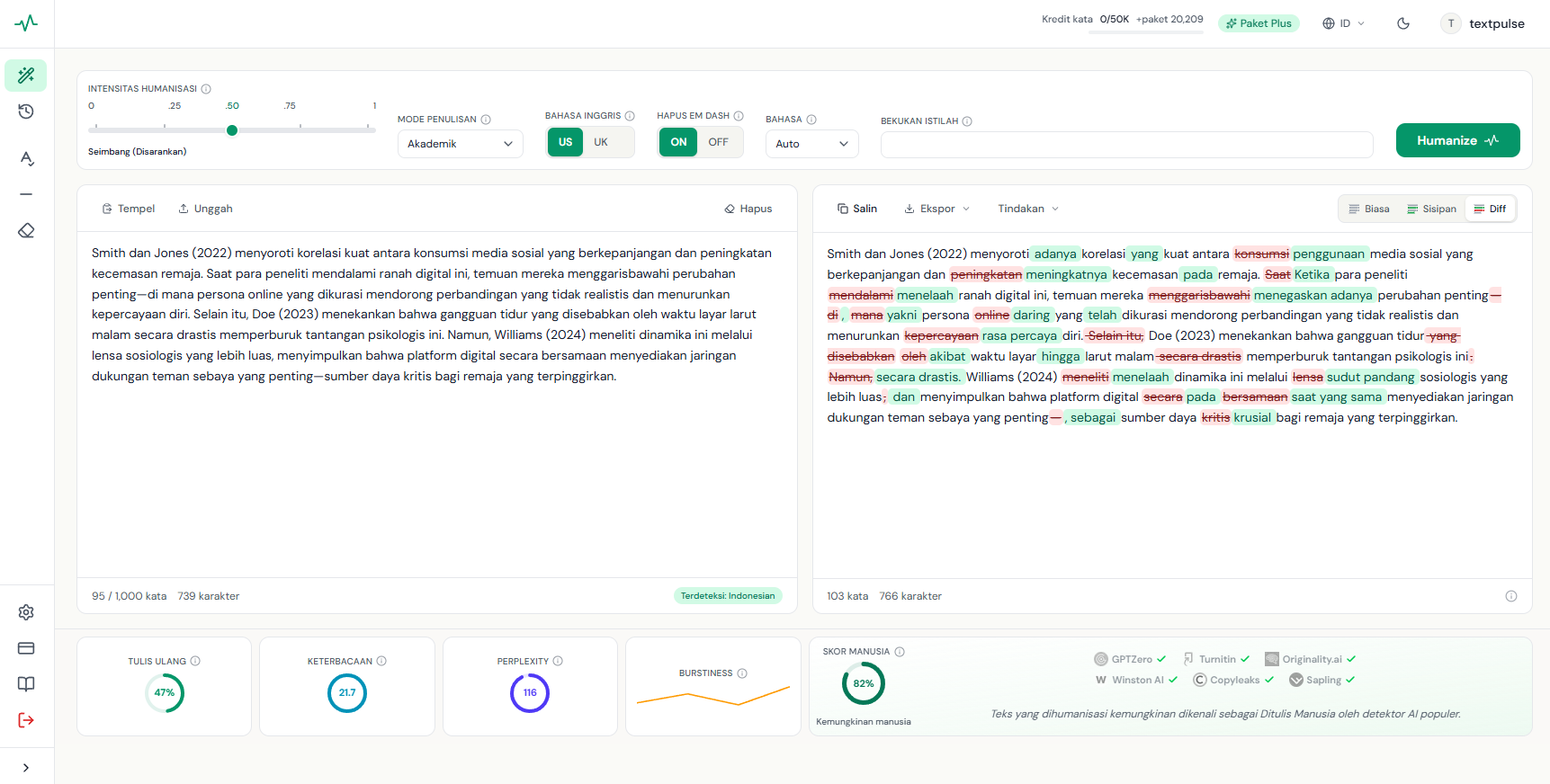
The pair below comes from a typical undergraduate paragraph on social media and public opinion, first as ChatGPT drafted it in Indonesian and then after humanizing. The AI version stacks four separate tells in three sentences: the globalization-era opener, the 'plays an important role' calque, the 'this shows that' connector, and a closing 'secara keseluruhan' summary. The humanized version keeps the same claim, that social media shapes student opinion and academic communication, but states it directly and adds a concrete qualification instead of a vague closing hedge. English glosses sit underneath each version so the comparison reads clearly even without Indonesian.
| AI-sounding Indonesian | After humanizing |
|---|---|
| Dalam era globalisasi ini, penggunaan media sosial memainkan peran penting dalam membentuk opini publik di kalangan mahasiswa. Hal ini menunjukkan bahwa platform digital tidak dapat dipungkiri telah mengubah cara generasi muda mengakses informasi. Selain itu, perlu dicatat bahwa fenomena ini juga berdampak pada pola komunikasi akademik secara keseluruhan. | Media sosial kini menjadi salah satu faktor yang membentuk opini mahasiswa, terutama karena platform digital mengubah cara generasi muda mencari informasi. Perubahan ini juga terasa pada pola komunikasi di lingkungan akademik, meskipun tidak semua mahasiswa mengalaminya dengan cara yang sama. |
| English gloss: Social media plays an important role in shaping student opinion in the era of globalization, and this undeniably extends to academic communication overall. | English gloss: same claim, made more concrete, with the throat-clearing opener and stacked hedges removed and a note that not all students experience the shift equally. |
AI detection in Indonesia
Turnitin is the dominant detector across Indonesian higher education, integrated into most institutional repositories for skripsi and thesis submission, and its AI-writing indicator now flags Indonesian-language text using the same underlying model trained across languages. GPTZero, Originality.ai, and Copyleaks show up less often as institution-mandated tools but circulate widely among students and supervisors checking drafts before submission. None of these detectors are built specifically for Bahasa Indonesia, which means they read fluency and rhythm patterns rather than dictionary-level cues, and that is exactly why calque phrases and repeated connectors raise their scores even when every sentence is grammatically correct.
Indonesian universities are not alone in tightening this scrutiny; institutions everywhere are running the same detectors against language-specific writing, and the calque patterns an AI humanizer for German catches in Sie-register drift are a close parallel to what shows up in Bahasa Indonesia's di- passive drift. What differs locally is how new the guidance still is: national and institutional AI policy in Indonesia has mostly been written since 2025, so students are often checking drafts against rules that did not exist a year earlier, and supervisors are still calibrating how strictly to read a flagged similarity or AI-writing score.
Humanize your own paper
Transform your AI-assisted text and make it sound human, without touching important words or citations.
University policies
Policy specifics vary by institution and the picture is still forming. Universitas Indonesia has published the most concrete rule: Peraturan Rektor UI No. 16/2025, in effect since July 2025, permits disclosed use of generative AI in scholarly writing but bars listing AI as an author and bars using it to produce plagiarized text. Universitas Gadjah Mada is reported to be building a formal AI ethics roadmap through 2030 rather than a single finalized rule, with interim guidance stressing ethical, transparent use. The table below lists policy as published for 2025 and 2026; where an institution has no dedicated generative-AI policy, its general academic-integrity rules are presumed to cover undisclosed use.
| University | Policy stance (as published 2025-2026) |
|---|---|
| Universitas Indonesia | Published guidance (Peraturan Rektor UI No. 16/2025, in effect since July 2025) allows disclosed use of generative AI in scholarly writing but bars listing AI as an author and bars using it for plagiarism. |
| Universitas Gadjah Mada | Reported to be building a formal AI ethics policy and roadmap through 2030 rather than a single finalized binding rule; interim guidance emphasizes ethical, transparent use. |
| Institut Teknologi Bandung | No specific published generative-AI writing policy could be verified for this pass; general academic-integrity rules are presumed to cover undisclosed AI use. |
| Universitas Airlangga | Publishes general academic-integrity guidance. |
| Universitas Padjadjaran | General academic-integrity rules are understood to extend to undisclosed AI use. |
| Institut Pertanian Bogor | Falls under the national ministry's 2026 guidance on generative AI in higher-education learning. |
Journals and citation culture
Indonesian researchers publish across a mix of Indonesian-language and English-medium venues, and the citation style depends heavily on field rather than institution. APA, in its sixth or seventh edition, dominates the humanities, social sciences, and education; Vancouver style is standard in medicine and health sciences; and IEEE style governs engineering and computer science papers. A humanizer that rewrites Indonesian prose without preserving in-text citation markers or reference list formatting creates real work for the author later, since APA in-text citations and Vancouver numbered references follow different rules and neither survives careless paraphrasing intact.
HUMANIORA out of Universitas Gadjah Mada publishes humanities research in Indonesian and English; Jurnal Pendidikan dan Kebudayaan, run by the Ministry of Education, publishes education research in Indonesian; Indonesian Journal of Applied Linguistics, based at Universitas Pendidikan Indonesia, publishes research primarily in English but some in Indonesian; Jurnal Ilmu Sosial dan Ilmu Politik at Universitas Gadjah Mada publishes research largely in Indonesian; and Media Kesehatan Masyarakat Indonesia, based at Universitas Diponegoro, publishes research primarily in Indonesian. Each expects a consistent formal register throughout a manuscript. This is what breaks when a paragraph humanized for tone drifts away from the register used in the surrounding sections.
How TextPulse's Indonesian AI humanizer handles Bahasa Indonesia
TextPulse runs Indonesian text through a mode built for the language rather than a generic multilingual pass, which matters because Bahasa Indonesia's di- passive constructions and formal hedges need different handling than a straight English rewrite would apply. The system keeps citations, in-text references, technical terms, and numbers untouched during a rewrite, so a Vancouver-numbered medical paper or an APA-cited education thesis keeps its reference list intact while the surrounding prose changes. Register is kept consistent across a document rather than varying paragraph to paragraph, which matters for supervisors who read register shifts as a sign that a section was pasted in rather than written.
The same engine removes the specific tells covered above: calque openers, stacked hedges, generic connectors, and the template-shaped paragraph rhythm that both native readers and detectors recognize as machine output. It does not translate or simplify the underlying argument, and it does not add content the student did not write; it restructures phrasing while leaving meaning, evidence, and citation placement where the author put them. That distinction matters for students working under policies like Universitas Indonesia's, which permit disclosed AI assistance but require the final submission to represent the student's own scholarly contribution rather than an AI-authored one.
Frequently Asked Questions
Yes. Turnitin's AI-writing indicator works across languages including Indonesian, and it flags Indonesian-language text using the same underlying model trained on English and other languages. Universitas Indonesia and other institutions use Turnitin as part of standard thesis and skripsi submission, so Indonesian-language drafts go through the same check as English ones.
Content strategist at TextPulse, here since the company started. Mark writes the product and technical coverage: how the humanizer works under the hood, what changes in each release, and what a specification actually means for your writing. His reviews of writing software come from using them on real documents rather than reading a feature list.