Japanese AI Humanizer for Academic Writing
Japanese academic writing runs on a single consistent register, and most AI-generated drafts break it within a paragraph. This post walks through the specific grammatical tells, how Japanese universities and detectors actually check for them, and what a Japanese AI humanizer needs to preserve along the way.
A Japanese AI humanizer has to solve a different problem than an English one does, because most of the tells are grammatical rather than lexical. Japanese academic writing normally holds a single register, である調, from the opening sentence to the last line of the conclusion, and a model trained on mixed web text does not always keep that consistent. Add a handful of stock openers and hedging phrases that a generic assistant reaches for by default, and a paragraph starts to read as generated even when every fact in it is correct. This post covers what those tells look like, how Turnitin and other checkers now read Japanese, and what needs to change before submission.
This post sits in the same series as our multilingual AI humanizer guide, which maps the same detection patterns across fourteen other languages; this instalment stays specific to Japanese, from the register mixing that gives away a rushed draft to the universities and journals where that draft eventually lands. The demo pair further down uses real AI-sounding Japanese next to a humanized rewrite, so the difference is visible rather than described in the abstract. None of what follows argues for hiding AI use. It argues for understanding what a checker actually measures, so editing time goes toward the sentences that need it instead of a uniform pass over the whole document.
Why AI-Generated Japanese Gets Flagged
The clearest tell is register drift: mixing である調, the plain assertive style expected in theses and papers, with the polite です/ます forms used in speech and casual writing, inside the same passage. A native writer stays in one register for an entire document; a generated draft will open a section in である調 and then slip into です/ます for a sentence or two before drifting back, because the underlying model was trained on both styles without a strong preference for either inside a single document.
A second tell is vocabulary that repeats across otherwise unrelated papers. The formulaic opener '~について考察する' (this paper will consider) shows up as a default first sentence more often than any single topic would explain, and 'また' gets used as the only transition across paragraph after paragraph where a native writer would vary the connector. Hedging closers such as '~と言えるだろう' stack onto nearly every claim in a generated draft, and nominal phrasing such as '~の実施' or '~の活用' replaces a plain verb far more often than in writing produced by a person under normal time pressure. The pattern is close to the English one covered in words that give away ChatGPT, just expressed through different fixed phrases.
A third tell is structure rather than vocabulary. Generated Japanese often reaches for the three-step scaffold 'まず〜次に〜最後に' (first, next, finally) even inside a single short paragraph that does not need three explicit steps to make its point, and every paragraph in a section ends up the same length and shape. A native writer varies how a paragraph opens and closes depending on what it is doing: summarizing a finding, introducing an exception, or setting up the next section. That variation, or the lack of it, is exactly what the next section shows side by side.
What AI-Sounding Japanese Looks Like
The pair below comes from an actual generated paragraph on educational technology and a humanized rewrite of the same claim. Both keep the same statistic, sixty-eight percent of instructors reporting higher participation, so nothing about the underlying finding changes between the two versions. What changes is the register: the first version opens on an abstract claim and closes on a stacked hedge, '~と言えるだろう', while the rewrite opens on a concrete scene, breaks the long sentence into shorter ones, and drops the stock closer entirely. An English gloss of each version follows in the second row for readers who do not read Japanese.
| AI-sounding Japanese | After humanizing |
|---|---|
| デジタル技術の活用は現代の教育現場において重要な役割を果たすと言えるだろう。調査によれば、教員の68%が学生の参加度の向上を報告している。このことから、当該技術の導入は学習の質を高めることに貢献するだけでなく、学習者の批判的思考力の育成にも寄与すると考えられる。 | デジタル技術が教室に入ってから、授業の雰囲気はかなり変わった。ある調査では、教員の68%が学生の参加度が上がったと答えている。興味深いのは成績だけでなく、学生の考え方そのものが変わった点だ。暗記に頼るのではなく、疑って確かめる姿勢が増えたという。 |
| English gloss: Digital technology is said to play an important role in education, with 68% of instructors reporting increased participation and a claimed contribution to critical thinking. | English gloss: Same 68% figure and the same claim, but opened with a concrete scene, broken into shorter sentences, and dropped the stock closers '~と言えるだろう' and '~に寄与すると考えられる'. |
AI Detection at Japanese Universities
Japan's detection landscape runs on three tools with different roles. Turnitin is used at many Japanese universities for both text-matching and AI-writing detection, in the same way it is used across much of the world. コピペルナー (Copy Perna) is a Japanese-built plagiarism-detection tool that is widely deployed independently of Turnitin, and instructors who rely on it are checking for overlap with existing text rather than for AI probability specifically. GPTZero is known among individual researchers and some departments, but it is far less institutionally embedded in Japan than the other two, so a paper is more likely to meet Turnitin or Copy Perna at the point of submission than any dedicated AI detector.
How a Japanese university actually checks a paper depends heavily on the instructor rather than one fixed campus-wide rule. Published guidance from the University of Tokyo states explicitly that decisions on whether and how generative AI tools may be used in a course are left to individual faculty members rather than one university-wide policy, and that pattern of instructor discretion over a single blanket rule shows up across the sector more broadly. The same institutional patchwork appears elsewhere in Asia: our guide to the Thai AI humanizer covers a comparable mix of course-level rules and national guidance rather than one national standard.
Humanize your own paper
Transform your AI-assisted text and make it sound human, without touching important words or citations.
University Policies on Generative AI
Public, university-wide AI policies are still uneven across Japan, and the table below reflects that directly rather than smoothing it over. Only the University of Tokyo has a clearly published, university-level stance as of this pass; for the other five, no centrally published policy was verified, which is itself informative, since it points toward the same instructor-level discretion the University of Tokyo states outright. Treat every line as a snapshot of what was publicly confirmed as of 2025-2026, not a permanent rule, since these pages change as fast as the tools they describe.
| University | Country | Published policy stance (2025-2026) |
|---|---|---|
| University of Tokyo | Japan | Leaves decisions on whether and how to use generative AI tools in a course to individual faculty members, rather than one fixed university-wide rule. |
| Kyoto University | Japan | No centrally published generative AI policy verified for Kyoto University itself; a separate, similarly named institution, Kyoto University of Foreign Studies, does publish its own guidelines. |
| Osaka University | Japan | No verified public university-wide AI policy statement found; Japanese universities broadly appear to favor instructor-level discretion over one fixed rule. |
| Tohoku University | Japan | No verified public AI policy statement found; treat any specific stance as unconfirmed pending direct confirmation from the institution. |
| Waseda University | Japan | No verified public AI policy statement found; as a large private university it likely issues course-level guidance rather than one blanket rule, consistent with the wider pattern. |
| Keio University | Japan | No verified public AI policy statement found; treat any specific stance as unconfirmed pending direct confirmation from the institution. |
Journals and Citation Culture in Japan
Japanese-language research is published across field-specific journals rather than one dominant outlet: 言語研究, the Journal of the Linguistic Society of Japan, for general linguistics; 教育学研究, the Japanese Journal of Educational Research; 心理学研究, the Japanese Journal of Psychology; 社会学評論, the Japanese Sociological Review; and 日本語教育, the Journal of Japanese Language Teaching, for applied linguistics and language pedagogy. Citation practice varies by field rather than following one national standard. SIST02, the Japan Science and Technology Agency's own standard, is common in the sciences, APA is increasingly used in psychology and education, Vancouver style dominates medicine, and the humanities largely still run on footnote or endnote house styles set by the publisher.
Citation style matters more here than the choice might suggest, because a paper written in one style for a linguistics journal and resubmitted to a psychology outlet after a rejection needs its references reformatted, not rewritten. A humanizing pass that quietly changes a citation format, drops a footnote number, or rewrites a reference list entry creates exactly the kind of error a careful reviewer catches immediately, and it has nothing to do with how natural the surrounding prose reads. Any tool used on a Japanese manuscript needs to leave SIST02 references, APA in-text citations, or footnote numbering exactly where the author placed them.
How TextPulse Works as a Japanese AI Humanizer
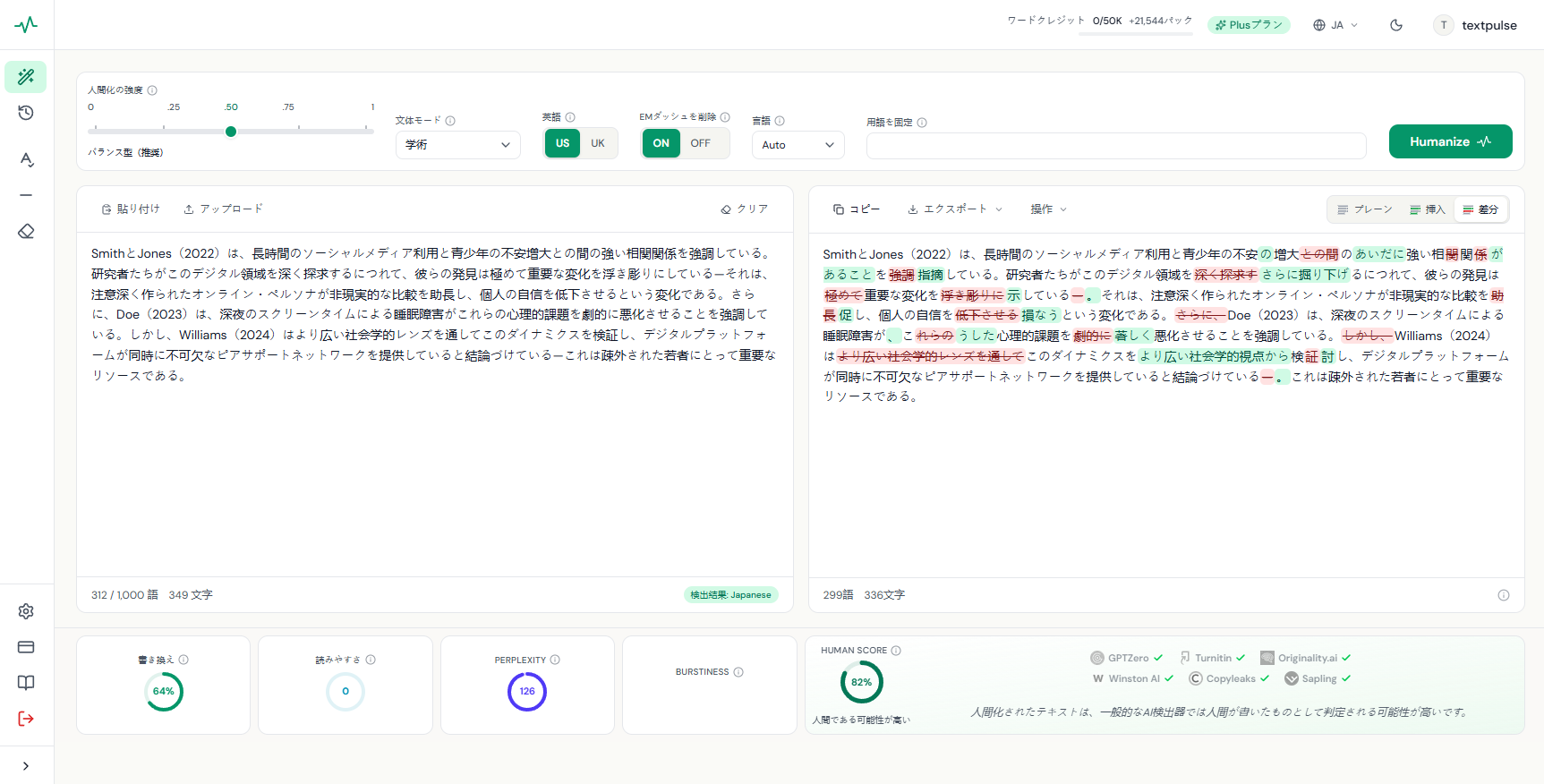
TextPulse's multilingual mode treats Japanese as its own language rather than running an English pipeline over translated text, which matters because the tells covered above, である調 drift, stacked hedges, the padded three-step structure, are grammatical patterns specific to Japanese and do not map cleanly from English rules. The tool keeps a manuscript in a single, consistent register throughout rather than introducing new です/ます slips of its own, and it varies sentence length and connector choice the way a careful human editor would, instead of replacing one stock phrase with a different stock phrase.
Citations, technical terms, and numbers are held fixed during the pass: a SIST02 reference, an APA in-text citation, or a statistic like the sixty-eight percent figure in the demo pair above comes out exactly as it went in, because none of those should change when only the surrounding prose is being rewritten. The output includes an estimated Human Score based on the text submitted, not a guarantee about what any specific detector will report, since detectors update on their own schedule and can disagree with each other on the same document.
Frequently Asked Questions
Both. A Japanese AI humanizer needs to recognize whichever register a document is already using and keep it consistent throughout, rather than assuming every academic text is written in である調. です/ます appears legitimately in some coursework and applied linguistics writing, and the tool's job is uniformity within whichever register the author chose, not forcing one style onto every document.
PhD in natural language processing, with years spent building NLP applications end to end. Moe works on text analysis: lexical and syntactic structure, and what separates machine-generated prose from human prose statistically. He has been experimenting with computational linguistics since the early days of NLTK, spaCy and WordNet, and still writes most of his tooling in Python.