AI Humanizer for Thai
ChatGPT's Thai output has its own tells: stacked formal connectives, over-nominalized verbs, and a hedge that opens nearly every paragraph. This post walks through what Thai universities and detectors actually do about AI-generated text, and how a Thai-aware rewrite keeps citations and register intact while removing the machine rhythm.
A student in Bangkok drafts a literature review in ChatGPT, translates the reply into Thai, and submits it as a first pass. That workflow is now routine across Thai universities, which means detectors are no longer just checking English prose for machine patterns. This post explains what a Thai AI humanizer actually needs to fix, why AI-generated Thai reads differently from AI-generated English, which Thai universities have published a stance on generative AI, and how TextPulse keeps citations, Thai script, and academic register intact while rewriting the parts that read as machine-written.
Thai has its own register rules, its own connective habits, and its own set of generative AI tools now used alongside ChatGPT, so the patterns that flag a paper in Bangkok are not identical to the patterns that flag one in Boston. A general multilingual AI humanizer that only tunes for English misses the Thai-specific tells: stacked formal connectives, over-nominalized verbs, and a hedge that opens almost every AI-written paragraph. The sections below walk through what those tells look like in practice, how Thai universities and detectors currently treat AI-generated submissions, and what a rewrite needs to preserve to stay usable in a graded thesis.
Why AI Text Gets Flagged in Thai Academic Writing
Thai academic prose favors a formal register, ภาษาทางการ, that avoids first-person pronouns in favor of impersonal constructions such as มีการศึกษา, roughly 'a study was conducted.' ChatGPT's Thai output tends to keep that impersonal shape but layers calque phrases on top of it, most recognizably a direct translation of the stock 'technology is advancing at a rapid pace' opener as ในยุคปัจจุบันที่เทคโนโลยีมีการพัฒนาอย่างรวดเร็ว. A human writer would either cut that opener entirely or replace it with a specific, dated claim. The calque version reads as translated English wearing Thai grammar, which is exactly the kind of surface pattern a Thai AI humanizer is built to catch.
Other tells stack on top of that opener. AI-generated Thai often chains a formal connective before a claim, ดังนั้น จึงสามารถกล่าวได้ว่า, meaning roughly 'therefore, it can be said that,' then reaches for an over-nominalized verb phrase like การดำเนินการวิเคราะห์ข้อมูล instead of the plainer 'analyzing the data.' A formulaic hedge, อย่างไรก็ตาม ควรพิจารณาว่า, tends to open the next paragraph, and a stock intensifier such as มีความสำคัญอย่างยิ่ง gets used as generic praise rather than a specific claim. None of these are wrong Thai. They are the same four or five shapes recurring at a rate no unscripted writer would produce.
The rhythm problem compounds the vocabulary problem. AI-generated Thai paragraphs tend to run at nearly identical sentence lengths and skip the natural sentence-final particles that vary a paragraph's pace, so even a passage with no obvious calque phrase can still read as machine-written on rhythm alone. The underlying habit is not unique to Thai. The same overused connectives and hedges collected as words that give away ChatGPT in English resurface, translated, in other languages too, and a researcher drafting in French runs into a comparable pattern, which is why an AI humanizer for French has to unwind those calques before the prose reads as native French.
What AI-Sounding Thai Looks Like
The pair below comes from a single AI-drafted opening sentence for a study on AI and student learning, rewritten by hand. The first row shows the Thai text before and after; the second row gives a short English gloss of each so the difference is legible without reading Thai. Notice that the claim and the research gap stay identical across both versions. What changes is the throat-clearing opener, the stacked hedge before the gap statement, and the uniform summary closer, all of which get cut, plus sentence length, which becomes varied instead of flat.
| AI-sounding Thai | After humanizing |
|---|---|
| ในยุคปัจจุบันที่เทคโนโลยีปัญญาประดิษฐ์มีการพัฒนาอย่างรวดเร็ว การดำเนินการศึกษาผลกระทบของปัญญาประดิษฐ์ต่อการเรียนรู้ของนักศึกษาจึงมีความสำคัญอย่างยิ่ง อย่างไรก็ตาม เป็นที่น่าสังเกตว่างานวิจัยส่วนใหญ่ยังคงมุ่งเน้นไปที่ประเด็นทางเทคนิคเป็นหลัก โดยสรุปแล้ว การศึกษานี้จึงมุ่งเติมเต็มช่องว่างดังกล่าว | ปัญญาประดิษฐ์เปลี่ยนวิธีที่นักศึกษาเรียนรู้ไปมากในช่วงไม่กี่ปีที่ผ่านมา แต่งานวิจัยส่วนใหญ่ยังเน้นแค่ด้านเทคนิค แทบไม่มีใครมองว่ามันกระทบการเรียนรู้จริง ๆ อย่างไร งานชิ้นนี้จึงพยายามเติมช่องว่างนั้น |
| Gloss: In an era of rapid AI development, studying AI's impact on student learning is of great importance; however, most research still focuses mainly on technical issues, so this study aims to fill that gap. | Gloss: Same claim and same gap being filled, but the throat-clearing opener and stacked hedges are cut, and the sentences are shortened and varied in length for a more natural rhythm. |
AI Detection in Thai Universities
Turnitin remains the detector most Thai universities license through their library or graduate school systems, and its AI writing indicator now runs alongside the similarity report on submitted theses and coursework. GPTZero and Originality.ai show up in the same role at institutions that supplement Turnitin with a second check, and some instructors run a submission through ZeroGPT informally when a paper's tone looks off, even where it is not the university's official tool. None of these give a binary verdict; they return a percentage that a supervisor then interprets alongside the rest of the submission. Many Thai researchers also submit manuscripts written directly in English, which puts them in the same territory covered for an AI humanizer for ESL writers.
That means reading a Thai thesis chapter twice: once by a human supervisor who knows the student's usual writing, and once by a detector trained mostly on English but increasingly extended to Thai and other languages. The chapter that trips the detector on a handful of paragraphs, typically the introduction and the discussion, where AI drafting is most common, will be more likely to attract a follow-up conversation than an outright penalty on a first pass. The paragraph-level tells described above are the actual point of intervention, not a vague overall AI score.
Humanize your own paper
Transform your AI-assisted text and make it sound human, without touching important words or citations.
University Policies on Generative AI in Thailand
Published, disclosure-specific policy for graded coursework is still thin across Thai higher education, and most institutions currently lean on existing academic integrity codes rather than a dedicated generative AI document. The stances below are hedged to what is publicly confirmable as of the 2025 to 2026 academic year, since several universities have announced AI initiatives without a matching written policy on undisclosed use in assessed work.
| University | Policy stance |
|---|---|
| Chulalongkorn University | Rolled out its own ChulaGenie generative AI platform for staff and students in 2025, pointing to an integration-first stance rather than an outright ban. |
| Thammasat University | Launched a dedicated AI Ethics curriculum in August 2025 aimed at responsible technology use, suggesting a permissive-with-guardrails approach. |
| Mahidol University | General academic integrity code requires submitted work to be a student's own, generally understood to extend to undisclosed generative AI text. |
| Chiang Mai University | Graduate school guidance appears to follow the national Ministry of Higher Education's caution against unattributed AI-generated text in theses. |
| Kasetsart University | Existing plagiarism and academic-honesty regulations are generally read as covering undisclosed AI-generated submissions. |
| Khon Kaen University | Has signaled interest in AI-assisted teaching and research support. |
Thai Journals and Citation Culture
Thai researchers publish across a mix of national and international outlets, and the citation expectations shift with the venue. Medical and health science work tends toward Vancouver style, seen in the Journal of the Medical Association of Thailand and the Chulalongkorn Medical Journal, while social science and education work, including titles like the Kasetsart Journal of Social Sciences and the Thammasat Review, generally follows APA. Most disciplinary journals in Thai, well beyond these named titles, are catalogued through the Thai Journal Citation Index, which functions as the national indexing body for domestic scholarship.
Citation practice in Thai theses carries a wrinkle that English-only tools miss: APA references in Thai-language work are commonly adapted with Buddhist Era, พ.ศ., year conversions alongside or instead of the Gregorian year, and bilingual theses often need parallel Thai and English reference formatting to satisfy TCI-house style. A small number of humanities and history departments still use Chicago-style footnotes. A rewrite that flattens these conventions, or drops a พ.ศ. date because it looks unfamiliar, creates a citation error the original AI draft did not have, which is exactly the kind of failure a subject-matter-blind edit introduces.
How TextPulse Works as a Thai AI Humanizer
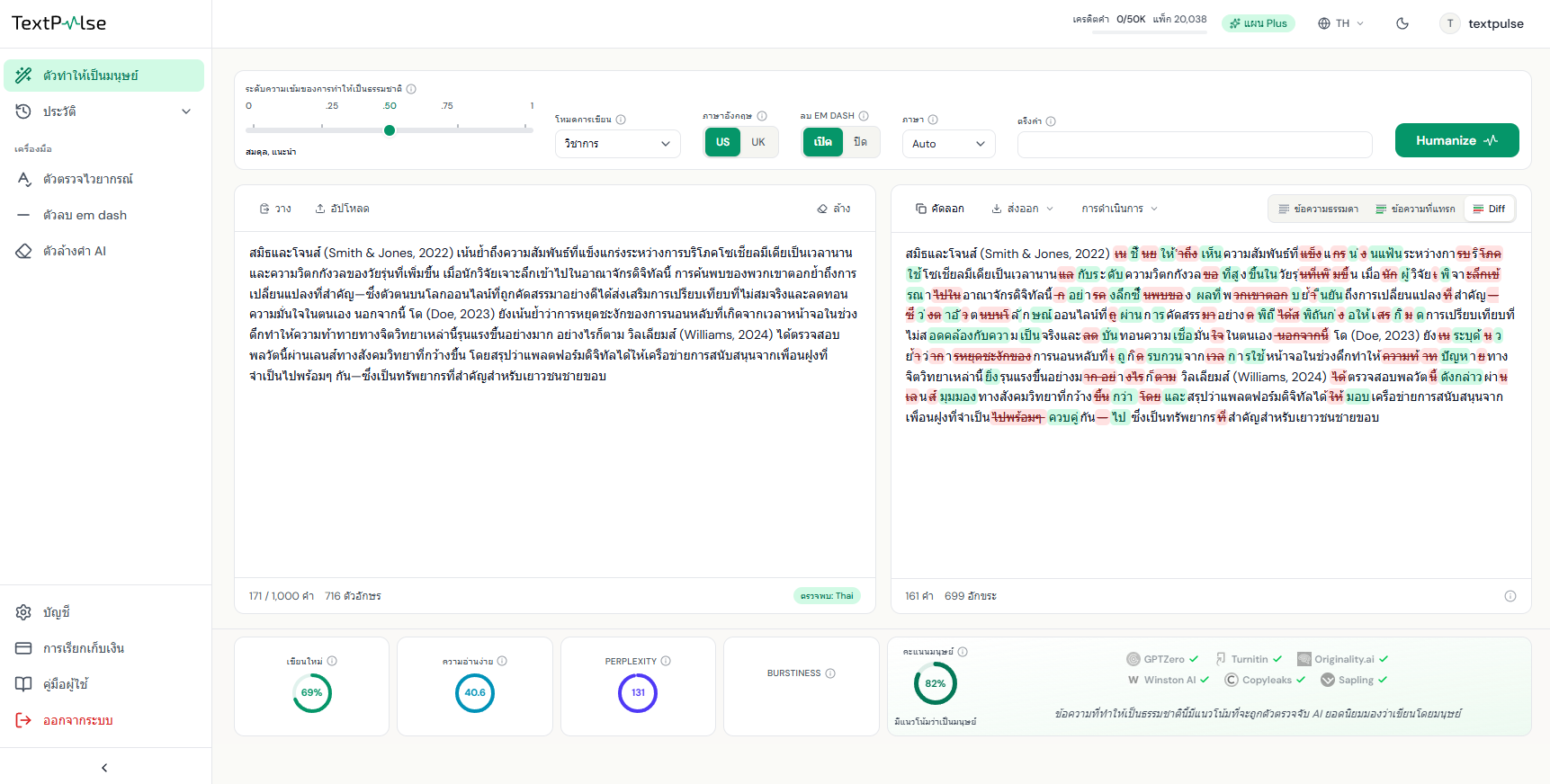
TextPulse runs Thai through the same multilingual mode used for the rest of this cluster, rewriting sentence structure and phrasing rather than swapping individual words for synonyms, which is what actually removes the stacked-connective and over-nominalization patterns described above. Citations, author names, numbers, and technical terms are held fixed during the rewrite, including พ.ศ. year conversions, so a reference list that was correct before humanizing stays correct after.
The formal register expected in Thai academic writing, impersonal constructions, no first-person pronouns, stays consistent across a rewritten document rather than drifting toward a casual tone mid-paragraph, which is a common failure mode of tools that were only tuned on English. For a thesis that pairs a Thai body with a required English abstract, both sections can be run through the same process without the two ending up in mismatched registers.
Frequently Asked Questions
Yes. Most Thai graduate theses now require an English abstract alongside the Thai body text, and a Thai AI humanizer needs to keep both sections in a matching formal register rather than treating them as separate jobs. TextPulse runs each language through its own multilingual mode so the Thai body and the English abstract come out consistent with each other, with citations and numbers held fixed in both.
Content strategist at TextPulse, here since the company started. Mark writes the product and technical coverage: how the humanizer works under the hood, what changes in each release, and what a specification actually means for your writing. His reviews of writing software come from using them on real documents rather than reading a feature list.