AI humanizer for Korean
Korean academic writing runs on a fixed formal register, and machine-generated Korean drifts from it in specific, repeatable ways. This post walks through the tells, the detectors South Korean universities actually use, and what a citation-preserving rewrite needs to get right.
Korean graduate students and researchers increasingly draft with ChatGPT, then discover that AI detectors and course instructors can read the output for what it is. A korean ai humanizer targets that gap: it works on the sentence and paragraph patterns that Korean-language large language model text tends to repeat, not just on translated English tells. This matters because Korean academic writing follows a distinct plain formal register, and machine-generated Korean drifts from that register in ways a native reader notices even when the grammar is technically correct.
This guide walks through what actually flags Korean text as AI-written, how South Korean universities and journals are responding, and how citation-preserving humanization works in practice. Universities from Seoul to Daejeon are still writing their policies as they go, and understanding the specific tells matters more than guessing at a blanket rule. The same problem shows up in every language TextPulse supports, which is why the site runs on an AI humanizer built to work across many languages rather than a single English-only model retrained for Korean.
Why AI text gets flagged in Korean
Korean academic writing sticks to one register throughout, the plain formal written style built on -다 endings, and never slides into the conversational -요 form partway through a paper. ChatGPT output in Korean usually keeps that register correct, and the giveaway sits in repetition rather than in tone. The closing hedge '-라고 할 수 있다' (it can be said that) gets tacked onto nearly every claim, turning a direct statement into a soft, hedged one even where the writer has clear evidence. A human writer varies how they qualify a claim, while a model tends to reach for the same closer again and again.
Two connectors do most of the damage. '또한' (also) shows up as the sole transition across paragraph after paragraph, where a human writer would switch between contrast, cause, and sequence markers depending on what the argument needs. '~을 통해' (through) stands in for a real verb almost every time a model wants to show that one thing led to another, producing sentences like '기술 도입을 통해 참여도가 향상되었다' where a plainer verb construction would read more naturally to a Korean reader. These are exactly the kind of stock phrases that give away ChatGPT once a reader has seen them a few times.
Padded enumeration is another tell: '첫째, 둘째, 셋째' (first, second, third) appears even when a paragraph makes only two points, because the model defaults to a three-part structure regardless of content. Papers often close with the stock formula '~라는 점에서 의의가 있다' (this is significant in that), a sentence that sounds like a conclusion but rarely says anything specific about the finding. Stacking Sino-Korean nominal compounds where a plain verb would read more naturally is a related habit worth watching for. Similar register discipline shows up in Japanese academic writing, where keigo choice plays a comparable role to Korean formality endings.
What AI-sounding Korean looks like
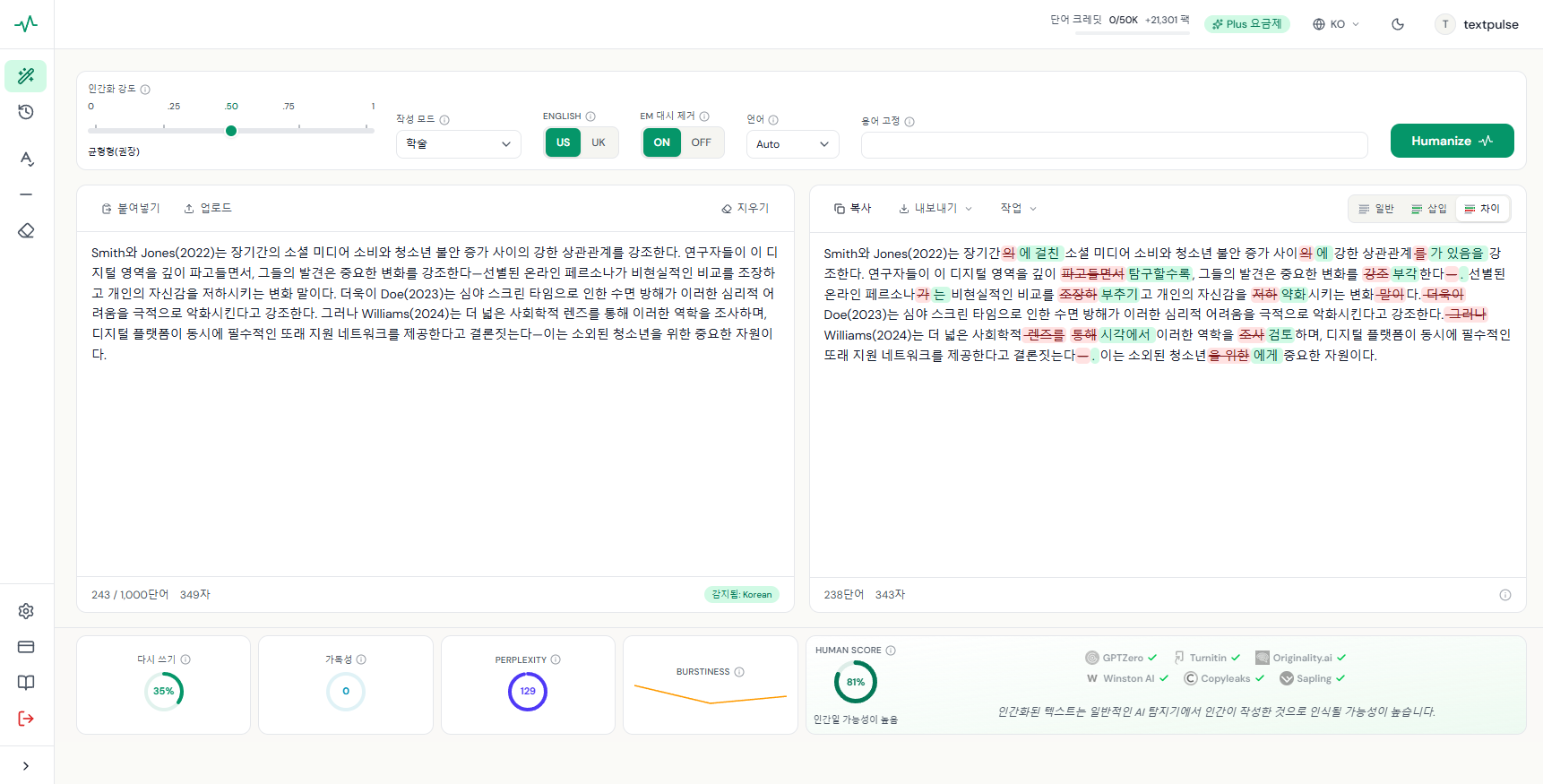
The pair below is drawn from a single passage about digital tools in the classroom, first as a model would produce it and then after humanizing. The Korean text in both rows keeps the same 68 percent figure and the same underlying claim; what changes is sentence rhythm, the hedging closers, and whether the writing opens with an abstraction or a concrete image. An English gloss sits underneath each version so the shift is legible even without reading Korean.
| AI-sounding Korean | After humanizing |
|---|---|
| 디지털 기술의 활용은 현대 교육 현장에서 중요한 역할을 한다고 할 수 있다. 조사에 따르면 교수자의 68%가 학생 참여도의 향상을 보고하였다. 이를 통해 해당 기술의 도입이 학습의 질을 높이는 데 기여할 뿐만 아니라 학습자의 비판적 사고력 발달에도 긍정적인 영향을 미친다고 할 수 있다. | 디지털 기술이 들어오면서 수업 풍경이 꽤 달라졌다. 설문에서 교수자의 68%가 학생 참여도가 늘었다고 답했다. 흥미로운 점은 성적만이 아니라 학생들이 생각하는 방식도 바뀌었다는 것이다. 그냥 외우기보다 의심하고 다시 확인하는 습관이 늘었다. |
| Digital technology use is said to play an important role in education, with 68% of instructors reporting increased engagement and a claimed positive effect on critical thinking. | Same 68% figure and the same claim, but opened with a concrete image, split into shorter sentences, and dropped the stock closers '-라고 할 수 있다' and '~을 통해'. |
AI detection in South Korea
South Korean universities check written work with a mix of tools. Copykiller (카피킬러), the dominant plagiarism and similarity checker in Korean higher education, is increasingly bundled with AI-text detection rather than sold as a separate product, which means a similarity report and an AI-likelihood score can now arrive in the same scan. Turnitin remains common in programs with international partnerships or English-medium instruction. A newer Korean-market entrant, GPTKiller, targets AI detection specifically and is starting to appear in course-level checks alongside the older similarity tools.
How closely instructors check varies by department, but recent incidents have pushed enforcement into public view. Yonsei University was reported to be planning a public hearing on AI policy and exam format after a mass cheating incident tied to AI tool use in an online course, and Korea University has faced a reported cheating case involving shared online-course answers that fed into a broader institutional reconsideration of assessment methods. Neither case describes a single fixed rule so much as an admission that current policy has not kept pace with how students actually use these tools.
For a student or researcher, the practical upshot is that South Korean AI detection is currently more department-by-department than nationally standardized, and it is getting stricter as more incidents surface. A paper that reads as machine-generated, with the hedging and connector patterns described above, is more likely to draw a second look regardless of which specific tool a program uses. Writing that already sounds like a careful human draft rather than translated boilerplate avoids that scrutiny in the first place.
Humanize your own paper
Transform your AI-assisted text and make it sound human, without touching important words or citations.
University policies
Formal, university-wide generative AI policies are still uncommon in South Korea; most of what exists sits at the course or department level, and even institutions actively debating the issue have not published a single fixed rule. The table below reflects what was publicly verifiable as of the 2025-2026 academic year, and several entries note plainly where no such policy could be confirmed.
| University | Policy stance |
|---|---|
| Seoul National University | No single formal AI-use policy verified; held a public student workshop in late 2025 on whether ChatGPT use for homework is acceptable, suggesting guidance is still being developed. |
| KAIST | Likely has course-level AI guidance as a technology-focused institution, but no verified university-wide public policy statement was found. |
| Yonsei University | Reported to be planning a public hearing on AI policy and exam format after an AI-related cheating incident, indicating rules were still in flux as of late 2025. |
| Korea University | No verified centralized generative AI policy found; a reported cheating case involving shared online-course answers has prompted broader reconsideration of assessment methods. |
| POSTECH | No verified public AI policy statement found; treat any specific stance as unconfirmed pending direct confirmation from the institution. |
| Sungkyunkwan University (SKKU) | No verified public AI policy statement found; AI guidance in South Korea generally appears to sit at the course or department level rather than in one fixed rule. |
Journals and citation culture
Korean-language scholarship spans a wide range of outlets, from purely Korean-language journals to English-medium science publishing. 한국어문학연구 (Korean Language and Literature) and 언어와 언어학 (Language and Linguistics) publish philology and linguistics work in Korean, 교육학연구 (Korean Journal of Educational Research) and 한국심리학회지 (Korean Journal of Psychology) cover education and psychology research in Korean, while the Journal of Korean Medical Science (JKMS) publishes medical research in English for an international readership. Citation style tracks the field: APA dominates in social sciences, education, and psychology, Vancouver style is standard in medicine, and many humanities journals indexed in the Korea Citation Index use a footnote-based house style instead of an author-date system.
The mix matters for humanizing AI-drafted text because a rewrite that smooths out hedging phrases or padded enumeration must not touch footnote markers, author-date parentheticals, or the specific figures a citation supports. A researcher submitting to JKMS in Vancouver style has different mechanical requirements than one submitting to a KCI-indexed humanities journal using footnotes, and a tool that flattens both into generic prose risks breaking the citation apparatus a journal expects.
How TextPulse works as a korean ai humanizer
TextPulse runs a multilingual mode built for exactly this situation rather than a translated version of an English-only model. Korean text is processed in Korean, which means the rewrite can target the specific tells covered above (the stacked hedging closers, the overused '또한' connector, padded '첫째, 둘째, 셋째' enumeration) instead of applying generic paraphrasing rules borrowed from English. Citations, author names, statistical figures, and technical or Sino-Korean terminology are preserved exactly as written, so a rewritten paragraph still points to the same sources and reports the same numbers.
Register consistency is handled deliberately: the plain formal written style stays fixed throughout a document, and the tool does not drift into the conversational -요 form or mix formality levels partway through a paper the way a poorly prompted model sometimes does. The goal is writing that reads like a careful researcher drafted it directly in Korean, with natural variation in sentence length and connector choice, rather than text that technically translates correctly but still carries the rhythm of a machine.
Frequently Asked Questions
Copykiller began as a similarity and plagiarism checker, but Korean universities increasingly use versions bundled with AI-text detection, so a single scan can flag both copied passages and machine-generated phrasing. A korean ai humanizer that targets stock hedges like '-라고 할 수 있다' and repeated connectors such as '또한' addresses the second signal directly rather than just avoiding copied text.
Content planner and copywriter at TextPulse. Sara runs the blog day to day, from planning and drafting through to publishing. She writes the practical guides: clear explanations of academic writing problems, aimed at the person who actually has to hand something in.