AI humanizer for Persian
Persian academic prose has its own tells, stacked connector phrases like 'در این راستا' and 'از این رو' that ChatGPT reaches for in almost every paragraph. This post breaks down where those patterns come from, how Iranian universities and detectors currently treat AI-written text, and how a humanizer built for Persian syntax removes them without disturbing citations or register.
Persian academic writing produces some of the most recognizable AI tells of any language, because ChatGPT's output leans hard on a small set of formal connector phrases that Iranian students and researchers know well and rarely choose themselves. A persian ai humanizer exists to fix exactly that problem: rewriting a drafted paragraph so its register, rhythm and connectors read the way a person educated in the field actually writes, while every citation, technical term and number stays untouched. This matters more now that Turnitin and other detectors have started reading Persian text directly, not just an English abstract attached to it.
Persian is the name used in linguistics and in most academic contexts, though outside university settings the same language is usually called Farsi, and many students search for a farsi ai humanizer rather than a persian ai humanizer without realizing the two terms point at the same tool. Iran restricts direct access to ChatGPT, so most drafts pass through a VPN, which does not change how a detector reads the finished paragraph. What follows covers where the AI tells sit in Persian academic prose, how Iranian universities and detectors currently handle flagged text, and how a humanizer built for Persian syntax removes them, as part of a broader multilingual AI humanizer that applies the same approach across fifteen languages.
Why AI Text Gets Flagged in Persian
ChatGPT's Persian output relies on a narrow set of stock connectors that a native academic writer would vary or drop entirely. 'در این راستا' (in this regard) opens sentence after sentence, 'از این رو' (hence) and 'در نتیجه' (as a result) repeat as generic transitions between paragraphs that share no real logical link, and clauses stack behind 'و همچنین' (and also) instead of being broken into separate sentences with their own punctuation. None of these phrases is wrong on its own. The tell is frequency: a human writer reaches for one of them occasionally, while a model reaches for the same handful in almost every paragraph.
Two more constructions show up constantly. The filler opener 'لازم به ذکر است که' (it is worth mentioning that) adds a sentence's worth of throat-clearing before the actual point, and the impersonal hedge 'میتوان گفت که' (it can be said that) distances the writer from a claim a supervisor would expect stated directly. English academic prose has its own version of this problem, cataloged in TextPulse's piece on words that give away ChatGPT, and the underlying mechanism is the same: a model trained to sound careful in any language defaults to hedging and repetition rather than a specific, committed sentence.
What AI-Sounding Persian Looks Like
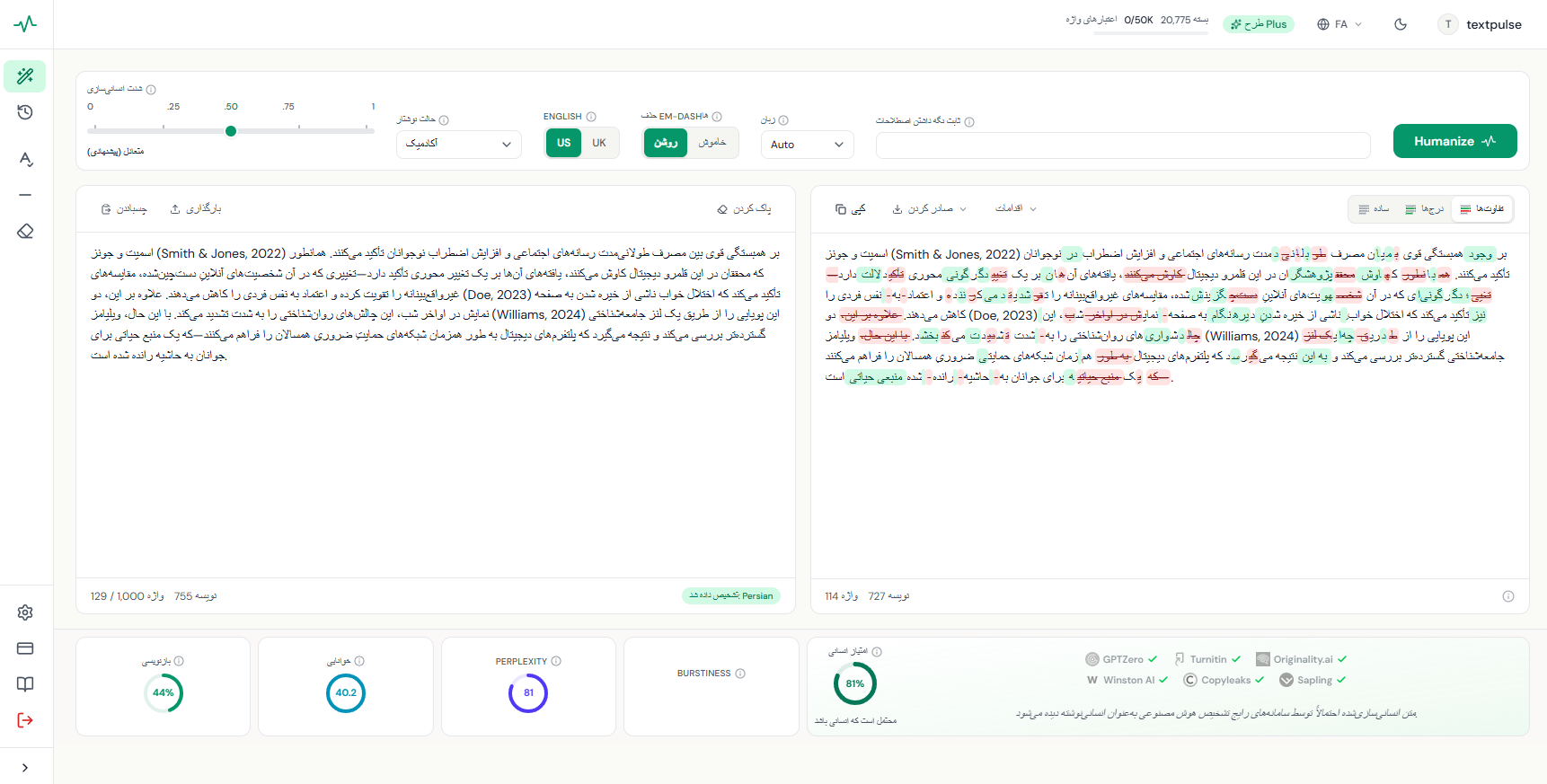
The pattern is easiest to see side by side. The example below is a short passage built entirely from the tells above: a stacked opening connector, the formulaic 'plays a significant role' clause, the filler 'it is worth mentioning' opener, and a closing sentence hedged with 'it can be said that'. The humanized version keeps every claim the original makes and drops none of the content, but removes the stacked connectors, varies sentence length, and states the study's aim directly instead of hedging toward it.
| AI-sounding Persian | After humanizing |
|---|---|
| در این راستا، فناوریهای هوش مصنوعی در سالهای اخیر نقش بسزایی در حوزه نگارش دانشگاهی ایفا کردهاند. لازم به ذکر است که پژوهشگران از این رو با چالشهایی در زمینه اصالت و کارایی مواجه هستند. در نتیجه، میتوان گفت که هدف این پژوهش بررسی نظاممند این چالشها است. | فناوریهای هوش مصنوعی در چند سال اخیر نگارش دانشگاهی را دگرگون کردهاند. پژوهشگران هم از مزیت سرعت بهره میبرند و هم با دشواریهایی درباره اصالت متن دستوپنجه نرم میکنند. این پژوهش میکوشد این دشواریها را به شکلی نظاممند بررسی کند. |
| English gloss: AI technologies have played a significant role in academic writing in recent years, researchers face challenges around originality and efficiency, and the study's goal is to systematically examine these challenges. | English gloss: the same claims, without the stacked connector phrases, in plainer and more rhythmically varied sentences a native academic writer would actually use. |
AI Detection in Iran and the Iranian Diaspora
Detector adoption inside Iran looks different from most other countries. Turnitin is used where a university holds a subscription, but OpenAI blocks direct access to ChatGPT from Iran, so most students and researchers reach it through a VPN, which shapes how AI text enters a draft in the first place and how hard it is to trace afterward. Alongside Turnitin, a domestic tool called Samim Noor (سمیم نور) is widely used for plagiarism screening and is starting to layer in AI detection, though its coverage of AI-specific flags is uneven compared with its similarity checking.
GPTZero and Originality.ai have limited direct penetration in Iranian institutions, again largely because of the access restriction, though diaspora researchers publishing from the United States, Canada or Europe encounter them the same way any other international author would. A paper co-authored across an Iranian university and a Western institution can face two different detection checks on the same manuscript: a domestic similarity screen at the Iranian end and a Turnitin or GPTZero pass once it reaches a co-author's university or a journal's own submission system.
None of this changes what actually gets flagged. A detector reading Persian text is still responding to the same statistical regularity, the stacked connectors and repeated hedges covered above, regardless of which tool runs the check or which country the check happens in. Writing that varies its connectors and states its claims directly reads as human to a Persian-reading academic and to whichever detector a given university or journal happens to use.
Humanize your own paper
Transform your AI-assisted text and make it sound human, without touching important words or citations.
University Policies
| University | Policy stance |
|---|---|
| University of Tehran | No single published university-wide generative-AI policy found in English; guidance appears to sit with individual faculties and thesis supervisors rather than a central rulebook. |
| Sharif University of Technology | No public English-language generative-AI policy found; undisclosed AI-written text is most likely treated as an academic-integrity matter handled case by case. |
| Amirkabir University of Technology | No verifiable published AI-use policy found; thesis and article review likely leans on supervisor judgment and standard plagiarism screening. |
| Shahid Beheshti University | No specific generative-AI policy could be verified; general academic-integrity regulations likely cover undisclosed AI use under existing plagiarism rules. |
| Isfahan University of Technology | No public AI-specific policy found; oversight is presumed to follow the same faculty-level discretion common across Iranian public universities. |
| Ferdowsi University of Mashhad | No dedicated generative-AI policy located; enforcement likely rests on existing academic-honesty codes rather than a named AI provision. |
Journals and Citation Culture
The academic literature in Persian is vast and spans multiple disciplines, and each discipline has its own journal publications with a corresponding referencing style. Medical journals are largely published in Vancouver style and numbered, for example: Journal of Isfahan Medical School (run by Isfahan University of Medical Sciences). Social sciences and humanities research is primarily published in APA style, for example: Iranian Journal of Sociology; Comparative Literature Studies Quarterly. Research in engineering and technology is published in IEEE style and numbered. Linguistic studies are published in the journal: نامه فرهنگستان, published by the Academy of Persian Language and Literature.
Citation-preserving humanization matters here because Vancouver, APA and IEEE numbering each format references differently, and a rewrite tool that does not recognize a numbered citation marker or an author-date parenthetical can quietly break it while smoothing the surrounding sentence. A researcher submitting to رهیافت (Rahyaft) on science-policy topics, or to a Vancouver-style medical journal, needs the argument rewritten and the reference list left exactly as submitted, handled as two separate jobs rather than one pass.
How TextPulse Works as a Persian AI Humanizer
TextPulse's multilingual mode processes Persian text directly rather than translating it into English, humanizing it and translating back, a round trip that would blur the register distinctions covered above. It reads the passage's academic field and formality level, then adjusts the connectors, sentence rhythm and hedging pattern to match how a human researcher in that field writes, while leaving numbers, citation markers and technical terminology exactly as submitted.
That preservation matters as much as the rewrite itself. A Vancouver-numbered citation, an APA author-date pair or an IEEE bracket number all have to survive the pass unchanged, since a broken reference is a separate problem from a flagged paragraph. Researchers moving between Persian and Vietnamese academic writing, for instance, hit the same detector logic even though the AI humanizer for Vietnamese has to solve a different set of tells, from diacritics to sentence-final particles. The result is a Persian passage that keeps its argument, its citations and its field-appropriate register, without the stacked connectors that make Persian AI output recognizable in the first place.
Frequently Asked Questions
Yes. A persian ai humanizer built for academic text separates the argument from the reference apparatus rather than rewriting everything as one block. Numbers, DOIs, author names and citation markers, whether they follow Vancouver numbering, APA author-date format or IEEE-style brackets, pass through unchanged while the surrounding Persian sentence gets rewritten for register and rhythm.
Content planner and copywriter at TextPulse. Sara runs the blog day to day, from planning and drafting through to publishing. She writes the practical guides: clear explanations of academic writing problems, aimed at the person who actually has to hand something in.