AI Humanizer for Vietnamese
Vietnamese formal writing has its own AI tells: a fixed rotation of Sino-Vietnamese transition openers that ChatGPT reaches for far more often than a person would. This guide breaks down what flags Vietnamese AI text, how Vietnamese universities handle detection, and what a humanizer has to preserve to keep citations and terminology intact.
Vietnamese universities are seeing more ChatGPT-drafted essays, theses, and journal submissions each year, and the detectors scanning that work have caught up with the language. If you are looking for a Vietnamese AI humanizer, you likely already recognize the pattern: text that is grammatically correct but sounds stamped from a template, repeating the same handful of transition words paragraph after paragraph. This guide walks through what actually flags AI-generated Vietnamese, how detection works at universities across the country, and what a humanizer needs to preserve so the result still reads as academic writing rather than a paraphrased shortcut.
Vietnamese carries its own tells because the language leans on a fixed set of Sino-Vietnamese transition phrases in formal writing, and ChatGPT overuses exactly those phrases. A reader does not need a detector to notice five paragraphs in a row opening with 'Tóm lại' or 'Bên cạnh đó'. The sections below cover the specific openers and calques that give away machine drafting, how Vietnam National University and other institutions currently handle AI-assisted submissions, and how a multilingual AI humanizer keeps citations, numbers, and technical terms untouched while resetting the rhythm of the sentences around them.
Why AI Text Gets Flagged in Vietnamese
ChatGPT's Vietnamese output leans on a narrow set of stock openers that a human writer would vary, the same kind of pattern covered in words that give away ChatGPT for English drafts. 'Trong bối cảnh đó' (in that context) shows up at the start of paragraphs that have no real contextual hinge to introduce. 'Đóng vai trò quan trọng' (plays an important role) gets attached to almost any noun the model wants to praise, regardless of whether the sentence has evidence to back the claim. These phrases are not wrong Vietnamese. They are simply used far more often, and far more predictably, than a person writing under normal time pressure would use them.
That's what shows the writing. Like, a paragraph can begin with 'Bên cạnh đó' as the only transition word, continue with 'Có thể nói rằng' (it can be said that) as a hedge, and end with 'Tóm lại' (in summary) although it may not have reached a conclusion. In general, the dense Sino-Vietnamese vocabulary already present in Vietnamese formal register becomes more conspicuous when it clumps together around the same set of transition words in each paragraph. Vietnamese formal register already favors dense Sino-Vietnamese vocabulary, so when that vocabulary bunches up around the same transition skeleton in every paragraph, the pattern reads as templated even to a reader who has never used a detector.
Rhythm is the other tell. Human Vietnamese academic writing varies sentence length and mixes shorter, plainer sentences in among the formal ones. Machine-generated Vietnamese tends toward uniform sentence length and a formal register that never relaxes, which flattens the variation a detector's language model has learned to expect from genuine student and researcher writing. A humanizer needs to reintroduce that variation without touching the underlying claims, citations, or terminology the writer is being graded or reviewed on.
What AI-Sounding Vietnamese Looks Like
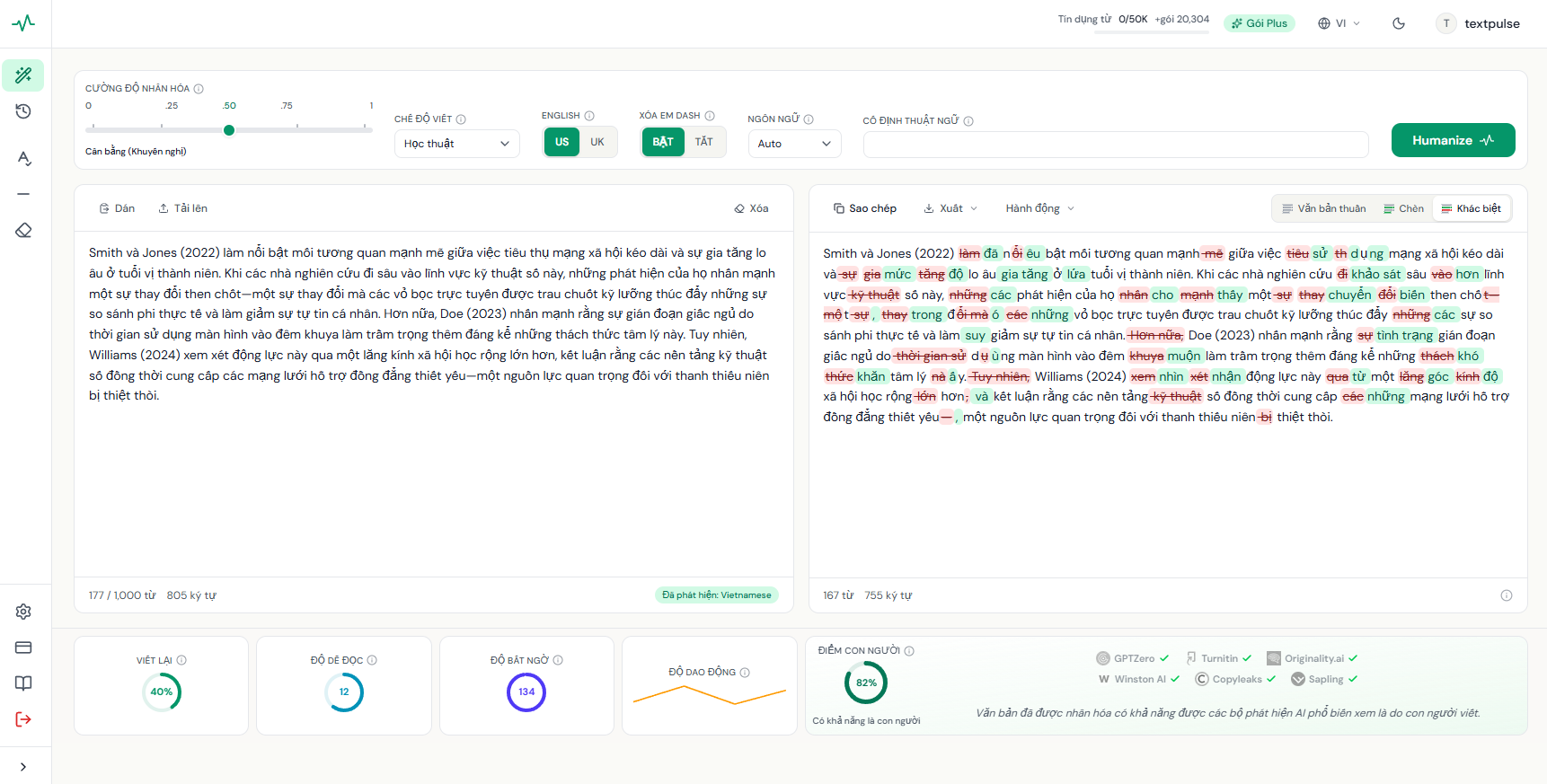
The pair below shows the same claim written two ways: the AI-sounding version stacks three of the tells covered above into three sentences, and the humanized version keeps every fact and citation the same while removing the templated openers. Reading them side by side, in Vietnamese or through the English gloss, makes the difference easier to hear than any abstract rule about sentence length.
| AI-sounding Vietnamese | After humanizing |
|---|---|
| Trong bối cảnh đó, công nghệ trí tuệ nhân tạo đã đóng vai trò quan trọng trong lĩnh vực viết học thuật những năm gần đây. Bên cạnh đó, có thể nói rằng các nhà nghiên cứu đang đối mặt với nhiều thách thức về tính nguyên bản và hiệu quả. Tóm lại, nghiên cứu này nhằm mục đích xem xét một cách có hệ thống những thách thức đó. | Công nghệ trí tuệ nhân tạo đã làm thay đổi cách viết học thuật trong vài năm qua. Các nhà nghiên cứu vừa được lợi về tốc độ, vừa gặp khó khăn trong việc giữ tính nguyên bản của bài viết. Nghiên cứu này xem xét những khó khăn đó một cách có hệ thống. |
| Gloss: AI technology has played an important role in academic writing in recent years, researchers face challenges around originality and efficiency, and this study aims to systematically examine these challenges. | Gloss: keeps the same claims but drops the stacked transition fillers for plainer, more varied sentence openings that read like an actual Vietnamese academic writer rather than a template. |
AI Detection in Vietnam
Turnitin is the detector with the clearest institutional footprint in Vietnam, used by major universities including the VNU system, most visibly for thesis submission where a similarity and AI-writing report is now a standard part of the review file. GPTZero and Originality.ai are less formally mandated across Vietnamese institutions, but domestic press coverage of ChatGPT use in coursework has grown, and that attention tends to precede formal policy rather than follow it.
What this means in practice is uneven enforcement rather than a single national standard. A thesis committee at a university running Turnitin will see an AI-writing indicator alongside the similarity score, while a course instructor grading weekly essays may have no detector at all and rely on noticing the same stock phrases a Vietnamese-reading human would notice anyway. The same gap between official caution and unofficial scrutiny shows up in the guide to the AI humanizer for Portuguese, where universities across Brazil and Portugal are working through comparable uncertainty. Either way, text that reads as templated risks scrutiny, and text that reads as ordinary formal Vietnamese does not, regardless of which tool is running.
Humanize your own paper
Transform your AI-assisted text and make it sound human, without touching important words or citations.
University Policies in Vietnam
None of the universities below have a single, clearly published university-wide generative-AI policy that could be verified in full. What is available points toward a country moving to integrate AI into higher education rather than ban it outright, with individual institutions and faculties filling the gap with their own discretion while central guidance catches up. Policy lines below are hedged to what could be confirmed as of 2025 to 2026.
| University | Policy stance (as published 2025-2026) |
|---|---|
| Vietnam National University, Hanoi (VNU Hanoi) | No single published university-wide generative-AI policy was verified; Vietnam's national push to integrate AI into higher education suggests guidance leans encouraging rather than restrictive, though this is inferred rather than confirmed for VNU Hanoi specifically. |
| Vietnam National University, Ho Chi Minh City (VNU-HCM) | No specific public generative-AI policy was verified; as a leading national university it likely follows the faculty-level discretion common across Vietnamese public universities pending firmer central guidance. |
| Hanoi University of Science and Technology (HUST) | HUST's Vice President has publicly framed AI as a strategic driver for the university's teaching, assessment, and governance overhaul, pointing toward integration rather than a blanket ban, though a detailed public policy document was not verified. |
| Hanoi University | Hanoi University's vice-rector has publicly acknowledged ChatGPT's usefulness for teaching and learning while stating the university needs to develop clearer regulations on its use, suggesting policy is still being formalized. |
| Ho Chi Minh City University of Technology (HCMUT) | No verified public generative-AI policy was found; oversight is presumed to sit with individual faculties and course instructors, as is common practice across Vietnamese technical universities. |
| University of Economics Ho Chi Minh City (UEH) | No specific published AI policy was verified; as with peer business schools in Vietnam, undisclosed AI use in coursework is likely treated under existing plagiarism and academic-integrity regulations rather than a dedicated AI clause. |
Journals and Citation Culture in Vietnamese Academia
Vietnamese-language journals span disciplines with different citation conventions. The VNU Journal of Science publishes multidisciplinary work in Vietnamese and English, Tạp chí Nghiên cứu Kinh tế covers economics for the Vietnam Academy of Social Sciences, and Tạp chí Y học Việt Nam serves the Vietnam Medical Association under Vancouver numbering, the standard in Vietnamese medical publishing. APA is increasingly standardized under Ministry of Education guidance, though older humanities journals still show mixed footnote conventions, and IEEE-style numbering remains the norm in engineering and technical fields.
This mix matters for humanizing because rewriting a paragraph in Vietnamese academic prose without preserving its citation markers risks breaking whichever numbering or author-date system the target journal requires. A Vancouver-numbered medical manuscript and an APA-formatted social-science paper both need the humanizer to leave reference numbers and author-date pairs exactly where they were, even as it resets the sentence rhythm around them.
Vietnamese AI Humanizer: How TextPulse Preserves Citations and Terms
TextPulse's multilingual mode processes Vietnamese directly rather than routing it through English and translating back, which is where round-trip tools lose the Sino-Vietnamese vocabulary and formal register that Vietnamese academic readers expect. Citation markers, whether Vancouver-style numbers or APA author-date pairs, stay locked in place, along with technical terms, proper nouns, and figures, so a methods section or literature review keeps its exact meaning while the surrounding sentence structure and transition words get rebuilt.
The goal is not to strip out formality. Vietnamese academic writing is expected to read as formal, dense, and precise. What changes is the predictability: fewer paragraphs opening on the same three or four stock phrases, more variation in sentence length, and hedges that sound like a person weighing evidence rather than a template inserting a transition word because one was due. The citations, numbers, and terminology a thesis committee or journal reviewer checks against the source material do not move.
Frequently Asked Questions
Turnitin is used by major Vietnamese universities, notably the VNU system, and its AI-writing indicator applies to Vietnamese submissions the same way it applies to English ones. A Vietnamese AI humanizer that only swaps individual words will not address this, because Turnitin's models respond to sentence-level patterns like repeated transition phrases, not to specific vocabulary choices.
PhD in natural language processing, with years spent building NLP applications end to end. Moe works on text analysis: lexical and syntactic structure, and what separates machine-generated prose from human prose statistically. He has been experimenting with computational linguistics since the early days of NLTK, spaCy and WordNet, and still writes most of his tooling in Python.