AI Humanizer for Portuguese
Brazilian and Portuguese universities are reading AI-generated Portuguese directly now, not just its English translation. This post breaks down the calque phrases and hedge openers that give ChatGPT away, what detection and university policy look like in both countries, and how a humanizer that respects ABNT and APA citations actually works.
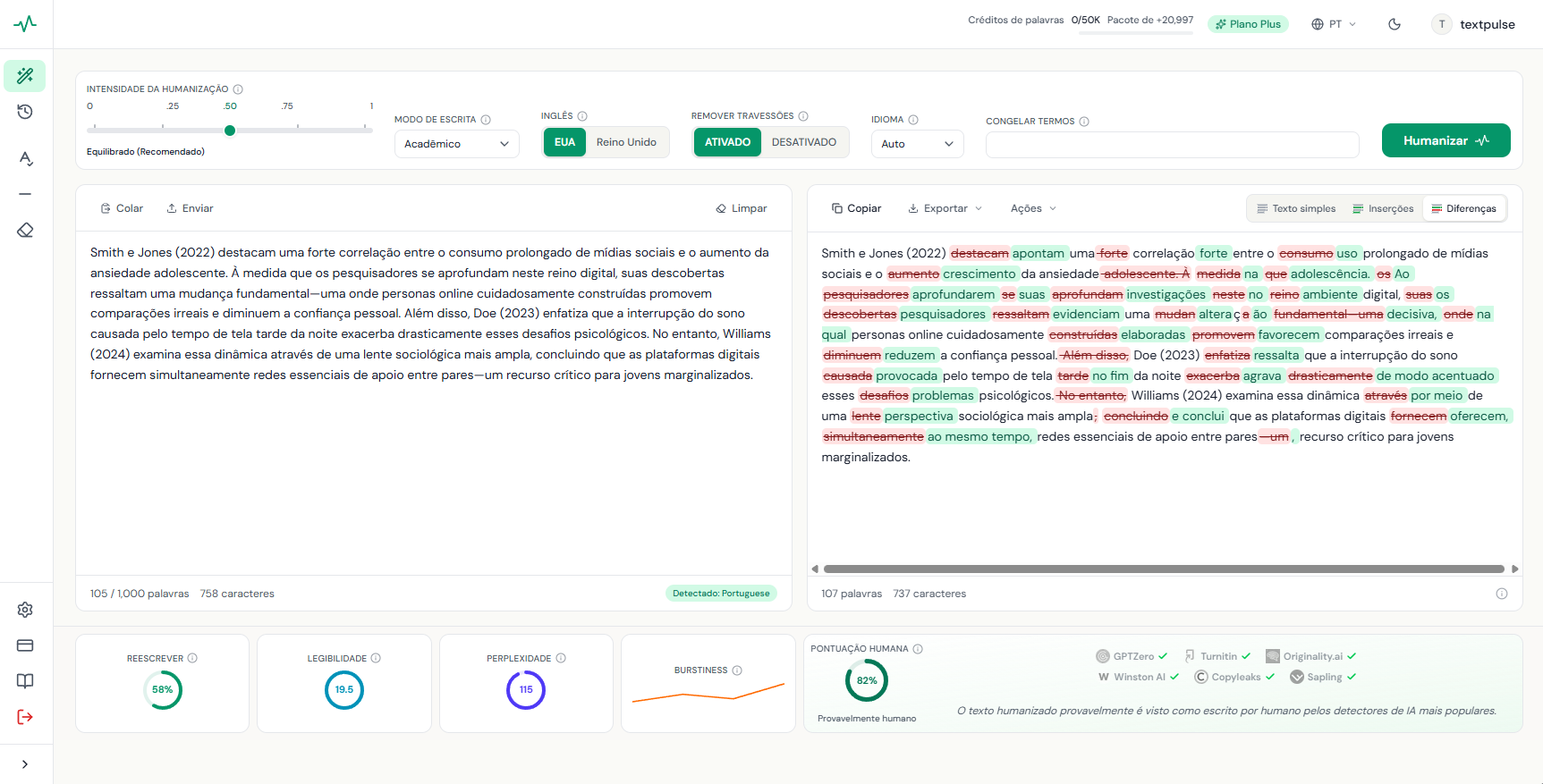
Academic writers across Brazil and Portugal increasingly draft with ChatGPT, then need the result to read as their own voice. A Portuguese AI humanizer takes that further than a paraphraser: it rewrites AI-generated Portuguese so sentence rhythm, connectors and register match how a person actually writes, not how a language model defaults to writing. This matters because plagiarism and integrity checks at Brazilian and Portuguese universities increasingly run detectors that read Portuguese directly, rather than relying on English-only tools. This post covers what marks a Portuguese paragraph as AI-written, how detection works in both countries, what universities say about it, and how TextPulse handles Portuguese specifically.
Portuguese is spoken differently on each side of the Atlantic, and that matters for humanized text: Brazilian academic Portuguese and European Portuguese diverge in vocabulary, formality norms and orthography. Most of what follows focuses on Brazil, where TCCs, dissertations and Turnitin submissions have made AI detection a daily concern for students, but the university and journal sections below cover Portugal too. The examples come from real AI-generated Portuguese sentences and their humanized rewrites, so the patterns described are concrete rather than abstract advice about tone.
Why AI Text Gets Flagged in Portuguese
Portuguese-language detectors and human reviewers both key on the same handful of habits ChatGPT falls into by default. Hedge openers such as 'é importante ressaltar que' or 'cabe destacar que' appear at the start of paragraph after paragraph, a pattern real writers rarely repeat that consistently. Stock conclusion phrases like 'em suma' or 'em síntese' close sections almost mechanically, and calque intensifiers such as 'desempenha um papel fundamental' or 'desempenha um papel crucial' turn up regardless of subject matter. These follow the broader pattern of words that give away ChatGPT in any language, just localized into Portuguese phrasing.
The rhythm gives it away as much as the vocabulary. Generated Portuguese tends to open transitions with 'além disso' by default, even when a sentence needs contrast or cause rather than addition, and it reaches for vague temporal filler like 'no cenário atual' instead of naming a specific period or context. Formulaic claims of obviousness, 'torna-se evidente que', appear where a study would normally state its finding directly. None of these phrases is wrong on its own; the problem is how often AI output repeats the same small set of them across one document.
What AI-Sounding Portuguese Looks Like
The next example is a pair of sentences that appeared in a paragraph on urbanization and chronic disease in Brazilian cities, a common topic in public health coursework. English glosses sit underneath each row for readers who do not read Portuguese. The AI-sounding version uses a hedge opener and an obviousness claim in one paragraph, stacking the hedges to create a fluent but formulaic tone. The humanized version uses the same claim and the same statistic but reworks the sentence length and structure and eliminates the templated connectors for a more direct voice.
| AI-sounding Portuguese | After humanizing |
|---|---|
| É importante ressaltar que a urbanização acelerada desempenha um papel fundamental no aumento da prevalência de doenças crônicas nas grandes cidades brasileiras. Segundo diversos estudos, cerca de 30% da população urbana apresenta pelo menos um fator de risco cardiovascular associado ao sedentarismo. Além disso, torna-se evidente que a falta de planejamento urbano adequado contribui significativamente para esse cenário, tornando fundamental a implementação de políticas públicas eficazes. | A urbanização acelerada tem um peso real no aumento das doenças crônicas nas grandes cidades brasileiras. Estudos mostram que cerca de 30% da população urbana já apresenta algum fator de risco cardiovascular ligado ao sedentarismo, um número que preocupa quem trabalha com saúde pública. Parte do problema vem do planejamento urbano mal feito: cidades pensadas para carros, poucas áreas verdes, deslocamentos longos. Políticas públicas mais eficazes precisam levar isso em conta. |
| Gloss: Rapid urbanization plays a key role in rising chronic disease in large Brazilian cities, with about 30% of the urban population showing a cardiovascular risk factor linked to inactivity, worsened by inadequate urban planning. | Gloss: Same claims and the same 30% figure, rewritten with varied sentence length, a colon-led list of concrete causes, and a more direct voice that drops calque phrases like 'é importante ressaltar' and 'torna-se evidente'. |
AI Detection in Brazil and Portugal
Turnitin is the detector most Brazilian and Portuguese universities already license for plagiarism checks, and its AI-writing indicator now flags Portuguese text directly rather than only English. Brazilian students preparing a TCC (trabalho de conclusão de curso) or dissertation are increasingly told their submission will run through both a similarity check and an AI-detection score, sometimes with a threshold set by an individual department rather than the university as a whole. GPTZero and Copyleaks show up in the same conversations, generally as tools instructors or committees run independently rather than as an official institutional standard.
iThenticate, aimed at manuscripts and theses rather than coursework, follows the same logic for postgraduate submissions and journal peer review. Detector adoption for Portuguese resembles the pattern documented for Chinese academic writing, where local and international tools coexist rather than one detector dominating. False positives on legitimately written text remain a documented concern for all of these systems, which has not slowed adoption. For a student, the practical result is the same across Brazil and Portugal: a paragraph full of the calque phrases above is more likely to draw scrutiny, whatever the underlying detector's accuracy.
Humanize your own paper
Transform your AI-assisted text and make it sound human, without touching important words or citations.
University Policies in Brazil and Portugal
Policy language on generative AI is still forming at most Portuguese-language universities, and wording varies by department as much as by country. The table below summarizes what each institution has published or been reported as saying, current as of 2025-2026. Treat it as a starting point and confirm the specific faculty or course guidance before submitting work, since a general university statement does not always match what an individual supervisor or program actually enforces.
| University | Country | Policy stance |
|---|---|---|
| Universidade de São Paulo (USP) | Brazil | USP's postgraduate council reportedly issued guidance (Resolução CoPGr, 2025) permitting disclosed AI use in research support while holding students to existing authorship and originality rules, though individual departments may set stricter terms. |
| Universidade Estadual de Campinas (Unicamp) | Brazil | Unicamp has been reported alongside USP and Unesp as one of the São Paulo state universities defining formal rules for AI use in coursework. |
| Universidade Federal do Rio de Janeiro (UFRJ) | Brazil | Discussion of AI in academic writing has been active at UFRJ, but the university has not yet published a single university-wide AI policy text. |
| Universidade de Lisboa | Portugal | ULisboa appears to treat generative AI under its existing academic integrity rules rather than a standalone AI policy. Tools like ChatGPT are not named explicitly, and undisclosed use is treated as a breach of academic honesty. |
| Universidade do Porto | Portugal | U.Porto has described a transparency-based approach built on disclosure of AI use, student responsibility for accuracy, and originality of analysis, though this reads as guidance rather than a single binding regulation. |
| Universidade Nova de Lisboa | Portugal | Like most Portuguese universities, Nova de Lisboa appears to fold AI use into general plagiarism and integrity policy rather than issue a dedicated AI statement, though this could not be fully confirmed. |
Journals and Citation Culture
SciELO is the default index for Lusophone research, hosting Portuguese, Spanish and English-language journals from Brazil and Portugal on one open-access platform. Field-specific journals sit alongside it: Revista Brasileira de Educação and Cadernos de Saúde Pública in Brazil, Análise Social and Revista Portuguesa de Educação in Portugal. Citation style depends heavily on field and country. ABNT dominates Brazilian theses and dissertations, APA is common in psychology and social sciences on both sides of the Atlantic, and Vancouver style governs most health sciences journals.
This matters for humanization because a rewrite that smooths out AI phrasing but drops or reformats a citation is worse than useless for a thesis defense or journal submission. ABNT in particular carries strict conventions around author-date citations and footnotes that a careless rewrite can quietly break. A Portuguese AI humanizer built for academic use has to preserve those markers exactly rather than paraphrase around them.
How TextPulse Works as a Portuguese AI Humanizer
TextPulse runs a multilingual AI humanizer built for exactly this kind of rewrite, keeping the argument, the citations and the numbers intact while changing the sentence-level patterns detectors and reviewers key on for Portuguese specifically. Citation markers, whether ABNT author-date or APA in-text format, pass through unchanged, and numerical claims like the 30% figure in the demo pair above are preserved rather than paraphrased into something looser. The same underlying engine handles the calque phrases and hedge openers documented above, one at a time, rather than flattening the whole paragraph into generic text.
Register stays consistent with the rest of the document too, so a formal third-person thesis chapter does not come back sounding like a blog post, and a more first-person education paper is not forced into artificial formality. Portuguese from Brazil and Portuguese from Portugal are treated differently where it counts, since a rewrite that quietly swaps European vocabulary into a Brazilian TCC, or the reverse, creates a new problem instead of solving the original one.
Frequently Asked Questions
Repeated hedge openers such as 'é importante ressaltar que', calque intensifiers such as 'desempenha um papel fundamental', and heavy reliance on 'além disso' as the default connector are the main tells. A Portuguese AI humanizer targets exactly these patterns instead of only checking overall similarity to other documents.
Content strategist at TextPulse, here since the company started. Mark writes the product and technical coverage: how the humanizer works under the hood, what changes in each release, and what a specification actually means for your writing. His reviews of writing software come from using them on real documents rather than reading a feature list.