AI Humanizer for Russian
ChatGPT drafts in Russian carry their own tells: stacked hedges, calqued phrases like играет важную роль, and a flattened, repetitive rhythm that both readers and Antiplagiat notice. This post breaks down what those tells look like, how detection actually works across Russia, Belarus, Kazakhstan and Kyrgyzstan, and what a humanizer needs to preserve to keep a thesis chapter intact.
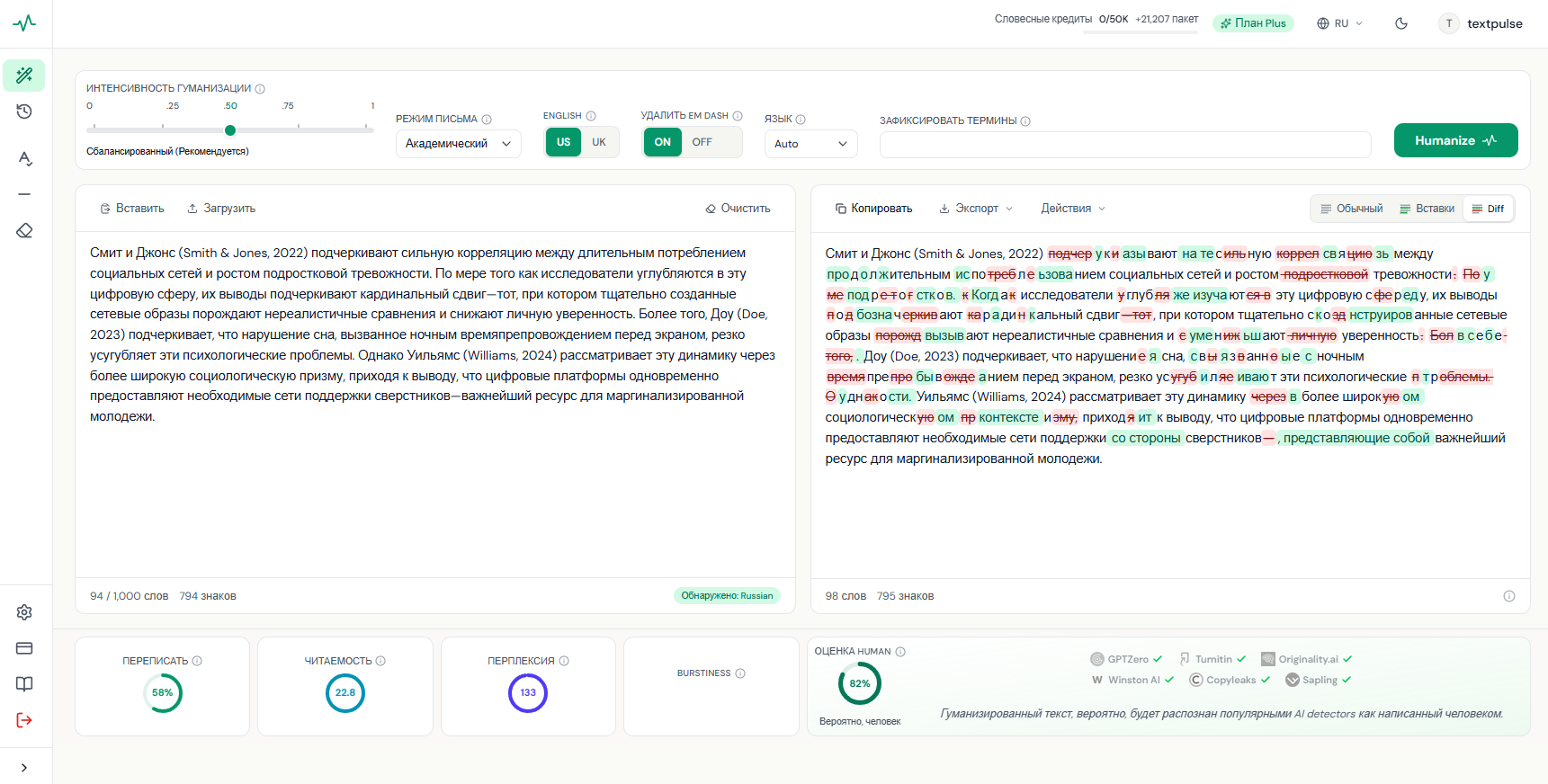
Students and researchers across Russia draft essays, coursework and dissertation chapters with ChatGPT, then need the text to read as their own before Antiplagiat or a supervisor sees it. A Russian AI humanizer rewrites that draft in natural academic Russian: it keeps the argument, the citations and the data, but removes the repetitive hedges and stock transitions that mark machine output. This post explains what actually flags Russian text as AI-written, how detectors and universities across the region respond to it, and where citation-preserving humanization fits into that process.
Russian is a heavily inflected language with a formal academic register built on passive constructions, impersonal verbs and long noun chains, which is exactly the territory where large language models default to stiff, repetitive phrasing. The tells are specific: stock hedges, a narrow set of transition words repeated in the same slot every paragraph, and calques that read as translated English rather than native Russian scholarship. Antiplagiat, the dominant checker in the region, is built to catch pattern-level similarity rather than meaning, so knowing which patterns to remove matters more than any single rewrite technique.
Why AI Text Gets Flagged in Russian
Russian academic prose has always leaned formal, with passive voice, reflexive verbs, and nominal phrasing where English would use a verb. That baseline makes AI-generated Russian harder to spot at a glance. The real giveaway is uniformity: a human writer varies hedges and sentence openings across a ten-page chapter, while ChatGPT leans on the same three or four set phrases in the same position, chapter after chapter, producing a flattened, repetitive cadence.
Specific phrases give the pattern away. 'Важно отметить, что' (an empty opener claiming a point deserves attention) opens sentences with a hedge that adds no information. 'Данный' shows up in place of the more natural 'этот' or 'такой', a bureaucratic register choice ChatGPT defaults to. Symmetric filler pairs like 'не только..., но и' appear even in short, simple sentences where a single clause would carry the point, and 'играет важную роль' substitutes for a verb that would actually describe what the technology does.
And then there's the rhythm. Nearly every paragraph ends with 'Таким образом' (thus), a default transition no matter if you actually conclude anything. There's too much nominalization too, verb chains become noun chains, so 'мы изучили' (we studied) becomes 'было осуществлено изучение' (the carrying out of study was accomplished). That's correct but sounds translated, not written. A Russian AI humanizer needs to break that uniform rhythm without touching the citations, numbers or argument structure underneath it.
What AI-Sounding Russian Looks Like
The table below shows the same claim written two ways: the AI-sounding version on the left carries every tell from the previous section, stacked into three sentences, and the humanized version on the right keeps the same statistic and the same argument while cutting the hedge openers, the stacked connector, and the closing 'thus' transition. English glosses sit underneath each row so the comparison is legible even without reading Russian.
| AI-sounding Russian | After humanizing |
|---|---|
| Важно отметить, что использование цифровых технологий играет важную роль в современном образовательном процессе. Согласно данным исследования, 68% преподавателей отмечают повышение вовлечённости студентов. Таким образом, внедрение данных технологий способствует не только повышению качества обучения, но и развитию критического мышления учащихся. | Цифровые технологии заметно меняют учебный процесс. По данным опроса, 68% преподавателей отметили рост вовлечённости студентов. Заметнее всего сдвиг в том, как учащиеся рассуждают: они чаще сомневаются и перепроверяют, а не просто запоминают материал. |
| English gloss: digital technologies are said to play an important role in education, with 68% of instructors reporting increased student engagement and improved critical thinking. | English gloss: same claim and the same 68% figure, but rewritten with a direct opening, one colon-linked pair instead of stacked connectors, and no calque fillers like 'it is important to note' or 'thus'. |
AI Detection in Russia, Belarus, Kazakhstan, and Kyrgyzstan
Antiplagiat is the checker most Russian universities require by default, and it has been mandatory at the majority of institutions for text-uniqueness checks well before generative AI became common. Its core function is a similarity score against a document database, built originally to catch copied text; a dedicated AI-generated-text classifier is a separate, newer layer that universities have adopted unevenly. A rewritten AI draft can clear a uniqueness score while still reading as machine-written to a supervisor who recognizes the pattern.
It is also used by programs or departments with an international focus, such as joint degrees and programs published in English language journals, where students turn in papers, which may end up being compared to a global database (rather than a Russian-language one). Finally, there're also free-to-use lightweight uniqueness checking tools like Content-Watch and ETXT, which students run themselves on their own drafts before submitting them. This practice has become prevalent even if a university does not formally need it. Students tend to use the same antiplagiarism software as universities do. However, Turnitin is primarily found in programs or departments which face outward, such as those publishing in English language journals, whereas students from Belarus, Kazakhstan and Kyrgyzstan generally follow the same Antiplagiat-first pattern, since much of the regional higher-education infrastructure shares vendors and reporting norms with Russian institutions.
A high similarity or AI-likelihood score rarely ends a paper on its own. It typically opens a conversation with a supervisor about drafting process, sources, and whether an argument holds together without the surface polish; in more serious cases it triggers a formal academic-integrity review at the faculty level, since standalone binding rules are still uncommon institution-wide. That local, faculty-by-faculty pattern makes an even, human-sounding draft the more reliable protection than betting on any single detector missing a pattern.
Humanize your own paper
Transform your AI-assisted text and make it sound human, without touching important words or citations.
University Policies on AI-Generated Writing
Most universities do not have any formal policy for using AI and rely on the decisions of departments or teachers. However, there're exceptions: for example, HSE University has introduced an ethical and educational policy for the use of AI in 2024. The table below reflects policy as published for the 2025-2026 academic year. Now only a few Russian universities have developed formal policies about the use of AI, which indicates that this topic is still not widely discussed.
| University | Country | Policy stance |
|---|---|---|
| Lomonosov Moscow State University (MSU) | Russia | No university-wide policy verified; some faculties, including Economics, have amended thesis regulations to address AI use. |
| HSE University (Higher School of Economics) | Russia | Adopted a formal ethical and educational AI-use policy in 2024, reportedly among the first Russian universities to set conditions for AI in thesis preparation. |
| Saint Petersburg State University | Russia | No centrally published AI policy was found for this pass; treat any specific stance as unconfirmed until checked directly. |
| ITMO University | Russia | No single verified public AI policy statement was found, despite ITMO's technology focus and likely program-level guidance. |
| Novosibirsk State University | Russia | No verified public AI policy statement was found; the matter appears to be left largely to individual instructors. |
| Belarusian State University | Belarus | No verified centralized AI policy was found for this pass. |
Journals and Citation Culture in Russian-Language Research
Russian-language scholarship still runs largely on its own journal ecosystem rather than folding entirely into English-language publishing. Вопросы языкознания, the Russian Academy of Sciences' flagship linguistics journal, and Высшее образование в России, a higher-education policy and pedagogy journal, both publish primarily in Russian and expect prose that reads as natural academic Russian rather than translated English. Вестник РУДН's linguistics series accepts both Russian and English, while Социологические исследования and Психологический журнал, both Academy of Sciences titles, remain Russian-language sociology and psychology outlets with their own house styles.
Citation conventions vary by field. GOST 7.0.5-2008 remains the default reference standard across most Russian academic writing, a numbered, footnote-heavy system distinct from Western author-date formats. APA has been gaining ground in social sciences and psychology journals, and Vancouver style is standard in medicine. Any rewriting tool working on Russian academic text needs to preserve GOST-formatted references, footnote numbering and exact figures exactly as written, since renumbering a citation or rounding a percentage during a stylistic rewrite turns a humanized draft into a document with new errors.
| Journal | Focus |
|---|---|
| Вопросы языкознания (Voprosy Jazykoznanija) | Russian Academy of Sciences flagship linguistics journal, published in Russian |
| Высшее образование в России (Higher Education in Russia) | Higher education policy and pedagogy journal, Russian-language |
| Вестник РУДН, серия Лингвистика | RUDN University bulletin, linguistics series, published in Russian and English |
| Социологические исследования (Socis) | Russian Academy of Sciences sociology journal, Russian-language |
| Психологический журнал | Russian Academy of Sciences psychology journal, Russian-language |
How TextPulse Works as a Russian AI Humanizer
TextPulse's multilingual AI humanizer mode treats Russian as a first-class case rather than a translated afterthought: it recognizes GOST citation formatting, keeps numbers, dates and percentages exactly as entered, and preserves technical terminology instead of paraphrasing it into something looser. The same underlying system applies the same approach to more than a dozen other languages, leaving facts untouched while rewriting the surrounding prose around them.
Register consistency matters as much as vocabulary. A humanizer that flattens formal Russian into casual phrasing creates a different problem, since a supervisor expects a thesis chapter to read as scholarship rather than casual prose. TextPulse keeps the formality level the source draft already had, adjusting rhythm and connector variety instead of tone. The same approach carries over to the Korean AI humanizer, where formality markers like keigo need the same careful handling.
Frequently Asked Questions
Antiplagiat was built as a text-uniqueness and plagiarism checker, comparing a document against a database of previously submitted and published work. It does not run a dedicated AI-content classifier by default, though some institutions have started layering additional AI-detection tools on top of it. A rewritten AI draft can pass a uniqueness score while still reading as machine-written to an experienced supervisor, which is a separate risk from plagiarism detection.
Content strategist at TextPulse, here since the company started. Mark writes the product and technical coverage: how the humanizer works under the hood, what changes in each release, and what a specification actually means for your writing. His reviews of writing software come from using them on real documents rather than reading a feature list.